
As you navigate the complexities of modern business, you’re likely seeking ways to optimize your operations and stay ahead of the curve. Your organization can benefit from the power of intelligent automation and AI, which can streamline processes, enhance efficiency, and drive growth. By leveraging these technologies, you can unlock new levels of productivity and innovation, enabling your business to thrive in a rapidly changing landscape. You can expect significant improvements in your operations, leading to increased competitiveness and success.
Key Takeaways:
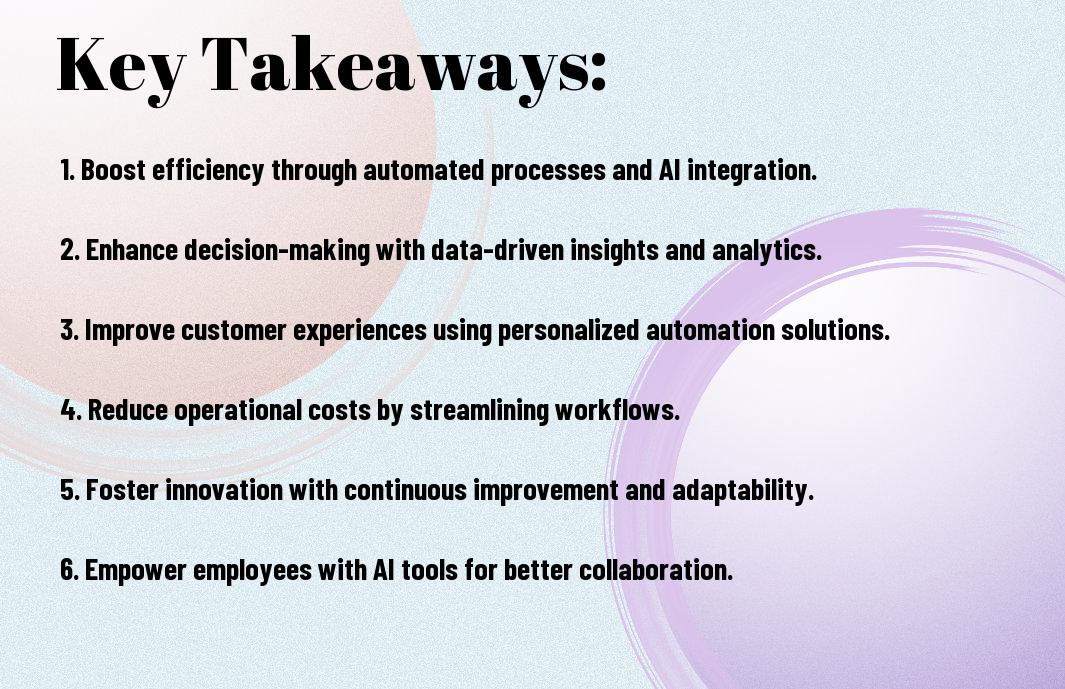
- Intelligent automation and AI can significantly enhance operational efficiency by automating repetitive tasks, reducing manual errors, and increasing productivity, leading to improved overall business performance.
- Implementing AI-powered automation enables organizations to make data-driven decisions, as it provides real-time insights and analytics, helping to identify areas of improvement and optimize processes.
- Combining intelligent automation with AI can lead to the development of innovative business models, products, and services, giving organizations a competitive edge in the market and driving growth.
- Effective integration of AI and automation requires a strategic approach, including change management, employee training, and continuous monitoring to ensure successful adoption and maximize benefits.
- As AI technology continues to evolve, organizations must stay adaptable and invest in ongoing development to leverage the latest advancements and maintain a competitive advantage in an increasingly automated business landscape.
The Current Landscape of Operational Processes
The modern business environment is characterized by complex operational processes that can either make or break your organization. You face numerous challenges in managing these processes, from manual data entry to inefficient workflows. As you navigate this landscape, you must consider the impact of traditional operational challenges and the cost of inefficiency on your bottom line.
Traditional Operational Challenges
Across various industries, you encounter similar pain points, including manual errors, lack of visibility, and inefficient use of resources. You struggle to streamline processes, leading to wasted time and effort, which can hinder your ability to compete in the market.
The Cost of Inefficiency
For your business, the cost of inefficiency can be substantial, resulting in wasted resources, lost productivity, and decreased customer satisfaction. You may experience significant financial losses due to inefficient operational processes, which can impact your ability to invest in growth and innovation.
In addition, as you investigate deeper into the cost of inefficiency, you will find that it can also lead to decreased employee morale, as they spend more time on mundane tasks rather than focusing on high-value activities. You may also experience decreased agility, making it difficult to respond to changing market conditions, and ultimately, impacting your competitiveness and reputation in the industry.
Core Technologies Driving Intelligent Automation
Any organization looking to transform its operations with intelligent automation and AI must understand the core technologies driving this transformation. You will need to familiarize yourself with the key technologies that enable intelligent automation, including machine learning, robotic process automation, and natural language processing.
Machine Learning Algorithms
Above all, machine learning algorithms are a key component of intelligent automation, enabling your systems to learn from data and make predictions or decisions. You can use these algorithms to analyze large datasets and identify patterns, allowing your organization to make data-driven decisions.
Robotic Process Automation
Between the various technologies driving intelligent automation, robotic process automation (RPA) is a significant one, allowing you to automate repetitive and rule-based tasks. You can use RPA to streamline your processes, reducing the need for manual intervention and increasing efficiency.
For instance, you can use RPA to automate tasks such as data entry, document processing, and workflow management, freeing up your staff to focus on higher-value tasks. As you explore RPA, you will find that it can be used to automate a wide range of processes, from simple to complex, and can be integrated with other technologies, such as machine learning and natural language processing, to create a powerful automation platform.
Implementation Strategies
Keep in mind that a well-planned implementation strategy is necessary for successful intelligent automation and AI integration. You need to consider your organization’s specific needs and goals when developing your approach.
Assessment and Planning
With a thorough understanding of your current operations, you can identify areas where intelligent automation and AI can have the most impact, and develop a tailored plan to achieve your objectives.
Phased Deployment Approach
One key consideration is to adopt a phased deployment approach, allowing you to test and refine your intelligent automation and AI solutions before scaling up to larger implementations.
Strategies for a phased deployment approach involve starting with small, high-impact projects, and then gradually expanding to more complex and larger-scale implementations, allowing you to build on your successes and learn from your experiences, and ensuring that your intelligent automation and AI solutions are aligned with your overall business strategy and goals, and that you are able to measure and evaluate their effectiveness throughout the deployment process.
Operational Areas Primed for Transformation
Despite the complexity of your operations, intelligent automation and AI can simplify and streamline processes, leading to increased efficiency and productivity. You can identify areas where automation can have the most impact, such as supply chain optimization and customer service enhancement.
Supply Chain Optimization
Across your organization, you can apply intelligent automation to improve supply chain management, predicting demand and optimizing logistics to reduce costs and improve delivery times. You will be able to make data-driven decisions, leveraging AI to analyze market trends and adjust your supply chain accordingly.
Customer Service Enhancement
One of the key areas where you can see significant improvements is in customer service, where AI-powered chatbots and virtual assistants can provide 24/7 support, helping to resolve issues quickly and efficiently. You will be able to offer personalized experiences, using data and analytics to understand your customers’ needs and preferences.
Optimization of customer service through intelligent automation and AI enables you to provide a seamless and omnichannel experience, allowing your customers to interact with your brand whenever and however they prefer. You can use AI to analyze customer feedback and sentiment, making adjustments to your services and products to meet their evolving needs and expectations, ultimately driving loyalty and growth.

Measuring Success
Unlike traditional operational transformations, measuring the success of intelligent automation and AI requires a nuanced approach. You will need to track key metrics that reflect the impact of these technologies on your organization.
Key Performance Indicators
Alongside other metrics, analyzing your key performance indicators will help you understand the effectiveness of your intelligent automation and AI initiatives, allowing you to make informed decisions about your operations.
Return on Investment Calculations
Returning to the basics of financial analysis, you will need to calculate the return on investment for your intelligent automation and AI projects to determine their viability and potential for future investment.
Plus, as you investigate deeper into return on investment calculations, you will find that considering both the direct and indirect benefits of intelligent automation and AI is necessary to accurately assessing their value to your organization, and you should take into account factors such as increased efficiency, improved accuracy, and enhanced customer experience when evaluating the success of your initiatives.
Overcoming Resistance
Not all organizations may be ready to adopt intelligent automation and AI, but you can overcome this resistance by understanding the concerns and hurdles involved.
Workforce Concerns
On the path to transformation, you will encounter workforce concerns, such as job security and training, which you must address to ensure a smooth transition to intelligent automation and AI.
Technical Integration Hurdles
One of the significant challenges you will face is integrating new technologies with your existing systems, which can be complex and time-consuming, but with the right approach, you can overcome these hurdles.
Considering the technical integration hurdles, you will need to assess your current infrastructure and identify the areas that require upgrades or replacement to ensure seamless integration with intelligent automation and AI, allowing you to maximize the benefits of these technologies and transform your operations.
Conclusion
Drawing together the various threads of intelligent automation and AI, you can revolutionize your operations. By leveraging these technologies, you can streamline processes and improve efficiency. To learn more about the impact of AI on operations, visit 10 ways artificial intelligence is transforming operations management to discover how you can transform your business and stay ahead of the curve with your operations management.
FAQ
Q: What is Intelligent Automation and how can it transform business operations?
A: Intelligent Automation (IA) is a combination of artificial intelligence (AI) and automation that enables businesses to automate complex processes, making them more efficient, accurate, and scalable. By leveraging IA, organizations can transform their operations by streamlining workflows, reducing manual errors, and enhancing decision-making capabilities. IA can be applied to various business functions, such as customer service, finance, and supply chain management, leading to improved productivity, reduced costs, and increased competitiveness.
Q: How does AI contribute to the success of Intelligent Automation in transforming operations?
A: AI plays a vital role in the success of Intelligent Automation by providing the intelligence and analytical capabilities needed to automate complex processes. AI algorithms can analyze large datasets, identify patterns, and make predictions, enabling businesses to make informed decisions and automate tasks that typically require human judgment. Additionally, AI-powered chatbots and virtual assistants can interact with customers, employees, and partners, providing personalized support and improving overall user experience. By integrating AI with automation, businesses can unlock new levels of efficiency, agility, and innovation in their operations.
Q: What are the key benefits of implementing Intelligent Automation and AI in business operations, and how can organizations measure their effectiveness?
A: The key benefits of implementing Intelligent Automation and AI in business operations include increased efficiency, improved accuracy, enhanced customer experience, and reduced costs. Organizations can measure the effectiveness of IA and AI by tracking key performance indicators (KPIs) such as process cycle time, error rates, customer satisfaction, and return on investment (ROI). Additionally, businesses can use analytics and monitoring tools to assess the impact of IA and AI on their operations, identify areas for improvement, and make data-driven decisions to optimize their automation strategies. By regularly evaluating and refining their IA and AI initiatives, organizations can ensure they are achieving their desired outcomes and maximizing the value of their investments.