As you initiate on your AI startup journey, you need a clear plan to achieve financial growth. Your success depends on making informed decisions and leveraging the right strategies. You will face challenges, but with a well-defined roadmap, you can navigate them effectively. Your ability to adapt and innovate will be key to driving your business forward and staying ahead of the competition, ultimately leading to a successful and profitable AI startup.
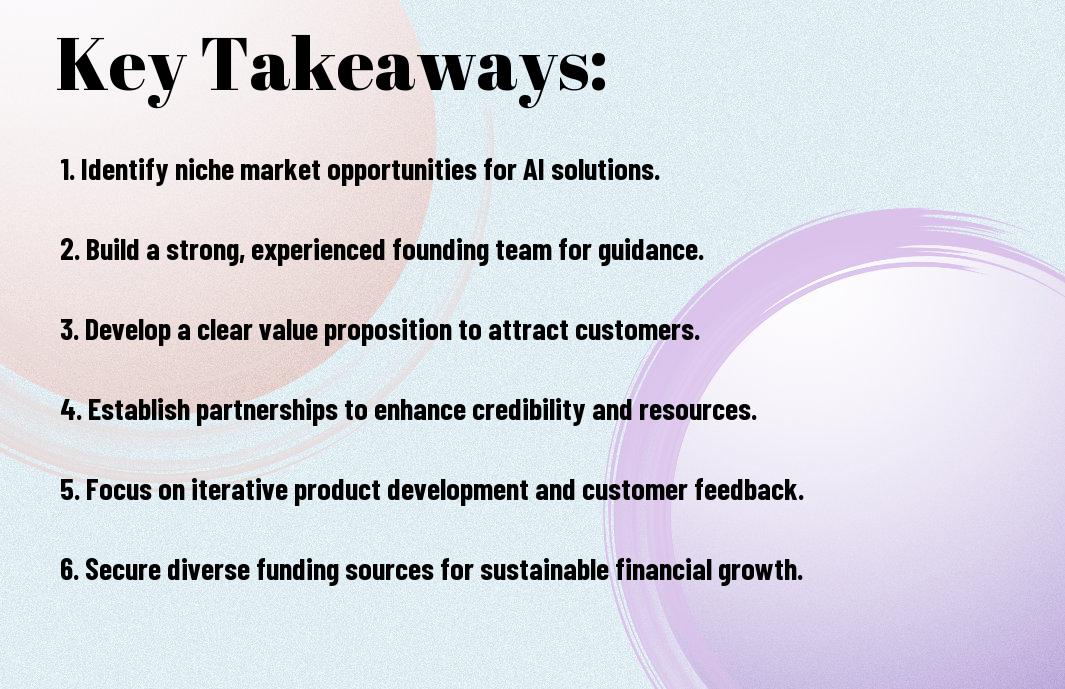
Key Takeaways:
- Developing a clear and unique value proposition is necessary for an AI startup to differentiate itself in a competitive market and attract investors, customers, and top talent.
- Building a strong team with a mix of technical, business, and industry expertise is vital for driving innovation, managing operations, and making informed strategic decisions.
- A well-planned go-to-market strategy is necessary for AI startups to effectively reach their target audience, generate revenue, and achieve financial growth.
- Securing funding through various channels, such as venture capital, grants, or partnerships, is necessary to support the development and scaling of AI technologies.
- Continuous monitoring and evaluation of the startup’s performance, combined with a willingness to adapt and pivot when necessary, is necessary to stay competitive and achieve long-term success in the rapidly evolving AI landscape.

The AI Startup Landscape
While navigating the AI startup landscape, you’ll encounter various challenges and opportunities. Your ability to adapt and innovate will be key to success. You’ll need to stay informed about the latest trends and technologies to make informed decisions about your business.
Current Market Dynamics
By examining the current market, you can identify areas of growth and potential roadblocks. You’ll gain insights into how your competitors are using AI and where you can differentiate your business. This knowledge will help you make strategic decisions about your products and services.
Identifying Viable Niches
Beside the main players, there are numerous niches waiting to be explored. You can find opportunities in areas like healthcare, finance, or education, where AI can solve specific problems. Your goal is to find a niche that aligns with your strengths and interests.
Viable niches often emerge at the intersection of AI and other technologies, such as IoT or blockchain. You can explore these areas to find innovative solutions that meet the needs of your target market. As you examine deeper, you’ll discover opportunities to create unique products and services that set your business apart from others.
Building Your Financial Foundation
It is vital to establish a solid financial foundation for your AI startup, as this will determine your company’s ability to grow and scale. You need to consider your funding options, revenue streams, and expense management to ensure a stable financial base.
Bootstrapping vs Venture Capital
Building on your initial funding, you must decide whether to bootstrap or seek venture capital. You should weigh the pros and cons of each option, considering factors such as control, risk, and growth potential.
Creating Sustainable Revenue Models
Building a robust revenue stream is vital for your AI startup’s success. You should focus on developing a scalable and profitable business model that generates consistent revenue, allowing your company to grow and expand.
In fact, creating sustainable revenue models requires careful planning and execution. You will need to identify your target market, develop a unique value proposition, and design a pricing strategy that balances revenue goals with customer demand. As you refine your revenue model, you can continually assess and adjust your approach to optimize your financial performance and drive long-term growth.
Product Development Strategy
For a successful AI startup, your product development strategy is key to driving financial growth. You need to focus on creating a product that meets the needs of your target market, while also being scalable and adaptable to changing market conditions.
Minimum Viable Product Approach
Before launching a full-scale product, you should consider a minimum viable product approach, allowing you to test and refine your product with a smaller investment of time and resources, and gather valuable feedback from early adopters.
Scaling Technology Infrastructure
Minimal technology infrastructure is required to support your growing product, you will need to ensure that your infrastructure can handle increased traffic and data storage, and that you have the necessary tools and expertise to manage and maintain it.
A well-planned technology infrastructure will enable you to scale your product quickly and efficiently, and will provide a solid foundation for your startup’s long-term success, allowing you to focus on developing new features and improving user experience, and ultimately driving your financial growth and expansion.
Customer Acquisition Frameworks
To establish a successful AI startup, you need to develop effective customer acquisition frameworks that drive financial growth. Your strategy should focus on identifying and targeting the right audience, creating engaging experiences, and building strong relationships with your customers.
B2B vs B2C Considerations
One key aspect to consider is the difference between B2B and B2C customer acquisition strategies, as you will need to tailor your approach to your specific target market, taking into account the unique needs and preferences of your customers.
Metrics That Matter
On the path to financial growth, you will need to track and analyze key metrics that indicate the success of your customer acquisition efforts, such as customer lifetime value, acquisition costs, and retention rates, to make informed decisions about your strategy.
Due to the complexity of AI-driven customer acquisition, you will need to closely monitor these metrics and adjust your approach as needed to optimize your results and achieve your financial goals, ensuring that your startup remains competitive in the market and continues to grow and thrive over time.
Talent Acquisition and Retention
Your ability to attract and retain top talent is vital to the success of your AI startup, as it enables you to develop innovative solutions and drive business growth.
Assembling the Right Team
With the right combination of skills and expertise, you can build a team that is well-equipped to tackle complex AI challenges and develop cutting-edge solutions that meet your customers’ needs.
Equity Distribution and Incentives
For your team members to feel motivated and invested in your startup’s success, you need to offer competitive equity distribution and incentives that align with their contributions and performance.
In fact, a well-structured equity distribution plan can help you attract and retain top talent, as it provides a clear path for team members to share in the startup’s growth and success, and can be a key differentiator in a competitive job market, allowing you to build a loyal and dedicated team that is committed to driving your startup’s financial growth.
Navigating Regulatory Challenges
Despite the numerous benefits of AI, you will face regulatory challenges that can impact your startup’s growth. You must understand the laws and regulations surrounding AI to avoid potential pitfalls and ensure compliance.
Data Privacy Compliance
Regulatory frameworks governing data privacy vary by region, and you must familiarize yourself with the specific laws applicable to your business, such as GDPR or CCPA, to ensure your AI systems handle user data responsibly.
Industry-Specific Regulations
Between the lines of general regulations, you will find industry-specific rules that apply to your AI startup, such as healthcare or finance, which require specialized compliance measures to ensure your business operates within legal boundaries.
Privacy concerns are paramount when dealing with industry-specific regulations, and you should prioritize transparency and security in your AI systems to maintain user trust and avoid legal repercussions, considering the unique challenges and requirements of your industry to ensure your startup’s success.
Final Words
With these considerations, you now have a clear understanding of the roadmap to a successful AI startup. You can navigate your business towards financial growth by implementing the strategies outlined. Your ability to adapt and innovate will be key to staying ahead in the competitive AI landscape. By following this guide, you will be well-equipped to make informed decisions and drive your AI startup towards long-term success, achieving your business goals and maximizing your returns on investment.
FAQ
Q: What are the key factors to consider when developing a roadmap for a successful AI startup?
A: When developing a roadmap for a successful AI startup, it’s vital to consider several key factors, including a clear definition of the problem you’re trying to solve, a thorough understanding of your target market and competition, and a well-defined unique value proposition. Additionally, you should have a solid plan for data collection and management, a talented team with the necessary skills and expertise, and a strategy for securing funding and managing finances. A well-structured roadmap will help you navigate the challenges of building a successful AI startup and achieve financial growth.
Q: How can AI startups effectively measure and track their financial growth and progress?
A: AI startups can effectively measure and track their financial growth and progress by establishing key performance indicators (KPIs) such as revenue growth, customer acquisition costs, and retention rates. Regularly reviewing financial statements, including income statements and balance sheets, is also vital. Utilizing data analytics tools to monitor and analyze financial data can help identify trends and areas for improvement. Moreover, setting realistic milestones and benchmarks, and regularly assessing progress against these targets, will enable AI startups to make informed decisions and adjust their strategies as needed to drive financial growth.
Q: What strategies can AI startups use to secure funding and investment for financial growth?
A: AI startups can use several strategies to secure funding and investment for financial growth, including developing a compelling pitch and business plan, building a strong network of contacts and connections in the investment community, and leveraging crowdfunding platforms and incubators. Applying for grants and government funding programs specifically designed for AI and technology startups can also be beneficial. Additionally, considering partnerships and collaborations with established companies can provide access to resources, expertise, and funding. A well-prepared and persuasive approach to investors, highlighting the unique value proposition and growth potential of the startup, is also vital for securing the funding needed to drive financial growth and success.