
Data can be a powerful tool when it comes to predicting horse race outcomes, but relying solely on past performance data has its limitations. As you explore into the intricacies of predicting race winners, it’s crucial to understand the constraints that come with using historical data. In a fascinating read on Can Machine Learning Predict Horse Race Winners? …, you will discover the challenges and shortcomings of depending solely on past performance data for your predictions.
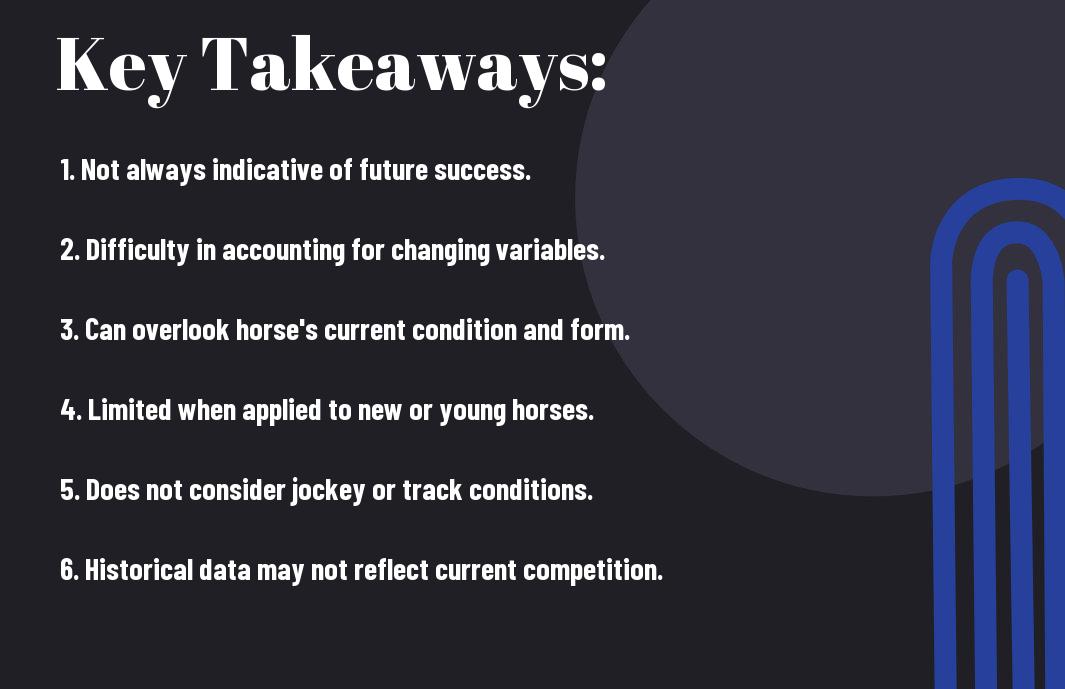
Key Takeaways:
- Sample size: Past performance data may not have a large enough sample size to accurately predict future outcomes.
- Variable factors: There are many variables that can affect race outcomes beyond past performance data, such as weather conditions, jockey performance, and track conditions.
- Complexity of horse racing: Horse racing is a complex and unpredictable sport, making it difficult to rely solely on past performance data for accurate predictions.
The Appeal of Past Performance Data
The Intuition Behind Historical Analysis
For The consequences of horse race reporting, horse racing enthusiasts and analysts alike, past performance data holds a special appeal. It offers a glimpse into the past races, allowing you to analyze trends and patterns that may help in predicting future outcomes. By submerging into these historical statistics, you can gain valuable insights into a horse’s performance, track conditions, jockey partnerships, and more.
The Promise of Pattern Recognition
Data is at the heart of past performance analysis. It enables you to identify patterns and trends that can inform your betting decisions. Whether it’s recognizing a horse’s preference for a specific track length or surface type, or understanding how certain jockeys consistently outperform others, historical data can provide you with a wealth of information to guide your predictions.
Another intriguing aspect of pattern recognition is the potential to uncover hidden gems – those undervalued horses or untapped potential waiting to be discovered. By delving deep into past performance data, you may spot trends that others overlook, giving you a competitive edge when placing your bets.

Limitations of Data Quality
Incomplete or Inaccurate Data
Any prediction based on past performance data is only as good as the data itself. Incomplete or inaccurate data can significantly impact the reliability of your predictions. Missing information about a horse’s previous races, jockeys, track conditions, or any other relevant factors can lead to flawed conclusions.
Biases in Data Collection and Recording
Incomplete or biased data collection and recording practices can skew the results of your analysis. One common bias is the tendency to focus on successful horses or popular trainers while neglecting other factors that could be equally important. This can create a distorted view of past performance and limit the accuracy of your predictions.
The accuracy of your predictions relies heavily on the quality and completeness of the data you use. The more comprehensive and unbiased your dataset, the more reliable your insights will be.
The Impact of External Factors on Performance
The performance of a horse in previous races can be influenced by various external factors beyond just its inherent capabilities. Factors like track conditions, jockey experience, or even weather can play a significant role in determining the outcome of a race. Understanding and incorporating these external factors into your analysis is crucial for making accurate predictions.
- Changes in track conditions, such as rain or wind, can have a major impact on how a horse performs.
- The experience and skill of the jockey can also play a significant role in a horse’s performance on race day.
Perceiving how external factors can affect a horse’s performance is imperative for refining your predictive models and making more accurate forecasts.
Data Collection
Collecting high-quality data for your analysis is key to overcoming the limitations of using past performance data. It’s imperative to gather data from reliable sources and ensure its accuracy and completeness. By carefully curating your dataset and accounting for potential biases in data collection, you can enhance the quality of your predictions and make more informed decisions.
- Avoiding biases in data collection, such as focusing only on certain horses or races, is crucial for obtaining a well-rounded dataset.
The Complexity of Horse Racing
Not only is horse racing a complex and intricate sport, but it also involves a myriad of variables that can impact race outcomes. From the performance of the horse to the jockey’s skill and the track conditions, predicting the winner of a race is far from a simple task.
The Multifaceted Nature of Horse Performance
Any given race is influenced by a multitude of factors, such as the horse’s breed, age, training regimen, and even its mood on race day. A horse that performed exceptionally well in one race may not deliver the same results in the next due to these fluctuating variables.
The Role of Intangible Factors
Any experienced bettor knows that there are intangible factors at play in horse racing that can significantly impact the outcome of a race. These factors include the horse’s temperament, the jockey’s relationship with the horse, and even external influences like the crowd’s energy. Perceiving and accounting for these intangibles is crucial in making accurate predictions.
- External factors such as weather conditions, track surface, and even the noise level at the racecourse can affect a horse’s performance.
- The bond between the jockey and the horse, as well as the horse’s overall mental state, can play a pivotal role in determining the outcome of a race. Perceiving and understanding these subtle influences can give you a competitive edge when predicting race results.
The Dynamic Interplay Between Horses and Environment
One of the most fascinating aspects of horse racing is the dynamic interplay between the horses and their environment. Every race is a unique event where factors like the competition’s strength, post position, and even the time of day can influence the race outcome. Plus, each horse has its own racing style and preferences, further complicating the prediction process.
This intricate dance between the horses and their surroundings adds an element of unpredictability to horse racing that makes it both thrilling and challenging to forecast. By understanding and acknowledging the complexity of these interactions, you can gain a deeper appreciation for the sport and enhance your ability to make informed predictions.

The Fallacy of Extrapolation
Unlike Ga Yau: Machine analysis of Hong Kong horse racing data, which researchs into the complexities of analyzing historical data to predict horse race outcomes, it is vital to understand the fallacy of extrapolation when it comes to using past performance data.
Assuming Consistency in Performance
The assumption that a horse’s past performance will perfectly predict its future outcomes is a common mistake made by many. While consistency is key in horse racing, it is crucial to remember that various factors can influence a horse’s performance on any given day, such as weather conditions, track surfaces, jockey changes, and even the horse’s mood.
Ignoring Contextual Differences
To truly grasp the limitations of using past performance data, you must acknowledge the significance of contextual differences. Each race is unique, with its own set of variables that can impact the outcome. Ignoring these contextual differences can lead to flawed predictions and unrealistic expectations.
This can include factors such as the length of the race, the class of competition, the post position, and even the overall pace of the race. Without considering these contextual nuances, relying solely on past performance data may not provide an accurate picture of what to expect.
Overlooking the Role of Chance and Variability
On the surface, past performance data may seem like a reliable indicator of future success. However, overlooking the role of chance and variability in horse racing can lead to misguided predictions. Random events, unexpected happenings, and the element of luck all play a significant role in determining the outcome of a race.
Factors such as a horse getting bumped at the start, encountering traffic during the race, or even an unforeseen burst of speed from an underdog can completely alter the result, regardless of past performances. Understanding and accepting the role of chance and variability is vital in avoiding the fallacy of extrapolation.
Plus, when analyzing past performance data, it’s important to remember that outliers and anomalies can skew the data, leading to inaccurate conclusions. By acknowledging these limitations and approaching data analysis with a critical mindset, you can navigate the complexities of predicting horse race outcomes more effectively.
The Dangers of Overfitting
Many times, when using past performance data to predict horse race outcomes, you might fall into the trap of overfitting. This occurs when you rely too heavily on historical data to make your predictions, without considering other important factors. Overfitting can lead to misleading results and inaccurate predictions, ultimately causing you to lose your bets.
The Perils of Over-Reliance on Historical Data
Data from past races can be valuable in analyzing trends and patterns, but it is crucial not to solely depend on this information. By over-relying on historical data, you might overlook current variables that could have a significant impact on the race outcome. This tunnel vision can blind you to important factors such as the horse’s current form, the jockey’s performance, or external factors like weather conditions.
The Risk of Misinterpreting Patterns
The interpretation of patterns in historical data is another pitfall to watch out for. It’s easy to fall into the trap of seeing patterns where none exist or misinterpreting random fluctuations as significant trends. To avoid this, it’s necessary to approach data analysis with a critical eye and a healthy dose of skepticism. Recall, not every pattern or correlation in the data necessarily translates to a causal relationship that can help you accurately predict race outcomes.
To
The Importance of Balancing Data with Expertise
To make informed predictions in horse racing, striking a balance between data and expertise is key. While historical data provides valuable insights, your expertise and knowledge of the sport are equally important. Your insights into the nuances of horse racing, understanding of individual horse behaviors, and awareness of track conditions can complement the data-driven analysis and enhance your predictive accuracy. By combining data with your expertise, you can make more well-rounded and insightful predictions, giving you an edge in the competitive world of horse race betting.
Understanding the limitations of relying solely on past performance data and the importance of integrating your expertise into the analysis can help you make more informed and successful predictions in horse racing. By finding the right balance between data and expertise, you can improve your predictive accuracy and increase your chances of success at the racetrack.
Alternative Approaches to Prediction
Integrating Multiple Sources of Information
To improve the accuracy of predicting horse race outcomes, you should consider integrating multiple sources of information. By combining past performance data with factors like track conditions, jockey skills, and trainer patterns, you can create a more comprehensive and holistic view of each race. This approach allows you to account for variables that may not be captured in historical data alone, giving you a more well-rounded basis for making predictions.
Incorporating Real-Time Data and Updates
With the advent of technology, incorporating real-time data and updates into your prediction process can provide a significant advantage. By monitoring last-minute changes in odds, weather conditions, or late scratches, you can adjust your predictions accordingly and adapt to the ever-evolving dynamics of each race. This real-time information can give you a competitive edge by allowing you to make more informed decisions right up to the moment of the race.
A key aspect to consider when incorporating real-time data is the reliability of your data sources. Ensure that you are sourcing information from reputable sources to make informed decisions based on accurate and up-to-date data.
The Potential of Machine Learning and AI
The integration of machine learning and Artificial Intelligence (AI) technologies holds great promise in revolutionizing the prediction of horse race outcomes. By leveraging sophisticated algorithms to analyze vast amounts of data, including historical performance, weather patterns, and even social media sentiment, these technologies can uncover complex patterns and correlations that human analysis may overlook. This can lead to more accurate and nuanced predictions, taking into account a multitude of factors simultaneously.
The use of machine learning and AI in predicting horse race outcomes is an exciting frontier that continues to evolve rapidly. As these technologies become more sophisticated and advanced, they have the potential to transform how we approach and engage with horse racing predictions, opening up new possibilities for more precise and insightful outcomes.
Final Words
Drawing together all the information presented, it is important to acknowledge that while past performance data can be a valuable tool in predicting horse race outcomes, it is not without its limitations. Factors such as the unpredictability of weather conditions, the human element of jockeys and trainers, unforeseen injuries, and the complex interactions within a dynamic system like a horse race all contribute to the inherent uncertainty of the sport.
Therefore, as you research into the world of horse race handicapping, keep in mind that past performance data is just one piece of the puzzle. While it can provide useful insights and trends, it is imperative to approach it with a critical eye and an understanding of its limitations. By combining past performance data with other factors such as current form, track conditions, and race dynamics, you can enhance your predictive abilities and make more informed decisions when placing your bets. Bear in mind, in the exciting and unpredictable world of horse racing, fortune favors the prepared mind.
FAQ
Q: What are the limitations of using past performance data for predicting horse race outcomes?
A: While past performance data can provide valuable insights into a horse’s capabilities, there are several limitations to consider:
Q: How reliable is past performance data in predicting horse race outcomes?
A: Past performance data can be a useful tool in predicting outcomes, but it is not foolproof. Factors such as track conditions, jockey performance, and unforeseen circumstances can all impact the outcome of a race.
Q: What other factors should be considered in addition to past performance data when predicting horse race outcomes?
A: In addition to past performance data, other factors such as current form, trainer abilities, horse health, and track biases should also be taken into account when making race predictions. A holistic approach that considers multiple variables will provide a more accurate prediction.


