
As you navigate the ever-evolving business landscape, you’re likely seeking a formula for success that drives growth and sets your organization apart. Your search ends here. By embracing artificial intelligence, you can unlock a powerful combination that fuels innovation, streamlines operations, and accelerates accumulation of valuable insights and revenue. You will discover how to harness the potential of AI to transform your business and stay ahead of the competition.
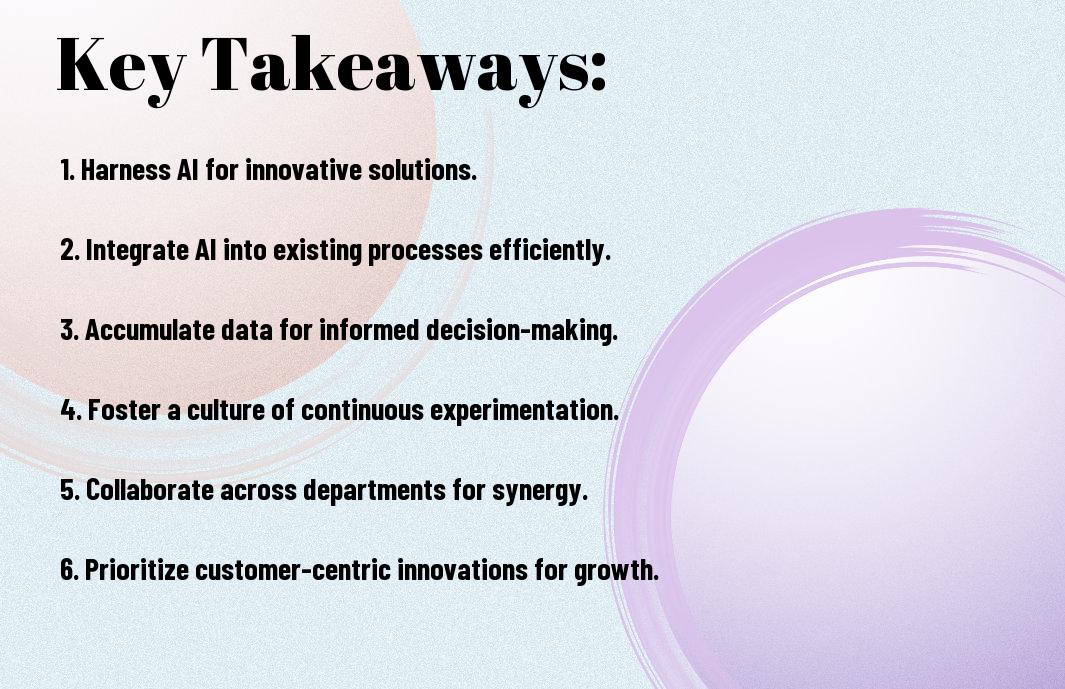
Key Takeaways:
- The formula “Innovate, Integrate, Accumulate” offers a structured approach to achieving business success through the strategic use of artificial intelligence (AI), emphasizing the importance of continuous innovation, seamless integration of new technologies, and accumulation of knowledge and resources.
- By innovating, businesses can leverage AI to develop new products, services, and processes that drive growth and competitiveness, while integration ensures that these innovations are effectively incorporated into existing systems and operations.
- Accumulation, the final component of the formula, involves building on successes and lessons learned to create a foundation for sustained growth and improvement, allowing businesses to stay ahead of the curve in an increasingly AI-driven marketplace.
The Innovation Catalyst
A key driver of business success in today’s fast-paced environment is innovation, and you can leverage AI to accelerate your growth. By embracing AI-driven solutions, you can unlock new opportunities and stay ahead of the competition.
Breaking Traditional Business Models
Beneath the surface of traditional business models lies a world of untapped potential, and you can uncover it by adopting AI-powered innovations that disrupt conventional practices and enable you to explore new avenues for growth.
AI-Powered Decision Making
With the ability to analyze vast amounts of data, AI empowers you to make informed decisions that drive your business forward, and you can trust the insights generated by AI to optimize your operations and improve your bottom line.
AIPowered decision making enables you to automate routine tasks, freeing up your time to focus on strategic planning and growth initiatives. You can utilize AI-driven tools to analyze market trends, customer behavior, and other factors that impact your business, allowing you to make data-driven decisions that propel your organization towards success. As you integrate AI into your decision-making process, you’ll be able to respond more quickly to changing market conditions and stay ahead of the competition.

Integration Architecture
If you’re looking to harness the full potential of AI in your business, a well-designed integration architecture is necessary. You need to ensure seamless communication between different systems and departments to maximize the benefits of AI-driven innovation.
Cross-Functional AI Implementation
Cross-functionally, you will need to implement AI solutions that can be used across various departments, allowing you to leverage AI-driven insights to inform your business decisions and drive growth.
Data Ecosystem Development
To develop a robust data ecosystem, you should focus on creating a unified platform that can collect, process, and analyze data from diverse sources, enabling you to make data-driven decisions and drive business success.
In addition, as you develop your data ecosystem, you will be able to integrate AI algorithms and machine learning models, allowing you to uncover hidden patterns and insights, and make predictions that can inform your business strategy and drive innovation, helping you to stay ahead of the competition and achieve your business goals.
Accumulation Strategy
Many businesses strive to create a robust accumulation strategy, leveraging their innovations and integrations to drive growth and success. You can achieve this by focusing on key areas that will propel your business forward, including knowledge capital growth and scalable learning systems.
Knowledge Capital Growth
One of the most significant advantages you can gain is through the growth of your knowledge capital, which enables you to make informed decisions and stay ahead of the competition. You will be able to identify opportunities and challenges, and develop effective strategies to address them.
Scalable Learning Systems
With the right approach, you can develop scalable learning systems that allow your business to adapt and evolve over time. You will be able to integrate new technologies and innovations, and apply them in a way that drives real results.
Capitalizing on the power of scalable learning systems, you can create a culture of continuous improvement within your organization, where you and your team are constantly learning and growing. You will be able to analyze data, identify areas for improvement, and develop targeted solutions to address them, ultimately driving your business towards long-term success.
Digital Transformation Journey
For your business to thrive in today’s fast-paced environment, embracing digital transformation is vital. You must adapt to stay competitive, leveraging technology to streamline processes and enhance customer experiences.
Cultural Shift Elements
One key aspect of digital transformation is the cultural shift within your organization. You need to foster a culture that encourages innovation, experimentation, and continuous learning, allowing your business to stay agile and responsive to changing market conditions.
Workforce Evolution
Around the time you begin on digital transformation, your workforce will undergo significant changes. You will need to upskill and reskill your employees to ensure they can effectively utilize new technologies and contribute to your business’s growth.
To achieve a successful workforce evolution, you should focus on providing ongoing training and development opportunities, allowing your employees to acquire the skills necessary to thrive in an AI-driven environment. You can also consider hiring new talent with expertise in emerging technologies, such as AI and data analytics, to complement your existing workforce and drive innovation within your organization.
Risk Management Framework
Unlike traditional risk management approaches, an AI-driven framework requires you to consider the unique risks associated with AI adoption, such as data bias and algorithmic errors, to ensure your business remains resilient and adaptable in a rapidly changing environment.
AI Security Protocols
Alongside your existing security measures, you should implement AI-specific protocols to protect your systems and data from potential threats, such as cyber attacks and data breaches, to safeguard your business and maintain customer trust.
Ethical Considerations
One of the key aspects of an AI-driven risk management framework is considering the ethical implications of AI adoption, including issues related to transparency, accountability, and fairness, to ensure your business operates responsibly and maintains a positive reputation.
And as you examine deeper into the ethical considerations of AI adoption, you will need to assess your business’s values and principles, and ensure that your AI systems align with these, to maintain transparency and trust with your customers and stakeholders, and to avoid potential reputational damage, you should also establish clear guidelines and protocols for AI development and deployment, and ensure that your teams are trained to identify and address potential ethical issues.
Performance Metrics
Despite the complexity of AI implementation, you can track your progress by monitoring key performance indicators. To develop a comprehensive strategy, you can Learn to Build an AI Strategy for Your Business that aligns with your goals.
Success Indicators
On the path to success, you will encounter various indicators that signal the effectiveness of your AI-driven approach, such as increased efficiency and improved decision-making.
ROI Measurement Systems
Before implementing any AI solution, you need to establish a robust ROI measurement system to evaluate its impact on your business.
Measurement of ROI is imperative to understanding the value of your AI investments, and you should consider factors such as cost savings, revenue growth, and enhanced customer experience when assessing the effectiveness of your AI strategy, allowing you to make informed decisions about future investments and optimizations.
Summing up
Presently, you have the power to transform your business with the AI-driven formula for success. You can innovate by leveraging AI technologies, integrate them into your operations, and accumulate the benefits. By following this formula, you will unlock new opportunities, enhance your decision-making, and drive growth. Your business will thrive in a competitive landscape, and you will stay ahead of the curve, achieving your goals and realizing your vision.
FAQ
Q: What is the concept of “Innovate, Integrate, Accumulate” and how does it relate to AI-driven business success?
A: The concept of “Innovate, Integrate, Accumulate” is a strategic formula designed to guide businesses towards achieving success in an AI-driven world. It emphasizes the importance of innovation in adopting new technologies and processes, integrating these innovations seamlessly into existing systems, and accumulating knowledge and data to drive continuous improvement and informed decision-making. By following this formula, businesses can harness the power of AI to enhance their operations, improve customer experiences, and stay competitive in the market.
Q: How does innovation play a role in the “Innovate, Integrate, Accumulate” formula for business success?
A: Innovation is the foundation of the “Innovate, Integrate, Accumulate” formula. It involves embracing new ideas, technologies, and methodologies that can transform business operations, products, and services. In the context of AI, innovation could mean adopting machine learning algorithms to improve predictive analytics, using natural language processing to enhance customer service, or leveraging computer vision to optimize supply chain management. By innovating, businesses can create new opportunities, solve complex problems, and differentiate themselves from competitors.
Q: What does integration mean in the context of the “Innovate, Integrate, Accumulate” formula, and why is it important?
A: Integration refers to the process of incorporating new technologies, systems, or processes into the existing infrastructure of a business. This step is vital because it ensures that innovations are not isolated but are instead connected and aligned with the overall business strategy. Effective integration enables businesses to derive maximum value from their investments in AI and other technologies, streamline operations, and provide a cohesive and enhanced experience for customers and employees alike. It involves technical integration, such as linking new AI tools with legacy systems, as well as cultural integration, ensuring that the workforce is prepared and trained to work with new technologies.
Q: How does accumulation contribute to business success in the “Innovate, Integrate, Accumulate” formula?
A: Accumulation in the “Innovate, Integrate, Accumulate” formula refers to the process of gathering, analyzing, and utilizing data and knowledge to drive business decisions and improvements. As businesses innovate and integrate new technologies, they generate vast amounts of data. Accumulating this data and leveraging it through AI-driven analytics can provide deep insights into customer behavior, market trends, operational efficiency, and more. This insights-driven approach enables businesses to refine their strategies, optimize operations, and make informed decisions, ultimately leading to sustained growth and success.
Q: What are the key challenges that businesses might face when implementing the “Innovate, Integrate, Accumulate” formula, and how can they be overcome?
A: Businesses may face several challenges when implementing the “Innovate, Integrate, Accumulate” formula, including resistance to change, lack of skilled personnel, technological compatibility issues, and data privacy concerns. To overcome these challenges, businesses should foster a culture of innovation, invest in employee training and development, adopt agile and flexible technological architectures, and implement robust data governance policies. Additionally, engaging with external partners, such as technology startups and consultants, can provide access to expertise and resources that can facilitate a smoother transition to an AI-driven business model. By addressing these challenges proactively, businesses can successfully implement the “Innovate, Integrate, Accumulate” formula and achieve their goals in an increasingly competitive and technology-driven marketplace.