AI

The Wealth-Building Impact of AI – Insights from Leading Entrepreneurs

As you navigate the ever-evolving landscape of business and technology, you’re likely aware of the significant role artificial intelligence (AI) plays in shaping your financial future. Your ability to leverage AI can be a key differentiator in achieving long-term success. You’ll discover how AI is transforming the way entrepreneurs build wealth, and gain valuable insights from leading entrepreneurs who have successfully harnessed its power to drive growth and profitability.

Key Takeaways:

  • Artificial intelligence (AI) is transforming the way businesses operate, creating new opportunities for wealth creation and growth, as highlighted by leading entrepreneurs who have successfully leveraged AI to drive innovation and profitability.
  • The integration of AI in business models can lead to significant increases in efficiency, productivity, and competitiveness, enabling companies to stay ahead of the curve in today’s fast-paced digital landscape.
  • Leading entrepreneurs emphasize the importance of investing in AI research and development to stay competitive, as well as fostering a culture of innovation and experimentation within their organizations.
  • AI-driven technologies, such as machine learning and natural language processing, are being used to develop new products and services, and to improve customer experiences, leading to increased revenue and market share.
  • The effective use of AI can also lead to the creation of new business models and revenue streams, such as data-driven services and AI-powered consulting, providing entrepreneurs with new opportunities for wealth-building and growth.
    AI as the New Gold Rush

    Your ability to capitalize on AI’s potential will depend on your willingness to adapt and innovate, as this technology is transforming industries and creating new opportunities for wealth creation.

    Early Adopters and Their Fortunes

    Gaining an early advantage in the AI space can lead to significant financial gains, as seen with pioneers who have successfully leveraged AI to disrupt markets and create new business models.

    Barriers to Entry in the AI Economy

    Entering the AI economy can be challenging due to the high costs of development, the need for specialized talent, and the complexity of integrating AI into existing systems, which can hinder your progress.

    Their inability to overcome these barriers can limit your potential for growth and profitability in the AI-driven market, making it vital for you to carefully plan and execute your AI strategy to stay competitive.

    The Democratization of AI Wealth

    It is now possible for you to access AI technologies that were previously exclusive to large corporations, allowing you to build wealth and grow your business like never before.

    How Small Entrepreneurs Leverage AI

    Any aspiring entrepreneur can now utilize AI-powered tools to streamline operations, making it easier for you to focus on growing your business and increasing your wealth.

    Subscription Models and Passive Income

    Wealth creation through AI-driven subscription models is becoming increasingly popular, enabling you to generate passive income and build a sustainable financial future.

    Another key aspect of subscription models is that they provide you with a predictable revenue stream, allowing you to plan and invest in your business with confidence, and ultimately, increase your wealth over time as you continue to leverage the power of AI in your business endeavors.

    AI’s Impact on Traditional Business Models

    After analyzing the effects of AI on various sectors, you can see how it’s changing the game. You can learn more about The Impact of Artificial Intelligence on Wealth Creation and its significance in your business.

    Industries Transformed

    Industry leaders are witnessing a significant shift in their operations, and you are likely to experience it too. You will notice changes in the way businesses function, making it important to adapt to the new landscape.

    The New Rules of Competitive Advantage

    Impact of AI on your business can be substantial, and you need to understand the new rules. You will have to rethink your strategy to stay ahead of the competition.

    Competitive advantage in the AI era requires you to be agile and innovative, leveraging technology to enhance your operations and customer experience. You will need to focus on developing a unique value proposition that sets you apart from others, and AI can be a key differentiator in achieving this goal.

    Building Wealth Through AI Automation

    All successful entrepreneurs understand that automation is key to building wealth, and AI is at the forefront of this revolution. You can leverage AI to streamline your business operations, reduce costs, and increase efficiency, ultimately leading to increased profits and wealth creation.

    Labor Arbitrage and Scaling

    Besides the cost savings, AI automation also enables you to scale your business quickly and efficiently, allowing you to take advantage of new opportunities and stay ahead of the competition. You can use AI to automate repetitive tasks, freeing up your time to focus on high-leverage activities that drive growth and wealth creation.

    The Compounding Effect of AI Investments

    For instance, when you invest in AI, you can expect a significant return on investment, which can be reinvested to generate even more wealth. You can use AI to identify new investment opportunities, optimize your portfolio, and make data-driven decisions to maximize your returns.

    But as you continue to invest in AI, you’ll find that the compounding effect can be staggering, with your wealth growing exponentially over time. You’ll be able to leverage AI to identify new trends, anticipate market shifts, and make strategic decisions that drive long-term wealth creation, allowing you to achieve your financial goals and build a lasting legacy.

    Ethical Considerations in AI Wealth Creation

    Once again, you will encounter complex issues as you examine into the world of AI-driven wealth creation, and ethical considerations will play a significant role in shaping your approach, as you navigate the potential benefits and drawbacks of this technology, considering its impact on your business and society.

    Addressing Inequality

    Construction of a more equitable system is key to ensuring that AI wealth creation benefits everyone, as you consider the potential consequences of AI on your workforce and the broader social landscape, you must think about how to mitigate any negative effects on your community.

    Responsible Innovation Practices

    Contemplation of the potential risks and benefits of AI is imperative, as you develop your strategy for AI wealth creation, you will need to prioritize responsible innovation practices, considering the long-term implications of your actions on your business and the world at large, and thinking about how to align your goals with societal values.

    But as you implement responsible innovation practices, you will have to balance competing demands, such as the need for profit and the need for social responsibility, and you will have to consider the potential trade-offs between these competing interests, thinking carefully about how to create a framework that supports both your business goals and the well-being of your stakeholders, and ensuring that your approach to AI wealth creation is both sustainable and ethical, reflecting your values and priorities as a business leader.

    Future Trends in AI-Driven Wealth

    Keep an eye on the future of AI-driven wealth, as it continues to evolve and transform the way you build and manage your wealth. You will see significant advancements in AI technology, leading to new opportunities and challenges.

    Emerging Opportunities

    Prior to the current trends, you may have thought that AI was only for large corporations, but now you can leverage AI to identify new investment opportunities and optimize your portfolio. You will be able to make data-driven decisions, giving you a competitive edge.

    Preparing for the Next Wave

    For your wealth-building strategy to succeed, you need to stay ahead of the curve and adapt to the changing landscape of AI-driven wealth. You should focus on developing a deep understanding of AI and its applications, allowing you to make informed decisions about your investments.

    Plus, as you prepare for the next wave of AI-driven wealth, you will need to consider the potential risks and challenges associated with AI, such as job displacement and cybersecurity threats. You should develop a comprehensive strategy to mitigate these risks and ensure that your wealth-building efforts are sustainable and resilient in the long term.

    Summing up

    Drawing together the insights from leading entrepreneurs, you now have a clearer understanding of the wealth-building impact of AI on your business. You can leverage AI to drive innovation, optimize operations, and create new revenue streams, ultimately transforming your enterprise. As you move forward, your ability to adapt and harness AI’s potential will be key to unlocking your company’s full potential and staying ahead in a rapidly evolving market.

    FAQ

    Q: What is the current state of AI adoption among entrepreneurs, and how is it impacting their wealth-building strategies?

    A: According to leading entrepreneurs, AI adoption is on the rise, with many leveraging its potential to automate tasks, gain data-driven insights, and drive innovation. This shift is significantly impacting their wealth-building strategies, as AI enables them to make more informed decisions, optimize operations, and create new revenue streams. By harnessing the power of AI, entrepreneurs can streamline their businesses, reduce costs, and increase efficiency, ultimately leading to increased profitability and wealth creation.

    Q: How are entrepreneurs using AI to drive business growth and stay competitive in their respective markets?

    A: Entrepreneurs are utilizing AI in various ways to drive business growth, including using machine learning algorithms to analyze customer data and personalize marketing efforts, implementing chatbots to enhance customer service, and leveraging predictive analytics to forecast market trends. Additionally, AI-powered tools are being used to automate routine tasks, freeing up time for entrepreneurs to focus on high-level strategy and innovation. By embracing AI, entrepreneurs can gain a competitive edge, improve customer engagement, and drive business expansion.

    Q: What skills and knowledge do entrepreneurs need to acquire to effectively harness the wealth-building potential of AI and stay ahead of the curve?

    A: To effectively leverage AI for wealth-building, entrepreneurs should acquire skills in data analysis, machine learning, and programming. They should also stay up-to-date with the latest AI trends, technologies, and applications, and be willing to invest in AI-powered tools and platforms. Furthermore, entrepreneurs need to develop a deep understanding of their customers’ needs and preferences, as well as the ability to integrate AI solutions into their existing business models. By acquiring these skills and knowledge, entrepreneurs can unlock the full potential of AI and drive sustainable wealth creation in their businesses.

A New Era of Entrepreneurship – How AI is Empowering the Next Generation

As you navigate the ever-changing landscape of business, you’re likely aware that artificial intelligence (AI) is revolutionizing the way you approach entrepreneurship. Your ability to leverage AI can significantly impact your success, and you’re not alone in this journey. You’re part of a new generation of entrepreneurs who are harnessing the power of AI to drive innovation and growth, and this shift is transforming the way you start, run, and scale your businesses, opening up new opportunities for you to thrive.

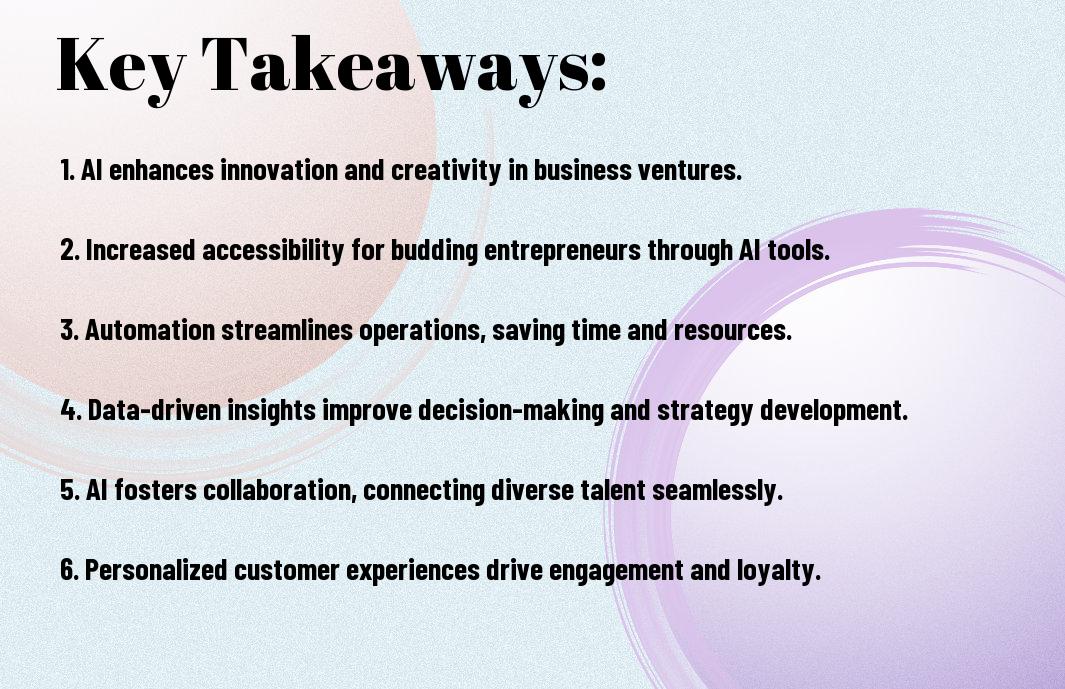
Key Takeaways:

  • AI is revolutionizing the entrepreneurial landscape by providing innovative tools and resources that enable the next generation of entrepreneurs to turn their ideas into reality, fostering a culture of creativity and innovation.
  • The integration of AI in entrepreneurship is democratizing access to opportunities, allowing individuals from diverse backgrounds to participate and succeed in the startup ecosystem, regardless of their geographical location or financial resources.
  • AI-powered technologies, such as machine learning and natural language processing, are helping entrepreneurs automate routine tasks, make data-driven decisions, and develop more effective business strategies, leading to increased efficiency and productivity.
  • The rise of AI is also creating new opportunities for social entrepreneurship, enabling individuals to develop innovative solutions to pressing social and environmental challenges, and creating a positive impact on communities around the world.
  • As AI continues to evolve, it is likely to have a profound impact on the future of entrepreneurship, enabling the next generation of entrepreneurs to build more sustainable, scalable, and successful businesses that drive economic growth and improve people’s lives.

    The AI Revolution in Business

    While AI is transforming the business landscape, you are witnessing a significant shift in the way companies operate. You can leverage AI to streamline processes, enhance customer experiences, and gain a competitive edge.

    Democratization of Technology

    Besides the numerous benefits of AI, you are seeing a democratization of technology, where access to AI tools and resources is becoming more widespread, allowing you to develop innovative solutions.

    Lowering Barriers to Entry

    Barriers to entry are being broken down, enabling you to start and grow a business with relatively low costs, thanks to AI-powered tools and platforms that provide you with the necessary infrastructure and support.

    Hence, as you consider starting your own business, you’ll find that AI is playing a significant role in lowering the barriers to entry, providing you with unprecedented opportunities to turn your ideas into reality, and you can now focus on developing your unique value proposition and reaching your target audience more efficiently.

    Tools Reshaping Entrepreneurial Landscapes

    Any entrepreneur looking to succeed in today’s fast-paced business environment needs to leverage the latest tools and technologies. You can utilize AI-powered solutions to streamline your operations, gain valuable insights, and make data-driven decisions to drive your business forward.

    AI-Powered Market Analysis

    Around the clock, you can access real-time market data and analytics, enabling you to identify trends, opportunities, and challenges. You can use this information to refine your business strategy and stay ahead of the competition.

    Automated Business Operations

    Assessing your business operations, you can identify areas where automation can increase efficiency and reduce costs. You can implement AI-powered tools to automate tasks, freeing up your time to focus on high-level decision-making and strategy.

    Reshaping your business operations with automation, you can achieve significant improvements in productivity and profitability. You can use AI-powered tools to manage your finances, customer relationships, and supply chain, allowing you to make informed decisions and drive growth in your business.

    The Psychology of AI-Empowered Founders

    To succeed as an AI-empowered founder, you need to understand the psychological aspects that drive your decision-making and behavior. Your mindset and approach will significantly impact your ability to leverage AI effectively.

    Confidence in Decision-Making

    Among the key benefits of AI is the ability to provide you with data-driven insights, enabling you to make informed decisions with confidence. You will be able to trust your judgment, knowing that it is backed by robust data and analysis.

    Cognitive Load Reduction

    To effectively utilize AI, you should consider how it can reduce your cognitive load, freeing you to focus on high-level strategic thinking. You will be able to offload routine and administrative tasks, allowing you to concentrate on driving your business forward.

    A key aspect of cognitive load reduction is the ability to automate repetitive tasks, which will enable you to allocate your time and energy more efficiently. As you leverage AI to streamline your operations, you will find that you have more bandwidth to devote to creative problem-solving, innovation, and growth, ultimately leading to increased productivity and success in your entrepreneurial endeavors.

    Economic Implications

    Despite the potential benefits of AI, you may wonder about its economic implications. As you explore this new era of entrepreneurship, consider how AI is changing the game for businesses and industries, and how you can adapt to these changes to stay ahead.

    New Business Formation Trends

    Besides the existing businesses, you will notice new trends emerging, with AI-enabled startups and entrepreneurs disrupting traditional markets and creating new opportunities for growth, allowing you to innovate and thrive in this new landscape.

    Shifting Industry Dynamics

    Among the key changes, you will see industries shifting towards more automated and efficient processes, and as you navigate this new era, you will need to be aware of these dynamics to make informed decisions about your business and investments.

    Hence, as you probe deeper into the shifting industry dynamics, you will discover that AI is not only changing the way businesses operate but also creating new opportunities for innovation and growth, and you will need to be prepared to adapt and evolve to stay competitive, by understanding how AI is transforming industries and identifying areas where you can leverage its power to drive your success.

    Challenges and Limitations

    After embracing AI in your entrepreneurial journey, you will encounter several challenges that can impact your business. You need to be aware of these limitations to navigate them effectively and ensure the successful integration of AI into your venture.

    Dependency Concerns

    Beneath the surface of AI’s benefits, you may find yourself relying heavily on technology, which can be a concern. You should consider the potential risks of over-reliance on AI systems and develop strategies to maintain a balance between technology and human expertise in your business.

    Ethical Considerations

    Above all, you must consider the ethical implications of using AI in your business. You have a responsibility to ensure that your use of AI is fair, transparent, and respectful of your customers’ privacy and rights.

    Apart from the basic ethical considerations, you should also think about the potential consequences of AI on your business and society as a whole. You will need to consider issues like job displacement, bias in AI decision-making, and the potential for AI to exacerbate existing social inequalities, and develop strategies to mitigate these risks and ensure that your use of AI is positive and beneficial for all stakeholders involved.

    Future Trajectories

    Once again, you’ll be at the forefront of innovation as AI transforms the entrepreneurial landscape. You can learn more about the upcoming changes at How AI Will Change the Face of Entrepreneurship in 2024 and Beyond, helping you prepare for your future endeavors.

    Evolving AI-Human Collaboration

    By examining the current trends, you’ll notice that AI is becoming an integral part of your business operations, enabling your teams to work more efficiently and make data-driven decisions.

    Next-Generation Business Models

    One of the most significant impacts of AI on entrepreneurship will be the emergence of new business models that you can leverage to stay competitive in the market.

    NextGeneration business models will focus on harnessing the power of AI to create personalized customer experiences, streamline your operations, and drive innovation. As you explore these new models, you’ll discover opportunities to disrupt traditional industries and create new markets, allowing your business to thrive in an AI-driven economy.

    Summing up

    Taking this into account, you can see that AI is revolutionizing the way you approach entrepreneurship. As you initiate on your entrepreneurial journey, you’ll find that AI is empowering your decisions, streamlining your operations, and enhancing your innovative capabilities. With AI by your side, you’ll be able to navigate the complexities of the business world with confidence, unlocking new opportunities and driving your venture forward, ultimately shaping your success in this new era of entrepreneurship. Your future looks promising.

    FAQ

    Q: What role is AI playing in the emergence of a new era of entrepreneurship, and how is it impacting the next generation of business leaders?

    A: AI is revolutionizing the landscape of entrepreneurship by providing unparalleled access to data, automating mundane tasks, and enhancing decision-making processes. This technology is empowering the next generation of entrepreneurs with innovative tools and insights, enabling them to develop more efficient, scalable, and sustainable business models. By leveraging AI, young entrepreneurs can focus on high-level strategy and creativity, driving innovation and growth in their ventures.

    Q: How are AI-powered tools and platforms supporting the development of new business ideas and prototypes among young entrepreneurs?

    A: AI-powered tools and platforms are offering a wide range of support to young entrepreneurs, from idea generation to prototype development. For instance, AI-driven market research tools help identify trends and consumer preferences, while AI-assisted design software enables the rapid creation of prototypes. Additionally, AI-facilitated crowdfunding platforms and incubators provide access to funding and mentorship, further nurturing the growth of new ventures. These resources are democratizing access to entrepreneurship, allowing a broader range of individuals to turn their ideas into successful businesses.

    Q: What skills and knowledge do the next generation of entrepreneurs need to acquire to effectively harness the potential of AI in their business ventures?

    A: To effectively leverage AI, the next generation of entrepreneurs should acquire a combination of technical, business, and soft skills. This includes understanding the fundamentals of AI and machine learning, as well as the ability to integrate these technologies into their business strategies. Additionally, skills such as data analysis, digital literacy, and creativity are important for maximizing the benefits of AI. Moreover, entrepreneurs need to develop a mindset that is open to continuous learning and adaptation, as the AI landscape is rapidly evolving. By combining these skills, young entrepreneurs can unlock the full potential of AI and drive their businesses forward in a competitive and ever-changing market.

Strategic Partnerships – Collaborating with AI to Drive Business Growth

As you navigate the ever-evolving business landscape, you’re likely exploring innovative ways to drive growth and stay competitive. Your organization can benefit from strategic partnerships that leverage artificial intelligence (AI) to enhance operations, improve efficiency, and unlock new opportunities. By collaborating with AI, you can tap into its potential to analyze vast amounts of data, identify patterns, and inform decision-making, ultimately propelling your business forward.

Key Takeaways:

  • Developing strategic partnerships with AI technology can significantly enhance business operations, leading to increased efficiency and productivity, and ultimately driving business growth.
  • Effective collaboration with AI requires a deep understanding of its capabilities and limitations, allowing businesses to identify areas where AI can add the most value and augment human capabilities.
  • AI-driven partnerships can facilitate innovation, enabling businesses to develop new products, services, and business models that might not have been possible without the power of artificial intelligence.
  • Successful implementation of AI partnerships depends on a robust infrastructure, including data management, security, and governance, to ensure seamless integration and optimal performance.
  • By leveraging AI in strategic partnerships, businesses can gain a competitive edge, improve customer experiences, and unlock new revenue streams, leading to sustained growth and success in an increasingly digital landscape.

    The Foundation of AI-Business Partnerships

    A strong foundation is vital for successful AI-business partnerships, and you will need to understand the basics of artificial intelligence and its applications in your industry to make informed decisions about your collaborations.

    Defining Strategic AI Collaborations

    For your business to thrive, you must define what strategic AI collaborations mean to you and identify areas where AI can augment your operations, enhancing your overall strategy and driving growth.

    The Evolution of Business-AI Dynamics

    AIBusiness collaborations are becoming increasingly common, and as you explore this space, you will notice that the lines between human and artificial intelligence are blurring, leading to new opportunities for innovation and expansion.

    In fact, as you research deeper into the evolution of business-AI dynamics, you will discover that the key to success lies in finding the right balance between human intuition and AI-driven insights, allowing you to make data-driven decisions that drive your business forward and stay ahead of the competition.

    Identifying Optimal AI Partnership Opportunities

    Now that you’re considering AI partnerships, it’s vital to identify opportunities that align with your business goals. You need to evaluate your organization’s strengths and weaknesses to determine the best AI solutions for your needs.

    Assessment of Organizational Readiness

    One key aspect of identifying optimal AI partnerships is assessing your organization’s readiness for AI adoption. You should evaluate your infrastructure, talent, and existing technology to determine if you’re prepared to integrate AI solutions.

    Mapping Business Challenges to AI Capabilities

    Beside understanding your organizational readiness, you must map your business challenges to AI capabilities. You should identify areas where AI can help solve specific problems or improve processes, and then explore AI solutions that address those needs.

    With a clear understanding of your business challenges and AI capabilities, you can create a roadmap for AI adoption that drives business growth. You will be able to identify the most effective AI solutions for your organization, and develop a strategy for implementing them in a way that maximizes their impact, helping you to achieve your business objectives and stay ahead of the competition.

    Implementation Frameworks for AI Collaboration

    Keep in mind that successful AI collaboration requires a well-structured approach. You need to consider various factors, including your business goals, AI capabilities, and resource allocation. By doing so, you can create a solid foundation for your AI partnership and drive business growth.

    Integration Methodologies

    With careful planning, you can integrate AI into your business operations seamlessly. You will need to assess your current infrastructure and identify areas where AI can be effectively incorporated, ensuring a smooth transition and minimal disruption to your workflow.

    Resource Allocation Strategies

    With the right resources, you can unlock the full potential of AI collaboration. You should allocate your resources efficiently, focusing on areas that will drive the most value for your business, such as data analysis, process automation, or customer service.

    Collaboration with AI requires a strategic approach to resource allocation. You will need to consider the skills and expertise required to implement and maintain AI systems, as well as the infrastructure and budget needed to support them. By allocating your resources effectively, you can ensure that your AI partnership is successful and drives meaningful business growth, helping you to stay ahead of the competition and achieve your goals.

    Measuring Partnership Success

    Once again, you will need to assess your partnership’s effectiveness, and you can learn more about this in The Essential Role of Strategic Partnerships in AI Adoption. As you evaluate your partnership, consider the various factors that contribute to its success.

    Key Performance Indicators

    Against the backdrop of your partnership’s goals, you will identify key performance indicators that measure progress, such as revenue growth or customer acquisition rates, to determine the success of your collaboration.

    ROI Evaluation Models

    For a comprehensive understanding of your partnership’s value, you will need to apply ROI evaluation models that account for both financial and non-financial benefits, providing a holistic view of the partnership’s impact on your business.

    This approach enables you to make informed decisions about your partnership, as you consider the return on investment and weigh the costs against the benefits, ultimately determining whether your collaboration is driving the desired business growth and if adjustments are needed to optimize your strategy. You can then refine your partnership strategy to better align with your business objectives, ensuring a successful and profitable collaboration.

    Overcoming Partnership Challenges

    Your ability to navigate challenges is vital when collaborating with AI to drive business growth, and being prepared for potential obstacles can make all the difference in the success of your partnerships.

    Technical Integration Hurdles

    One of the primary concerns you may face is integrating AI systems with your existing infrastructure, which can be a complex and time-consuming process, but with the right planning and expertise, you can overcome these hurdles and achieve seamless integration.

    Organizational Resistance Management

    After establishing a partnership, you may encounter resistance from within your organization, which can hinder the progress and effectiveness of your collaboration, and it’s imperative to address these concerns proactively to ensure a smooth transition.

    This resistance can stem from various factors, including fear of job displacement, lack of understanding about AI, or concerns about data security, and you can address these concerns by providing training and education to your employees, and by establishing clear guidelines and protocols for the use of AI within your organization, which will help to build trust and confidence in the technology and its benefits, allowing you to maximize the potential of your partnership and drive business growth.

    Future Trajectories of AI-Business Partnerships

    All signs point to a future where AI-business partnerships will become increasingly prevalent, driving innovation and growth in various industries. You can expect to see more strategic collaborations between companies and AI solution providers, leading to new business models and revenue streams. Your ability to adapt to these changes will be key to staying ahead of the competition.

    Emerging Collaborative Models

    Any analysis of current trends suggests that emerging collaborative models will play a significant role in shaping the future of AI-business partnerships. You will see new forms of cooperation, such as co-creation and joint innovation, becoming more prominent, enabling companies to leverage AI capabilities and drive business growth.

    Industry-Specific Developments

    Behind the scenes, industry-specific developments are already underway, with companies in sectors like healthcare and finance exploring AI applications tailored to their needs. You will need to stay informed about these developments to identify opportunities for your business to benefit from AI partnerships.

    In fact, as you investigate deeper into industry-specific developments, you will discover that AI is being used to address complex challenges and create new opportunities in various sectors, from improving patient outcomes in healthcare to enhancing customer experience in finance, and you can apply these lessons to your own business to drive growth and innovation.

    To wrap up

    With these considerations, you can now effectively leverage strategic partnerships to collaborate with AI and drive your business growth. You will be able to identify opportunities, assess potential partners, and develop mutually beneficial agreements. By doing so, you will enhance your competitive edge and stay ahead in the market, ultimately achieving your business goals through successful AI-driven collaborations that boost your bottom line and expand your market reach.

    FAQ

    Q: What are Strategic Partnerships and how can they benefit my business when collaborating with AI?

    A: Strategic Partnerships refer to collaborative agreements between two or more organizations to achieve common goals, share resources, and drive business growth. When collaborating with AI, these partnerships can enhance operational efficiency, improve decision-making, and unlock new revenue streams. By leveraging AI technologies, businesses can automate processes, gain deeper insights into customer behavior, and develop innovative products and services that meet evolving market demands. Effective strategic partnerships with AI-focused companies can help businesses stay competitive, expand their market reach, and foster long-term success.

    Q: How can AI-driven Strategic Partnerships help drive business growth and what are the key factors to consider when forming such partnerships?

    A: AI-driven Strategic Partnerships can help drive business growth by providing access to advanced technologies, expertise, and data analytics capabilities. These partnerships enable businesses to develop targeted marketing strategies, optimize supply chain operations, and improve customer engagement. When forming AI-driven partnerships, key factors to consider include aligning business objectives, defining clear roles and responsibilities, establishing robust data governance policies, and ensuring seamless integration of AI solutions with existing infrastructure. Additionally, businesses should assess the partner’s AI capabilities, evaluate potential risks and challenges, and develop a comprehensive plan for measuring partnership success and return on investment.

    Q: What are the potential challenges and limitations of Strategic Partnerships with AI companies, and how can businesses mitigate these risks to ensure successful collaboration?

    A: Potential challenges and limitations of Strategic Partnerships with AI companies include data privacy and security concerns, intellectual property protection, and the need for significant upfront investments in AI infrastructure and talent acquisition. Businesses can mitigate these risks by conducting thorough due diligence on potential partners, establishing clear contractual agreements, and developing a comprehensive risk management strategy. It is also imperative to foster open communication, ensure cultural alignment, and provide ongoing training and support to employees to address potential skills gaps and facilitate successful AI adoption. By being aware of these challenges and taking proactive measures to address them, businesses can navigate the complexities of AI-driven partnerships and achieve their growth objectives.

Navigating the Data Deluge – AI Solutions for Entrepreneurial Decision-Making

As you navigate the complex landscape of modern entrepreneurship, you’re constantly faced with an overwhelming amount of data. Your ability to make informed decisions hinges on your capacity to sift through this information and extract actionable insights. You need effective tools to help you make sense of the data deluge, and artificial intelligence (AI) solutions are poised to revolutionize your decision-making process, enabling you to drive your business forward with confidence and precision.

Key Takeaways:

  • Effective data management is crucial for entrepreneurs to make informed decisions, and AI solutions can help navigate the vast amounts of data available, providing valuable insights to drive business growth.
  • AI-powered tools can automate data analysis, freeing up time for entrepreneurs to focus on strategic decision-making and high-level thinking, rather than getting bogged down in data processing.
  • By leveraging AI solutions, entrepreneurs can identify patterns and trends in their data that may not be immediately apparent, enabling them to respond quickly to changes in the market and stay ahead of the competition.
  • AI-driven decision-making can also help entrepreneurs mitigate risk by identifying potential pitfalls and opportunities, allowing them to make more informed decisions and avoid costly mistakes.
  • Ultimately, the successful integration of AI solutions into an entrepreneur’s decision-making process can lead to increased efficiency, improved accuracy, and enhanced business outcomes, giving them a competitive edge in their industry.

    The Raw Data Landscape

    The sheer amount of data available to you as an entrepreneur can be overwhelming, making it difficult to discern valuable insights from irrelevant information. You need to navigate this complex landscape to make informed decisions for your business.

    Volume Challenges

    Between the various sources of data, including social media, customer feedback, and sales reports, you are faced with a vast amount of information to sift through, making it hard to determine what is relevant to your business goals.

    Velocity Concerns

    Challenges arise when trying to process and analyze data in real-time, as the speed at which it is generated can be staggering, leaving you struggling to keep up with the latest trends and patterns.

    In fact, as you research deeper into the velocity concerns, you will find that the rapid pace of data generation requires you to have a system in place that can handle the influx of information, allowing you to respond quickly to changes in the market and make timely decisions that drive your business forward.

    AI Tools for Data Processing

    Some of the most effective AI tools for data processing are designed to help you streamline your workflow and make more informed decisions. You can leverage these tools to analyze large datasets, identify patterns, and gain valuable insights that inform your entrepreneurial endeavors.

    Machine Learning Solutions

    Following the initial data processing stage, you can utilize machine learning solutions to further refine your analysis. You will be able to develop predictive models that help you forecast trends and make data-driven decisions that drive your business forward.

    Natural Language Processing Applications

    Across various industries, natural language processing applications are being used to analyze and interpret large amounts of text-based data. You can use these applications to extract insights from customer feedback, social media posts, and other sources of unstructured data.

    But as you probe deeper into natural language processing applications, you will discover that they offer more than just text analysis. You can use them to automate tasks such as sentiment analysis, entity recognition, and language translation, freeing up more time for you to focus on high-level decision-making and strategy development.

    Decision Frameworks

    Many entrepreneurs struggle to make informed decisions due to the overwhelming amount of data available. You need a structured approach to filter and analyze this data, and that’s where decision frameworks come in. By implementing a decision framework, you can streamline your decision-making process and make more accurate predictions about your business’s future.

    Algorithmic Approaches

    Against the backdrop of increasing data complexity, algorithmic approaches can help you identify patterns and trends that inform your decision-making. You can leverage machine learning algorithms to analyze large datasets and uncover insights that might elude human analysts, enabling you to make more informed decisions about your business.

    Human-AI Collaboration

    Following the integration of AI into your decision-making process, you’ll need to consider how humans and AI systems can work together effectively. You should design a collaboration framework that plays to the strengths of both humans and AI, allowing you to augment your decision-making capabilities and drive business success.

    Consequently, as you develop your human-AI collaboration framework, you’ll need to focus on creating an environment where humans and AI systems can interact seamlessly. You can achieve this by implementing transparent AI systems that provide explanations for their decisions, and by training your team to work effectively with AI tools, ultimately enhancing your decision-making capabilities and driving business growth.

    Implementation Strategies

    Despite the complexity of AI solutions, you can effectively integrate them into your decision-making process by starting small and scaling up, allowing you to navigate the data deluge with ease and make informed decisions.

    Resource Allocation

    Beneath the surface of successful AI implementation lies a thoughtful allocation of your resources, ensuring that you dedicate sufficient budget and personnel to support your AI initiatives, enabling you to maximize their potential and drive business growth.

    Team Structure

    Across your organization, you will need to establish a team with a mix of technical and business expertise to effectively implement and manage AI solutions, allowing you to leverage their capabilities and drive business success.

    And as you build your team, you will need to consider the skills and expertise required to support your AI initiatives, including data scientists, engineers, and business analysts, ensuring that you have the right talent in place to drive your AI strategy forward and help you make informed, data-driven decisions that propel your business forward.

    Risk Assessment

    Unlike traditional methods, AI solutions offer a more comprehensive approach to risk assessment, enabling you to identify potential pitfalls and opportunities in your entrepreneurial endeavors. By leveraging machine learning algorithms and data analytics, you can make informed decisions that mitigate risks and maximize returns on your investments.

    Data Security

    Securing your data is vital to preventing unauthorized access and protecting your business from potential threats. You need to ensure that your AI systems are designed with robust security measures to safeguard your sensitive information and maintain the integrity of your decision-making processes.

    Algorithmic Bias

    With the increasing reliance on AI-driven decision-making, you must be aware of the potential for algorithmic bias in your systems. You can avoid this by regularly auditing your algorithms and training data to ensure that they are fair, transparent, and unbiased.

    The issue of algorithmic bias is particularly significant, as it can have far-reaching consequences for your business, including perpetuating existing social inequalities and leading to poor decision-making. You should take steps to address this issue by implementing diverse and representative training data, as well as ongoing monitoring and evaluation of your AI systems to detect and correct any biases that may arise, ensuring that your decision-making processes are fair and reliable.

    Measuring Success

    Not every entrepreneurial venture succeeds, but with the right tools, you can increase your chances of making informed decisions. You will be able to track your progress and adjust your strategy accordingly, which is imperative for achieving your goals.

    Key Performance Indicators

    Against the backdrop of your business objectives, you will need to establish relevant metrics to evaluate your performance. You should identify the indicators that best reflect your company’s success and use them to guide your decision-making process, allowing you to stay focused on what matters most.

    Adaptation Protocols

    Among the various strategies you can employ to navigate the data deluge, adaptation protocols are imperative for responding to changes in your industry. You will be able to adjust your approach as needed, ensuring that your business remains competitive and agile in a rapidly evolving market.

    Protocols for adaptation involve continuously monitoring your performance and making adjustments to optimize your outcomes. You will be able to refine your strategy over time, incorporating new insights and data into your decision-making process, and driving your business forward with confidence and precision, allowing you to achieve your goals and stay ahead of the competition.

    Summing up

    Now that you have explored AI solutions for entrepreneurial decision-making, you can harness the power of data to drive your business forward. You will be able to make informed decisions, streamline operations, and stay ahead of the competition. With AI by your side, you can effectively navigate the data deluge and unlock your business’s full potential, enabling you to achieve your goals and succeed in today’s fast-paced market.

    FAQ

    Q: What are the main challenges entrepreneurs face when navigating the data deluge, and how can AI solutions help?

    A: Entrepreneurs often struggle with managing and making sense of the vast amounts of data available to them. This can lead to difficulties in identifying trends, making informed decisions, and staying competitive. AI solutions can help by providing advanced data analytics and machine learning capabilities that enable entrepreneurs to efficiently process large datasets, uncover hidden insights, and make data-driven decisions. By leveraging AI, entrepreneurs can streamline their decision-making processes, reduce the risk of human error, and drive business growth.

    Q: How can AI-powered tools support entrepreneurial decision-making in the context of data analysis and interpretation?

    A: AI-powered tools can support entrepreneurial decision-making by offering automated data analysis, predictive modeling, and visualization capabilities. These tools can help entrepreneurs to quickly identify patterns, trends, and correlations within their data, and provide actionable recommendations based on that analysis. Additionally, AI-driven solutions can facilitate real-time monitoring and alerts, enabling entrepreneurs to respond promptly to changes in their business environment. By harnessing the power of AI, entrepreneurs can make more informed, strategic decisions that drive innovation and success.

    Q: What are some best practices for entrepreneurs to effectively implement AI solutions for navigating the data deluge and enhancing their decision-making capabilities?

    A: To effectively implement AI solutions, entrepreneurs should start by defining clear goals and objectives for their data analysis and decision-making processes. They should also invest in user-friendly, intuitive AI tools that can be easily integrated into their existing workflows. Furthermore, entrepreneurs should prioritize data quality and ensure that their AI systems are trained on accurate, relevant, and up-to-date information. Regularly monitoring and evaluating the performance of AI solutions, as well as staying informed about the latest advancements in AI technology, can also help entrepreneurs maximize the benefits of these tools and drive long-term business success.

Financial Freedom Through AI – Entrepreneurial Stories of Success and Innovation

As you explore the world of entrepreneurship, you’re likely seeking innovative ways to achieve financial freedom. Your journey to success can be accelerated by leveraging Artificial Intelligence (AI). You’ll discover how AI is transforming industries and creating new opportunities for entrepreneurs like yourself. By embracing AI, you can unlock new revenue streams, optimize operations, and gain a competitive edge, ultimately achieving the financial freedom you desire.

Key Takeaways:

  • Financial freedom can be achieved through the strategic implementation of Artificial Intelligence (AI) in entrepreneurial ventures, as seen in various success stories where AI-driven innovations have transformed businesses and created new opportunities for growth and profitability.
  • Entrepreneurs who have successfully harnessed the power of AI have been able to automate tasks, enhance decision-making, and gain a competitive edge in their respective markets, leading to significant financial gains and increased freedom.
  • The application of AI in finance and business has given rise to new entrepreneurial opportunities, such as AI-powered investment platforms, automated trading systems, and data-driven consulting services, which have enabled individuals to build successful and profitable businesses.
  • Stories of entrepreneurial success through AI highlight the importance of embracing innovation, taking calculated risks, and continuously learning and adapting to the rapidly evolving AI landscape in order to stay ahead of the curve and achieve financial freedom.
  • By leveraging AI and machine learning, entrepreneurs can create scalable and sustainable business models that generate passive income, providing them with the financial freedom to pursue their passions and interests without being tied to a traditional 9-to-5 job.

The Tipping Point of AI Entrepreneurship

Before the advent of AI, you may have thought that achieving financial freedom through entrepreneurship was a distant dream, but with the rise of innovative technologies, your chances of success have increased exponentially.

When AI Became Accessible to Everyday Entrepreneurs

For many years, AI was reserved for large corporations, but now you can access these powerful tools to transform your business and create new opportunities for growth and development.

Small Changes That Created Massive Opportunities

Beside the numerous benefits of AI, you can leverage its capabilities to streamline your operations, making your business more efficient and profitable, which can have a significant impact on your bottom line.

For instance, you can use AI-powered chatbots to automate customer service, freeing up your time to focus on high-leverage activities, such as strategy and innovation, allowing you to stay ahead of the competition and achieve your financial goals faster.

AI Outliers: Unconventional Paths to Financial Success

You are about to discover the unconventional paths to financial success through AI, where entrepreneurs have achieved remarkable results by deviating from traditional methods.

The 10,000 Hours Myth in AI Business

For instance, you’ll find that the notion of requiring 10,000 hours to master AI is being challenged by entrepreneurs who have achieved success in a fraction of the time, leveraging their unique strengths and innovative approaches.

Intuitive Entrepreneurs Who Defied Convention

Across various industries, you’ll encounter entrepreneurs who have defied conventional wisdom and achieved remarkable success with AI, often by trusting their intuition and taking calculated risks to stay ahead of the curve.

Plus, as you examine deeper into the stories of these intuitive entrepreneurs, you’ll notice that they share a common trait: the ability to balance technical expertise with creative vision, allowing them to identify opportunities that others may have missed, and to develop innovative solutions that have disrupted entire markets, leading to significant financial gains and a lasting impact on their industries.

The Financial Freedom Algorithm

Once again, you can achieve financial freedom by leveraging AI, as seen in The age of the entrepreneur: AI unlocks financial freedom, where innovative entrepreneurs share their success stories.

Recurring Revenue Models in AI Businesses

For instance, you can create a stable income stream by developing AI-powered products with subscription-based models, allowing you to generate revenue consistently.

Scaling Without Traditional Resources

Financial constraints no longer limit your ability to scale your AI business, as cloud computing and outsourcing enable you to access necessary resources without significant upfront investments.

Models like pay-as-you-go pricing and freemium models allow you to scale your AI business efficiently, enabling you to focus on growth and development, rather than worrying about resource allocation, and you can explore these models to find what works best for your business.

Cognitive Barriers to AI Wealth Creation

Your mindset plays a significant role in achieving financial freedom through AI. You must be aware of the cognitive barriers that can hinder your success, such as fear and lack of understanding.

Overcoming Technological Intimidation

Among the most significant obstacles to AI wealth creation is technological intimidation. You may feel overwhelmed by the complexity of AI, but you can overcome this by educating yourself and taking small steps towards automation.

Reframing Risk in the Age of Automation

To succeed in AI-driven wealth creation, you need to reframe your perception of risk. You should view risk as an opportunity for growth and innovation, rather than a threat to your financial security.

And as you probe deeper into the world of AI, you will discover that reframing risk is imperative to unlocking your full potential. You will learn to navigate the uncertainties of automation and make informed decisions that drive your financial freedom forward, enabling you to stay ahead of the curve and achieve your goals.

The Connector Effect in AI Entrepreneurship

Not every entrepreneur has the same level of access to resources, but you can still achieve financial freedom through AI by leveraging the right connections. You will learn how to build a network that amplifies your AI solutions and increases your social currency.

Building Networks That Amplify AI Solutions

Against the backdrop of a rapidly evolving AI landscape, you will find opportunities to connect with like-minded entrepreneurs and innovators, helping you to stay ahead of the curve and identify new opportunities for growth.

The Social Currency of Technical Innovation

About the time you start to build your reputation as an AI entrepreneur, you will begin to appreciate the value of social currency in technical innovation, which can open doors to new partnerships, investments, and collaborations.

And as you examine deeper into the world of AI entrepreneurship, you will discover that your social currency is directly tied to your ability to innovate and adapt, and you will need to continually develop your skills and knowledge to stay relevant in this rapidly changing field, allowing you to make informed decisions about your business and stay ahead of the competition.

Pattern Recognition: Identifying Profitable AI Niches

Unlike traditional industries, AI niches often emerge unexpectedly, and your ability to identify them can make or break your entrepreneurial venture. You need to stay vigilant and adapt quickly to capitalize on new opportunities. By analyzing market trends and consumer behavior, you can uncover profitable AI niches and position yourself for success.

The Psychology of Market Gaps

Prior to venturing into AI entrepreneurship, you should understand the psychology behind market gaps. You will find that unmet consumer needs and desires often drive innovation, and your task is to identify these gaps and develop AI solutions to fill them. By doing so, you can create a loyal customer base and establish a strong market presence.

Timing Your Entry for Maximum Impact

Entering the AI market at the right time is important for your success. You should monitor industry developments and wait for the perfect moment to launch your product or service. This strategic approach will enable you to maximize your impact and gain a competitive edge.

A key aspect of timing your entry for maximum impact is being able to analyze market conditions and anticipate future trends. As you consider launching your AI-powered product or service, you should assess the current competitive landscape, consumer demand, and potential barriers to entry. By doing so, you can make informed decisions and increase your chances of success in the rapidly evolving AI landscape, allowing you to stay ahead of the curve and achieve your entrepreneurial goals.

To wrap up

Ultimately, as you explore Financial Freedom Through AI, you will discover entrepreneurial stories of success and innovation that can inspire your own journey. You will learn how to leverage AI to optimize your financial decisions, creating a more secure and prosperous future for yourself. By embracing AI-driven solutions, you can unlock new opportunities and achieve your financial goals, transforming your life and securing your financial freedom.

FAQ

Q: What is Financial Freedom Through AI and how can it benefit entrepreneurs?

A: Financial Freedom Through AI refers to the ability to achieve financial independence and success through the strategic use of Artificial Intelligence (AI) in business. By leveraging AI technologies, entrepreneurs can automate tasks, gain valuable insights, and make data-driven decisions, leading to increased efficiency, productivity, and profitability. This can enable them to break free from the constraints of traditional business models and achieve financial freedom, allowing them to pursue their passions and interests without being tied down by financial worries.

Q: What kind of entrepreneurial stories can I expect to learn from Financial Freedom Through AI?

A: Financial Freedom Through AI features a collection of inspiring and informative stories from successful entrepreneurs who have harnessed the power of AI to achieve remarkable success in their respective fields. These stories showcase innovative business models, cutting-edge AI applications, and strategic decision-making, providing valuable lessons and insights for aspiring entrepreneurs. From e-commerce and marketing to healthcare and finance, these stories demonstrate the versatility and potential of AI in driving business growth and achieving financial freedom.

Q: How can I apply the principles of Financial Freedom Through AI to my own business or entrepreneurial venture?

A: By reading and learning from the entrepreneurial stories featured in Financial Freedom Through AI, you can gain practical knowledge and insights on how to integrate AI into your own business or venture. You can start by identifying areas where AI can automate tasks, improve efficiency, or provide valuable insights, and then explore the various AI tools and technologies available to support your goals. Additionally, you can learn from the successes and challenges faced by other entrepreneurs, avoiding common pitfalls and staying up-to-date with the latest trends and innovations in the field, ultimately paving your way to achieving financial freedom through AI-driven innovation.

Skip to content