Business

Transforming Your Business with AI – Lessons in Modern Entrepreneurship

As you navigate the ever-evolving landscape of modern entrepreneurship, you’re likely aware of the profound impact artificial intelligence (AI) can have on your business. You’re considering how to harness its power to drive growth, enhance efficiency, and stay competitive. Your ability to adapt and innovate will be key to unlocking AI’s full potential, and this post will guide you through the process, providing valuable insights and lessons to help you transform your business and thrive in an AI-driven world.

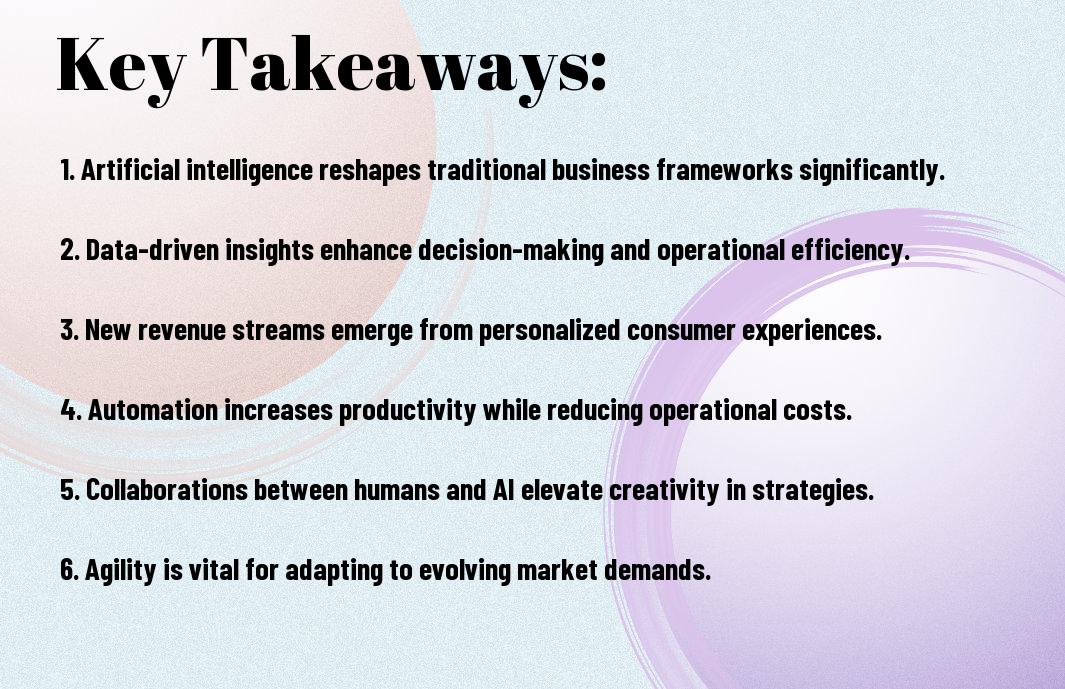
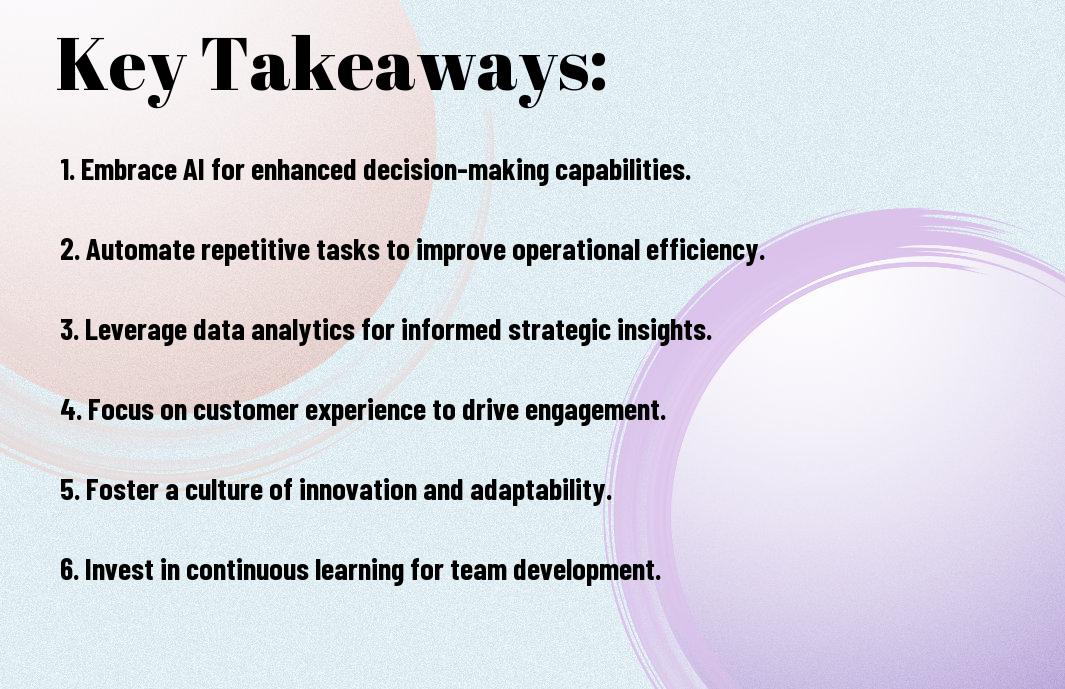
Key Takeaways:

  • Embracing AI technology can significantly enhance business operations, leading to increased efficiency and productivity, and ultimately driving growth and competitiveness in the market.
  • Successful AI integration requires a deep understanding of the technology and its potential applications, as well as a willingness to experiment and innovate in order to stay ahead of the curve.
  • AI can be used to automate routine tasks, freeing up human resources for more strategic and creative work, and enabling businesses to focus on high-value activities that drive innovation and revenue.
  • Effective AI adoption also depends on the ability to manage and analyze large amounts of data, and to use insights gained from this data to inform business decisions and drive strategy.
  • By leveraging AI, entrepreneurs can create new business models, products, and services that meet evolving customer needs and preferences, and establish a strong foundation for long-term success and sustainability.
The AI Revolution in Business

While embracing AI, you can revolutionize your business operations, enhancing efficiency and decision-making. AI-driven technologies help you streamline processes, analyze data, and gain valuable insights, ultimately driving growth and innovation in your organization.

The Tipping Point for AI Adoption

Besides the numerous benefits, you are likely considering the optimal time to integrate AI into your business. As AI technologies continue to advance, you will find more opportunities to leverage them, making now the perfect moment to start exploring their potential.

Small Changes, Big Results

Alongside other strategies, you can begin by implementing minor AI-powered adjustments to your daily operations. By doing so, you will be able to experience the positive impact of AI on your business without overwhelming your systems or staff.

This approach allows you to test and refine your AI integration, identifying areas where AI can have the most significant effect, and making data-driven decisions to drive further improvements, ultimately leading to significant benefits for your business, such as increased productivity, enhanced customer experience, and improved competitiveness in the market, all resulting from your thoughtful and incremental adoption of AI solutions.

Identifying AI Opportunities

Clearly, to transform your business with AI, you need to identify areas where AI can bring the most value. You must assess your operations, looking for tasks that are repetitive, time-consuming, or prone to human error, as these are prime candidates for AI integration.

Data as Your Business Compass

On the path to AI adoption, your data will serve as a guiding light, helping you understand where AI can be most effectively applied. You will use your data to pinpoint inefficiencies and opportunities for improvement, allowing you to make informed decisions about where to focus your AI efforts.

Automation Sweet Spots

For your business to reap the benefits of AI, you need to find the automation sweet spots – areas where automation can significantly enhance efficiency and productivity. You will look for tasks that are not only repetitive but also high-volume, as these will yield the greatest returns on your AI investment.

Understanding how to identify these automation sweet spots is key to successfully integrating AI into your business. You will need to analyze your workflows, looking for bottlenecks and areas where manual processing is holding you back, and then apply AI solutions to streamline these processes, freeing up your resources for more strategic and creative work, and ultimately driving your business forward with increased efficiency and innovation.

Implementation Strategies

To successfully integrate AI into your business, you need to develop a comprehensive plan, considering your goals, resources, and potential challenges. This involves assessing your current infrastructure, identifying areas where AI can add value, and creating a roadmap for implementation.

The Minimal Viable AI Approach

Vital to your AI strategy is starting small, testing, and iterating to ensure you’re on the right track. You’ll want to focus on a specific problem or process where AI can have the most impact, and then scale up as you gather more insights and confidence in the technology.

Building Your AI Team

Modest beginnings are often the best approach when assembling your AI team. You’ll need to bring together individuals with diverse skill sets, including data scientists, engineers, and domain experts, to ensure your AI solutions are effective and aligned with your business objectives.

Implementation of an AI team requires careful consideration of your organization’s structure and culture. As you build your team, you’ll need to provide ongoing training and support to help your staff develop the skills they need to work effectively with AI systems, and to ensure that your AI strategy is integrated into every aspect of your business, driving innovation and growth.

Customer Experience Transformation

Your business can greatly benefit from AI-driven customer experience transformation, enabling you to deliver personalized and efficient services to your clients, ultimately leading to increased customer satisfaction and loyalty.

Personalization at Scale

With advanced AI technologies, you can now offer tailored experiences to your customers, analyzing their behavior and preferences to provide them with relevant offers and services, thus enhancing their overall experience with your brand.

Predictive Service Models

After implementing AI-powered predictive models, you can anticipate and address customer needs proactively, reducing wait times and improving response rates, which can significantly boost your customer satisfaction ratings and retention.

At the heart of predictive service models lies the ability to analyze vast amounts of customer data, allowing you to identify patterns and trends that inform your decision-making, enabling you to provide your customers with timely and effective support, and ultimately driving business growth and success, as you continue to meet and exceed their evolving expectations.

Operational Excellence Through AI

Once again, you can leverage AI to streamline your business operations, enhancing efficiency and productivity. By implementing AI-powered tools, you can automate routine tasks, analyze data, and make informed decisions to drive growth.

Supply Chain Intelligence

Exemplary performance in supply chain management is achievable with AI. You can use AI-driven analytics to forecast demand, manage inventory, and optimize logistics, resulting in improved delivery times and reduced costs.

Resource Optimization

Along with AI, you can optimize your resources, allocating them more effectively to maximize output. You can use AI to identify areas of waste, predict maintenance needs, and improve overall resource utilization.

Indeed, optimizing your resources with AI can have a significant impact on your bottom line. You can expect to see reduced waste, improved productivity, and increased efficiency, allowing you to allocate resources to more strategic initiatives and drive business growth. By leveraging AI in this way, you can stay ahead of the competition and achieve your business goals.

Ethical Considerations

Despite the numerous benefits of AI, you must consider the ethical implications of its integration into your business, as you can learn more about How will AI shape the future of entrepreneurship? and make informed decisions.

Transparency in AI Systems

Transparently, you need to understand how AI systems work and make decisions, ensuring that your business operates fairly and without bias, as you implement AI solutions.

Privacy and Trust Building

Against the backdrop of increasing AI adoption, you should prioritize building trust with your customers by protecting their data and being transparent about your AI-driven processes.

Trust is imperative in establishing a strong relationship with your customers, and as you implement AI in your business, you must ensure that their privacy is respected and their data is secure, fostering a trustworthy environment for your business to thrive.

Final Words

With these considerations, you now have a solid foundation to transform your business with AI. You can leverage AI to drive innovation, enhance efficiency, and stay competitive. As you begin on this journey, your ability to adapt and evolve will be key to success. By applying the lessons in modern entrepreneurship, you will be well-equipped to harness the power of AI and take your business to the next level, achieving your goals and realizing your vision.

FAQ

Q: What are the key benefits of integrating Artificial Intelligence (AI) into my business operations?

A: Integrating AI into your business can significantly enhance efficiency, reduce operational costs, and improve decision-making processes. AI technologies such as machine learning and natural language processing can automate routine tasks, analyze large datasets to provide actionable insights, and personalize customer interactions. By leveraging these capabilities, businesses can innovate their products and services, stay competitive in the market, and achieve sustainable growth.

Q: How can entrepreneurs ensure that their AI-driven business strategies are aligned with ethical standards and social responsibility?

A: Ensuring that AI-driven business strategies are ethically sound involves several steps. Firstly, entrepreneurs should prioritize transparency in how AI is used, including clear communication about data collection and usage. Secondly, they must implement robust data protection measures to safeguard customer privacy. Additionally, businesses should adopt principles of fairness and accountability in AI decision-making processes to prevent bias and discrimination. Engaging in ongoing dialogue with stakeholders, including consumers, regulators, and ethical experts, can also provide valuable insights into maintaining ethical standards in AI integration.

Q: What skills and knowledge do entrepreneurs need to acquire to successfully transform their businesses with AI and thrive in modern entrepreneurship?

A: To successfully transform their businesses with AI, entrepreneurs need to develop a combination of technical, business, and soft skills. Technically, they should have a basic understanding of AI concepts, including machine learning, deep learning, and data analytics. From a business perspective, they need to be able to identify areas where AI can add value, develop strategies for AI adoption, and manage the change process within their organization. Soft skills such as leadership, creativity, and the ability to collaborate with AI experts are also necessary. Furthermore, staying updated with the latest AI trends, best practices, and regulatory environments through continuous learning is vital for making informed decisions and navigating the challenges of AI adoption.

From Concept to Cash – AI Strategies for Building a Sustainable Business

As you begin on building a sustainable business, you’ll need to leverage innovative technologies to drive growth. You’re likely aware that artificial intelligence (AI) can be a game-changer, but may be unsure how to harness its power. Your business can benefit from AI-driven strategies that streamline operations, enhance customer experiences, and boost revenue. By exploring the right AI approaches, you can turn your concept into a profitable reality, setting your business up for long-term success.

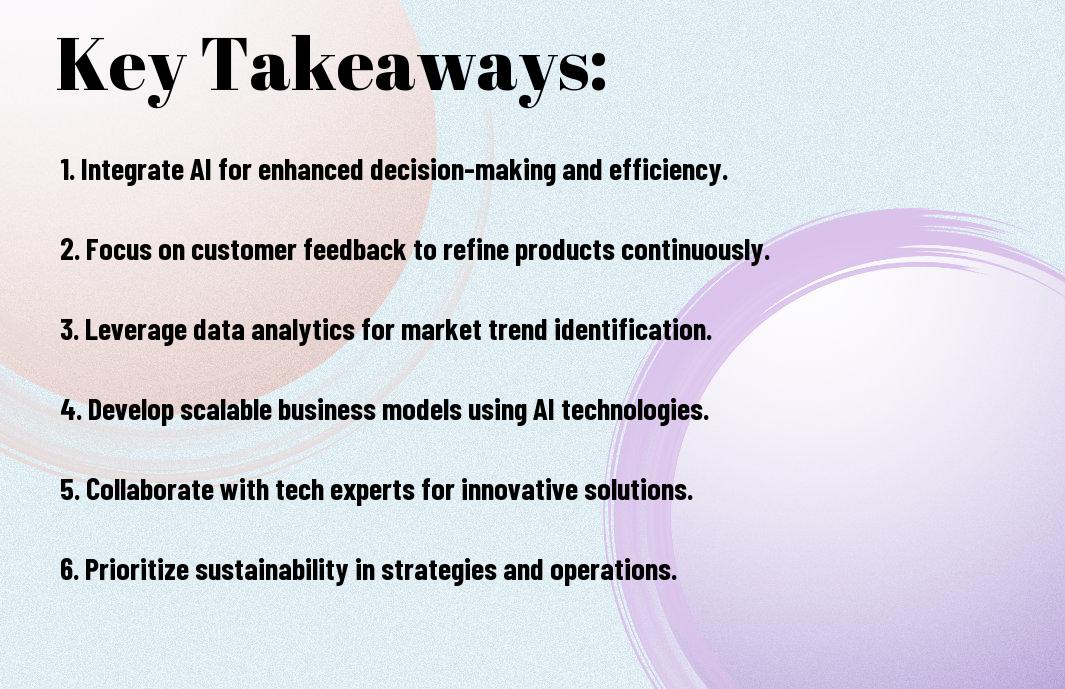
Key Takeaways:

  • Developing a solid business strategy that incorporates AI can significantly enhance a company’s ability to innovate and stay competitive in the market, leading to sustainable growth and increased revenue.
  • Implementing AI solutions requires a thorough understanding of the technology and its potential applications within the business, as well as a clear plan for integration and deployment.
  • A successful AI strategy involves identifying areas where automation and machine learning can improve efficiency, reduce costs, and drive innovation, and prioritizing these areas for development and investment.
  • Building a sustainable business with AI also involves considering the ethical implications of AI adoption, including issues related to data privacy, bias, and job displacement, and developing strategies to mitigate these risks.
  • Continuous monitoring and evaluation of AI initiatives is vital to ensure they are meeting business objectives and driving long-term value, and to make adjustments as needed to optimize performance and stay ahead of the competition.

    The AI Business Landscape

    The current state of the AI business landscape is evolving rapidly, and you need to stay informed to make the most of it. You will encounter various trends, technologies, and innovations that can help you build a sustainable business. Your understanding of this landscape will enable you to make informed decisions and create effective AI strategies.

    Current Market Opportunities

    Options abound in the AI market, and you can capitalize on them to drive your business forward. You can explore various sectors, such as healthcare, finance, and education, where AI is being increasingly adopted. Your ability to identify and leverage these opportunities will help you stay ahead of the competition.

    Competitive Analysis

    Assessing the competitive landscape is imperative for your business, and you should conduct a thorough analysis to understand your position in the market. You can analyze your competitors’ strengths, weaknesses, and AI strategies to inform your own decisions and create a unique value proposition.

    Further examination of your competitors’ AI adoption and strategies will help you identify gaps in the market and potential areas for innovation. You can use this information to develop a tailored approach that sets your business apart and drives long-term success. Your competitive analysis will be an ongoing process, and you should continuously monitor the market to stay informed and adapt to changes.

    Identifying Viable AI Concepts

    Assuming you have a solid understanding of AI and its applications, the next step is to identify viable concepts that can be developed into a sustainable business. You will need to evaluate various ideas and determine which ones have the potential to generate revenue and drive growth.

    Problem-Solution Fit

    Any successful AI concept starts with a clear understanding of the problem you are trying to solve. You need to identify a genuine need in the market and develop a solution that addresses it effectively, providing value to your customers and setting your business up for success.

    Market Validation Techniques

    Above all, you need to validate your concept with potential customers to ensure there is a demand for your solution. You can use various techniques to gather feedback and refine your idea, ultimately increasing your chances of launching a successful product.

    Techniques such as surveys, customer interviews, and prototyping can help you validate your concept and make informed decisions about your business. You can use these techniques to test your assumptions, gather feedback, and refine your idea, ensuring that your AI solution meets the needs of your target market and has a strong potential for growth and revenue generation.

    Revenue Model Design

    Keep your revenue model design aligned with your business goals and target audience. You need to consider various factors, including pricing, packaging, and revenue streams, to create a sustainable business model.

    Subscription vs. Transaction Models

    Beneath the surface of revenue models, you’ll find two primary options: subscription and transaction models. You can choose one or a combination of both, depending on your product or service and your customers’ preferences.

    Value-Based Pricing Strategies

    Between the lines of pricing strategies, value-based pricing stands out as an effective approach. You can set prices based on the value your product or service delivers to customers, rather than just costs or competition.

    This approach allows you to capture a share of the value you create for your customers, increasing your revenue potential. You can use techniques like tiered pricing, discounts, or premium services to implement value-based pricing, and continually assess and adjust your strategy as your business grows and customer needs evolve, ensuring your pricing remains competitive and aligned with the value you deliver.

    Technical Architecture Decisions

    Many technical architecture decisions will impact your business’s ability to scale and adapt to changing market conditions, so it’s crucial to consider your options carefully as you build your AI strategy.

    Build vs. Buy Considerations

    Building your own AI solutions can provide a high degree of customization, but buying existing solutions can save you time and resources, allowing you to focus on your core business.

    Scalability Planning

    Besides the initial development costs, you should also consider the long-term scalability of your AI systems, ensuring they can handle increased traffic and data volume as your business grows.

    Decisions about scalability planning will have a significant impact on your business’s future, and you should consider factors such as cloud infrastructure, data storage, and processing power to ensure your AI systems can handle increased demand, allowing you to focus on expanding your business and increasing revenue.

    Go-to-Market Strategy

    Unlike traditional approaches, an effective go-to-market strategy leveraging AI involves careful planning and execution to reach your target audience and drive business growth.

    Customer Acquisition Channels

    One of the key considerations is identifying the most effective customer acquisition channels for your business, and you will need to analyze data to determine which channels will yield the best results for your AI-driven products or services.

    Messaging and Positioning

    To develop a compelling narrative, you must craft a unique value proposition that resonates with your target market and differentiates your AI-powered offerings from the competition, allowing you to establish a strong market presence.

    Even as you refine your messaging and positioning, you will need to continuously test and refine your approach to ensure that it is resonating with your target audience and driving the desired outcomes for your business, and you can use AI tools to analyze customer feedback and make data-driven decisions to optimize your strategy.

    Operational Sustainability

    For your business to achieve long-term success, you need to focus on operational sustainability, which involves implementing strategies that reduce waste, optimize processes, and improve efficiency. This will help you build a strong foundation for your business and ensure its continued growth.

    Cost Management

    Above all, you should prioritize cost management to maintain a healthy financial balance, allowing you to allocate resources effectively and make informed decisions about investments and expenses, which will help you navigate your business towards profitability.

    Resource Allocation

    For your business to thrive, you need to allocate resources wisely, assigning them to areas that drive growth and innovation, and minimizing waste in non-vital areas, enabling you to maximize your return on investment and achieve your business objectives.

    Further, as you allocate resources, you should consider your business goals and priorities, ensuring that your resources are aligned with your strategy, and continuously monitor and adjust your allocation to respond to changing market conditions and customer needs, allowing you to stay competitive and achieve sustainable success.

    Conclusion

    Conclusively, you now have the tools to transform your concept into a thriving business using AI strategies. You can leverage AI to streamline operations, enhance customer experiences, and drive growth. By implementing these strategies, you will be well on your way to building a sustainable business that generates consistent cash flow and stays ahead of the competition, ultimately securing your success in the market and maximizing your returns on investment, allowing you to achieve your business goals.

    FAQ

    Q: What is the main focus of the “From Concept to Cash” approach in building a sustainable business using AI strategies?

    A: The main focus of the “From Concept to Cash” approach is to provide a comprehensive framework for entrepreneurs and business leaders to develop and implement Artificial Intelligence (AI) strategies that drive innovation, efficiency, and profitability. This approach emphasizes the importance of aligning AI initiatives with business goals, identifying opportunities for automation and optimization, and creating a culture of continuous learning and improvement. By following this approach, businesses can unlock the full potential of AI and achieve sustainable growth and success.

    Q: How can AI strategies help businesses move from concept to cash, and what are the key benefits of this approach?

    A: AI strategies can help businesses move from concept to cash by enabling them to develop and launch new products and services more quickly, improve operational efficiency, and enhance customer experiences. The key benefits of this approach include increased revenue, reduced costs, and improved competitiveness. Additionally, AI-powered analytics and insights can help businesses make data-driven decisions, identify new market opportunities, and stay ahead of the competition. By leveraging AI, businesses can accelerate their journey from concept to cash and achieve sustainable success.

    Q: What skills and resources are required to implement AI strategies and achieve success with the “From Concept to Cash” approach?

    A: To implement AI strategies and achieve success with the “From Concept to Cash” approach, businesses need to have a combination of technical, business, and leadership skills. This includes expertise in AI and machine learning, data science, and software development, as well as business acumen, market knowledge, and strategic thinking. Additionally, businesses need to have access to relevant data, computing resources, and AI tools and platforms. They also need to foster a culture of innovation, experimentation, and continuous learning, and be willing to invest in employee training and development to build the skills required to succeed with AI. With the right skills, resources, and mindset, businesses can unlock the full potential of AI and achieve sustainable success with the “From Concept to Cash” approach.

The AI-Driven Revolution – New Business Models for the Digital Age

As you navigate the ever-changing landscape of the digital age, you’re likely aware that artificial intelligence (AI) is transforming the way businesses operate. You may be wondering how to leverage AI to drive innovation and stay ahead of the competition. Your organization’s ability to adapt to this shift will be key to its success, and understanding the new business models enabled by AI is vital to making informed decisions about your company’s future. You will learn how to harness AI’s power.

Key Takeaways:

  • The AI-driven revolution is transforming the business landscape by enabling companies to create new business models that are more efficient, agile, and customer-centric, leveraging technologies such as machine learning and natural language processing to drive innovation.
  • Successful companies in the digital age will be those that can harness the power of AI to develop new revenue streams, improve operational efficiency, and enhance customer experiences, thereby gaining a competitive edge in the market.
  • The integration of AI into business operations requires a fundamental shift in organizational culture, with a focus on data-driven decision-making, continuous learning, and collaboration between humans and machines to drive business outcomes.
  • AI-driven business models can take many forms, including subscription-based services, freemium models, and data-as-a-service, allowing companies to monetize their data and intellectual property in new and innovative ways.
  • As AI continues to evolve and improve, companies must prioritize ongoing investment in AI research and development, talent acquisition, and employee upskilling to stay ahead of the curve and capitalize on emerging opportunities in the digital age.

The Strategic Imperative of AI

The advent of AI is transforming the business landscape, and you must adapt to stay competitive. You will need to reassess your business models and strategies to leverage AI’s potential. Your ability to integrate AI into your operations will determine your success in the digital age.

Competitive Advantage Through Algorithmic Decision-Making

Above all, you should focus on developing algorithmic decision-making capabilities to drive your business forward. You can gain a competitive edge by using AI to analyze data, identify patterns, and make informed decisions. Your organization will become more agile and responsive to changing market conditions.

Value Chain Transformation

To fully harness the power of AI, you need to transform your value chain. You should identify areas where AI can streamline processes, improve efficiency, and reduce costs. Your value chain will become more resilient and better equipped to handle the challenges of the digital age.

Another key aspect of value chain transformation is the ability to create new revenue streams and business models. You can use AI to develop innovative products and services that meet the evolving needs of your customers. Your business will become more customer-centric, and you will be able to differentiate yourself from competitors. As you launch on this journey, you will discover new opportunities for growth and expansion.

Five Fundamental Business Models

Now that you’re exploring the AI-driven revolution, you’ll discover new opportunities for growth. You’ll find that these models are designed to help your business thrive in the digital age, leveraging AI to drive innovation and revenue.

AI-as-a-Service Providers

For instance, as you consider AI-as-a-Service providers, you’ll see how they offer scalable solutions, enabling your business to access AI capabilities without significant upfront investments, allowing you to focus on core operations.

Data Monetization Ecosystems

Business leaders like you are turning to data monetization ecosystems, which enable you to unlock the value of your data, creating new revenue streams and driving business growth through strategic partnerships and data-driven insights.

Ecosystems like these allow you to leverage your data assets, creating a competitive advantage in the market. You can develop targeted marketing campaigns, improve customer experiences, and drive innovation, all while maintaining control over your data and ensuring its security and integrity, which is vital for building trust with your customers and partners.

Cost Structure Realignment

Once again, you will need to reassess your business model as AI-driven technologies continue to advance, and this includes reevaluating your cost structure to remain competitive in the digital age.

Fixed to Variable Cost Shifting

Fixing your costs to variable expenses allows you to adapt to changing market conditions, and you can achieve this by adopting AI-driven solutions that reduce your fixed costs and increase your variable costs, enabling your business to scale more efficiently.

Scalability Economics

At the heart of AI-driven business models is the ability to scale quickly and efficiently, and you can achieve this by leveraging AI technologies that enable your business to grow without a corresponding increase in costs, allowing you to reap the benefits of scalability economics.

Realignment of your cost structure to take advantage of scalability economics will enable you to reduce your costs per unit as your business grows, and you can achieve this by investing in AI-driven technologies that automate processes, improve efficiency, and enable your business to scale quickly and efficiently, allowing you to stay competitive in the digital age and increase your profitability.

Market Entry Strategies

To succeed in the AI-driven revolution, you need to develop effective market entry strategies that set your business up for success. Your approach will depend on your goals, resources, and target market.

First-Mover Positioning

Entering a new market first can give you a competitive edge, allowing you to establish your brand and capture market share before others follow. Your early mover advantage can help you shape the market and influence consumer behavior.

Strategic Partnerships and Acquisitions

On the other hand, forming strategic partnerships or acquiring existing businesses can provide a faster and more cost-effective way to enter a new market. Your partnerships can bring new technologies, expertise, and customer bases to your business.

But as you explore strategic partnerships and acquisitions, you should carefully evaluate the potential benefits and risks, considering factors such as cultural fit, financial performance, and regulatory compliance. You will need to assess how these partnerships and acquisitions align with your overall business strategy and goals, and ensure that you have the necessary resources and expertise to integrate them successfully into your operations.

Organizational Architecture

After establishing your AI-driven business model, you need to design an organizational architecture that supports its implementation, enabling you to leverage technology and data to drive growth and innovation, and you must consider how your organization’s structure and processes will be impacted.

Talent Requirements and Knowledge Management

To effectively manage your AI-driven business, you will need to assess your talent requirements and develop a knowledge management strategy that ensures your team has the necessary skills and expertise to succeed in the digital age, and you should prioritize ongoing learning and development.

Governance Frameworks

Above all, you must establish governance frameworks that ensure accountability, transparency, and ethics in your AI-driven decision-making processes, and you should define clear roles and responsibilities for your team members, and you will need to establish a framework that ensures compliance with regulatory requirements.

Knowledge of governance frameworks is necessary for you to develop a comprehensive approach to managing your AI-driven business, and you should consider factors such as data privacy, security, and intellectual property protection when designing your governance framework, and you must ensure that your framework is flexible and adaptable to evolving regulatory requirements and technological advancements.

Measuring AI-Driven Performance

Unlike traditional business models, AI-driven performance requires a new set of metrics. You can learn more about How the Rise of AI Drives New Business Models and discover the latest trends in AI adoption.

Key Performance Indicators

Monitoring your AI-driven performance involves tracking key metrics that matter to your business. You will need to identify the most relevant indicators to measure the success of your AI initiatives.

Return on AI Investment Metrics

For your AI investments to pay off, you need to measure their impact on your bottom line. You should focus on metrics that show the direct financial benefits of your AI initiatives.

In addition, to get the most out of your AI investments, you will need to consider metrics such as customer acquisition costs, customer lifetime value, and revenue growth, which can help you evaluate the effectiveness of your AI-driven business models and make data-driven decisions to optimize your strategies.

Conclusion

So, as you commence on this journey of the AI-driven revolution, you will discover new business models that transform your operations and unlock unprecedented opportunities. You will leverage AI to create innovative products, services, and experiences that meet evolving customer needs. By embracing this digital age, you will stay ahead of the curve and drive your business forward, leveraging the power of AI to achieve your goals and succeed in a rapidly changing landscape. Your ability to adapt will be key to your success.

FAQ

Q: What is the main driving force behind the AI-driven revolution in the digital age?

A: The main driving force behind the AI-driven revolution is the rapid advancement and accessibility of artificial intelligence technologies. This has enabled businesses to leverage AI to automate processes, enhance customer experiences, and develop new business models that were previously unimaginable. As AI continues to evolve, it is transforming industries and creating new opportunities for innovation and growth.

Q: How are new business models emerging in the digital age as a result of AI-driven revolution?

A: New business models are emerging in various forms, including subscription-based services, data-as-a-service, and platform-based economies. For instance, companies are using AI to offer personalized products and services, creating new revenue streams and disrupting traditional industries. Additionally, AI-driven automation is enabling businesses to reduce costs and improve efficiency, allowing them to focus on high-value tasks and create new business opportunities. The AI-driven revolution is also giving rise to new forms of entrepreneurship and innovation, as startups and established companies alike are using AI to develop novel solutions and business models.

Q: What skills and strategies do businesses need to adopt to thrive in the AI-driven digital age?

A: To thrive in the AI-driven digital age, businesses need to adopt a range of skills and strategies. These include developing a deep understanding of AI technologies and their applications, investing in data analytics and digital infrastructure, and fostering a culture of innovation and experimentation. Businesses also need to develop strategies for managing and mitigating the risks associated with AI, such as job displacement and bias in decision-making. Furthermore, they need to prioritize continuous learning and upskilling, as the AI-driven revolution is creating new job categories and requiring workers to develop new skills to remain relevant in the digital economy.

Bonza training Skip to content