
As you begin on building a sustainable business, you’ll need to leverage innovative technologies to drive growth. You’re likely aware that artificial intelligence (AI) can be a game-changer, but may be unsure how to harness its power. Your business can benefit from AI-driven strategies that streamline operations, enhance customer experiences, and boost revenue. By exploring the right AI approaches, you can turn your concept into a profitable reality, setting your business up for long-term success.
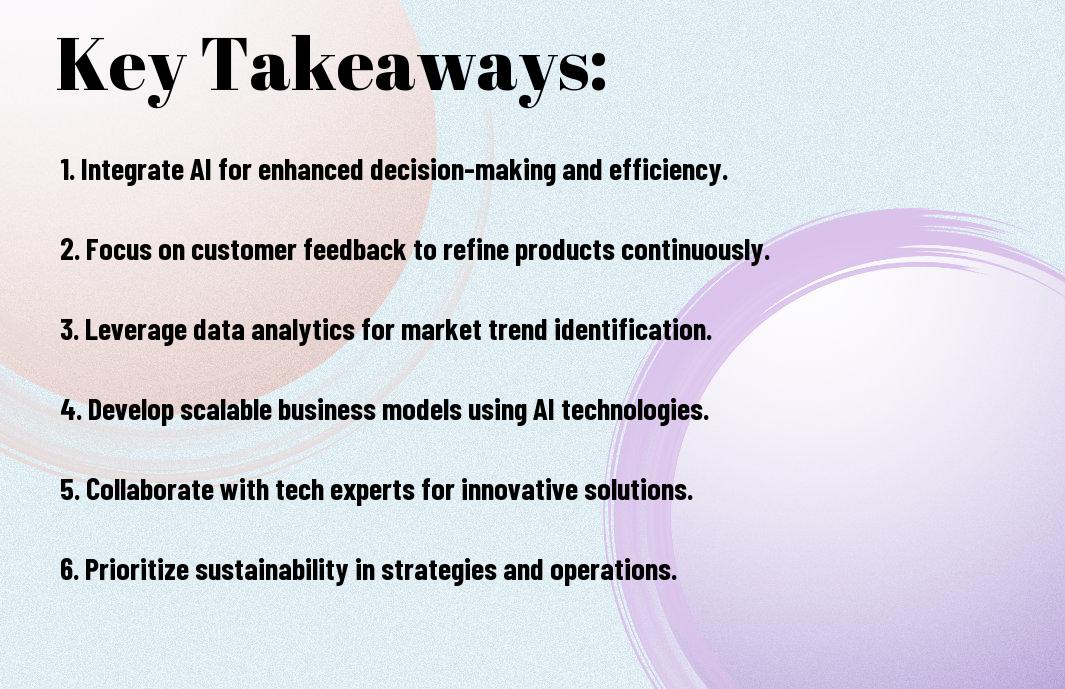
Key Takeaways:
- Developing a solid business strategy that incorporates AI can significantly enhance a company’s ability to innovate and stay competitive in the market, leading to sustainable growth and increased revenue.
- Implementing AI solutions requires a thorough understanding of the technology and its potential applications within the business, as well as a clear plan for integration and deployment.
- A successful AI strategy involves identifying areas where automation and machine learning can improve efficiency, reduce costs, and drive innovation, and prioritizing these areas for development and investment.
- Building a sustainable business with AI also involves considering the ethical implications of AI adoption, including issues related to data privacy, bias, and job displacement, and developing strategies to mitigate these risks.
- Continuous monitoring and evaluation of AI initiatives is vital to ensure they are meeting business objectives and driving long-term value, and to make adjustments as needed to optimize performance and stay ahead of the competition.
The AI Business Landscape
The current state of the AI business landscape is evolving rapidly, and you need to stay informed to make the most of it. You will encounter various trends, technologies, and innovations that can help you build a sustainable business. Your understanding of this landscape will enable you to make informed decisions and create effective AI strategies.
Current Market Opportunities
Options abound in the AI market, and you can capitalize on them to drive your business forward. You can explore various sectors, such as healthcare, finance, and education, where AI is being increasingly adopted. Your ability to identify and leverage these opportunities will help you stay ahead of the competition.
Competitive Analysis
Assessing the competitive landscape is imperative for your business, and you should conduct a thorough analysis to understand your position in the market. You can analyze your competitors’ strengths, weaknesses, and AI strategies to inform your own decisions and create a unique value proposition.
Further examination of your competitors’ AI adoption and strategies will help you identify gaps in the market and potential areas for innovation. You can use this information to develop a tailored approach that sets your business apart and drives long-term success. Your competitive analysis will be an ongoing process, and you should continuously monitor the market to stay informed and adapt to changes.
Identifying Viable AI Concepts
Assuming you have a solid understanding of AI and its applications, the next step is to identify viable concepts that can be developed into a sustainable business. You will need to evaluate various ideas and determine which ones have the potential to generate revenue and drive growth.
Problem-Solution Fit
Any successful AI concept starts with a clear understanding of the problem you are trying to solve. You need to identify a genuine need in the market and develop a solution that addresses it effectively, providing value to your customers and setting your business up for success.
Market Validation Techniques
Above all, you need to validate your concept with potential customers to ensure there is a demand for your solution. You can use various techniques to gather feedback and refine your idea, ultimately increasing your chances of launching a successful product.
Techniques such as surveys, customer interviews, and prototyping can help you validate your concept and make informed decisions about your business. You can use these techniques to test your assumptions, gather feedback, and refine your idea, ensuring that your AI solution meets the needs of your target market and has a strong potential for growth and revenue generation.
Revenue Model Design
Keep your revenue model design aligned with your business goals and target audience. You need to consider various factors, including pricing, packaging, and revenue streams, to create a sustainable business model.
Subscription vs. Transaction Models
Beneath the surface of revenue models, you’ll find two primary options: subscription and transaction models. You can choose one or a combination of both, depending on your product or service and your customers’ preferences.
Value-Based Pricing Strategies
Between the lines of pricing strategies, value-based pricing stands out as an effective approach. You can set prices based on the value your product or service delivers to customers, rather than just costs or competition.
This approach allows you to capture a share of the value you create for your customers, increasing your revenue potential. You can use techniques like tiered pricing, discounts, or premium services to implement value-based pricing, and continually assess and adjust your strategy as your business grows and customer needs evolve, ensuring your pricing remains competitive and aligned with the value you deliver.

Technical Architecture Decisions
Many technical architecture decisions will impact your business’s ability to scale and adapt to changing market conditions, so it’s crucial to consider your options carefully as you build your AI strategy.
Build vs. Buy Considerations
Building your own AI solutions can provide a high degree of customization, but buying existing solutions can save you time and resources, allowing you to focus on your core business.
Scalability Planning
Besides the initial development costs, you should also consider the long-term scalability of your AI systems, ensuring they can handle increased traffic and data volume as your business grows.
Decisions about scalability planning will have a significant impact on your business’s future, and you should consider factors such as cloud infrastructure, data storage, and processing power to ensure your AI systems can handle increased demand, allowing you to focus on expanding your business and increasing revenue.
Go-to-Market Strategy
Unlike traditional approaches, an effective go-to-market strategy leveraging AI involves careful planning and execution to reach your target audience and drive business growth.
Customer Acquisition Channels
One of the key considerations is identifying the most effective customer acquisition channels for your business, and you will need to analyze data to determine which channels will yield the best results for your AI-driven products or services.
Messaging and Positioning
To develop a compelling narrative, you must craft a unique value proposition that resonates with your target market and differentiates your AI-powered offerings from the competition, allowing you to establish a strong market presence.
Even as you refine your messaging and positioning, you will need to continuously test and refine your approach to ensure that it is resonating with your target audience and driving the desired outcomes for your business, and you can use AI tools to analyze customer feedback and make data-driven decisions to optimize your strategy.
Operational Sustainability
For your business to achieve long-term success, you need to focus on operational sustainability, which involves implementing strategies that reduce waste, optimize processes, and improve efficiency. This will help you build a strong foundation for your business and ensure its continued growth.
Cost Management
Above all, you should prioritize cost management to maintain a healthy financial balance, allowing you to allocate resources effectively and make informed decisions about investments and expenses, which will help you navigate your business towards profitability.
Resource Allocation
For your business to thrive, you need to allocate resources wisely, assigning them to areas that drive growth and innovation, and minimizing waste in non-vital areas, enabling you to maximize your return on investment and achieve your business objectives.
Further, as you allocate resources, you should consider your business goals and priorities, ensuring that your resources are aligned with your strategy, and continuously monitor and adjust your allocation to respond to changing market conditions and customer needs, allowing you to stay competitive and achieve sustainable success.
Conclusion
Conclusively, you now have the tools to transform your concept into a thriving business using AI strategies. You can leverage AI to streamline operations, enhance customer experiences, and drive growth. By implementing these strategies, you will be well on your way to building a sustainable business that generates consistent cash flow and stays ahead of the competition, ultimately securing your success in the market and maximizing your returns on investment, allowing you to achieve your business goals.
FAQ
Q: What is the main focus of the “From Concept to Cash” approach in building a sustainable business using AI strategies?
A: The main focus of the “From Concept to Cash” approach is to provide a comprehensive framework for entrepreneurs and business leaders to develop and implement Artificial Intelligence (AI) strategies that drive innovation, efficiency, and profitability. This approach emphasizes the importance of aligning AI initiatives with business goals, identifying opportunities for automation and optimization, and creating a culture of continuous learning and improvement. By following this approach, businesses can unlock the full potential of AI and achieve sustainable growth and success.
Q: How can AI strategies help businesses move from concept to cash, and what are the key benefits of this approach?
A: AI strategies can help businesses move from concept to cash by enabling them to develop and launch new products and services more quickly, improve operational efficiency, and enhance customer experiences. The key benefits of this approach include increased revenue, reduced costs, and improved competitiveness. Additionally, AI-powered analytics and insights can help businesses make data-driven decisions, identify new market opportunities, and stay ahead of the competition. By leveraging AI, businesses can accelerate their journey from concept to cash and achieve sustainable success.
Q: What skills and resources are required to implement AI strategies and achieve success with the “From Concept to Cash” approach?
A: To implement AI strategies and achieve success with the “From Concept to Cash” approach, businesses need to have a combination of technical, business, and leadership skills. This includes expertise in AI and machine learning, data science, and software development, as well as business acumen, market knowledge, and strategic thinking. Additionally, businesses need to have access to relevant data, computing resources, and AI tools and platforms. They also need to foster a culture of innovation, experimentation, and continuous learning, and be willing to invest in employee training and development to build the skills required to succeed with AI. With the right skills, resources, and mindset, businesses can unlock the full potential of AI and achieve sustainable success with the “From Concept to Cash” approach.