Data

Harnessing Data Science for Entrepreneurial Wealth – AI Best Practices

As you navigate the complex landscape of entrepreneurship, you’re likely aware of the vast potential of data science to drive your business forward. You understand that leveraging data can help you make informed decisions, optimize operations, and unlock new opportunities for growth. By applying AI best practices, you can harness the power of data science to propel your entrepreneurial ventures towards unprecedented success, and this blog post will guide you through the process, providing you with actionable insights to enhance your business acumen and drive wealth creation.

Key Takeaways:

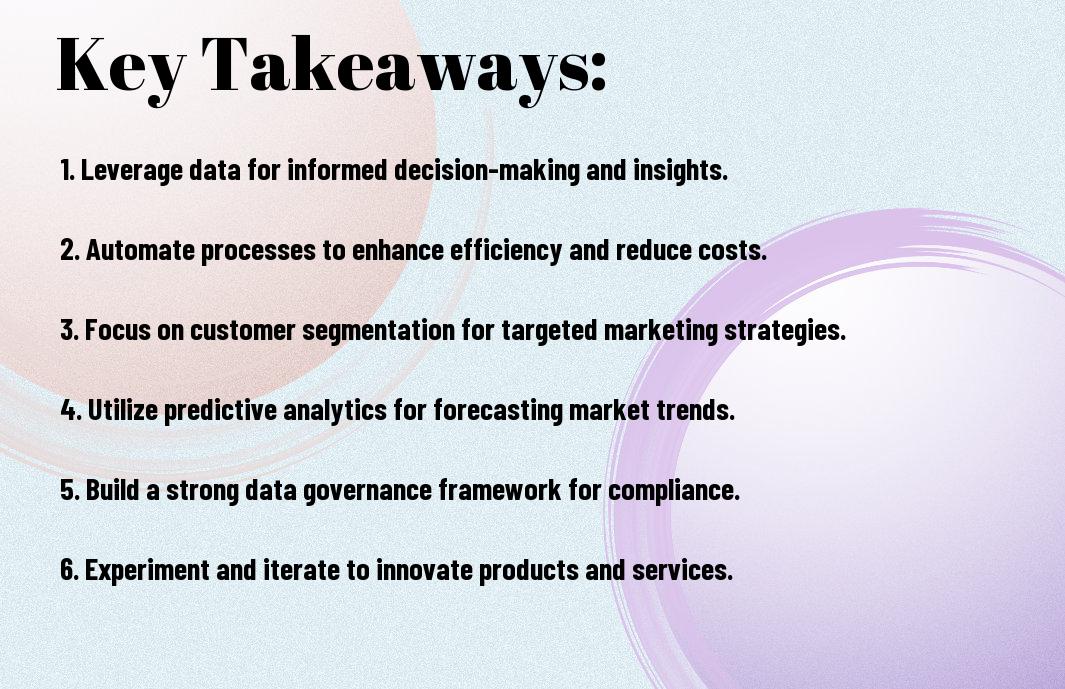
  • Effective use of data science can significantly enhance entrepreneurial ventures by providing valuable insights that inform strategic business decisions, drive innovation, and optimize operations for maximum profitability.
  • Implementing AI best practices, such as leveraging machine learning algorithms and natural language processing, can help entrepreneurs automate tasks, predict market trends, and personalize customer experiences, thereby gaining a competitive edge in the market.
  • Data-driven decision making is crucial for entrepreneurial success, as it enables entrepreneurs to measure the effectiveness of their strategies, identify areas of improvement, and make data-informed decisions that mitigate risks and capitalize on opportunities.
  • Entrepreneurs should prioritize data quality and integrity, ensuring that their data management systems are robust, secure, and compliant with regulatory requirements, to maintain the trust of their customers and stakeholders.
  • Staying up-to-date with the latest advancements in AI and data science is vital for entrepreneurs to remain competitive, as new technologies and techniques can provide innovative solutions to complex business problems and create new opportunities for growth and expansion.
The Entrepreneur’s Data Advantage

To gain a competitive edge, you can leverage data science to inform your business decisions, as discussed in Harnessing AI for Entrepreneurs: Big Data’s Role in Social Innovation. This will enable you to make data-driven decisions and drive your business forward.

Identifying Market Gaps

With access to vast amounts of data, you can identify market gaps and opportunities to innovate and differentiate your business from competitors, ultimately driving your growth and success.

Customer Behavior Analytics

Below the surface of customer interactions, you can uncover valuable insights that inform your marketing strategies and improve customer satisfaction, allowing you to tailor your approach to meet their evolving needs.

A key aspect of customer behavior analytics is understanding the complexities of your customers’ decision-making processes, which enables you to develop targeted marketing campaigns and personalized experiences, increasing the likelihood of conversion and loyalty, and ultimately, driving your business’s revenue and growth, as you continue to refine your strategies based on data-driven insights.

AI Implementation Fundamentals

One of the key aspects of harnessing data science for entrepreneurial wealth is understanding the fundamentals of AI implementation. You will need to consider how AI can be integrated into your business model to drive growth and increase efficiency. By doing so, you can unlock new opportunities and stay ahead of the competition.

Cost-Effective AI Solutions

At this stage, you should be looking for AI solutions that are cost-effective and align with your business goals. You can explore various options, such as cloud-based services or open-source tools, to find the most suitable solution for your needs.

Technical Requirements

Against the backdrop of rapid technological advancements, you must ensure that your technical infrastructure can support AI implementation. You will need to assess your current systems and identify any gaps that need to be addressed to ensure seamless integration.

A thorough evaluation of your technical requirements is imperative to successful AI implementation. As you probe into the specifics, you will need to consider factors such as data storage, processing power, and security protocols to ensure that your systems can handle the demands of AI-driven applications, and that you can effectively leverage your data to drive business growth and inform your decision-making process.

Predictive Models for Business Growth

Keep in mind that predictive models are important for your business growth, as they enable you to make informed decisions and stay ahead of the competition. You can leverage these models to identify opportunities, mitigate risks, and drive your business forward.

Sales Forecasting Systems

Among the various predictive models, sales forecasting systems are particularly useful for your business, as they help you anticipate demand and optimize your resources accordingly. You can use these systems to analyze historical data, identify patterns, and make accurate predictions about future sales.

Trend Analysis Techniques

For your business to stay competitive, you need to stay on top of the latest trends, and trend analysis techniques can help you do just that. You can use these techniques to identify emerging trends, analyze their impact, and adjust your strategy accordingly.

Due to the complexity of trend analysis, you will need to invest time and effort into developing your skills and expertise. You can start by exploring various techniques, such as regression analysis and time series analysis, and then apply them to your business data to gain valuable insights and make informed decisions.

Data-Driven Decision Making

For entrepreneurs, making informed decisions is key to success. You can leverage data science to analyze market trends, customer behavior, and financial performance, enabling you to make strategic decisions that drive your business forward.

Risk Assessment Frameworks

Contrary to intuition, you should consider risk assessment frameworks to identify potential pitfalls and opportunities. You can use data science to develop frameworks that help you evaluate risks and make informed decisions to mitigate them.

Opportunity Scoring Methods

Counterintuitively, you should use opportunity scoring methods to evaluate potential investments and partnerships. You can use data science to develop scoring models that help you assess opportunities and make informed decisions.

At the heart of opportunity scoring methods is the ability to analyze large datasets and identify patterns. You can use techniques such as clustering and decision trees to develop models that score opportunities based on their potential return on investment, market demand, and competitive landscape, allowing you to make informed decisions that drive your business forward.

Competitive Intelligence Through AI

Now, you can leverage AI to gather insights about your competitors, enabling you to make informed decisions and stay ahead in the market. By utilizing AI-powered tools, you can analyze vast amounts of data, identify trends, and gain a deeper understanding of your competitors’ strengths and weaknesses.

Market Positioning Tools

Technologies such as natural language processing and machine learning enable you to analyze your competitors’ market positioning, allowing you to identify gaps in the market and opportunities to differentiate your business. You can use these tools to analyze your competitors’ marketing strategies and adjust your own approach accordingly.

Competitor Strategy Mapping

Any analysis of your competitors’ strategies can help you anticipate their next moves and adjust your own strategy to stay competitive. You can use AI to map your competitors’ strategies, identifying patterns and trends that can inform your own decision-making.

In fact, by mapping your competitors’ strategies, you can identify potential vulnerabilities and opportunities to gain a competitive edge. You can use this information to adjust your pricing, product development, and marketing strategies, enabling you to stay ahead of the competition and drive business growth.

Scaling With Automated Systems

Many entrepreneurs struggle to scale their businesses efficiently, but with automated systems, you can streamline your operations and increase productivity. By leveraging data science and AI, you can identify areas for improvement and implement solutions that drive growth.

Workflow Optimization

Behind every successful business is a well-optimized workflow, and you can achieve this by analyzing your processes and eliminating bottlenecks. By doing so, you can reduce costs, enhance customer experience, and gain a competitive edge.

Resource Allocation Models

Automatically allocating resources is key to efficient business operations, and you can achieve this by developing models that predict demand and optimize supply. By using data science and AI, you can make informed decisions about resource allocation, reducing waste and improving profitability.

Further, by implementing resource allocation models, you can dynamically adjust to changing market conditions, ensuring that your business remains agile and competitive. You can use machine learning algorithms to analyze historical data, identify patterns, and predict future demand, enabling you to make data-driven decisions about resource allocation and drive business growth.

To wrap up

The application of data science and AI best practices can significantly boost your entrepreneurial endeavors, leading to increased wealth and success. You can leverage data-driven insights to inform your business decisions, optimize operations, and drive innovation. By following AI best practices, you will be able to harness the full potential of data science, ultimately elevating your business to new heights and securing your position in the market, allowing you to achieve your goals and maximize your returns.

FAQ

Q: What are the key benefits of harnessing data science for entrepreneurial wealth, and how can AI best practices be applied to achieve success?

A: Harnessing data science for entrepreneurial wealth offers numerous benefits, including enhanced decision-making, improved operational efficiency, and increased revenue growth. By leveraging AI best practices such as machine learning, natural language processing, and predictive analytics, entrepreneurs can gain valuable insights into customer behavior, market trends, and business operations. This enables them to make data-driven decisions, optimize resources, and stay ahead of the competition. Additionally, AI-powered tools can automate routine tasks, freeing up time for strategic planning and innovation, ultimately leading to increased profitability and entrepreneurial wealth.

Q: How can entrepreneurs effectively integrate data science and AI into their business strategy, and what skills or expertise are required to implement these technologies?

A: To effectively integrate data science and AI into their business strategy, entrepreneurs should start by identifying areas where data-driven insights can have the most impact, such as customer segmentation, marketing, or supply chain management. They should then invest in building a skilled team with expertise in data analysis, machine learning, and programming languages like Python or R. It’s also important to develop a data-driven culture within the organization, where data is used to inform decision-making at all levels. Furthermore, entrepreneurs should stay up-to-date with the latest AI trends and best practices, and consider partnering with data science consultants or AI vendors to accelerate implementation and minimize costs.

Q: What are some common challenges that entrepreneurs may face when implementing data science and AI in their business, and how can these challenges be overcome with AI best practices?

A: Common challenges that entrepreneurs may face when implementing data science and AI include data quality issues, lack of skilled talent, and integration with existing systems. To overcome these challenges, entrepreneurs can adopt AI best practices such as data preprocessing and validation, investing in employee training and development, and using cloud-based AI platforms that offer seamless integration with existing infrastructure. Additionally, entrepreneurs should prioritize transparency and explainability in AI decision-making, ensure compliance with data privacy regulations, and continuously monitor and evaluate the performance of AI systems to prevent bias and errors. By addressing these challenges proactively, entrepreneurs can unlock the full potential of data science and AI to drive business growth and entrepreneurial wealth.

Data-Driven Growth – AI Fueling Entrepreneurial Success Stories

As you navigate the ever-evolving landscape of entrepreneurship, you’re likely aware of the significant impact data-driven decision making can have on your business. Your ability to leverage artificial intelligence (AI) can be a key differentiator, driving growth and setting you apart from competitors. By harnessing the power of AI, you can unlock new insights, optimize operations, and propel your venture forward, ultimately achieving unparalleled success in your industry.

Key Takeaways:

  • Data-driven growth is a key factor in entrepreneurial success, with AI playing a significant role in informing business decisions and driving innovation, leading to increased efficiency and competitiveness.
  • AI-powered analytics enable entrepreneurs to gain valuable insights from large datasets, identifying trends and patterns that can inform product development, marketing strategies, and customer engagement initiatives.
  • By leveraging AI and machine learning, entrepreneurs can automate routine tasks, streamline operations, and free up resources to focus on high-value activities such as strategy, innovation, and customer relationships.
  • AI-driven personalization is a key driver of customer engagement and loyalty, allowing entrepreneurs to tailor their offerings and experiences to individual preferences and behaviors, resulting in increased satisfaction and retention.
  • Entrepreneurs who effectively harness the power of AI and data analytics can create significant competitive advantages, driving business growth, and achieving long-term success in an increasingly data-driven marketplace.

The AI Revolution in Business

While the concept of artificial intelligence (AI) has been around for decades, its application in business has only recently started to gain traction. You are now seeing AI being used to drive growth, improve efficiency, and inform decision-making in various industries.

From Big Data to Smart Data

Revolutionizing the way you approach data, the shift from big data to smart data is enabling businesses to make more informed decisions. You can now leverage AI to analyze vast amounts of data and extract valuable insights that drive your business forward.

Democratization of Advanced Analytics

With the advancement of AI, you have access to a wide range of tools and technologies that make advanced analytics more accessible. Consider the following benefits:

  1. Automated data processing
  2. Predictive modeling

Key Features of Advanced Analytics

Feature Description
Machine Learning Enables systems to learn from data
Natural Language Processing Allows for human-computer interaction

You can now use these features to drive your business forward and make data-driven decisions.

Also, as you probe deeper into the world of advanced analytics, you will discover more ways to leverage AI for your business. Consider the following advantages:

  1. Improved accuracy
  2. Enhanced customer experience

Benefits of Advanced Analytics

Benefit Description
Competitive Advantage Stays ahead of the competition
Increased Efficiency Streamlines business processes

You can now use these benefits to drive your business forward and achieve your goals.

Entrepreneurial Decision-Making Transformed

Some of the most successful entrepreneurs are leveraging AI to inform their decision-making processes. You can see the impact for yourself by checking out the findings from 86% of founders report positive impact, HubSpot finds, which highlights the significant role AI plays in driving growth.

Intuition Meets Algorithm

Around the idea that AI enhances your decision-making, you’ll find that your intuition is supported by data-driven insights, allowing you to make more informed choices.

Predictive Power in Market Positioning

With the ability to analyze vast amounts of data, you can better understand your target market and position your business for success, using AI to guide your strategic decisions.

For instance, you can use predictive analytics to forecast market trends, identify new opportunities, and optimize your marketing efforts, giving you a competitive edge in the market and enabling you to make data-driven decisions that drive your business forward.

Customer Acquisition in the AI Era

Despite the rise of digital marketing, acquiring new customers remains a challenge for many entrepreneurs. You can leverage AI to analyze vast amounts of data, identifying patterns and trends that inform your marketing strategies, helping you reach your target audience more effectively.

Behavioral Pattern Recognition

The key to successful customer acquisition lies in understanding your target audience’s behavior. You can use AI-powered tools to recognize patterns in customer interactions, preferences, and purchasing decisions, enabling you to tailor your marketing efforts to their needs.

Personalization at Scale

Behind every successful customer acquisition strategy is a deep understanding of personalization. You can use AI to analyze customer data, creating personalized experiences that resonate with your target audience, driving engagement and conversion.

Behavioral data plays a significant role in personalization at scale, allowing you to create targeted marketing campaigns that speak directly to your customers’ interests and needs. You can use AI to analyze this data, identifying opportunities to upsell, cross-sell, and enhance customer loyalty, ultimately driving your business growth and revenue.

Operational Efficiency Breakthroughs

After implementing AI in your business, you can expect significant improvements in operational efficiency, leading to increased productivity and reduced costs. This is achieved through various means, including automation and optimization of resources.

Automation of Routine Tasks

On the path to operational efficiency, you’ll find that automating routine tasks is a key step, allowing you to focus on more strategic and creative endeavors, and enabling your business to run more smoothly and consistently.

Resource Optimization Systems

An crucial aspect of operational efficiency is the implementation of resource optimization systems, which enable you to allocate your resources more effectively, minimizing waste and maximizing output, and ultimately leading to better decision-making and improved overall performance.

Consequently, as you integrate resource optimization systems into your business, you’ll be able to analyze your operations in greater detail, identifying areas where resources can be better allocated, and making adjustments to optimize your workflows, leading to increased efficiency and productivity, and giving you a competitive edge in the market, allowing you to achieve your business goals more effectively.

Product Development Acceleration

Unlike traditional methods, AI-powered tools can significantly speed up your product development process, enabling you to get your product to market faster and stay ahead of the competition.

Feedback Loops and Iteration

The ability to collect and analyze user feedback is imperative for refining your product, and AI can help you streamline this process, allowing you to make data-driven decisions and iterate on your product more efficiently, ultimately leading to a better user experience for your customers.

AI-Assisted Innovation

The integration of AI in your product development process can lead to groundbreaking innovations, enabling you to identify new opportunities and create unique solutions that meet the evolving needs of your target market, giving you a competitive edge in the industry.

Another significant advantage of AI-assisted innovation is that it allows you to explore new product ideas and concepts that you may not have considered before, helping you to diversify your offerings and expand your business into new areas, which can lead to increased revenue and growth for your company, and you can leverage this technology to stay ahead of the curve and drive your business forward.

Scaling Strategies with Algorithmic Precision

Once again, you find yourself at the forefront of innovation, leveraging AI to drive your entrepreneurial success. With algorithmic precision, you can scale your business efficiently, making data-driven decisions that propel your growth.

Growth Modeling and Forecasting

Above all, you need to understand your business’s growth trajectory, and AI-powered forecasting tools help you do just that. You can analyze your data to identify trends, patterns, and areas of improvement, enabling you to make informed decisions about your business’s future.

Risk Assessment and Mitigation

Any potential risks to your business can be identified and mitigated with the help of AI-driven risk assessment tools. You can analyze your data to identify potential pitfalls and take proactive measures to avoid them, ensuring your business’s stability and success.

Modeling your business’s risk landscape allows you to simulate different scenarios, anticipating potential outcomes and developing strategies to address them. You can use machine learning algorithms to analyze your data, identifying correlations and patterns that may indicate potential risks, and develop targeted mitigation strategies to minimize their impact on your business, ultimately protecting your investments and ensuring your continued growth and success.

Final Words

So, as you initiate on your entrepreneurial journey, you will find that data-driven growth is the key to unlocking your success. With AI by your side, you can make informed decisions, drive innovation, and stay ahead of the competition. By leveraging AI, you can turn your business into a thriving venture, and your success story will be an inspiration to others, as you achieve your goals and take your business to new heights, with data-driven insights guiding your every move.

FAQ

Q: What is Data-Driven Growth and how does it contribute to entrepreneurial success?

A: Data-Driven Growth refers to the process of using data analysis and insights to inform business decisions, drive innovation, and optimize operations. By leveraging data, entrepreneurs can identify new opportunities, mitigate risks, and create personalized experiences for their customers. AI plays a significant role in Data-Driven Growth by providing advanced analytics, predictive modeling, and automation capabilities, enabling entrepreneurs to make informed decisions and stay ahead of the competition. This approach has been instrumental in the success of many entrepreneurial ventures, allowing them to scale efficiently and achieve sustainable growth.

Q: How can AI fuel entrepreneurial success stories, and what are some examples of AI-powered growth strategies?

A: AI can fuel entrepreneurial success stories by providing actionable insights, automating routine tasks, and enhancing customer engagement. For instance, AI-powered chatbots can help entrepreneurs provide 24/7 customer support, while machine learning algorithms can analyze customer behavior and preferences to inform personalized marketing campaigns. Additionally, AI-driven predictive analytics can help entrepreneurs identify new market trends and opportunities, enabling them to make data-driven decisions and stay ahead of the curve. Examples of AI-powered growth strategies include using natural language processing to analyze customer feedback, leveraging computer vision to optimize supply chain operations, and utilizing recommendation engines to drive sales and revenue growth.

Q: What skills and resources do entrepreneurs need to leverage AI for Data-Driven Growth, and how can they get started with implementing AI-powered solutions?

A: To leverage AI for Data-Driven Growth, entrepreneurs need to have a basic understanding of data analysis, machine learning, and AI technologies. They should also have access to relevant data sources, computational resources, and AI-powered tools and platforms. Additionally, entrepreneurs should be willing to experiment, learn from failures, and continuously adapt to changing market conditions. To get started, entrepreneurs can explore cloud-based AI services, such as Google Cloud AI Platform or Microsoft Azure Machine Learning, which provide pre-built models, APIs, and development tools. They can also leverage open-source AI frameworks, such as TensorFlow or PyTorch, and collaborate with data scientists, AI researchers, or innovation labs to develop custom AI-powered solutions tailored to their specific business needs.

The AI Entrepreneur’s Journey – Turning Data into Dollars

As you initiate on your entrepreneurial venture, you’re likely aware of the vast potential of artificial intelligence to transform your business. You’re about to discover how to harness the power of AI to drive growth and profitability. Your ability to turn data into dollars will be the key to unlocking success, and this journey will guide you through the process of leveraging AI to make informed decisions, optimize operations, and ultimately, boost your bottom line.

Key Takeaways:

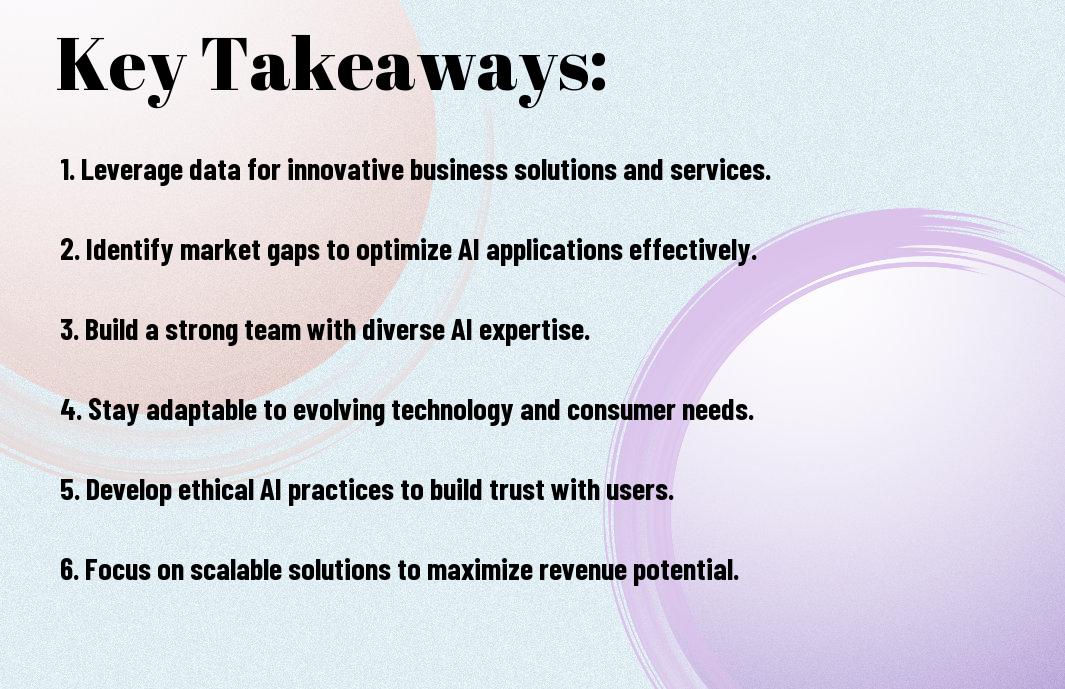
  • Identifying the right business problem to solve is crucial for AI entrepreneurs, as it determines the direction of their project and potential for success.
  • Developing a deep understanding of the data available and its potential applications is vital for creating effective AI solutions that can be monetized.
  • Building a strong team with diverse skill sets, including data scientists, engineers, and business experts, is necessary for navigating the complexities of AI development and commercialization.
  • AI entrepreneurs must be adaptable and willing to iterate on their products and services based on feedback from users and the market to ensure they meet real needs and generate revenue.
  • Establishing a clear go-to-market strategy and revenue model is necessary for turning AI solutions into profitable businesses, and this often involves identifying and partnering with key stakeholders and customers.

    The Data Goldmine

    A vast amount of data is available to you, and it’s up to you to tap into it. Your ability to collect and analyze data will be the key to unlocking new business opportunities and turning them into dollars.

    Identifying Valuable Data Sources

    With the right tools and mindset, you can uncover hidden gems in your data. You will need to explore various sources, such as social media, customer feedback, and market trends, to find the data that will drive your business forward.

    Extracting Meaningful Patterns

    Above all, your goal is to extract insights that will inform your business decisions. You will need to apply advanced analytics and machine learning techniques to identify patterns and relationships in your data.

    Understanding the intricacies of data analysis, you will be able to extract meaningful patterns and turn them into actionable insights. You will need to consider factors such as data quality, sampling bias, and correlation versus causation to ensure that your insights are accurate and reliable. By doing so, you will be able to make informed decisions that drive your business forward and increase your revenue.

    AI Technology Landscape

    One of the key aspects of your AI journey is understanding the technology landscape, which is constantly evolving with new innovations and advancements. You need to stay updated on the latest trends and developments to make informed decisions about your business.

    Tools for the Modern Entrepreneur

    Above all, you’ll need to familiarize yourself with the various tools available to you, such as machine learning frameworks, data analytics platforms, and cloud computing services, to name a few. You’ll need to assess which tools best fit your business needs and goals.

    Selecting the Right Algorithms

    Along with choosing the right tools, you’ll also need to select the most suitable algorithms for your specific use case, considering factors such as data quality, complexity, and performance requirements. You’ll need to evaluate different algorithms and their trade-offs to make an informed decision.

    Right from the outset, you should consider the characteristics of your data and the problem you’re trying to solve, as this will help you narrow down the options and choose the most effective algorithm for your needs. You’ll need to consider factors such as accuracy, interpretability, and scalability, and balance these with business considerations like cost, risk, and potential return on investment.

    Market Opportunity Analysis

    After identifying your AI solution, you’ll need to analyze the market to determine its potential. You can learn from success stories like From Zero to $1M: How AI Is Creating First-Time Entrepreneurs, which highlight the possibilities of AI-driven entrepreneurship.

    Finding Gaps in the AI Ecosystem

    Assessing the current AI landscape helps you find gaps in the market that your solution can fill, allowing you to differentiate your product and attract potential customers.

    Validating Your Value Proposition

    Marking the uniqueness of your AI solution is key to standing out in a crowded market, and you must test your value proposition with potential customers to refine your offering.

    Considering the competitive landscape and your target audience’s needs, you’ll need to validate your value proposition by gathering feedback and iterating on your solution to ensure it meets the market’s demands, ultimately increasing your chances of success as an AI entrepreneur.

    Building Your AI Product

    Once again, you’ll need to focus on developing a product that meets your customers’ needs, and this time, it’s about creating an AI-powered solution that drives business value, as you turn data into dollars.

    From Prototype to Scalable Solution

    Across various industries, you’ll find that building a scalable AI solution requires careful planning, and as you progress from prototype to full-scale deployment, you’ll need to ensure your product is robust and efficient.

    Technical Architecture Considerations

    Between the lines of code and infrastructure, you’ll need to consider several technical aspects, such as data storage, processing power, and security, to ensure your AI product functions seamlessly and securely.

    Indeed, as you probe deeper into technical architecture considerations, you’ll need to think about how your AI system will handle large volumes of data, and how you’ll integrate it with existing systems, while also ensuring scalability, reliability, and maintainability, to ultimately drive business success and turn data into dollars.

    Monetization Strategies

    Unlike traditional businesses, AI-driven ventures offer unique opportunities for generating revenue. You can leverage your data and AI capabilities to create innovative products and services, attracting a wide range of customers and driving your business forward.

    Pricing Models for AI Solutions

    Solutions to your monetization strategy involve developing pricing models that align with your AI offerings. You can explore various models, such as subscription-based, pay-per-use, or tiered pricing, to maximize your revenue and stay competitive in the market.

    Recurring Revenue Approaches

    One key aspect of a successful monetization strategy is implementing recurring revenue approaches. You can achieve this by offering ongoing services, such as data analytics or AI-powered consulting, that provide continuous value to your customers and generate steady income for your business.

    Revenue streams from recurring revenue approaches can help you stabilize your financials and invest in further development of your AI capabilities. You can focus on delivering high-quality services, building strong relationships with your customers, and expanding your offerings to increase your revenue and stay ahead in the market.

    Scaling Your AI Business

    Now that you have established your AI business, it’s time to focus on growth and expansion. You will need to develop strategies to increase your revenue and customer base, while also improving your products and services.

    Attracting Investment

    Besides having a solid business plan, you need to showcase your potential for growth and returns to attract investors. You should prepare a persuasive pitch and financial projections to secure funding for your AI business.

    Operational Expansion Tactics

    Before you can expand your operations, you need to assess your current infrastructure and identify areas for improvement. You should evaluate your technology, talent, and processes to ensure they can support your growth plans.

    And as you implement your operational expansion tactics, you will need to monitor your progress and make adjustments as needed. You should focus on streamlining your operations, improving efficiency, and reducing costs to maximize your profits and stay competitive in the market.

    To wrap up

    So, as you conclude your journey through the world of AI entrepreneurship, you now have the tools to turn data into dollars. You have learned how to harness the power of AI to drive your business forward, and you are equipped to make informed decisions about your investments. With your newfound knowledge, you can unlock the full potential of your data and take your business to the next level, achieving success and driving growth in the process, and maximizing your returns on investment.

    FAQ

    Q: What is the main focus of “The AI Entrepreneur’s Journey – Turning Data into Dollars”?

    A: The main focus of “The AI Entrepreneur’s Journey – Turning Data into Dollars” is to guide entrepreneurs in leveraging artificial intelligence (AI) and data analytics to create successful and profitable businesses. This journey encompasses understanding the potential of AI, identifying opportunities, developing strategies, and implementing AI solutions to drive business growth and generate revenue.

    Q: How does “The AI Entrepreneur’s Journey” help entrepreneurs in turning data into dollars?

    A: “The AI Entrepreneur’s Journey” provides entrepreneurs with a structured approach to harness the power of data and AI. It starts with understanding the types of data available, collecting and analyzing this data, and then using insights gained to develop innovative products or services. The journey also covers how to navigate the ethical and legal considerations of data usage, build a team with the right skill set, and create a business model that effectively monetizes data-driven solutions.

    Q: What skills or knowledge do entrepreneurs need to initiate on “The AI Entrepreneur’s Journey” and successfully turn data into dollars?

    A: To initiate on “The AI Entrepreneur’s Journey” and successfully turn data into dollars, entrepreneurs need a combination of technical, business, and soft skills. Technically, they should have a basic understanding of AI concepts, data analysis, and programming. From a business perspective, they need to understand market trends, consumer behavior, and how to develop a viable business model. Additionally, skills like leadership, innovation, and the ability to adapt to changing technologies and market conditions are necessary for navigating the challenges and opportunities of the AI entrepreneurship landscape.

Turning Data into Riches – The Entrepreneur's Guide to AI Analytics

As you navigate the complex world of entrepreneurship, you’re constantly looking for ways to gain a competitive edge. Your business generates vast amounts of data, and harnessing its power can be a game-changer. You can unlock new insights, optimize operations, and drive growth by leveraging AI analytics. This guide will show you how to turn your data into riches, helping you make informed decisions and stay ahead of the curve in today’s fast-paced business landscape.

Key Takeaways:

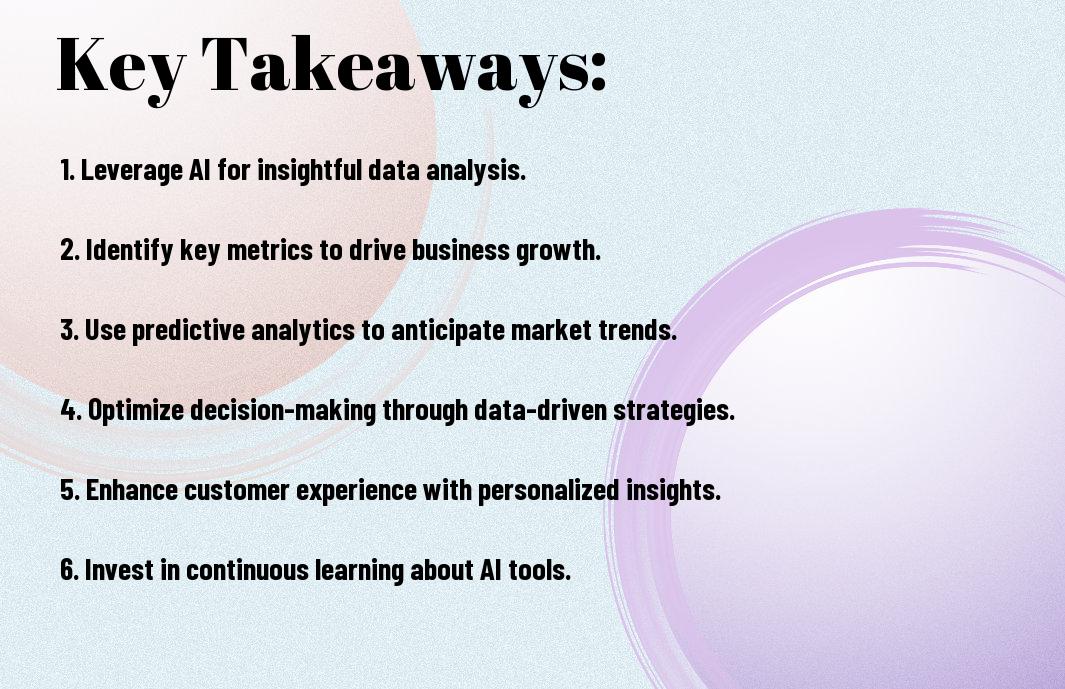
  • Businesses can leverage AI analytics to turn data into actionable insights, driving informed decision-making and ultimately, revenue growth.
  • Implementing AI-powered analytics tools enables entrepreneurs to automate data processing, identify patterns, and uncover hidden trends that may not be apparent through traditional analysis methods.
  • AI-driven analytics can help entrepreneurs optimize their operations, improve customer experiences, and develop targeted marketing strategies, leading to increased competitiveness in the market.
  • Effective use of AI analytics requires a combination of technical expertise, business acumen, and strategic thinking, making it vital for entrepreneurs to invest in talent and resources that can support their analytics initiatives.
  • By embracing AI analytics, entrepreneurs can gain a significant edge over their competitors, drive innovation, and create new business opportunities, ultimately turning data into a valuable asset that drives long-term success.

The Hidden Patterns in Your Business Data

To unlock the full potential of your business, you need to understand the hidden patterns in your data, and How AI is Transforming Data Analytics: A Guide for Tech Professionals can provide valuable insights. This will help you make informed decisions and drive growth.

The Tipping Point of Data Collection

Toward the point where your data collection reaches its peak, you will start to notice patterns emerging, giving you a competitive edge in the market. Your ability to analyze and interpret this data will be key to your success.

Separating Signals from Noise

Between the vast amounts of data you collect, you need to identify what is relevant and what is not, to make accurate predictions and informed decisions about your business. This is where AI analytics comes in, helping you to separate the signals from the noise.

Business owners like you face the challenge of extracting meaningful insights from their data, and this is where the process of separating signals from noise becomes vital. By using AI-powered analytics tools, you can filter out irrelevant data and focus on the patterns and trends that will drive your business forward, giving you a deeper understanding of your customers, market, and operations, and enabling you to make data-driven decisions that will propel your business towards success.

AI Tools That Transform Raw Numbers into Strategy

Some of the most powerful AI tools available to you as an entrepreneur are those that can take raw data and turn it into actionable strategy. You can use these tools to gain insights into your business and make informed decisions to drive growth and increase revenue.

Predictive Analytics for the Non-Technical Founder

About leveraging predictive analytics, you don’t need to be a technical expert to benefit from its power. You can use user-friendly platforms to forecast sales, predict customer behavior, and identify trends in your industry.

Automation Systems That Pay for Themselves

To maximize your ROI, you should consider implementing automation systems that can streamline your operations and reduce costs. You can use automation to optimize your marketing campaigns, manage your supply chain, and improve customer service.

Numbers don’t lie, and when you invest in automation systems, you can expect to see a significant return on your investment. You will be able to reduce manual errors, increase efficiency, and free up resources to focus on high-level strategy and growth. By automating routine tasks, you can also improve your customer experience and build a competitive advantage in your market, allowing you to make data-driven decisions and drive your business forward.

The Psychology of Data-Driven Decisions

Many entrepreneurs struggle to make data-driven decisions, often relying on instinct instead of insights. You need to understand the psychology behind your decision-making process to effectively leverage AI analytics.

Overcoming Intuition Bias

Instinctively, you may trust your gut feelings over data, but this can lead to poor decisions. You must be aware of your biases and take steps to overcome them, ensuring your decisions are based on facts, not feelings.

When to Trust the Algorithm (And When Not To)

Any algorithm is only as good as the data it’s trained on, so you need to carefully evaluate its limitations. You should consider the quality of the data, the complexity of the problem, and the potential risks involved before trusting the algorithm’s output.

Consequently, as you become more comfortable with AI analytics, you will develop a sense of when to trust the algorithm and when to exercise caution. You will learn to identify situations where the algorithm is likely to provide accurate insights and situations where human judgment is necessary, allowing you to make more informed decisions and drive your business forward.

Small Data Moves with Outsized Returns

All entrepreneurs know that making data-driven decisions is key to success. You can leverage small data to drive significant returns by focusing on high-impact areas of your business.

Customer Journey Insights Worth Their Weight in Gold

Valuable as gold, your customer data holds the key to unlocking new revenue streams. You can use it to identify pain points and optimize your customer journey for maximum conversion.

Pricing Optimization Through Machine Learning

Besides driving revenue, machine learning can help you optimize your pricing strategy. You can use algorithms to analyze market trends and adjust your prices for maximum profit.

This pricing optimization technique allows you to stay competitive in the market while maximizing your revenue. You can use machine learning models to analyze historical data, seasonality, and customer behavior to determine the optimal price for your products or services. By doing so, you can increase your profit margins and stay ahead of the competition.

Building Your Data Analytics Team

Not every entrepreneur has the luxury of hiring a full-fledged data analytics team, but you can start by identifying the key roles you need to fill to get started with AI analytics.

In-House vs. Outsourced Expertise

Between the options of hiring in-house experts or outsourcing to a third-party vendor, you need to weigh the pros and cons of each approach to determine what works best for your business and budget.

The Surprising Skills That Matter Most

For your data analytics team to be effective, you will need individuals with a combination of technical, business, and soft skills, including communication, collaboration, and problem-solving abilities.

Another key aspect to consider when building your data analytics team is the ability of your team members to tell stories with data, as this will enable you to make informed decisions and drive business growth, you will need to look for individuals who can extract insights from data and present them in a clear and actionable way, allowing you to turn data into riches.

Privacy Concerns in the Age of Data Capitalism

For entrepreneurs, navigating the complex landscape of data analytics and privacy is a significant challenge. You must balance the need for data-driven insights with the need to protect your customers’ sensitive information. As you collect and analyze data, you must consider the potential risks and consequences of data breaches and misuse.

Navigating Regulations Without Paralyzing Progress

Proceeding with caution, you can ensure compliance with regulations while still driving innovation. You will need to stay up-to-date on the latest laws and guidelines, such as GDPR and CCPA, to avoid costly fines and reputational damage.

Building Customer Trust Through Transparency

Concerned about the potential backlash from customers, you should prioritize transparency in your data collection and usage practices. You can achieve this by clearly communicating what data you collect, how you use it, and with whom you share it.

Navigating the complexities of customer trust, you will find that transparency is key to building and maintaining strong relationships with your customers. You can establish trust by being open and honest about your data practices, providing customers with control over their data, and ensuring that their information is protected and secure. By doing so, you can create a loyal customer base and drive long-term growth for your business.

Conclusion

Conclusively, you now have the tools to turn data into riches using AI analytics. You can leverage your newfound knowledge to make informed decisions, driving your business forward. Your ability to analyze and interpret data will give you a competitive edge, allowing you to maximize your returns and achieve your goals. You are equipped to unlock the full potential of your data, transforming it into a valuable asset that fuels your success.

FAQ

Q: What is the main focus of the book “Turning Data into Riches – The Entrepreneur’s Guide to AI Analytics”?

A: The book “Turning Data into Riches – The Entrepreneur’s Guide to AI Analytics” primarily focuses on empowering entrepreneurs with the knowledge and skills to leverage Artificial Intelligence (AI) and analytics to turn their data into actionable insights and wealth. It provides a comprehensive guide on how to harness the power of AI-driven analytics to make informed business decisions, drive innovation, and stay ahead in the competitive market.

Q: How can entrepreneurs benefit from using AI analytics in their businesses as outlined in the book?

A: Entrepreneurs can benefit from using AI analytics in several ways. Firstly, AI analytics enables them to process and analyze large volumes of data quickly and efficiently, uncovering patterns and trends that might be missed by human analysis. This leads to better decision-making and strategic planning. Secondly, AI analytics can automate many routine tasks, freeing up resources for more strategic and creative endeavors. Lastly, by leveraging AI analytics, entrepreneurs can gain a deeper understanding of their customers’ needs and preferences, allowing for personalized marketing and improved customer satisfaction.

Q: Does the book “Turning Data into Riches – The Entrepreneur’s Guide to AI Analytics” provide practical advice and examples for implementing AI analytics in real-world business scenarios?

A: Yes, the book “Turning Data into Riches – The Entrepreneur’s Guide to AI Analytics” is designed to be a practical guide for entrepreneurs. It includes numerous case studies, real-world examples, and step-by-step instructions on how to implement AI analytics in various business contexts. From setting up an AI analytics system to interpreting results and making data-driven decisions, the book covers the entire spectrum of AI analytics implementation. It also discusses common challenges and pitfalls, offering advice on how to overcome them, making it a valuable resource for entrepreneurs looking to integrate AI analytics into their business operations.

Navigating the Data Deluge – AI Solutions for Entrepreneurial Decision-Making

As you navigate the complex landscape of modern entrepreneurship, you’re constantly faced with an overwhelming amount of data. Your ability to make informed decisions hinges on your capacity to sift through this information and extract actionable insights. You need effective tools to help you make sense of the data deluge, and artificial intelligence (AI) solutions are poised to revolutionize your decision-making process, enabling you to drive your business forward with confidence and precision.

Key Takeaways:

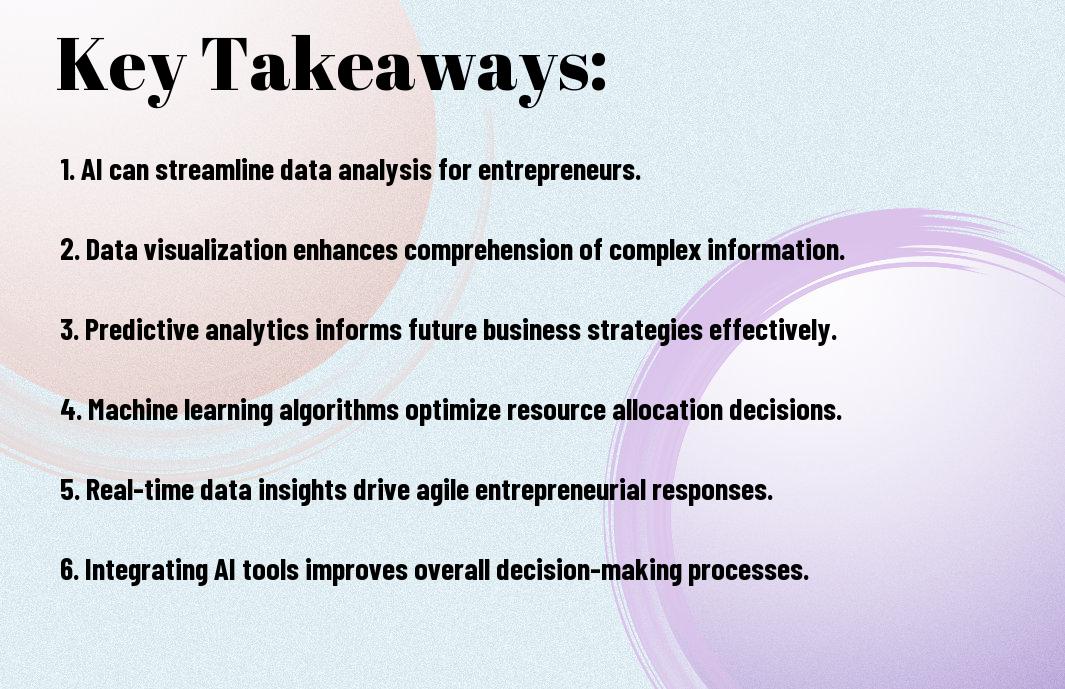
  • Effective data management is crucial for entrepreneurs to make informed decisions, and AI solutions can help navigate the vast amounts of data available, providing valuable insights to drive business growth.
  • AI-powered tools can automate data analysis, freeing up time for entrepreneurs to focus on strategic decision-making and high-level thinking, rather than getting bogged down in data processing.
  • By leveraging AI solutions, entrepreneurs can identify patterns and trends in their data that may not be immediately apparent, enabling them to respond quickly to changes in the market and stay ahead of the competition.
  • AI-driven decision-making can also help entrepreneurs mitigate risk by identifying potential pitfalls and opportunities, allowing them to make more informed decisions and avoid costly mistakes.
  • Ultimately, the successful integration of AI solutions into an entrepreneur’s decision-making process can lead to increased efficiency, improved accuracy, and enhanced business outcomes, giving them a competitive edge in their industry.

    The Raw Data Landscape

    The sheer amount of data available to you as an entrepreneur can be overwhelming, making it difficult to discern valuable insights from irrelevant information. You need to navigate this complex landscape to make informed decisions for your business.

    Volume Challenges

    Between the various sources of data, including social media, customer feedback, and sales reports, you are faced with a vast amount of information to sift through, making it hard to determine what is relevant to your business goals.

    Velocity Concerns

    Challenges arise when trying to process and analyze data in real-time, as the speed at which it is generated can be staggering, leaving you struggling to keep up with the latest trends and patterns.

    In fact, as you research deeper into the velocity concerns, you will find that the rapid pace of data generation requires you to have a system in place that can handle the influx of information, allowing you to respond quickly to changes in the market and make timely decisions that drive your business forward.

    AI Tools for Data Processing

    Some of the most effective AI tools for data processing are designed to help you streamline your workflow and make more informed decisions. You can leverage these tools to analyze large datasets, identify patterns, and gain valuable insights that inform your entrepreneurial endeavors.

    Machine Learning Solutions

    Following the initial data processing stage, you can utilize machine learning solutions to further refine your analysis. You will be able to develop predictive models that help you forecast trends and make data-driven decisions that drive your business forward.

    Natural Language Processing Applications

    Across various industries, natural language processing applications are being used to analyze and interpret large amounts of text-based data. You can use these applications to extract insights from customer feedback, social media posts, and other sources of unstructured data.

    But as you probe deeper into natural language processing applications, you will discover that they offer more than just text analysis. You can use them to automate tasks such as sentiment analysis, entity recognition, and language translation, freeing up more time for you to focus on high-level decision-making and strategy development.

    Decision Frameworks

    Many entrepreneurs struggle to make informed decisions due to the overwhelming amount of data available. You need a structured approach to filter and analyze this data, and that’s where decision frameworks come in. By implementing a decision framework, you can streamline your decision-making process and make more accurate predictions about your business’s future.

    Algorithmic Approaches

    Against the backdrop of increasing data complexity, algorithmic approaches can help you identify patterns and trends that inform your decision-making. You can leverage machine learning algorithms to analyze large datasets and uncover insights that might elude human analysts, enabling you to make more informed decisions about your business.

    Human-AI Collaboration

    Following the integration of AI into your decision-making process, you’ll need to consider how humans and AI systems can work together effectively. You should design a collaboration framework that plays to the strengths of both humans and AI, allowing you to augment your decision-making capabilities and drive business success.

    Consequently, as you develop your human-AI collaboration framework, you’ll need to focus on creating an environment where humans and AI systems can interact seamlessly. You can achieve this by implementing transparent AI systems that provide explanations for their decisions, and by training your team to work effectively with AI tools, ultimately enhancing your decision-making capabilities and driving business growth.

    Implementation Strategies

    Despite the complexity of AI solutions, you can effectively integrate them into your decision-making process by starting small and scaling up, allowing you to navigate the data deluge with ease and make informed decisions.

    Resource Allocation

    Beneath the surface of successful AI implementation lies a thoughtful allocation of your resources, ensuring that you dedicate sufficient budget and personnel to support your AI initiatives, enabling you to maximize their potential and drive business growth.

    Team Structure

    Across your organization, you will need to establish a team with a mix of technical and business expertise to effectively implement and manage AI solutions, allowing you to leverage their capabilities and drive business success.

    And as you build your team, you will need to consider the skills and expertise required to support your AI initiatives, including data scientists, engineers, and business analysts, ensuring that you have the right talent in place to drive your AI strategy forward and help you make informed, data-driven decisions that propel your business forward.

    Risk Assessment

    Unlike traditional methods, AI solutions offer a more comprehensive approach to risk assessment, enabling you to identify potential pitfalls and opportunities in your entrepreneurial endeavors. By leveraging machine learning algorithms and data analytics, you can make informed decisions that mitigate risks and maximize returns on your investments.

    Data Security

    Securing your data is vital to preventing unauthorized access and protecting your business from potential threats. You need to ensure that your AI systems are designed with robust security measures to safeguard your sensitive information and maintain the integrity of your decision-making processes.

    Algorithmic Bias

    With the increasing reliance on AI-driven decision-making, you must be aware of the potential for algorithmic bias in your systems. You can avoid this by regularly auditing your algorithms and training data to ensure that they are fair, transparent, and unbiased.

    The issue of algorithmic bias is particularly significant, as it can have far-reaching consequences for your business, including perpetuating existing social inequalities and leading to poor decision-making. You should take steps to address this issue by implementing diverse and representative training data, as well as ongoing monitoring and evaluation of your AI systems to detect and correct any biases that may arise, ensuring that your decision-making processes are fair and reliable.

    Measuring Success

    Not every entrepreneurial venture succeeds, but with the right tools, you can increase your chances of making informed decisions. You will be able to track your progress and adjust your strategy accordingly, which is imperative for achieving your goals.

    Key Performance Indicators

    Against the backdrop of your business objectives, you will need to establish relevant metrics to evaluate your performance. You should identify the indicators that best reflect your company’s success and use them to guide your decision-making process, allowing you to stay focused on what matters most.

    Adaptation Protocols

    Among the various strategies you can employ to navigate the data deluge, adaptation protocols are imperative for responding to changes in your industry. You will be able to adjust your approach as needed, ensuring that your business remains competitive and agile in a rapidly evolving market.

    Protocols for adaptation involve continuously monitoring your performance and making adjustments to optimize your outcomes. You will be able to refine your strategy over time, incorporating new insights and data into your decision-making process, and driving your business forward with confidence and precision, allowing you to achieve your goals and stay ahead of the competition.

    Summing up

    Now that you have explored AI solutions for entrepreneurial decision-making, you can harness the power of data to drive your business forward. You will be able to make informed decisions, streamline operations, and stay ahead of the competition. With AI by your side, you can effectively navigate the data deluge and unlock your business’s full potential, enabling you to achieve your goals and succeed in today’s fast-paced market.

    FAQ

    Q: What are the main challenges entrepreneurs face when navigating the data deluge, and how can AI solutions help?

    A: Entrepreneurs often struggle with managing and making sense of the vast amounts of data available to them. This can lead to difficulties in identifying trends, making informed decisions, and staying competitive. AI solutions can help by providing advanced data analytics and machine learning capabilities that enable entrepreneurs to efficiently process large datasets, uncover hidden insights, and make data-driven decisions. By leveraging AI, entrepreneurs can streamline their decision-making processes, reduce the risk of human error, and drive business growth.

    Q: How can AI-powered tools support entrepreneurial decision-making in the context of data analysis and interpretation?

    A: AI-powered tools can support entrepreneurial decision-making by offering automated data analysis, predictive modeling, and visualization capabilities. These tools can help entrepreneurs to quickly identify patterns, trends, and correlations within their data, and provide actionable recommendations based on that analysis. Additionally, AI-driven solutions can facilitate real-time monitoring and alerts, enabling entrepreneurs to respond promptly to changes in their business environment. By harnessing the power of AI, entrepreneurs can make more informed, strategic decisions that drive innovation and success.

    Q: What are some best practices for entrepreneurs to effectively implement AI solutions for navigating the data deluge and enhancing their decision-making capabilities?

    A: To effectively implement AI solutions, entrepreneurs should start by defining clear goals and objectives for their data analysis and decision-making processes. They should also invest in user-friendly, intuitive AI tools that can be easily integrated into their existing workflows. Furthermore, entrepreneurs should prioritize data quality and ensure that their AI systems are trained on accurate, relevant, and up-to-date information. Regularly monitoring and evaluating the performance of AI solutions, as well as staying informed about the latest advancements in AI technology, can also help entrepreneurs maximize the benefits of these tools and drive long-term business success.

Skip to content