
Decision-Making

Driving Profitability – How AI Enhances Entrepreneurial Decision-Making

As you navigate the complexities of entrepreneurship, you’re constantly seeking ways to optimize your business for maximum profitability. Your ability to make informed decisions is key to driving growth and staying ahead of the competition. With the advent of Artificial Intelligence (AI), you now have access to powerful tools that can significantly enhance your decision-making capabilities, providing you with data-driven insights to inform your strategic choices and propel your business forward.

Key Takeaways:

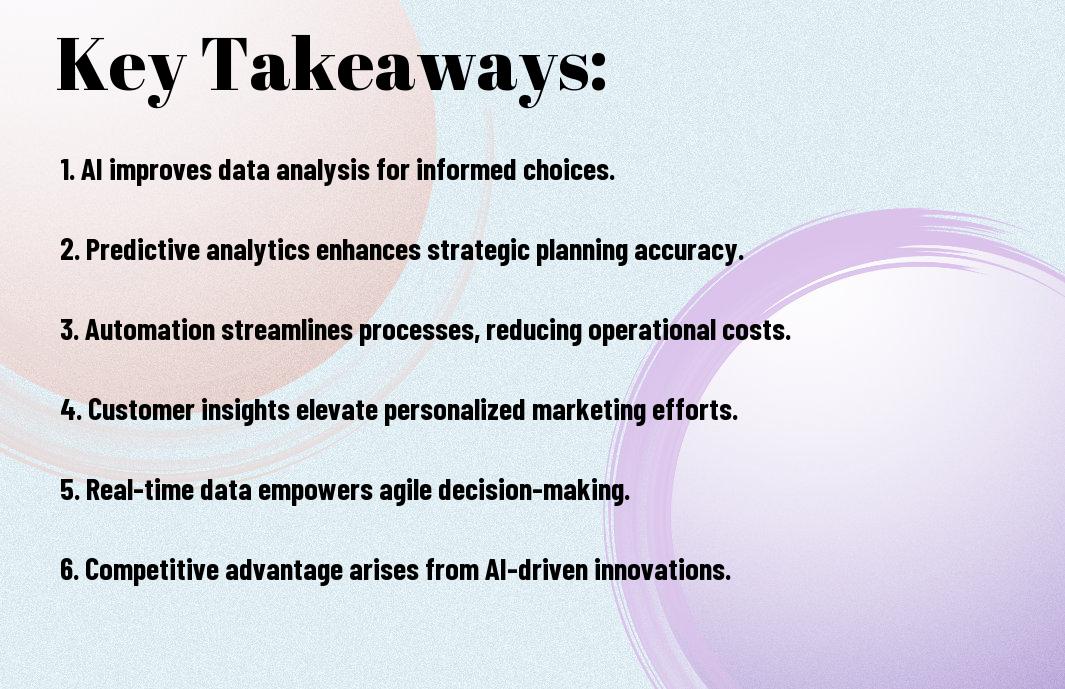
  • AI-driven analytics provide entrepreneurs with actionable insights, enabling them to make informed decisions that drive business growth and increase profitability by identifying areas of inefficiency and optimizing operations.
  • By leveraging machine learning algorithms, entrepreneurs can automate routine tasks, freeing up time to focus on strategic decision-making and exploring new opportunities for innovation and expansion.
  • AI-enhanced decision-making also allows entrepreneurs to mitigate risks and anticipate potential challenges, enabling them to develop proactive strategies and stay ahead of the competition in a rapidly changing business landscape.

    The Economic Value of AI in Business

    For businesses, AI offers significant economic benefits, enabling you to make data-driven decisions and drive profitability. By leveraging AI, you can optimize operations, improve efficiency, and increase competitiveness, ultimately leading to enhanced financial performance and growth.

    Cost Reduction Mechanisms

    Following the implementation of AI, subsequently, you will notice a significant decrease in operational costs, as automated processes and predictive maintenance help minimize waste and reduce expenses, allowing you to allocate your resources more effectively.

    Revenue Enhancement Opportunities

    Reducing costs is just the beginning, as AI also presents you with numerous opportunities to increase revenue, by enabling you to offer personalized customer experiences, develop targeted marketing campaigns, and create innovative products and services that meet the evolving needs of your customers.

    A key aspect of revenue enhancement opportunities is the ability to analyze large amounts of customer data, which allows you to gain valuable insights into their behavior and preferences, enabling you to develop tailored solutions that meet their specific needs, and ultimately drive business growth and increase your revenue streams.
    Data-Driven Decision Frameworks

    Even with the best intentions, your business decisions can fall short without a solid foundation. A data-driven decision framework, enhanced by AI, provides you with actionable insights to inform your choices, driving profitability and growth.

    Predictive Analytics Models

    Around the clock, predictive analytics models process vast amounts of data, enabling you to forecast trends, identify opportunities, and make informed decisions that propel your business forward.

    Risk Assessment Protocols

    By integrating AI-powered risk assessment protocols, you can proactively identify potential threats and develop strategies to mitigate them, safeguarding your business and ensuring long-term success.

    It is imperative to note that effective risk assessment protocols involve continuous monitoring and analysis of your business environment, allowing you to respond quickly to changes and stay ahead of the competition. As you implement these protocols, you will be able to make more informed decisions, minimizing risks and maximizing opportunities for growth and profitability.

    AI Implementation Strategies

    Unlike traditional methods, AI implementation requires a thoughtful approach to maximize its benefits. You need to consider your business goals, existing infrastructure, and potential challenges to ensure a seamless integration.

    Scalable Technology Integration

    Beneath the surface of successful AI adoption lies a robust technology infrastructure. You will need to assess your current systems and identify areas where AI can be integrated to enhance your decision-making processes.

    Resource Allocation Optimization

    Above all, optimizing your resource allocation is key to getting the most out of AI. You should focus on allocating your resources effectively to support AI-driven initiatives and maximize your returns on investment.

    And as you research deeper into resource allocation optimization, you will discover that AI can help you identify areas where resources are being underutilized or misallocated. By leveraging AI-driven insights, you can make data-driven decisions to adjust your resource allocation strategy, ultimately leading to increased efficiency and profitability in your business.

    Competitive Market Positioning

    Now, as you navigate the complex landscape of entrepreneurial decision-making, you can leverage AI to gain a competitive edge. By exploring resources such as How AI Can Help Leaders Make Better Decisions Under Pressure, you can unlock the full potential of AI-driven insights to inform your strategic choices.

    Industry Disruption Patterns

    Meanwhile, market trends and shifts can significantly impact your business. You must stay attuned to these changes to maintain your competitive position and make informed decisions about your company’s direction.

    First-Mover Advantage Metrics

    Besides analyzing industry trends, you should also consider the benefits of being a first-mover in your market, including increased brand recognition and customer loyalty, which can be measured using specific metrics to evaluate your performance.

    Another key aspect of first-mover advantage metrics is the ability to track and analyze the impact of your decisions on your market position. By using AI-driven tools, you can monitor your competitors, identify gaps in the market, and adjust your strategy to stay ahead, ultimately driving profitability and growth for your business as you make data-driven decisions to enhance your entrepreneurial endeavors.

    Financial Performance Indicators

    After establishing your business goals, you need to track your financial performance indicators to make informed decisions. You can use AI to analyze your financial data and identify areas for improvement, enabling you to optimize your business operations and increase profitability.

    ROI Measurement Techniques

    On the path to driving profitability, you will encounter various ROI measurement techniques. You can leverage AI-powered tools to calculate your return on investment and make data-driven decisions to maximize your returns, ensuring your business remains competitive in the market.

    Profitability Trend Analysis

    Along with tracking your financial performance, you should also conduct profitability trend analysis to identify patterns and trends in your business. You can use AI to analyze your historical data and forecast future trends, enabling you to make strategic decisions to drive business growth.

    Understanding your profitability trends is imperative to making informed decisions about your business. You can use AI to analyze your data and identify areas where you can improve profitability, such as optimizing pricing, reducing costs, or improving operational efficiency. By leveraging AI-powered insights, you can develop a data-driven strategy to drive business growth and increase your bottom line, allowing you to stay ahead of the competition and achieve your business goals.

    Ethical Considerations in AI Adoption

    Keep in mind that as you adopt AI, you must consider the ethical implications, ensuring your business practices are fair and transparent, as you can learn more about How AI Innovation Can Drive Business Growth and Exit Success in your decision-making process.

    Transparency in Algorithmic Decisions

    Around the use of AI, you need to prioritize transparency, understanding how algorithms make decisions that impact your business, to maintain trust and accountability in your operations.

    Balancing Automation and Human Judgment

    Balancing the use of AI with human oversight is vital, as you strive to make informed decisions that consider both data-driven insights and your expertise, ensuring that your business decisions are well-rounded.

    But as you navigate the balance between automation and human judgment, you will find that AI can augment your decision-making capabilities, freeing you to focus on high-level strategic thinking, while AI handles more routine and data-intensive tasks, ultimately enhancing your entrepreneurial decision-making and driving profitability.

    Conclusion

    The effective use of AI in your business can significantly enhance your decision-making, driving profitability and giving you a competitive edge. You can leverage AI to analyze data, identify trends, and make informed decisions. By embracing AI, you can optimize your operations, improve efficiency, and increase your bottom line. As you continue to navigate the ever-changing business landscape, you will find that AI is an indispensable tool in your pursuit of success. You will be able to make smarter decisions, leading to greater profitability and growth for your business.

    FAQ

    Q: What role does AI play in driving profitability for entrepreneurs?

    A: AI plays a significant role in driving profitability for entrepreneurs by providing them with data-driven insights that enable informed decision-making. By analyzing large amounts of data, AI algorithms can identify trends, patterns, and correlations that may not be apparent to human analysts, allowing entrepreneurs to make more accurate predictions and optimize their business strategies. This, in turn, can lead to increased revenue, reduced costs, and improved profitability.

    Q: How does AI enhance entrepreneurial decision-making?

    A: AI enhances entrepreneurial decision-making by providing entrepreneurs with real-time data analysis, predictive analytics, and automated reporting. This enables them to respond quickly to changing market conditions, identify new opportunities, and mitigate potential risks. Additionally, AI-powered tools can help entrepreneurs to prioritize tasks, manage resources, and allocate budget more effectively, leading to more efficient and effective decision-making.

    Q: What types of data can AI analyze to drive profitability?

    A: AI can analyze a wide range of data types to drive profitability, including customer data, market trends, financial data, operational data, and social media data. By analyzing this data, AI algorithms can identify areas of opportunity, such as untapped customer segments, new market trends, and process inefficiencies, and provide entrepreneurs with actionable insights to drive growth and profitability.

    Q: Can AI replace human decision-making in entrepreneurial ventures?

    A: While AI can provide valuable insights and support decision-making, it is unlikely to replace human decision-making entirely. Entrepreneurial decision-making often requires a level of creativity, intuition, and emotional intelligence that is unique to humans. Instead, AI should be seen as a tool that can augment and support human decision-making, providing entrepreneurs with the data and insights they need to make informed decisions.

    Q: How can entrepreneurs implement AI solutions to drive profitability in their businesses?

    A: Entrepreneurs can implement AI solutions to drive profitability by identifying areas of their business where AI can add value, such as customer service, marketing, or operations. They can then select AI-powered tools and platforms that meet their specific needs, and work with data scientists and analysts to integrate these tools into their existing systems. Additionally, entrepreneurs should prioritize data quality, ensure that their AI systems are transparent and explainable, and continuously monitor and evaluate the performance of their AI solutions to ensure they are driving profitability and growth.

Navigating the Data Deluge – AI Solutions for Entrepreneurial Decision-Making

As you navigate the complex landscape of modern entrepreneurship, you’re constantly faced with an overwhelming amount of data. Your ability to make informed decisions hinges on your capacity to sift through this information and extract actionable insights. You need effective tools to help you make sense of the data deluge, and artificial intelligence (AI) solutions are poised to revolutionize your decision-making process, enabling you to drive your business forward with confidence and precision.

Key Takeaways:

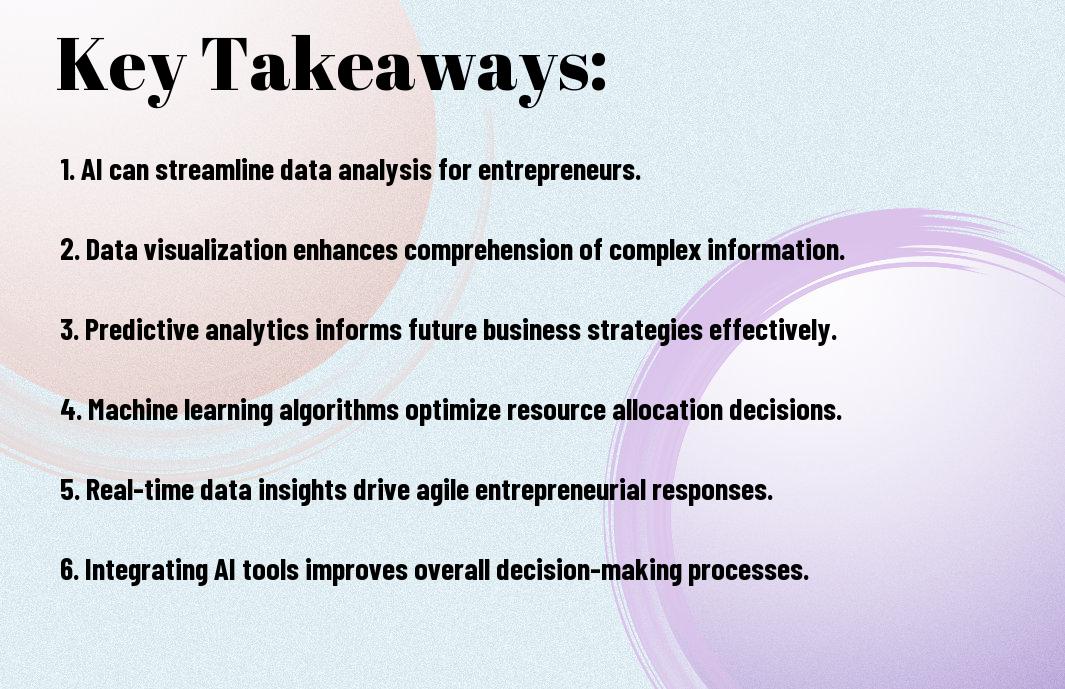
  • Effective data management is crucial for entrepreneurs to make informed decisions, and AI solutions can help navigate the vast amounts of data available, providing valuable insights to drive business growth.
  • AI-powered tools can automate data analysis, freeing up time for entrepreneurs to focus on strategic decision-making and high-level thinking, rather than getting bogged down in data processing.
  • By leveraging AI solutions, entrepreneurs can identify patterns and trends in their data that may not be immediately apparent, enabling them to respond quickly to changes in the market and stay ahead of the competition.
  • AI-driven decision-making can also help entrepreneurs mitigate risk by identifying potential pitfalls and opportunities, allowing them to make more informed decisions and avoid costly mistakes.
  • Ultimately, the successful integration of AI solutions into an entrepreneur’s decision-making process can lead to increased efficiency, improved accuracy, and enhanced business outcomes, giving them a competitive edge in their industry.

    The Raw Data Landscape

    The sheer amount of data available to you as an entrepreneur can be overwhelming, making it difficult to discern valuable insights from irrelevant information. You need to navigate this complex landscape to make informed decisions for your business.

    Volume Challenges

    Between the various sources of data, including social media, customer feedback, and sales reports, you are faced with a vast amount of information to sift through, making it hard to determine what is relevant to your business goals.

    Velocity Concerns

    Challenges arise when trying to process and analyze data in real-time, as the speed at which it is generated can be staggering, leaving you struggling to keep up with the latest trends and patterns.

    In fact, as you research deeper into the velocity concerns, you will find that the rapid pace of data generation requires you to have a system in place that can handle the influx of information, allowing you to respond quickly to changes in the market and make timely decisions that drive your business forward.

    AI Tools for Data Processing

    Some of the most effective AI tools for data processing are designed to help you streamline your workflow and make more informed decisions. You can leverage these tools to analyze large datasets, identify patterns, and gain valuable insights that inform your entrepreneurial endeavors.

    Machine Learning Solutions

    Following the initial data processing stage, you can utilize machine learning solutions to further refine your analysis. You will be able to develop predictive models that help you forecast trends and make data-driven decisions that drive your business forward.

    Natural Language Processing Applications

    Across various industries, natural language processing applications are being used to analyze and interpret large amounts of text-based data. You can use these applications to extract insights from customer feedback, social media posts, and other sources of unstructured data.

    But as you probe deeper into natural language processing applications, you will discover that they offer more than just text analysis. You can use them to automate tasks such as sentiment analysis, entity recognition, and language translation, freeing up more time for you to focus on high-level decision-making and strategy development.

    Decision Frameworks

    Many entrepreneurs struggle to make informed decisions due to the overwhelming amount of data available. You need a structured approach to filter and analyze this data, and that’s where decision frameworks come in. By implementing a decision framework, you can streamline your decision-making process and make more accurate predictions about your business’s future.

    Algorithmic Approaches

    Against the backdrop of increasing data complexity, algorithmic approaches can help you identify patterns and trends that inform your decision-making. You can leverage machine learning algorithms to analyze large datasets and uncover insights that might elude human analysts, enabling you to make more informed decisions about your business.

    Human-AI Collaboration

    Following the integration of AI into your decision-making process, you’ll need to consider how humans and AI systems can work together effectively. You should design a collaboration framework that plays to the strengths of both humans and AI, allowing you to augment your decision-making capabilities and drive business success.

    Consequently, as you develop your human-AI collaboration framework, you’ll need to focus on creating an environment where humans and AI systems can interact seamlessly. You can achieve this by implementing transparent AI systems that provide explanations for their decisions, and by training your team to work effectively with AI tools, ultimately enhancing your decision-making capabilities and driving business growth.

    Implementation Strategies

    Despite the complexity of AI solutions, you can effectively integrate them into your decision-making process by starting small and scaling up, allowing you to navigate the data deluge with ease and make informed decisions.

    Resource Allocation

    Beneath the surface of successful AI implementation lies a thoughtful allocation of your resources, ensuring that you dedicate sufficient budget and personnel to support your AI initiatives, enabling you to maximize their potential and drive business growth.

    Team Structure

    Across your organization, you will need to establish a team with a mix of technical and business expertise to effectively implement and manage AI solutions, allowing you to leverage their capabilities and drive business success.

    And as you build your team, you will need to consider the skills and expertise required to support your AI initiatives, including data scientists, engineers, and business analysts, ensuring that you have the right talent in place to drive your AI strategy forward and help you make informed, data-driven decisions that propel your business forward.

    Risk Assessment

    Unlike traditional methods, AI solutions offer a more comprehensive approach to risk assessment, enabling you to identify potential pitfalls and opportunities in your entrepreneurial endeavors. By leveraging machine learning algorithms and data analytics, you can make informed decisions that mitigate risks and maximize returns on your investments.

    Data Security

    Securing your data is vital to preventing unauthorized access and protecting your business from potential threats. You need to ensure that your AI systems are designed with robust security measures to safeguard your sensitive information and maintain the integrity of your decision-making processes.

    Algorithmic Bias

    With the increasing reliance on AI-driven decision-making, you must be aware of the potential for algorithmic bias in your systems. You can avoid this by regularly auditing your algorithms and training data to ensure that they are fair, transparent, and unbiased.

    The issue of algorithmic bias is particularly significant, as it can have far-reaching consequences for your business, including perpetuating existing social inequalities and leading to poor decision-making. You should take steps to address this issue by implementing diverse and representative training data, as well as ongoing monitoring and evaluation of your AI systems to detect and correct any biases that may arise, ensuring that your decision-making processes are fair and reliable.

    Measuring Success

    Not every entrepreneurial venture succeeds, but with the right tools, you can increase your chances of making informed decisions. You will be able to track your progress and adjust your strategy accordingly, which is imperative for achieving your goals.

    Key Performance Indicators

    Against the backdrop of your business objectives, you will need to establish relevant metrics to evaluate your performance. You should identify the indicators that best reflect your company’s success and use them to guide your decision-making process, allowing you to stay focused on what matters most.

    Adaptation Protocols

    Among the various strategies you can employ to navigate the data deluge, adaptation protocols are imperative for responding to changes in your industry. You will be able to adjust your approach as needed, ensuring that your business remains competitive and agile in a rapidly evolving market.

    Protocols for adaptation involve continuously monitoring your performance and making adjustments to optimize your outcomes. You will be able to refine your strategy over time, incorporating new insights and data into your decision-making process, and driving your business forward with confidence and precision, allowing you to achieve your goals and stay ahead of the competition.

    Summing up

    Now that you have explored AI solutions for entrepreneurial decision-making, you can harness the power of data to drive your business forward. You will be able to make informed decisions, streamline operations, and stay ahead of the competition. With AI by your side, you can effectively navigate the data deluge and unlock your business’s full potential, enabling you to achieve your goals and succeed in today’s fast-paced market.

    FAQ

    Q: What are the main challenges entrepreneurs face when navigating the data deluge, and how can AI solutions help?

    A: Entrepreneurs often struggle with managing and making sense of the vast amounts of data available to them. This can lead to difficulties in identifying trends, making informed decisions, and staying competitive. AI solutions can help by providing advanced data analytics and machine learning capabilities that enable entrepreneurs to efficiently process large datasets, uncover hidden insights, and make data-driven decisions. By leveraging AI, entrepreneurs can streamline their decision-making processes, reduce the risk of human error, and drive business growth.

    Q: How can AI-powered tools support entrepreneurial decision-making in the context of data analysis and interpretation?

    A: AI-powered tools can support entrepreneurial decision-making by offering automated data analysis, predictive modeling, and visualization capabilities. These tools can help entrepreneurs to quickly identify patterns, trends, and correlations within their data, and provide actionable recommendations based on that analysis. Additionally, AI-driven solutions can facilitate real-time monitoring and alerts, enabling entrepreneurs to respond promptly to changes in their business environment. By harnessing the power of AI, entrepreneurs can make more informed, strategic decisions that drive innovation and success.

    Q: What are some best practices for entrepreneurs to effectively implement AI solutions for navigating the data deluge and enhancing their decision-making capabilities?

    A: To effectively implement AI solutions, entrepreneurs should start by defining clear goals and objectives for their data analysis and decision-making processes. They should also invest in user-friendly, intuitive AI tools that can be easily integrated into their existing workflows. Furthermore, entrepreneurs should prioritize data quality and ensure that their AI systems are trained on accurate, relevant, and up-to-date information. Regularly monitoring and evaluating the performance of AI solutions, as well as staying informed about the latest advancements in AI technology, can also help entrepreneurs maximize the benefits of these tools and drive long-term business success.

Bonza training Skip to content