
As you navigate the ever-changing landscape of business, you’re likely aware that artificial intelligence (AI) is transforming the way companies compete. Your ability to adapt to this shift will determine your success. With AI, traditional rules no longer apply, and you must be prepared to innovate and disrupt to stay ahead. You’ll need to understand how AI is redefining the competitive landscape and positioning your business for dominance in this new era.
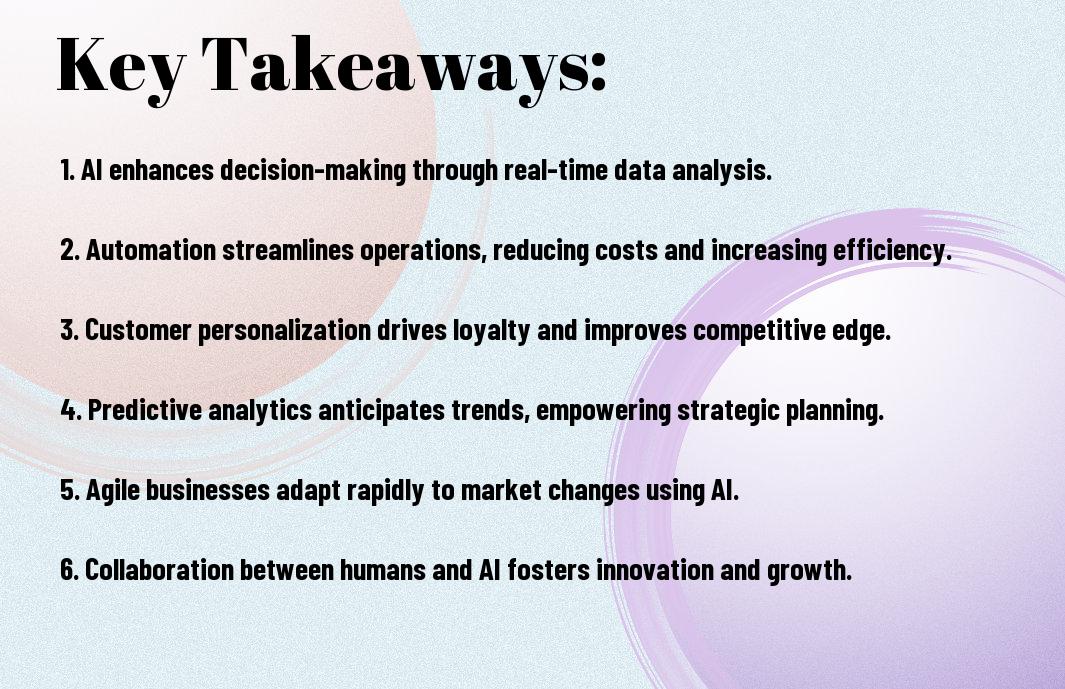
Key Takeaways:
- AI is transforming the business landscape by redefining the rules of competition, allowing companies to disrupt traditional industries and dominate new markets through innovative applications and strategies.
- Companies that successfully leverage AI can create new business models, products, and services that unlock new revenue streams and drive growth, making them more competitive in the market.
- The integration of AI into business operations enables organizations to make data-driven decisions, automate processes, and enhance customer experiences, leading to increased efficiency and profitability.
- As AI continues to evolve, businesses must be prepared to adapt and innovate to stay ahead of the competition, investing in AI research and development to identify new opportunities and stay competitive.
- Ultimately, the effective use of AI can be a key differentiator for businesses, enabling them to outmaneuver their competitors and achieve long-term success in a rapidly changing market environment.
The AI Competitive Landscape
Your business operates in a world where artificial intelligence (AI) is redefining the rules of competition, and understanding this landscape is crucial for success. You need to be aware of how AI is changing the way companies operate and compete. This landscape is characterized by rapid innovation and disruption, and you must be prepared to adapt.
Traditional vs. AI-Enhanced Business Models
Behind the scenes of every industry, a transformation is taking place, as traditional business models are being replaced by AI-enhanced ones, offering you new opportunities for growth and innovation. You can leverage AI to streamline processes, improve customer experiences, and gain a competitive edge.
The New Economics of Machine Intelligence
For you to succeed in this new landscape, it’s crucial to understand the economics of machine intelligence, where data and algorithms are the new currencies. You must learn to navigate this new economy, where AI-driven businesses can scale quickly and efficiently, and traditional businesses may struggle to keep up.
But as you examine deeper into the new economics of machine intelligence, you’ll discover that it’s not just about adopting AI technologies, but also about creating a culture that embraces innovation and experimentation. You’ll need to invest in data infrastructure, develop new skills, and foster a mindset that is open to change and willing to take calculated risks to stay ahead of the competition.

Strategic Disruption Vectors
You are about to enter a new era of business competition, where AI redefines the rules. Your ability to adapt and innovate will be key to staying ahead.
Speed as the Ultimate Competitive Advantage
Against the backdrop of rapid technological advancements, you will need to prioritize speed to outmaneuver your competitors and capitalize on emerging opportunities.
Scaling Intelligence Across Organizations
After implementing AI solutions, you can unlock new levels of efficiency and productivity, enabling your organization to make data-driven decisions and drive growth.
In fact, as you scale intelligence across your organization, you will be able to automate routine tasks, enhance customer experiences, and uncover new business insights, ultimately giving you a significant edge in the market and allowing you to dominate the competition.
Data as the New Corporate Arsenal
After understanding the power of AI, you can leverage it to transform your business, as discussed in AI is Reshaping Business: How to Leverage It for Smarter Decision Making, to gain a competitive edge.
From Information Silos to Predictive Insights
Besides the benefits of AI, you can break down information silos to uncover predictive insights that inform your business strategy and drive growth.
The Competitive Moats of Proprietary Datasets
Data drives your business forward, and proprietary datasets can become a significant competitive advantage, setting you apart from your rivals.
Even as you collect and analyze data, you can create a robust dataset that becomes a valuable asset, providing unique insights and informing your decision-making process, ultimately leading to a stronger market position and increased competitiveness.
AI Transformation Patterns
Despite the complexity of AI, its impact on business is undeniable. You can observe this in how companies are leveraging AI to redefine their operations, products, and services, leading to new competitive landscapes.
The Small Moves That Create Big Shifts
Transfiguring your business with AI starts with small, strategic moves. You can begin by identifying areas where AI can enhance efficiency, decision-making, and customer experience, setting the stage for significant shifts in your market position.
When Algorithms Become Strategic Differentiators
On the path to AI-driven competitiveness, you will find that algorithms can become your strategic differentiators. You can develop unique algorithms that solve specific problems or create new opportunities, giving you an edge over your competitors.
When you integrate AI algorithms into your business strategy, you open up new avenues for innovation and growth. You can use these algorithms to analyze vast amounts of data, predict market trends, and make informed decisions that drive your business forward. By doing so, you position your company as a leader in your industry, capable of adapting and evolving in a rapidly changing environment.
Human-AI Collaboration Frameworks
Not surprisingly, your business success in the AI era depends on your ability to collaborate with artificial intelligence. You will need to develop frameworks that enable seamless interaction between humans and AI systems, leveraging each other’s strengths to drive innovation and growth.
Augmentation vs. Automation Strategies
By examining your business processes, you can determine whether to use AI for augmentation or automation, allowing you to make informed decisions about where to apply AI to maximize impact and minimize disruption to your operations.
The Paradox of AI Leadership
Across various industries, you will encounter the paradox of AI leadership, where the need for human judgment and oversight is balanced with the benefits of AI-driven decision-making, forcing you to navigate this complex interplay to unlock the full potential of AI in your organization.
And as you probe deeper into the paradox of AI leadership, you will discover that it requires you to strike a balance between empowering AI systems to make decisions and maintaining human oversight to ensure accountability and ethical considerations, ultimately allowing you to harness the power of AI while mitigating its risks and challenges, and positioning your business for success in a rapidly changing landscape where AI is increasingly dominant.
Competitive Blind Spots
For businesses, identifying competitive blind spots is vital in today’s fast-paced market. You must be aware of the areas where your competition is vulnerable, and where you can gain an edge. Your ability to recognize these blind spots will determine your success in the market.
The Dangers of Algorithmic Groupthink
By relying too heavily on AI-driven insights, you may fall into the trap of algorithmic groupthink, where your decisions become limited by the data and patterns that AI systems recognize. You need to be aware of this potential pitfall to avoid missing out on innovative opportunities.
When AI Creates Market Vulnerabilities
Dangerously, AI can create market vulnerabilities if not properly managed. You may inadvertently expose your business to risks by relying too heavily on AI-driven decision-making, without considering the potential consequences. Your market position can be compromised if you fail to address these vulnerabilities.
To mitigate these risks, you need to develop a deep understanding of how AI is impacting your market and your business. You should continuously monitor your AI systems and be prepared to adapt to changing market conditions. By doing so, you can minimize the risks associated with AI-driven decision-making and stay ahead of the competition. Your ability to navigate these challenges will determine your success in the market, and you must be proactive in addressing these vulnerabilities to maintain a competitive edge.
Conclusion
So, as you navigate the evolving business landscape, you will find that AI is redefining the rules of competition. You must adapt to stay ahead, leveraging AI to disrupt and dominate your market. Your ability to innovate and respond to changing circumstances will be key to your success, enabling you to outmaneuver competitors and achieve your goals in this new era of business competition.
FAQ
Q: What is the main idea behind the concept of “Disrupt and Dominate” in the context of AI and business competition?
A: The concept of “Disrupt and Dominate” refers to the ability of companies to leverage Artificial Intelligence (AI) to completely upend traditional business models and market structures, thereby gaining a significant competitive advantage. This involves using AI to identify and capitalize on new opportunities, automate processes, and create innovative products and services that meet evolving customer needs. By doing so, businesses can disrupt existing markets and dominate their respective industries.
Q: How does AI redefine the rules of business competition, and what are the implications for companies that fail to adapt?
A: AI redefines the rules of business competition by introducing new dimensions of competition, such as data-driven decision making, automated customer service, and personalized product offerings. Companies that fail to adapt to these changes risk being left behind, as AI-powered businesses are able to respond more quickly to changing market conditions, innovate more rapidly, and build stronger relationships with their customers. The implications of failing to adapt include declining market share, reduced profitability, and eventual obsolescence.
Q: What strategies can businesses use to effectively harness the power of AI and achieve “Disrupt and Dominate” status in their respective markets?
A: To effectively harness the power of AI and achieve “Disrupt and Dominate” status, businesses should focus on developing a robust AI strategy that aligns with their overall business goals. This involves investing in AI talent, building a strong data infrastructure, and leveraging AI technologies such as machine learning, natural language processing, and computer vision to drive innovation and automation. Additionally, businesses should prioritize a culture of experimentation and continuous learning, and be willing to take calculated risks to stay ahead of the competition. By doing so, companies can unlock the full potential of AI and achieve a dominant position in their respective markets.