Entrepreneurship

Transforming Your Business with AI – Lessons in Modern Entrepreneurship

As you navigate the ever-evolving landscape of modern entrepreneurship, you’re likely aware of the profound impact artificial intelligence (AI) can have on your business. You’re considering how to harness its power to drive growth, enhance efficiency, and stay competitive. Your ability to adapt and innovate will be key to unlocking AI’s full potential, and this post will guide you through the process, providing valuable insights and lessons to help you transform your business and thrive in an AI-driven world.

Key Takeaways:

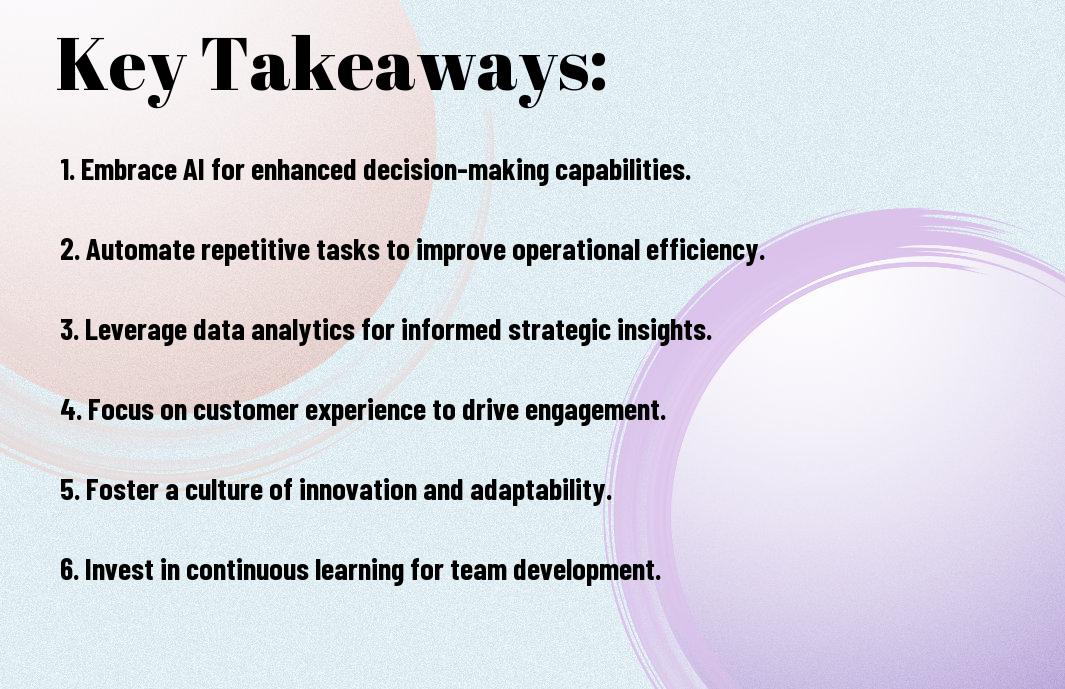
  • Embracing AI technology can significantly enhance business operations, leading to increased efficiency and productivity, and ultimately driving growth and competitiveness in the market.
  • Successful AI integration requires a deep understanding of the technology and its potential applications, as well as a willingness to experiment and innovate in order to stay ahead of the curve.
  • AI can be used to automate routine tasks, freeing up human resources for more strategic and creative work, and enabling businesses to focus on high-value activities that drive innovation and revenue.
  • Effective AI adoption also depends on the ability to manage and analyze large amounts of data, and to use insights gained from this data to inform business decisions and drive strategy.
  • By leveraging AI, entrepreneurs can create new business models, products, and services that meet evolving customer needs and preferences, and establish a strong foundation for long-term success and sustainability.
The AI Revolution in Business

While embracing AI, you can revolutionize your business operations, enhancing efficiency and decision-making. AI-driven technologies help you streamline processes, analyze data, and gain valuable insights, ultimately driving growth and innovation in your organization.

The Tipping Point for AI Adoption

Besides the numerous benefits, you are likely considering the optimal time to integrate AI into your business. As AI technologies continue to advance, you will find more opportunities to leverage them, making now the perfect moment to start exploring their potential.

Small Changes, Big Results

Alongside other strategies, you can begin by implementing minor AI-powered adjustments to your daily operations. By doing so, you will be able to experience the positive impact of AI on your business without overwhelming your systems or staff.

This approach allows you to test and refine your AI integration, identifying areas where AI can have the most significant effect, and making data-driven decisions to drive further improvements, ultimately leading to significant benefits for your business, such as increased productivity, enhanced customer experience, and improved competitiveness in the market, all resulting from your thoughtful and incremental adoption of AI solutions.

Identifying AI Opportunities

Clearly, to transform your business with AI, you need to identify areas where AI can bring the most value. You must assess your operations, looking for tasks that are repetitive, time-consuming, or prone to human error, as these are prime candidates for AI integration.

Data as Your Business Compass

On the path to AI adoption, your data will serve as a guiding light, helping you understand where AI can be most effectively applied. You will use your data to pinpoint inefficiencies and opportunities for improvement, allowing you to make informed decisions about where to focus your AI efforts.

Automation Sweet Spots

For your business to reap the benefits of AI, you need to find the automation sweet spots – areas where automation can significantly enhance efficiency and productivity. You will look for tasks that are not only repetitive but also high-volume, as these will yield the greatest returns on your AI investment.

Understanding how to identify these automation sweet spots is key to successfully integrating AI into your business. You will need to analyze your workflows, looking for bottlenecks and areas where manual processing is holding you back, and then apply AI solutions to streamline these processes, freeing up your resources for more strategic and creative work, and ultimately driving your business forward with increased efficiency and innovation.

Implementation Strategies

To successfully integrate AI into your business, you need to develop a comprehensive plan, considering your goals, resources, and potential challenges. This involves assessing your current infrastructure, identifying areas where AI can add value, and creating a roadmap for implementation.

The Minimal Viable AI Approach

Vital to your AI strategy is starting small, testing, and iterating to ensure you’re on the right track. You’ll want to focus on a specific problem or process where AI can have the most impact, and then scale up as you gather more insights and confidence in the technology.

Building Your AI Team

Modest beginnings are often the best approach when assembling your AI team. You’ll need to bring together individuals with diverse skill sets, including data scientists, engineers, and domain experts, to ensure your AI solutions are effective and aligned with your business objectives.

Implementation of an AI team requires careful consideration of your organization’s structure and culture. As you build your team, you’ll need to provide ongoing training and support to help your staff develop the skills they need to work effectively with AI systems, and to ensure that your AI strategy is integrated into every aspect of your business, driving innovation and growth.

Customer Experience Transformation

Your business can greatly benefit from AI-driven customer experience transformation, enabling you to deliver personalized and efficient services to your clients, ultimately leading to increased customer satisfaction and loyalty.

Personalization at Scale

With advanced AI technologies, you can now offer tailored experiences to your customers, analyzing their behavior and preferences to provide them with relevant offers and services, thus enhancing their overall experience with your brand.

Predictive Service Models

After implementing AI-powered predictive models, you can anticipate and address customer needs proactively, reducing wait times and improving response rates, which can significantly boost your customer satisfaction ratings and retention.

At the heart of predictive service models lies the ability to analyze vast amounts of customer data, allowing you to identify patterns and trends that inform your decision-making, enabling you to provide your customers with timely and effective support, and ultimately driving business growth and success, as you continue to meet and exceed their evolving expectations.

Operational Excellence Through AI

Once again, you can leverage AI to streamline your business operations, enhancing efficiency and productivity. By implementing AI-powered tools, you can automate routine tasks, analyze data, and make informed decisions to drive growth.

Supply Chain Intelligence

Exemplary performance in supply chain management is achievable with AI. You can use AI-driven analytics to forecast demand, manage inventory, and optimize logistics, resulting in improved delivery times and reduced costs.

Resource Optimization

Along with AI, you can optimize your resources, allocating them more effectively to maximize output. You can use AI to identify areas of waste, predict maintenance needs, and improve overall resource utilization.

Indeed, optimizing your resources with AI can have a significant impact on your bottom line. You can expect to see reduced waste, improved productivity, and increased efficiency, allowing you to allocate resources to more strategic initiatives and drive business growth. By leveraging AI in this way, you can stay ahead of the competition and achieve your business goals.

Ethical Considerations

Despite the numerous benefits of AI, you must consider the ethical implications of its integration into your business, as you can learn more about How will AI shape the future of entrepreneurship? and make informed decisions.

Transparency in AI Systems

Transparently, you need to understand how AI systems work and make decisions, ensuring that your business operates fairly and without bias, as you implement AI solutions.

Privacy and Trust Building

Against the backdrop of increasing AI adoption, you should prioritize building trust with your customers by protecting their data and being transparent about your AI-driven processes.

Trust is imperative in establishing a strong relationship with your customers, and as you implement AI in your business, you must ensure that their privacy is respected and their data is secure, fostering a trustworthy environment for your business to thrive.

Final Words

With these considerations, you now have a solid foundation to transform your business with AI. You can leverage AI to drive innovation, enhance efficiency, and stay competitive. As you begin on this journey, your ability to adapt and evolve will be key to success. By applying the lessons in modern entrepreneurship, you will be well-equipped to harness the power of AI and take your business to the next level, achieving your goals and realizing your vision.

FAQ

Q: What are the key benefits of integrating Artificial Intelligence (AI) into my business operations?

A: Integrating AI into your business can significantly enhance efficiency, reduce operational costs, and improve decision-making processes. AI technologies such as machine learning and natural language processing can automate routine tasks, analyze large datasets to provide actionable insights, and personalize customer interactions. By leveraging these capabilities, businesses can innovate their products and services, stay competitive in the market, and achieve sustainable growth.

Q: How can entrepreneurs ensure that their AI-driven business strategies are aligned with ethical standards and social responsibility?

A: Ensuring that AI-driven business strategies are ethically sound involves several steps. Firstly, entrepreneurs should prioritize transparency in how AI is used, including clear communication about data collection and usage. Secondly, they must implement robust data protection measures to safeguard customer privacy. Additionally, businesses should adopt principles of fairness and accountability in AI decision-making processes to prevent bias and discrimination. Engaging in ongoing dialogue with stakeholders, including consumers, regulators, and ethical experts, can also provide valuable insights into maintaining ethical standards in AI integration.

Q: What skills and knowledge do entrepreneurs need to acquire to successfully transform their businesses with AI and thrive in modern entrepreneurship?

A: To successfully transform their businesses with AI, entrepreneurs need to develop a combination of technical, business, and soft skills. Technically, they should have a basic understanding of AI concepts, including machine learning, deep learning, and data analytics. From a business perspective, they need to be able to identify areas where AI can add value, develop strategies for AI adoption, and manage the change process within their organization. Soft skills such as leadership, creativity, and the ability to collaborate with AI experts are also necessary. Furthermore, staying updated with the latest AI trends, best practices, and regulatory environments through continuous learning is vital for making informed decisions and navigating the challenges of AI adoption.

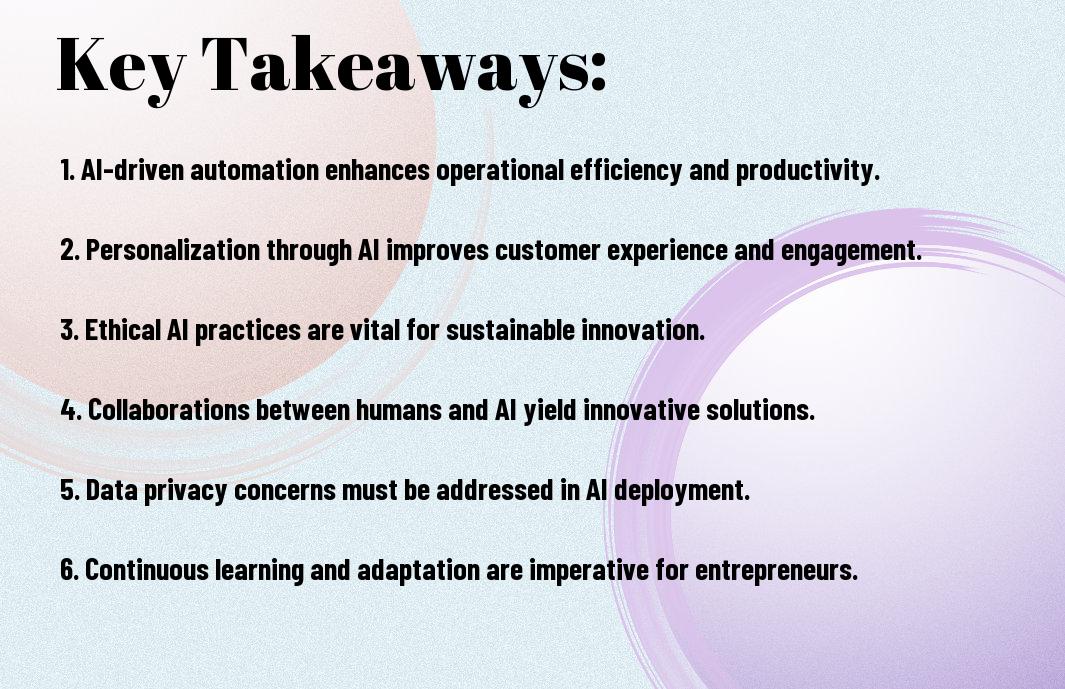
The Future of Innovation – AI Trends Every Entrepreneur Should Watch

As you navigate the ever-changing landscape of business, you’re likely aware that artificial intelligence (AI) is revolutionizing industries. Your ability to adapt to these advancements will be key to staying ahead. You’ll need to understand the latest AI trends to drive your innovation forward. By exploring the current state of AI, you’ll be better equipped to make informed decisions about your business’s future, leveraging the power of AI to propel your success.

Key Takeaways:

  • Artificial intelligence (AI) is transforming the innovation landscape, and entrepreneurs should be aware of the latest trends to stay ahead of the curve, including the increasing use of machine learning and natural language processing.
  • AI-powered automation is expected to revolutionize industries such as healthcare, finance, and transportation, creating new opportunities for entrepreneurs to develop innovative solutions and business models.
  • The rise of explainable AI (XAI) is becoming more prominent, enabling entrepreneurs to build trust and transparency into their AI systems, which is imperative for widespread adoption and regulatory compliance.
  • Entrepreneurs should focus on developing AI solutions that augment human capabilities, rather than replacing them, to create more efficient and effective workflows, and to improve customer experiences.
  • The future of innovation will be shaped by the convergence of AI with other emerging technologies, such as blockchain, Internet of Things (IoT), and quantum computing, creating new possibilities for entrepreneurs to develop groundbreaking products and services.

The Evolution of Machine Learning

Your understanding of machine learning is likely rooted in its early applications, but the field has undergone significant transformations, paving the way for more advanced AI trends.

Supervised to Unsupervised Learning

Beneath the surface of traditional machine learning lies a shift from supervised to unsupervised learning, enabling your models to discover patterns and make decisions without labeled data.

Democratization of AI Tools

Against the backdrop of increasing complexity, AI tools are becoming more accessible, allowing you to develop and implement machine learning models without extensive expertise.

Indeed, the democratization of AI tools has opened up new opportunities for you to leverage machine learning in your business, from automating routine tasks to driving innovation and growth, and you can expect to see more user-friendly platforms and interfaces emerge in the future, making it easier for you to get started with AI.

Natural Language Processing Revolution

Any entrepreneur looking to stay ahead of the curve should be aware of the rapid advancements in natural language processing (NLP). You will see significant improvements in how machines understand and generate human-like language, enabling more efficient interactions between humans and computers.

Conversational AI for Business

Among the various applications of NLP, conversational AI is particularly relevant to your business, as it allows for more natural and intuitive interactions with customers, enhancing their overall experience and improving your customer service.

Content Creation and Analysis

About to revolutionize the way you approach content, NLP-powered tools will enable you to generate high-quality content, such as articles and social media posts, and analyze large amounts of data to gain valuable insights into your audience’s preferences and behaviors.

The ability to analyze and generate content using NLP will have a significant impact on your business, as you will be able to automate tasks such as content creation, sentiment analysis, and language translation, freeing up more time for you to focus on strategic decision-making and driving growth, and enabling you to make data-driven decisions to optimize your content strategy and improve your overall marketing efforts.

Computer Vision Breakthroughs

To stay ahead in the innovation curve, you need to keep an eye on computer vision breakthroughs, which are transforming industries and revolutionizing the way you interact with technology.

Visual Recognition in Industry

Across various sectors, you will find visual recognition being used to improve efficiency and accuracy, enabling you to make better decisions and drive your business forward.

Augmented Reality Applications

Along with advancements in computer vision, you can expect to see more augmented reality applications that will change the way you experience and interact with your surroundings.

Another significant aspect of augmented reality applications is their potential to enhance your customer experience, allowing you to provide immersive and engaging experiences that set your business apart from the competition, and as you explore these applications, you will discover new ways to leverage them to drive growth and innovation in your industry.

AI Ethics and Governance

Keep in mind that as you explore AI trends, you should also consider the ethical implications, and for more insights, you can check out What Every Entrepreneur Should Prepare for in 2025 to stay ahead.

Regulatory Landscapes

Along with the growth of AI, you will need to navigate the evolving regulatory landscapes that impact your business, ensuring your AI systems comply with new laws and standards.

Building Responsible AI Systems

Between the lines of code and data, you must consider the human impact, designing AI systems that prioritize transparency, fairness, and accountability, reflecting your values and mission.

Ethics play a significant role in building responsible AI systems, and as you develop your AI strategy, you should prioritize fairness, transparency, and accountability, considering the potential consequences of your AI systems on your customers, employees, and the broader community, and by doing so, you can ensure that your AI systems align with your values and mission, ultimately enhancing your reputation and building trust with your stakeholders.

AI-Human Collaboration Models

Many entrepreneurs are now exploring AI-human collaboration models to drive innovation in their businesses. You can leverage these models to enhance your decision-making processes and improve overall efficiency.

Augmented Decision Making

Alongside human intuition, AI can provide valuable insights, enabling you to make more informed decisions. You will be able to analyze complex data and identify patterns that may have gone unnoticed otherwise.

Workflow Automation Strategies

Any effective workflow automation strategy should prioritize tasks that are repetitive or time-consuming, allowing you to focus on higher-value tasks. You can use AI to streamline your workflows and increase productivity.

Due to the advancements in AI technology, you can now automate various aspects of your business, from data entry to customer service. You will be able to allocate your resources more efficiently and achieve your goals faster, making your business more competitive in the market.

Investment Trends in AI

Not surprisingly, investment in AI is on the rise, and you should be aware of the latest trends to stay ahead. You’ll notice a significant increase in funding for AI startups, and you can expect this trend to continue in the coming years.

Venture Capital Priorities

Following the surge in AI adoption, you’ll find that venture capital firms are prioritizing investments in AI-powered startups, and you should consider this when planning your own investments.

Corporate AI Integration Costs

Above the initial investment, you’ll need to consider the costs of integrating AI into your existing infrastructure, and you should factor this into your budget to avoid unexpected expenses.

With the cost of corporate AI integration in mind, you’ll want to carefully plan your implementation strategy to maximize your return on investment, and you should consider seeking guidance from AI experts to ensure a smooth transition and minimize costs, as you navigate the complex process of integrating AI into your business.

Final Words

Hence, as you begin on your entrepreneurial journey, you will witness the AI landscape evolving rapidly. You should stay informed about the latest AI trends to leverage their potential and drive your business forward. By doing so, you will be able to harness the power of AI and shape your company’s future, ultimately giving you a competitive edge in the market and enabling you to make informed decisions about your business’s innovation strategy.

FAQ

Q: What are the most significant AI trends that entrepreneurs should watch in the future of innovation?

A: The most significant AI trends that entrepreneurs should watch include the integration of Artificial General Intelligence (AGI), the rise of Explainable AI (XAI), and the increasing use of AI in cybersecurity. AGI has the potential to revolutionize industries by enabling machines to learn and apply knowledge across a wide range of tasks. XAI, on the other hand, focuses on making AI decision-making processes more transparent and understandable. Meanwhile, AI-powered cybersecurity solutions are becoming important for protecting businesses from sophisticated threats. By keeping an eye on these trends, entrepreneurs can stay ahead of the curve and leverage AI to drive innovation and growth.

Q: How can entrepreneurs apply AI trends to their businesses to drive innovation and stay competitive?

A: Entrepreneurs can apply AI trends to their businesses by identifying areas where AI can automate processes, enhance customer experiences, and improve decision-making. For instance, they can use machine learning algorithms to analyze customer data and develop personalized marketing strategies. They can also leverage natural language processing (NLP) to build chatbots and virtual assistants that provide 24/7 customer support. Additionally, entrepreneurs can use AI-powered predictive analytics to forecast market trends and make data-driven decisions. By embracing AI, entrepreneurs can streamline operations, reduce costs, and create new revenue streams, ultimately driving innovation and staying competitive in their respective markets.

Q: What are the potential challenges and limitations that entrepreneurs may face when adopting AI trends in their businesses?

A: Entrepreneurs may face several challenges and limitations when adopting AI trends, including the need for significant investments in infrastructure and talent, the risk of job displacement, and the potential for AI bias and errors. Moreover, ensuring the transparency and accountability of AI decision-making processes can be a challenge. To overcome these challenges, entrepreneurs should prioritize AI education and training, develop strategies for upskilling and reskilling their workforce, and implement robust testing and validation protocols to ensure AI systems are fair, reliable, and secure. By being aware of these challenges and taking proactive steps to address them, entrepreneurs can successfully navigate the adoption of AI trends and unlock their full potential for driving innovation and growth.

Bridging the Gap – How AI Merges Traditional Entrepreneurship with Modern Tech

As you navigate the ever-evolving landscape of entrepreneurship, you’re likely aware of the growing intersection of traditional business practices and modern technology. You may be wondering how to effectively merge these two worlds to drive innovation and success. Your ability to adapt and leverage artificial intelligence (AI) will be key to staying ahead of the curve, and this post will explore the ways in which AI is revolutionizing traditional entrepreneurship, enabling you to make informed decisions about your own business strategy.

Key Takeaways:

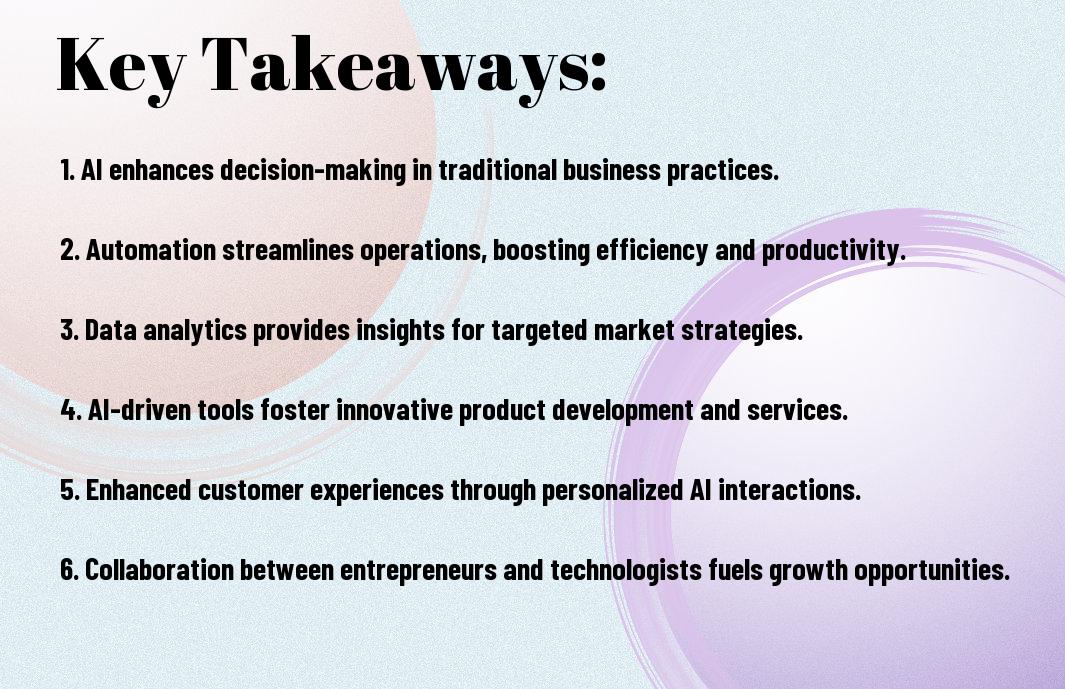
  • Combining traditional entrepreneurship principles with modern AI technology can lead to innovative business models and increased efficiency, allowing entrepreneurs to stay competitive in a rapidly changing market.
  • AI-driven tools can automate routine tasks, freeing up entrepreneurs to focus on high-level strategy and creative problem-solving, enabling them to make more informed decisions and drive business growth.
  • The integration of AI in traditional entrepreneurship can also enhance customer experience, providing personalized services and improving customer engagement through data-driven insights and predictive analytics.
  • Entrepreneurs who effectively merge traditional entrepreneurship with AI technology can gain a significant advantage over their competitors, driving innovation and disrupting industries with new and innovative products or services.
  • The future of entrepreneurship will likely involve a seamless blend of human intuition and AI-driven insights, requiring entrepreneurs to develop a deep understanding of both traditional business principles and modern AI technologies to succeed.

    The Evolution of Entrepreneurship

    A look at the history of entrepreneurship shows that it has undergone significant transformations over the years, shaping the business landscape into what you see today, with various factors contributing to its growth and development, ultimately leading to the incorporation of modern technologies.

    Traditional Business Models

    By examining the past, you can see that traditional business models were often limited by their geographical location and market reach, restricting your ability to expand and connect with a broader audience, which in turn hindered your potential for growth and success.

    The Digital Revolution

    Digitally, the world has become more interconnected, allowing you to access a global market and leverage technology to streamline your business operations, making it easier for you to manage and scale your enterprise, and this shift has significantly impacted the way you approach entrepreneurship.

    Due to the advancements in technology and the rise of the digital age, you now have the opportunity to harness the power of artificial intelligence, data analytics, and other digital tools to drive innovation and stay competitive in the market, enabling you to make informed decisions and adapt to changing consumer needs and preferences, which is imperative for your business to thrive in today’s fast-paced environment.

    AI as the Bridge

    While navigating the intersection of traditional entrepreneurship and modern tech, you’ll find that AI plays a significant role in merging these two worlds, enabling you to leverage the best of both.

    Cognitive Tools for Ancient Problems

    Toward solving long-standing business challenges, you can utilize AI-powered cognitive tools that offer innovative solutions, allowing you to tackle complex issues with ease and efficiency, thereby enhancing your entrepreneurial endeavors.

    Algorithmic Decision-Making

    To make informed decisions, you can rely on algorithmic processes that analyze vast amounts of data, providing you with valuable insights that inform your business strategy and drive growth.

    This ability to make data-driven decisions is particularly significant, as it enables you to optimize your operations, mitigate risks, and capitalize on new opportunities, ultimately giving you a competitive edge in the market and allowing you to stay ahead of the curve in your industry, with your business reaping the benefits of AI-driven decision-making.

    The Human Element Preserved

    Despite the rise of AI, you can still maintain the human touch in your entrepreneurship endeavors. As you explore the possibilities of AI, consider reading about Bridging the execution gap – why AI is the new frontier for corporate strategy to understand how AI merges with traditional entrepreneurship.

    Intuition Meets Data

    Beneath the surface of AI-driven decision-making, you’ll find that your intuition still plays a significant role. As you navigate the intersection of human insight and machine learning, you’ll discover new ways to inform your business strategy.

    Values in the Machine Age

    Essentially, you’ll need to consider the values that drive your business in the age of AI. Your approach to ethics, transparency, and accountability will be more important than ever as you integrate AI into your operations.

    And as you probe deeper into the world of AI, you’ll find that your values are not only preserved but also amplified. You’ll have the opportunity to create a business that is more responsive, more responsible, and more aligned with your vision, allowing you to build a stronger connection with your customers and community.

    Implementation Strategies

    All successful entrepreneurs know that integrating AI into their business requires a well-thought-out plan. You need to consider your goals, resources, and current infrastructure to ensure a seamless transition. Your implementation strategy will serve as a roadmap, guiding you through the process and helping you avoid potential pitfalls.

    Gradual Integration Methods

    Implementing AI solutions gradually allows you to test and refine your approach as you go. You can start by automating simple tasks and then move on to more complex processes, ensuring that your systems and workforce are adapted to the new technology. Your business will benefit from a phased introduction of AI, minimizing disruptions and maximizing efficiency.

    Workforce Adaptation

    Before introducing AI to your business, you should assess your workforce’s readiness for the change. You need to consider the skills and training required for your employees to work effectively with AI systems. Your goal is to create a workforce that is not only comfortable with the new technology but also able to leverage its capabilities to drive innovation and growth.

    Methods for adapting your workforce to AI-driven systems include providing comprehensive training programs, encouraging a culture of innovation, and fostering a mindset of continuous learning. You can also consider hiring professionals with expertise in AI and machine learning to help guide your team through the transition. By investing in your workforce, you will be able to unlock the full potential of AI and drive long-term success for your business.

    Economic Implications

    Once again, you will notice that the integration of AI in traditional entrepreneurship has significant effects on the economy, transforming the way you conduct business and make financial decisions.

    Productivity Paradoxes

    Profitably, you can increase efficiency and output with AI, but this may also lead to job displacement and changes in your workforce dynamics.

    New Market Formations

    Any analysis of AI’s impact on your business will show that new market opportunities emerge, allowing you to expand your customer base and develop innovative products.

    Understanding the dynamics of these new markets is key to your success, as you will need to adapt your strategies to meet the evolving needs and preferences of your customers, and stay ahead of the competition in an increasingly tech-driven landscape.

    Ethical Considerations

    Not all AI applications are created equal, and as you begin on merging traditional entrepreneurship with modern tech, you must consider the ethical implications of your actions.

    Bias in Automated Systems

    The transparency of AI decision-making processes is crucial to identify and mitigate biases, and as you develop your AI-powered business, you should be aware of the potential for biased automated systems.

    Governance Frameworks

    For your AI-driven venture to succeed, you need to establish governance frameworks that ensure accountability and fairness, and you should prioritize the development of these frameworks from the outset.

    Frameworks like these will help you navigate the complex ethical landscape of AI and ensure that your business is aligned with your values and the values of your customers, allowing you to build trust and maintain a competitive edge in the market, and as you move forward, you will be able to adapt these frameworks to meet the evolving needs of your business and the regulatory environment.

    Conclusion

    Considering all points, you now understand how AI merges traditional entrepreneurship with modern tech, transforming your business. You can leverage AI to streamline operations, enhance decision-making, and drive innovation. By embracing this synergy, you will stay ahead of the curve, unlocking new opportunities and maximizing your potential in the ever-evolving entrepreneurial landscape, making your venture more efficient and competitive.

    FAQ

    Q: What is the main goal of bridging the gap between traditional entrepreneurship and modern technology?

    A: The primary objective of merging traditional entrepreneurship with modern tech is to leverage the strengths of both worlds, creating a harmonious blend of innovative ideas, cutting-edge technology, and time-tested business principles. By doing so, entrepreneurs can tap into new markets, streamline operations, and stay competitive in an ever-evolving business landscape. This integration enables businesses to adapt to changing consumer behaviors, improve customer experiences, and drive sustainable growth.

    Q: How can artificial intelligence (AI) enhance traditional entrepreneurial ventures?

    A: AI can significantly enhance traditional entrepreneurial ventures by automating routine tasks, providing data-driven insights, and enabling predictive decision-making. AI-powered tools can help entrepreneurs identify new business opportunities, optimize supply chains, and personalize customer interactions. Moreover, AI-driven analytics can facilitate market research, competitor analysis, and financial forecasting, allowing entrepreneurs to make informed decisions and mitigate risks. By embracing AI, traditional businesses can become more agile, efficient, and responsive to changing market conditions.

    Q: What skills do entrepreneurs need to acquire to successfully merge traditional entrepreneurship with modern technology?

    A: To successfully bridge the gap between traditional entrepreneurship and modern tech, entrepreneurs need to acquire a combination of skills, including digital literacy, data analysis, and strategic thinking. They should be familiar with emerging technologies like AI, blockchain, and the Internet of Things (IoT), and understand how to leverage these technologies to drive business growth. Additionally, entrepreneurs need to develop soft skills like adaptability, creativity, and collaboration to effectively work with cross-functional teams, including data scientists, software developers, and designers. By acquiring these skills, entrepreneurs can navigate the complexities of modern tech and create innovative, tech-enabled businesses that thrive in today’s fast-paced economy.

Entrepreneurship in the Digital Age – Harnessing AI for Exponential Growth

As you navigate the ever-evolving landscape of entrepreneurship, you’re likely aware of the profound impact technology has on your business. Your ability to adapt and leverage artificial intelligence (AI) will be the key to unlocking exponential growth. You will discover how to harness AI to streamline operations, enhance customer experiences, and drive innovation, ultimately giving you a competitive edge in the digital marketplace. By embracing AI, you can revolutionize your entrepreneurial journey and achieve unprecedented success.

Key Takeaways:

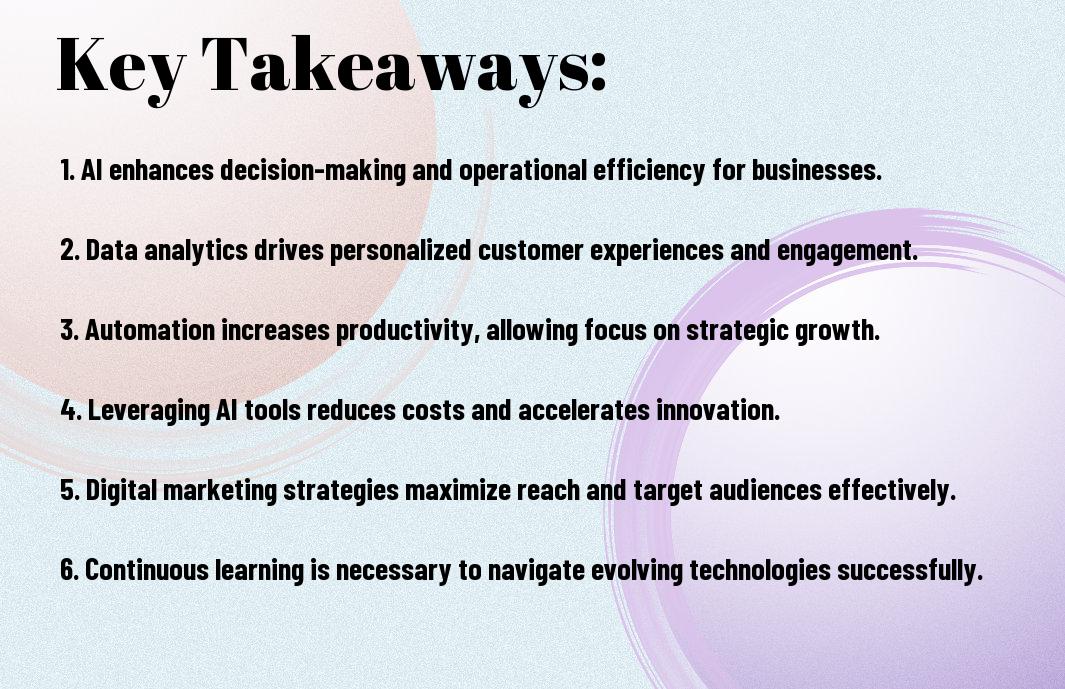
  • Embracing artificial intelligence (AI) is necessary for entrepreneurs to stay competitive in the digital age, as it enables them to automate tasks, analyze large datasets, and make data-driven decisions to drive exponential growth.
  • AI-powered tools can help entrepreneurs identify new business opportunities, improve customer engagement, and optimize operations, leading to increased efficiency and productivity.
  • Leveraging AI can also facilitate innovation, allowing entrepreneurs to develop new products and services that meet evolving customer needs and preferences, and gain a competitive edge in the market.
  • To harness the full potential of AI, entrepreneurs need to develop a strategic approach to AI adoption, including investing in AI talent, building a strong data infrastructure, and fostering a culture of innovation and experimentation.
  • By combining human creativity and judgment with the power of AI, entrepreneurs can unlock new possibilities for growth, innovation, and success in the digital age, and create sustainable and scalable businesses that thrive in a rapidly changing environment.

    The AI Revolution in Business

    For entrepreneurs, the AI revolution presents a significant opportunity for growth and innovation, enabling you to streamline processes, enhance customer experiences, and gain a competitive edge in the market. You can leverage AI to analyze vast amounts of data, identify trends, and make informed decisions to drive your business forward.

    From Automation to Intelligence

    Contrary to traditional views, AI is not just about automating routine tasks, but about augmenting your capabilities with intelligent systems that can learn, adapt, and improve over time, allowing you to focus on high-value tasks that drive innovation and growth.

    The Tipping Point of AI Adoption

    Businesses like yours are now at the forefront of AI adoption, and you are likely to see significant returns on investment as you integrate AI into your operations, from enhanced customer service to improved supply chain management, and you will be able to measure the impact of AI on your bottom line.

    Automation of repetitive tasks is just the beginning, as you investigate deeper into the capabilities of AI, you will find that it can help you identify new business opportunities, optimize your operations, and create new products and services that meet the evolving needs of your customers, and you will be able to stay ahead of the competition by leveraging the power of AI to drive innovation and growth in your business.

    Identifying AI Opportunities

    There’s a wealth of information available on leveraging AI for business growth, such as the AI Revolution: Harnessing change for business growth, which can help you navigate the landscape and identify opportunities for your business.

    Pattern Recognition in Market Gaps

    Gaps in the market can be a goldmine for entrepreneurs, and you can use AI to identify patterns and capitalize on them, allowing you to stay ahead of the competition and drive innovation in your industry.

    Data as the New Business Currency

    One of the key drivers of AI-powered growth is data, and you need to understand how to harness it to inform your business decisions and drive success.

    It is imperative to develop a data-driven mindset, as this will enable you to make informed decisions and drive your business forward, and you can use AI to analyze and interpret the vast amounts of data available, providing you with valuable insights to inform your strategy and drive exponential growth.

    Building AI-Enhanced Business Models

    Keep in mind that AI-enhanced business models can revolutionize your entrepreneurial journey, enabling you to make data-driven decisions and drive exponential growth.

    Scalability Without Linear Resource Growth

    With the power of AI, you can scale your business without proportionally increasing resources, allowing you to maximize efficiency and minimize costs as you expand your operations.

    Predictive Customer Engagement

    Ai-driven insights enable you to anticipate your customers’ needs, personalize their experiences, and build strong relationships, ultimately driving loyalty and revenue growth for your business.

    Another key aspect of predictive customer engagement is the ability to analyze customer behavior and preferences, allowing you to tailor your marketing strategies and product offerings to meet their evolving needs, and stay ahead of the competition in the market, giving you a unique advantage as you navigate the digital landscape and make informed decisions to propel your business forward.

    The Human-AI Partnership

    Despite the rise of AI, your success as an entrepreneur still depends on your ability to leverage human skills and judgment. You must learn to collaborate with AI systems to drive innovation and growth.

    Augmentation vs. Replacement

    Around the concept of AI, you’ll find that it’s often about enhancing your capabilities, rather than replacing them. You’ll need to understand how AI can augment your business, making you more efficient and effective.

    Developing AI-Complementary Skills

    Before you can harness the full potential of AI, you’ll need to develop skills that complement its capabilities. You’ll want to focus on areas like creativity, empathy, and strategic thinking, which are difficult for AI to replicate.

    Skills like problem-solving, communication, and leadership will become increasingly valuable as AI takes over routine and repetitive tasks. You’ll need to develop these skills to work effectively with AI and drive business growth, making you a more effective and innovative entrepreneur in the digital age.

    Navigating Ethical Considerations

    Once again, you find yourself at the forefront of innovation, and with that comes the responsibility to address the ethical implications of AI integration in your business, ensuring that your practices align with your values and the expectations of your audience.

    Transparency in AI-Driven Decisions

    Maneuvering through the complexities of AI transparency, you must consider how your AI systems make decisions and ensure that these processes are clear and understandable to your customers and stakeholders, fostering an environment of openness and accountability.

    Building Trust with Customers and Stakeholders

    Anyway, as you commence on building trust, you should prioritize honesty and reliability in all interactions, especially when it comes to the data and AI-driven insights that influence your business decisions, demonstrating your commitment to ethical practices.

    At the heart of building trust with your customers and stakeholders is the consistent application of ethical standards in your AI practices, which includes being transparent about data usage, protecting privacy, and ensuring that your AI systems are fair and unbiased, allowing you to maintain a strong, trustworthy reputation in the market.

    Financial Strategies for AI Implementation

    After developing a solid AI strategy, you need to focus on the financial aspects of implementation, ensuring that your investments yield significant returns and drive exponential growth for your business.

    Investment Models for AI Integration

    Implementing AI solutions requires careful consideration of various investment models, and you should explore options that align with your business goals, such as subscription-based or pay-per-use models, to optimize your AI integration costs.

    Measuring AI-Driven ROI

    Measuring the effectiveness of your AI investments is vital, and you should track key performance indicators, such as revenue growth, customer engagement, and operational efficiency, to evaluate the return on investment and make data-driven decisions.

    At this stage, you will need to establish a robust metrics framework to assess the impact of AI on your business, allowing you to identify areas of improvement, adjust your strategies, and maximize the benefits of AI-driven innovation, ultimately driving your business towards exponential growth and success.

    To wrap up

    Hence, as you launch on your entrepreneurial journey in the digital age, you will find that harnessing AI is key to unlocking exponential growth. You can leverage AI to streamline your operations, enhance customer experience, and drive innovation. By embracing AI, you will be able to stay ahead of the competition and achieve your business goals. Your ability to adapt and innovate with AI will ultimately determine your success in the digital landscape.

    FAQ

    Q: What role does Artificial Intelligence (AI) play in entrepreneurship in the digital age?

    A: AI plays a significant role in entrepreneurship in the digital age by automating processes, enhancing decision-making, and driving innovation. With AI, entrepreneurs can analyze vast amounts of data, identify patterns, and make informed decisions to drive their businesses forward. Additionally, AI-powered tools can help entrepreneurs streamline operations, improve customer service, and develop personalized marketing strategies, ultimately leading to exponential growth.

    Q: How can entrepreneurs effectively harness AI for business growth in the digital landscape?

    A: To effectively harness AI for business growth, entrepreneurs should start by identifying areas where AI can add value to their business, such as customer service, marketing, or operations. They should then invest in AI-powered tools and technologies that can help them achieve their goals. Furthermore, entrepreneurs should stay up-to-date with the latest AI trends and developments, and be willing to experiment and adapt to new technologies. It’s also vital to have a solid understanding of data analytics and interpretation to make the most out of AI-driven insights.

    Q: What are the potential risks and challenges associated with leveraging AI in entrepreneurship, and how can they be mitigated?

    A: While AI offers numerous benefits for entrepreneurs, there are also potential risks and challenges associated with its adoption, such as data privacy concerns, job displacement, and algorithmic bias. To mitigate these risks, entrepreneurs should prioritize transparency and accountability in their AI systems, ensure that they have robust data protection measures in place, and regularly monitor and audit their AI-powered tools for bias and fairness. Additionally, entrepreneurs should invest in employee training and upskilling to prepare their workforce for an AI-driven future, and establish clear guidelines and regulations for AI development and deployment.

Disruptive Innovation – AI as a Catalyst for Entrepreneurial Transformation

As you navigate the ever-changing landscape of entrepreneurship, you’re likely aware that staying ahead of the curve is key to success. You’re constantly looking for ways to innovate and transform your business, and artificial intelligence (AI) is poised to be a major catalyst for this change. You may be wondering how AI can disrupt traditional industries and create new opportunities for growth, and this post will explore the ways in which AI can revolutionize your entrepreneurial endeavors, helping you stay competitive in a rapidly evolving market.

Key Takeaways:

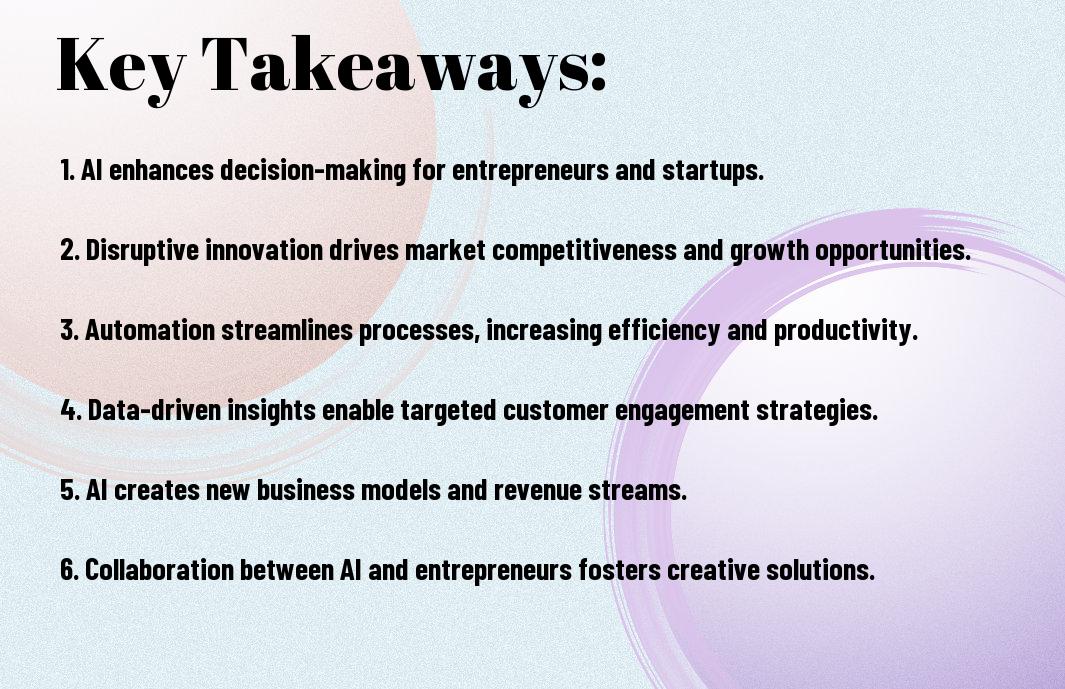
  • AI-driven disruptive innovation has the potential to transform traditional industries and create new markets, enabling entrepreneurs to develop novel business models and gain a competitive edge.
  • The integration of AI in entrepreneurial ventures can significantly enhance operational efficiency, reduce costs, and improve decision-making processes, leading to increased productivity and profitability.
  • AI-powered technologies, such as machine learning and natural language processing, can facilitate the development of innovative products and services that cater to evolving customer needs and preferences.
  • Entrepreneurs who leverage AI as a catalyst for transformation must prioritize strategic planning, talent acquisition, and continuous learning to stay ahead of the curve and adapt to the rapidly changing business landscape.
  • The successful adoption of AI-driven innovation requires a culture of experimentation, collaboration, and risk-taking, allowing entrepreneurs to navigate uncertainty and unlock new opportunities for growth and success.

    The Evolution of AI in Business

    To understand the impact of AI on entrepreneurship, you need to consider how it has transformed the business landscape. You will see that AI has come a long way, and its applications are becoming increasingly prevalent in various industries.

    Historical Context

    About a decade ago, AI was still in its infancy, and you might have thought of it as a futuristic concept. You were just beginning to explore its potential, and it was not yet integrated into your daily business operations.

    Present Landscape

    The current state of AI in business is characterized by rapid growth and adoption, and you are now witnessing its widespread implementation. You can see AI-powered tools and technologies being used in your industry, and it’s changing the way you approach your business.

    Even as you navigate this new landscape, you are likely to encounter more advanced AI applications that will continue to disrupt traditional business models. You will need to adapt and evolve your strategies to stay competitive, and leveraging AI will be vital to your success. You can expect AI to play an increasingly important role in your decision-making processes, and it will likely become a key driver of innovation in your organization.

    Fundamental Disruption Mechanisms

    Now that you’re exploring the concept of disruptive innovation, you’ll discover that AI plays a significant role in transforming your business. It enables you to rethink your approach and create new opportunities, allowing your company to stay ahead of the competition.

    Value Chain Reconfiguration

    To effectively leverage AI, you need to consider how it can reconfigure your value chain, enabling you to streamline processes and improve efficiency, ultimately enhancing your overall business performance and allowing you to better serve your customers.

    Market Creation Dynamics

    Behind the success of many innovative companies lies their ability to create new markets, and you can do the same by harnessing the power of AI to identify and capitalize on untapped opportunities, driving growth and expansion in your industry.

    At the heart of market creation dynamics is your ability to use AI to analyze market trends, identify gaps, and develop innovative solutions that meet the evolving needs of your customers, enabling you to stay ahead of the curve and establish your company as a leader in your industry, allowing you to drive growth and increase your market share.

    AI-Driven Entrepreneurial Opportunities

    Many entrepreneurs are leveraging AI to create innovative businesses, and you can too. You can use AI to automate tasks, gain insights, and make data-driven decisions, giving you a competitive edge in the market.

    Low-hanging Fruit

    On the path to entrepreneurial transformation, you’ll find opportunities that are easily accessible and profitable. You can start by identifying areas where AI can improve existing processes, making your business more efficient and cost-effective.

    Blue Ocean Territories

    Any entrepreneur looking to make a significant impact can explore uncharted territories with AI. You can create new markets, products, or services that didn’t exist before, giving you a unique advantage.

    Plus, as you venture into blue ocean territories, you’ll have the opportunity to create new demand and establish yourself as a pioneer in your industry. You can use AI to identify gaps in the market, develop innovative solutions, and disrupt traditional business models, allowing you to stay ahead of the competition and achieve long-term success.

    Implementation Challenges

    Keep in mind that integrating AI into your business is not without its challenges, and you will need to navigate these obstacles to achieve successful implementation.

    Technical Barriers

    After overcoming initial hurdles, you will encounter technical barriers, such as data quality issues and system integration, which can hinder your AI adoption and you must address these challenges proactively.

    Organizational Resistance

    The biggest challenge you may face is organizational resistance, as your employees may be hesitant to adopt new technologies and processes, and you need to develop strategies to mitigate this resistance.

    Resistance to change is natural, and you should expect it when introducing AI-powered innovations in your organization, so you must develop a clear communication plan to educate your employees about the benefits of AI and involve them in the implementation process to ensure a smoother transition.

    Competitive Advantage Framework

    For entrepreneurs, understanding the competitive advantage framework is important to leverage AI for transformative growth, as you navigate the complexities of innovation and disruption in your industry.

    First-mover Positioning

    Adeptly, you can seize the first-mover advantage by embracing AI-powered solutions, allowing you to establish a strong market presence and set the stage for your competitors to follow.

    Sustainable Differentiation

    Against the backdrop of intense competition, you can create sustainable differentiation by harnessing AI to develop unique products, services, or business models that set you apart from your rivals and capture your target market’s attention.

    The key to sustainable differentiation lies in your ability to continuously innovate and improve your AI-driven offerings, ensuring that you stay ahead of the curve and maintain a competitive edge in the market, as you adapt to changing customer needs and preferences, and capitalize on new opportunities for growth and expansion.

    Ethical Considerations

    Not all AI innovations are created equal, and as you consider implementing AI in your business, you must think about the potential consequences of your actions.

    Societal Impact

    Any significant shift in technology can have far-reaching effects on society, and as you develop your AI strategy, you should consider how your actions may impact the world around you.

    Responsible Innovation Practices

    To ensure that your AI innovations are both effective and ethical, you should prioritize responsible innovation practices, such as transparency and accountability, in your development process.

    Understanding the complexities of AI and its potential impact on your business and society is key to developing responsible innovation practices. As you move forward with your AI strategy, you will need to consider factors such as data privacy, bias, and job displacement, and develop strategies to mitigate any negative consequences, ensuring that your use of AI is both beneficial and ethical, and aligns with your values and goals.

    Conclusion

    Ultimately, you now understand how AI drives entrepreneurial transformation through disruptive innovation. You see that your business can leverage AI to create new markets, products, and services. As you move forward, your ability to adapt and innovate with AI will be key to staying ahead in a rapidly changing landscape, enabling you to unlock new opportunities and drive growth in your organization.

    FAQ

    Q: What is Disruptive Innovation and how does AI contribute to it?

    A: Disruptive innovation refers to the process of introducing new products, services, or business models that significantly alter the market landscape, often rendering existing ones obsolete. AI acts as a catalyst for this transformation by providing entrepreneurs with the tools to analyze vast amounts of data, automate processes, and create personalized experiences. This enables them to develop innovative solutions that disrupt traditional industries and create new markets, thereby driving entrepreneurial transformation.

    Q: How can entrepreneurs leverage AI to drive Disruptive Innovation in their businesses?

    A: Entrepreneurs can leverage AI in several ways to drive disruptive innovation. Firstly, they can use machine learning algorithms to analyze customer data and preferences, allowing them to develop tailored products and services that meet specific needs. Secondly, AI-powered automation can help streamline business operations, reducing costs and increasing efficiency. Lastly, AI-driven technologies like natural language processing and computer vision can enable the development of innovative products and services that were previously unimaginable, such as chatbots and virtual assistants, thereby driving entrepreneurial transformation.

    Q: What are the potential risks and challenges associated with using AI as a catalyst for Disruptive Innovation, and how can entrepreneurs mitigate them?

    A: While AI can be a powerful catalyst for disruptive innovation, it also poses several risks and challenges, including job displacement, data privacy concerns, and the potential for biased decision-making. To mitigate these risks, entrepreneurs should prioritize transparency and accountability in their AI systems, invest in employee retraining and upskilling, and ensure that their AI systems are designed with ethics and fairness in mind. Additionally, entrepreneurs should stay up-to-date with the latest AI regulations and guidelines to avoid potential legal and reputational risks, thereby ensuring that their use of AI drives sustainable and responsible entrepreneurial transformation.

Skip to content