Financial

Financial Freedom Through AI – Entrepreneurial Stories of Success and Innovation

As you explore the world of entrepreneurship, you’re likely seeking innovative ways to achieve financial freedom. Your journey to success can be accelerated by leveraging Artificial Intelligence (AI). You’ll discover how AI is transforming industries and creating new opportunities for entrepreneurs like yourself. By embracing AI, you can unlock new revenue streams, optimize operations, and gain a competitive edge, ultimately achieving the financial freedom you desire.

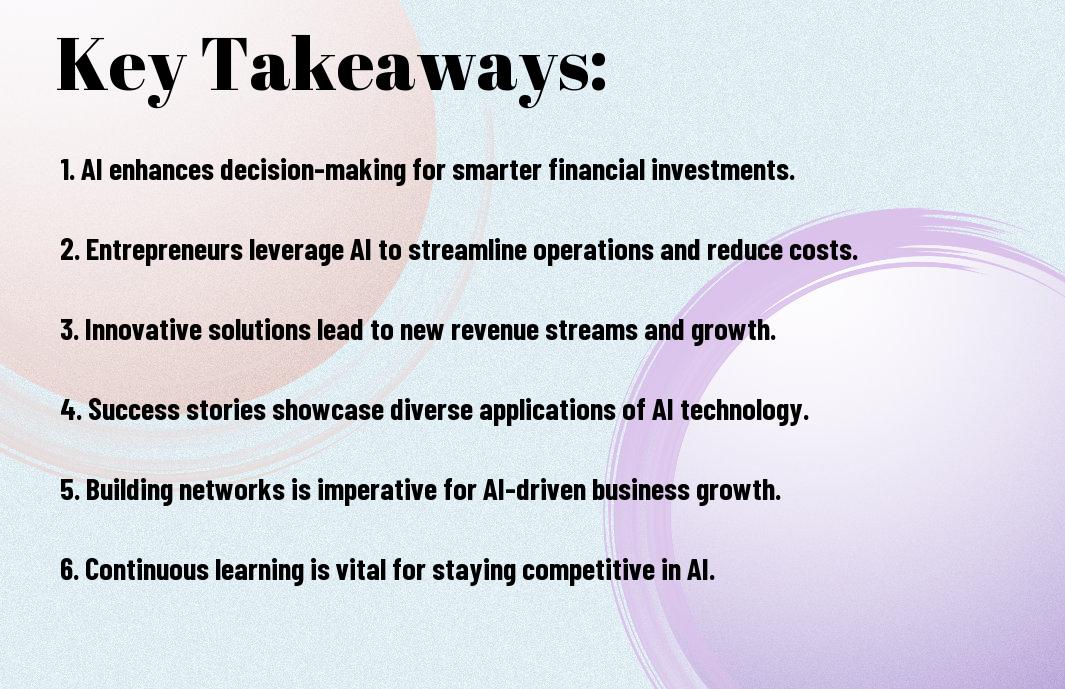
Key Takeaways:

  • Financial freedom can be achieved through the strategic implementation of Artificial Intelligence (AI) in entrepreneurial ventures, as seen in various success stories where AI-driven innovations have transformed businesses and created new opportunities for growth and profitability.
  • Entrepreneurs who have successfully harnessed the power of AI have been able to automate tasks, enhance decision-making, and gain a competitive edge in their respective markets, leading to significant financial gains and increased freedom.
  • The application of AI in finance and business has given rise to new entrepreneurial opportunities, such as AI-powered investment platforms, automated trading systems, and data-driven consulting services, which have enabled individuals to build successful and profitable businesses.
  • Stories of entrepreneurial success through AI highlight the importance of embracing innovation, taking calculated risks, and continuously learning and adapting to the rapidly evolving AI landscape in order to stay ahead of the curve and achieve financial freedom.
  • By leveraging AI and machine learning, entrepreneurs can create scalable and sustainable business models that generate passive income, providing them with the financial freedom to pursue their passions and interests without being tied to a traditional 9-to-5 job.
The Tipping Point of AI Entrepreneurship

Before the advent of AI, you may have thought that achieving financial freedom through entrepreneurship was a distant dream, but with the rise of innovative technologies, your chances of success have increased exponentially.

When AI Became Accessible to Everyday Entrepreneurs

For many years, AI was reserved for large corporations, but now you can access these powerful tools to transform your business and create new opportunities for growth and development.

Small Changes That Created Massive Opportunities

Beside the numerous benefits of AI, you can leverage its capabilities to streamline your operations, making your business more efficient and profitable, which can have a significant impact on your bottom line.

For instance, you can use AI-powered chatbots to automate customer service, freeing up your time to focus on high-leverage activities, such as strategy and innovation, allowing you to stay ahead of the competition and achieve your financial goals faster.

AI Outliers: Unconventional Paths to Financial Success

You are about to discover the unconventional paths to financial success through AI, where entrepreneurs have achieved remarkable results by deviating from traditional methods.

The 10,000 Hours Myth in AI Business

For instance, you’ll find that the notion of requiring 10,000 hours to master AI is being challenged by entrepreneurs who have achieved success in a fraction of the time, leveraging their unique strengths and innovative approaches.

Intuitive Entrepreneurs Who Defied Convention

Across various industries, you’ll encounter entrepreneurs who have defied conventional wisdom and achieved remarkable success with AI, often by trusting their intuition and taking calculated risks to stay ahead of the curve.

Plus, as you examine deeper into the stories of these intuitive entrepreneurs, you’ll notice that they share a common trait: the ability to balance technical expertise with creative vision, allowing them to identify opportunities that others may have missed, and to develop innovative solutions that have disrupted entire markets, leading to significant financial gains and a lasting impact on their industries.

The Financial Freedom Algorithm

Once again, you can achieve financial freedom by leveraging AI, as seen in The age of the entrepreneur: AI unlocks financial freedom, where innovative entrepreneurs share their success stories.

Recurring Revenue Models in AI Businesses

For instance, you can create a stable income stream by developing AI-powered products with subscription-based models, allowing you to generate revenue consistently.

Scaling Without Traditional Resources

Financial constraints no longer limit your ability to scale your AI business, as cloud computing and outsourcing enable you to access necessary resources without significant upfront investments.

Models like pay-as-you-go pricing and freemium models allow you to scale your AI business efficiently, enabling you to focus on growth and development, rather than worrying about resource allocation, and you can explore these models to find what works best for your business.

Cognitive Barriers to AI Wealth Creation

Your mindset plays a significant role in achieving financial freedom through AI. You must be aware of the cognitive barriers that can hinder your success, such as fear and lack of understanding.

Overcoming Technological Intimidation

Among the most significant obstacles to AI wealth creation is technological intimidation. You may feel overwhelmed by the complexity of AI, but you can overcome this by educating yourself and taking small steps towards automation.

Reframing Risk in the Age of Automation

To succeed in AI-driven wealth creation, you need to reframe your perception of risk. You should view risk as an opportunity for growth and innovation, rather than a threat to your financial security.

And as you probe deeper into the world of AI, you will discover that reframing risk is imperative to unlocking your full potential. You will learn to navigate the uncertainties of automation and make informed decisions that drive your financial freedom forward, enabling you to stay ahead of the curve and achieve your goals.

The Connector Effect in AI Entrepreneurship

Not every entrepreneur has the same level of access to resources, but you can still achieve financial freedom through AI by leveraging the right connections. You will learn how to build a network that amplifies your AI solutions and increases your social currency.

Building Networks That Amplify AI Solutions

Against the backdrop of a rapidly evolving AI landscape, you will find opportunities to connect with like-minded entrepreneurs and innovators, helping you to stay ahead of the curve and identify new opportunities for growth.

The Social Currency of Technical Innovation

About the time you start to build your reputation as an AI entrepreneur, you will begin to appreciate the value of social currency in technical innovation, which can open doors to new partnerships, investments, and collaborations.

And as you examine deeper into the world of AI entrepreneurship, you will discover that your social currency is directly tied to your ability to innovate and adapt, and you will need to continually develop your skills and knowledge to stay relevant in this rapidly changing field, allowing you to make informed decisions about your business and stay ahead of the competition.

Pattern Recognition: Identifying Profitable AI Niches

Unlike traditional industries, AI niches often emerge unexpectedly, and your ability to identify them can make or break your entrepreneurial venture. You need to stay vigilant and adapt quickly to capitalize on new opportunities. By analyzing market trends and consumer behavior, you can uncover profitable AI niches and position yourself for success.

The Psychology of Market Gaps

Prior to venturing into AI entrepreneurship, you should understand the psychology behind market gaps. You will find that unmet consumer needs and desires often drive innovation, and your task is to identify these gaps and develop AI solutions to fill them. By doing so, you can create a loyal customer base and establish a strong market presence.

Timing Your Entry for Maximum Impact

Entering the AI market at the right time is important for your success. You should monitor industry developments and wait for the perfect moment to launch your product or service. This strategic approach will enable you to maximize your impact and gain a competitive edge.

A key aspect of timing your entry for maximum impact is being able to analyze market conditions and anticipate future trends. As you consider launching your AI-powered product or service, you should assess the current competitive landscape, consumer demand, and potential barriers to entry. By doing so, you can make informed decisions and increase your chances of success in the rapidly evolving AI landscape, allowing you to stay ahead of the curve and achieve your entrepreneurial goals.

To wrap up

Ultimately, as you explore Financial Freedom Through AI, you will discover entrepreneurial stories of success and innovation that can inspire your own journey. You will learn how to leverage AI to optimize your financial decisions, creating a more secure and prosperous future for yourself. By embracing AI-driven solutions, you can unlock new opportunities and achieve your financial goals, transforming your life and securing your financial freedom.

FAQ

Q: What is Financial Freedom Through AI and how can it benefit entrepreneurs?

A: Financial Freedom Through AI refers to the ability to achieve financial independence and success through the strategic use of Artificial Intelligence (AI) in business. By leveraging AI technologies, entrepreneurs can automate tasks, gain valuable insights, and make data-driven decisions, leading to increased efficiency, productivity, and profitability. This can enable them to break free from the constraints of traditional business models and achieve financial freedom, allowing them to pursue their passions and interests without being tied down by financial worries.

Q: What kind of entrepreneurial stories can I expect to learn from Financial Freedom Through AI?

A: Financial Freedom Through AI features a collection of inspiring and informative stories from successful entrepreneurs who have harnessed the power of AI to achieve remarkable success in their respective fields. These stories showcase innovative business models, cutting-edge AI applications, and strategic decision-making, providing valuable lessons and insights for aspiring entrepreneurs. From e-commerce and marketing to healthcare and finance, these stories demonstrate the versatility and potential of AI in driving business growth and achieving financial freedom.

Q: How can I apply the principles of Financial Freedom Through AI to my own business or entrepreneurial venture?

A: By reading and learning from the entrepreneurial stories featured in Financial Freedom Through AI, you can gain practical knowledge and insights on how to integrate AI into your own business or venture. You can start by identifying areas where AI can automate tasks, improve efficiency, or provide valuable insights, and then explore the various AI tools and technologies available to support your goals. Additionally, you can learn from the successes and challenges faced by other entrepreneurs, avoiding common pitfalls and staying up-to-date with the latest trends and innovations in the field, ultimately paving your way to achieving financial freedom through AI-driven innovation.

How does financial education impact an individual’s ability to build wealth

With the right financial education, you can truly pave the way towards building wealth and securing your financial future. This article probes into the crucial role that understanding finances plays in accumulating wealth over time. By gaining insights on budgeting, savings, investments, and smart financial decisions, you can empower yourself to make informed choices that fuel your journey towards prosperity. Let’s explore how equipping yourself with financial knowledge can lead to long-term financial success and stability.

Key Takeaways:

  • Increased financial literacy: Financial education helps individuals understand how to manage money effectively, make informed financial decisions, and avoid pitfalls that could hinder wealth accumulation.
  • Improved savings and investment habits: Individuals with financial education are more likely to save regularly, invest wisely, and take advantage of wealth-building opportunities such as retirement accounts, stocks, and real estate.
  • Ability to set and achieve financial goals: With a solid understanding of personal finance principles, individuals can set clear financial goals, create a realistic plan to achieve them, and track their progress over time, leading to greater wealth accumulation.

The Current State of Financial Literacy

A crucial aspect of building wealth is having a strong foundation in financial literacy. Research has shown that How Financial Literacy Affects Household Wealth and individual financial outcomes. Understanding the current state of financial literacy is imperative for making informed decisions about your financial future.

The prevalence of financial illiteracy

Illiteracy in financial matters is a widespread issue that impacts individuals of all ages and backgrounds. Many people lack basic knowledge of topics such as budgeting, saving, investing, and managing debt. This lack of understanding can lead to poor financial decision-making and hinder wealth-building potential.

The consequences of poor financial decision-making

An important consequence of poor financial decision-making is the detrimental impact it can have on your long-term financial well-being. Making uninformed choices about saving, investing, or borrowing can result in debt, limited savings, and missed opportunities for growth. For instance, failing to create a budget or overspending without a plan can lead to financial instability and prevent you from achieving your wealth-building goals.

The Benefits of Financial Education

Improved budgeting and saving habits

You can benefit greatly from financial education by improving your budgeting and saving habits. Learning how to create and stick to a budget will help you track your expenses, identify areas where you can cut back, and save more effectively. With a better understanding of your financial situation, you can set realistic savings goals and work towards achieving them.

Increased investment knowledge and confidence

By investing the time to educate yourself financially, you will gain valuable knowledge and confidence in making investment decisions. Understanding the different investment options available, such as stocks, bonds, and real estate, will empower you to make informed choices that align with your financial goals. This knowledge will also give you the confidence to take calculated risks and grow your wealth over time.

Budgeting

Increased investment knowledge and confidence can lead to better decision-making when it comes to growing your wealth. When you have a solid understanding of the various investment vehicles and strategies, you can make informed choices that have the potential to yield higher returns. This confidence can also help you navigate the ups and downs of the market with a level head, avoiding impulsive decisions that could negatively impact your financial future.

Better debt management and credit scores

Financial education can also help you better manage your debts and improve your credit scores. By understanding how interest rates work, the impact of making minimum payments, and the importance of paying off high-interest debt first, you can develop a strategic debt repayment plan. Improving your credit scores through responsible debt management will open up more opportunities for favorable loan terms and lower interest rates in the future.

scores

The knowledge gained from financial education can empower you to take control of your debts and ultimately improve your credit scores. By implementing effective debt management strategies, such as prioritizing high-interest debt and making consistent payments, you can work towards reducing your overall debt burden and demonstrating to creditors that you are a responsible borrower. This, in turn, can lead to a higher credit score, making it easier for you to access credit when needed at better terms.

How Financial Education Affects Wealth Creation

Now, let’s investigate into how financial education can impact an individual’s ability to build wealth. One key factor is understanding the role of compound interest in wealth accumulation.

The role of compound interest in wealth accumulation

On the journey to building wealth, compound interest plays a crucial role. By earning interest on both the initial principal and the accumulated interest, your money can grow exponentially over time. The earlier you start investing and saving, the more time your investments have to compound, allowing your wealth to snowball and reach substantial levels.

The importance of starting early in investing and saving

One of the most critical aspects of wealth creation is starting early. The power of compounding works best over long periods. By taking advantage of this principle and starting to invest and save as soon as possible, you give your money more time to grow. Time is your greatest asset when it comes to accumulating wealth, and starting early can significantly impact the final amount you accumulate.

Starting early is akin to giving your money more time to work for you. The longer your investments have to grow, the more you can benefit from the compounding effect. This underscores the importance of beginning your financial journey as soon as you can, even if it’s with small amounts. The habits you develop early on can set the foundation for long-term financial success.

The impact of financial education on long-term financial goals

An important aspect of financial education is understanding how to set and achieve long-term financial goals. Whether it’s saving for retirement, buying a home, or starting a business, having a solid understanding of financial principles and strategies can help you navigate your way towards achieving these milestones.

Financial education empowers you to make informed decisions about your money, enabling you to align your everyday choices with your long-term financial goals. By learning about budgeting, investing, and different asset classes, you can build a robust financial plan that propels you towards wealth creation and financial security.

The Impact of Financial Education on Career Advancement

How financial literacy affects career choices and advancement

Financial education plays a crucial role in shaping your career choices and advancement. By understanding concepts such as budgeting, investing, and debt management, you can make informed decisions about your career path. For example, with financial literacy, you can evaluate job offers not just based on salary but also on benefits such as retirement plans and healthcare coverage. This knowledge empowers you to negotiate for better compensation packages and seek opportunities for career growth.

The correlation between financial knowledge and earning potential

On your journey to building wealth, having financial knowledge can significantly impact your earning potential. Studies have shown that individuals with higher levels of financial literacy tend to earn more over their lifetime compared to those with limited understanding of personal finance. This correlation highlights the importance of continuously educating yourself about money management to increase your income and build long-term wealth.

Affects

Improving your financial knowledge can lead to better job performance, increased chances of promotions, and access to higher-paying opportunities. Employers value employees who demonstrate financial acumen as they are often more responsible, strategic, and capable of contributing to the company’s success. By investing in your financial education, you are investing in your career growth and financial future.

The role of financial education in entrepreneurship and business success

Career advancement is not limited to climbing the corporate ladder. Financial education also plays a vital role in entrepreneurship and business success. When starting a business, having a solid understanding of financial principles is crucial for managing cash flow, budgeting effectively, and making strategic investment decisions. This knowledge can set you apart as a savvy entrepreneur and increase your chances of building a successful and profitable business.

Financial

Overcoming Barriers to Financial Education

Addressing the lack of access to financial education resources

For access to financial education resources is a crucial first step in building your wealth. Many individuals, especially those in underserved communities, face barriers when it comes to accessing the necessary knowledge and tools to make informed financial decisions. Lack of awareness about available resources, limited availability of financial education programs, and a lack of financial literacy within communities can all contribute to this challenge.

One way to address this barrier is by increasing the availability of financial education programs in schools, community centers, and online platforms. By making these resources more accessible, individuals can equip themselves with the knowledge and skills needed to make sound financial choices and ultimately build wealth for themselves and their families.

Breaking down cultural and socio-economic barriers to financial literacy

To break down cultural and socio-economic barriers to financial literacy, it is necessary to recognize and understand the diverse backgrounds and experiences of individuals. Different cultures may have varying beliefs and attitudes towards money, savings, and investments, which can impact how financial education is received. Socio-economic factors such as income levels, access to banking services, and historical disparities in wealth distribution can also influence one’s ability to engage with financial education.

Breaking these barriers involves tailoring financial education programs to be culturally sensitive and inclusive of people from all socio-economic backgrounds. By recognizing the unique circumstances and challenges that individuals face, financial educators can better connect with their audience and deliver information in a way that is relatable and impactful.

The importance of financial education in underserved communities

For barriers to building wealth are often more pronounced in underserved communities, making financial education even more critical. In these communities, individuals may face challenges such as limited access to traditional banking services, higher levels of debt, and a lack of exposure to financial planning concepts. By providing comprehensive and accessible financial education, individuals in underserved communities can gain the knowledge and confidence needed to take control of their financial futures and work towards building wealth.

Implementing Effective Financial Education Strategies

Integrating financial education into school curricula

Despite the importance of financial education, many school curricula have yet to incorporate these imperative lessons. Strategies to promote financial literacy in schools include integrating concepts like budgeting, saving, and investing into subjects like math and economics. By starting financial education at a young age, students can develop good money habits early on, setting them up for future financial success.

Utilizing online resources and financial literacy apps

Curricula can be enhanced by utilizing online resources and financial literacy apps. These tools offer interactive lessons, budgeting simulations, and investment trackers that make learning about finances engaging and practical. By incorporating technology into financial education, students can learn at their own pace and practice real-life money management skills in a controlled environment.

To further support financial education, consider recommending popular financial literacy apps like Mint, Acorns, or YNAB (You Need A Budget) to your students or children. These apps provide hands-on experience in budgeting, investing, and tracking expenses, empowering individuals to take control of their financial futures.

The role of financial advisors and mentors in promoting financial education

Integrating the expertise of financial advisors and mentors into financial education programs can provide invaluable guidance and insight. These professionals can offer personalized advice, answer specific questions, and share real-world experiences to help individuals navigate complex financial decisions. By establishing mentorship programs or inviting financial advisors to speak at workshops, you can inspire others to take proactive steps towards financial literacy and wealth-building.

Financial advisors and mentors play a crucial role in promoting financial education by offering tailored guidance and support. Their expertise can help demystify complex financial concepts, provide customized strategies for wealth accumulation, and empower individuals to make informed decisions about their money. By building relationships with knowledgeable mentors in the financial field, you can gain the confidence and skills needed to secure your financial future.

Conclusion

The article has shown you the significant impact of financial education on your ability to build wealth. By understanding key financial concepts, making informed decisions, and practicing good money habits, you can set yourself on the path to financial success. Do not forget, financial literacy is crucial for everyone, regardless of age or income level. It equips you with the knowledge and skills needed to secure your financial future and achieve your long-term goals. To learn more about why financial literacy is important for everyone, you can read the article Why Financial Literacy is Important for Everyone.

Q: How does financial education impact an individual’s ability to build wealth?

A: Financial education plays a crucial role in helping individuals make informed decisions about managing their money, investments, and assets. With the right knowledge and skills, individuals can create and execute effective financial plans to grow their wealth over time.

Q: What are the benefits of having financial education when it comes to building wealth?

A: Financial education empowers individuals to understand key financial concepts such as budgeting, saving, investing, and managing debt. By having a strong foundation in financial literacy, individuals are better equipped to make sound financial decisions that can lead to long-term wealth accumulation.

How can someone improve their financial education to enhance their ability to build wealth?

A: There are various ways individuals can improve their financial education, such as taking courses or workshops on personal finance, reading books on investing and wealth-building strategies, seeking advice from financial advisors, and actively practicing good financial habits like budgeting and saving. Continuous learning and application of financial knowledge are key to building wealth effectively.

Bonza training Skip to content