Horse racing

What statistical methods are most effective for predicting horse race winners

Predictions about horse race winners can be a thrilling and rewarding exercise, but it requires more than just luck. By delving into statistical methods, you can enhance your chances of making accurate forecasts. In this article, we will explore some of the most effective statistical techniques that can help you decipher the complex world of horse racing and improve your predictive abilities. So, saddle up and get ready to examine the fascinating world of predictive analytics in horse racing!

Key Takeaways:

  • Historical Data Analysis: Utilizing historical data such as past performance, track conditions, jockey statistics, and previous race outcomes can help in predicting horse race winners effectively.
  • Machine Learning Models: Implementing machine learning algorithms like logistic regression, random forest, or gradient boosting can improve the accuracy of predictions by identifying patterns in the data and making informed decisions.
  • Ensemble Methods: Combining the predictions of multiple models through ensemble methods like bagging or boosting can further enhance the accuracy and reliability of horse race winner predictions.

The Fundamentals of Horse Racing Statistics

For a beginner in horse race prediction, understanding the fundamentals of horse racing statistics is crucial. This knowledge provides the foundation for more advanced statistical models and strategies.

Historical Context: The Evolution of Horse Racing Data

Data collection and analysis in horse racing have come a long way over the years. In the past, handicappers relied heavily on basic information such as win percentage and jockey performance. Nowadays, with the advent of technology, vast amounts of data including speed figures, track conditions, and past performances are available to analyze. This historical context highlights the importance of embracing data-driven approaches in your horse racing predictions.

Key Performance Indicators (KPIs): What Matters Most

When entering into horse racing statistics, identifying the key performance indicators (KPIs) that matter most can significantly enhance your prediction accuracy. Factors such as speed figures, pace analysis, class ratings, and trainer/jockey statistics are crucial metrics to consider. This subsection examines into the significance of these KPIs and how they can be leveraged to make informed betting decisions.

Racing enthusiasts understand that not all statistics are created equal when it comes to predicting race outcomes. It’s vital to focus on the KPIs that have proven to have the most impact on a horse’s performance. By honing in on these key metrics, you can refine your predictive models and increase your chances of success at the racetrack.

Descriptive Statistics in Horse Racing

Clearly, understanding how to analyze the performance of horses in racing is crucial for predicting winners. If you want to investigate deeper into predicting horse race outcomes, you can explore the Formula for most probable horse winner available online.

Mean and Median: The Basics of Performance Analysis

Any keen horse racing enthusiast knows that analyzing the mean and median performance metrics of horses can provide valuable insights. The mean gives you the average performance level of a horse, while the median helps you understand the typical performance within a dataset of races.

Standard Deviation: Measuring Consistency and Volatility

With standard deviation, you can measure the consistency and volatility of a horse’s performances over a series of races. This statistical tool helps you gauge how much a horse’s performance typically varies from its average, giving you a sense of its reliability on the track.

Performance analysis using standard deviation allows you to see which horses have more stable performances versus those with erratic results. By considering this metric, you can make more informed predictions about how a horse is likely to perform in an upcoming race.

Correlation Coefficients: Identifying Patterns and Relationships

Performance in horse racing is influenced by various factors, and correlation coefficients can help you identify patterns and relationships between these variables. By analyzing how different factors such as track conditions, jockeys, or previous performances correlate with race outcomes, you can enhance your predictive skills.

Statistics such as correlation coefficients allow you to quantify the relationships between different variables affecting horse race results. This deeper understanding can give you a competitive edge when assessing the potential success of a horse in a given race.

Inferential Statistics in Horse Racing

Many opportunities exist to apply inferential statistics in horse racing to improve your chances of predicting winners. If you’re interested in exploring the intersection of statistics and horse racing, you may find Can Machine Learning Predict Horse Race Winners? A Deep Dive an intriguing read.

Hypothesis Testing: Proving Theories and Debunking Myths

The realm of hypothesis testing in horse racing allows you to validate or refute various conjectures regarding race outcomes. By analyzing data and applying statistical tests, you can confirm or dismiss hypotheses, enabling you to make more informed decisions when selecting horses to bet on.

Confidence Intervals: Estimating True Performance Levels

Horse racing involves numerous variables that can impact a horse’s performance. Confidence intervals help you estimate the true performance levels of horses by providing a range within which their actual performance may lie. These intervals enable you to assess the reliability of your predictions and make adjustments based on the level of certainty you desire.

Racing enthusiasts often employ confidence intervals to gauge the consistency and potential of horses in different racing conditions. By understanding the range within which a horse’s true performance likely falls, you can make well-informed decisions when evaluating race contenders.

Advanced Statistical Methods for Horse Racing

Your quest to predict horse race winners more accurately has led you to explore advanced statistical methods. These methods can offer deeper insights and help enhance your predictions significantly. Let’s probe into some innovative approaches that harness the power of data and analytics to give you an edge in horse racing.

  1. Machine Learning Algorithms: Boosting Prediction Accuracy

    Horse racing enthusiasts like yourself are increasingly turning to machine learning algorithms to improve their prediction accuracy. By leveraging algorithms like Gradient Boosting and Random Forest, you can analyze vast amounts of data to identify intricate patterns and factors that contribute to race outcomes. These algorithms can adapt and learn from new information, continuously refining your predictions and increasing your chances of picking winners.

  2. Neural Networks: Uncovering Hidden Patterns and Trends

    Trends in horse racing can be complex and elusive, often hiding valuable insights that traditional statistical methods may overlook. Neural networks offer a powerful solution by uncovering these hidden patterns and trends in the data. By mimicking the human brain’s ability to process information, neural networks can identify subtle correlations and relationships that influence race results. Incorporating neural networks into your predictive modeling can provide a comprehensive understanding of the factors impacting race outcomes.

  3. Monte Carlo Simulations: Estimating Probabilities and Outcomes

    Hidden probabilities and potential outcomes in horse racing can be challenging to assess with conventional methods. Monte Carlo simulations offer a sophisticated approach to estimate these probabilities by running thousands of simulations based on different variables and scenarios. This method allows you to gauge the likelihood of various race results, helping you make informed decisions when selecting your winners. By simulating a wide range of possibilities, you can gain a more nuanced perspective on the potential outcomes of each race.

Through these advanced statistical methods, you can elevate your horse racing predictions to new heights. By harnessing the power of machine learning algorithms, neural networks, and Monte Carlo simulations, you can unlock valuable insights and enhance your decision-making process. Embrace these innovative tools to sharpen your predictive abilities and stay ahead in the thrilling world of horse racing.

Data Visualization in Horse Racing

All Unveiling the Secrets of Horse Race Modeling can help you gain a better understanding of horse racing data. Utilizing charts and graphs effectively can communicate insights in a visually compelling manner, allowing you to identify trends and patterns more easily. By visualizing data, you can uncover hidden relationships and characteristics that may not be apparent when simply looking at rows of numbers.

Charts and Graphs: Communicating Insights Effectively

Data visualization plays a crucial role in horse racing analysis. By using various charts and graphs, you can effectively communicate complex insights to make more informed decisions. Bar graphs can help you compare different horses’ performance metrics at a glance, while line charts can show how these metrics evolve over time. Scatter plots can reveal correlations between variables, enabling you to spot factors that may influence race outcomes.

Heat Maps and Clustering: Identifying Patterns and Relationships

Communicating through heat maps and clustering techniques allows you to uncover intricate patterns and relationships within horse racing data. By visualizing data in this way, you can identify clusters of similar horses based on performance attributes such as speed, stamina, or track preferences. These techniques enable you to segment horses effectively, leading to more targeted and accurate predictions for race outcomes.

It is fascinating how heat maps and clustering methods can reveal hidden insights in horse racing data. By identifying patterns and relationships using these visualizations, you can obtain a deeper understanding of the factors that contribute to a horse’s success on the track. This detailed analysis can give you a competitive edge when predicting race winners and developing winning strategies.

Interactive Visualizations: Exploring Data in Real-Time

With interactive visualizations, you can research into horse racing data in real-time, allowing you to explore trends and insights dynamically. These tools enable you to interact with the data, filter information, and customize visualizations to focus on specific aspects that interest you the most. By engaging with the data actively, you can uncover new perspectives and make well-informed decisions when predicting race outcomes.

Clustering techniques can enhance your understanding of horse racing data by grouping similar horses together based on performance attributes. By clustering horses with comparable characteristics, you can identify distinct groups within the data, which may shed light on different racing styles or preferences. This segmentation can help you tailor your analysis and predictions more effectively, leading to more accurate outcomes.

Real-World Applications of Statistical Methods

Handicapping Strategies: Putting Statistics into Practice

To effectively predict horse race winners, you need to apply statistical methods in handicapping strategies. Handicapping involves analyzing various factors such as past performance, speed figures, track conditions, and jockey-trainer combinations to determine the most likely outcome of a race. By utilizing statistical models and algorithms, you can make more informed decisions when selecting horses to bet on.

Betting Systems: Maximizing Returns and Minimizing Risk

On your journey to predicting horse race winners, it’s important to consider different betting systems that can help you maximize returns and minimize risk. These systems use statistical analysis to determine the most profitable bets based on factors like odds, track bias, and historical data. By incorporating these systems into your betting strategy, you can increase your chances of success and make more strategic wagers.

Understanding betting systems allows you to not only enjoy the thrill of horse racing but also approach it with a more calculated and strategic mindset. By incorporating statistical methods into your betting systems, you can make more informed decisions and increase your potential for long-term profitability.

Stable Management: Using Data to Inform Training and Breeding Decisions

Any successful horse racing operation relies heavily on data and statistical analysis to inform key decisions related to training and breeding. By collecting and analyzing data on individual horse performance, pedigree, training routines, and environmental factors, trainers and breeders can optimize their strategies for success. Statistical methods play a crucial role in identifying patterns and trends that can lead to more successful training programs and breeding choices.

Decisions related to stable management are critical in the horse racing industry, and using data-driven approaches can give you a competitive edge. By leveraging statistical methods to inform your training and breeding decisions, you can improve the overall performance and success rate of your racing stable.

To wrap up

Conclusively, when it comes to predicting horse race winners, statistical methods like logistic regression, machine learning algorithms such as Random Forest, and neural networks have all proven to be effective tools. Each of these methods has its strengths and weaknesses, but when used in combination with expert knowledge of the sport, they can significantly increase your chances of making informed predictions. Bear in mind, no method is foolproof, and there will always be an element of uncertainty in horse racing, but by utilizing these statistical techniques, you can stay ahead of the curve and make more informed betting decisions.

Q: What statistical methods can be used to predict horse race winners?

A: There are several statistical methods that can be effective for predicting horse race winners. Some of the most commonly used methods include speed figures, handicapping algorithms, machine learning models, and past performance analysis.

Q: How are speed figures used in predicting horse race winners?

A: Speed figures are numerical representations of a horse’s performance in previous races. By analyzing a horse’s speed figures, bettors can gauge its current form and potential for success in an upcoming race. Speed figures can be a useful tool for predicting winners, especially when combined with other factors like track conditions and race distance.

Q: Can machine learning models be effective for predicting horse race winners?

A: Yes, machine learning models have shown promise in predicting horse race winners. These models use algorithms to analyze a wide range of variables, such as past performance data, jockey statistics, and track conditions, to identify patterns and make predictions. While machine learning models can be complex, they have the potential to provide valuable insights for bettors looking to make informed decisions.


What ethical considerations should be taken into account when developing horse race prediction models

There’s a fine line to tread when delving into the world of horse race prediction models, where technical prowess meets ethical responsibility. In this intricate dance, you must consider the implications of developing such models, ensuring that fairness, transparency, and respect for animal welfare are at the forefront of your endeavors. As you navigate this terrain, ponder on the ethical considerations that must not be overlooked in your quest for predictive accuracy.

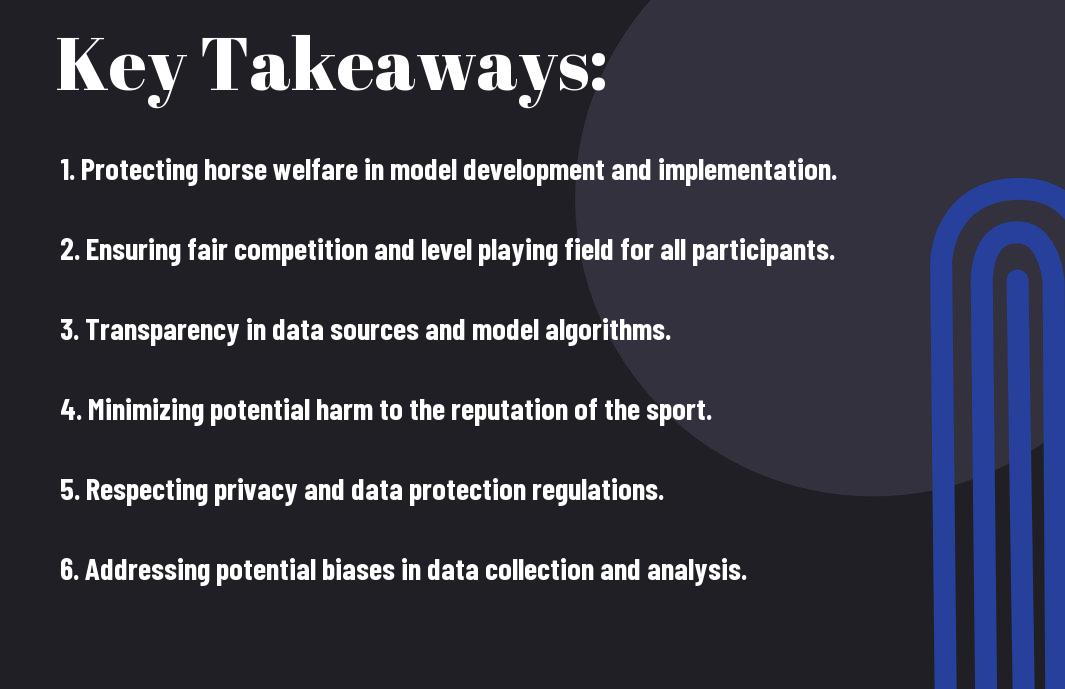
Key Takeaways:

  • Transparency: It is vital for developers of horse race prediction models to be transparent about the data used, the methodologies applied, and the potential biases in the model.
  • Fairness: Ethical considerations should be made to ensure that the models do not discriminate against certain horses, trainers, or jockeys based on irrelevant factors such as gender or race.
  • Accountability: Developers should be held accountable for the predictions made by their models and take responsibility for any negative impacts that may arise from inaccuracies or biases in the model.

The Ethics of Prediction

The Responsibility of Forecasting

Before delving into the intricacies of developing horse race prediction models, it is necessary to consider the ethical implications of forecasting. As a developer of prediction models, you hold a significant responsibility in ensuring that your predictions are made ethically and with the utmost consideration for the well-being of all involved. It is crucial to approach the task with integrity, transparency, and a deep understanding of the potential consequences of your predictions.

The Impact of Inaccurate Predictions

Prediction models, especially those related to horse racing, can have far-reaching effects on various stakeholders. Inaccurate predictions can lead to financial losses, emotional distress, and even harm to the welfare of the horses or individuals involved. As you develop your prediction models, it is imperative to acknowledge the potential impact of inaccuracies and work towards minimizing these risks. By prioritizing accuracy, ethical considerations, and continuous evaluation of your models, you can help mitigate the negative repercussions of inaccurate predictions.

With the power of prediction comes great responsibility. It is necessary to approach the development of horse race prediction models with a deep sense of ethical awareness and a commitment to uphold the welfare of all those affected by your forecasts. By embracing transparency, accountability, and a conscientious approach to forecasting, you can navigate the complex ethical landscape of prediction modeling with integrity and prudence.

Data Collection and Bias

Even in horse race prediction models, data collection is a crucial aspect that can dictate the success or failure of your endeavors. It is vital to consider the sources of data you are utilizing and their potential limitations.

Sources of Data and Their Limitations

Their selection and quality can significantly impact the performance and ethical considerations of your prediction model. Ensure that the data you collect is diverse, representative, and devoid of any underlying biases to avoid misleading outcomes.

Avoiding Implicit Bias in Data Collection

Data collection plays a pivotal role in shaping the accuracy and fairness of your prediction model. It is imperative to approach data collection with a critical eye to prevent the introduction of implicit biases that could skew your results.

Bias can manifest in various forms, such as skewed sampling methods, incomplete data sets, or even unintentional preferences in selecting certain variables. Being mindful of these potential pitfalls and incorporating checks and balances in your data collection process can help mitigate these biases and enhance the robustness of your model.

The Dangers of Cherry-Picking Data

Collection of data should be approached with integrity and transparency to avoid the dangers of cherry-picking. Selectively choosing data points that align with your desired outcome can lead to skewed predictions and ethical concerns.

This practice not only compromises the credibility of your model but also raises ethical questions about the validity and fairness of your predictions. By prioritizing a comprehensive and unbiased approach to data collection, you can uphold the integrity of your horse race prediction model and foster trust among stakeholders.

Model Development and Transparency

The Importance of Transparent Modeling

Many ethical considerations come into play when developing horse race prediction models, and one of the most critical is the need for transparent modeling. Transparency in model development is crucial to ensure that the processes, data sources, and methodologies used are clear and understandable. When developing prediction models for horse racing, transparency helps to build trust with stakeholders, including bettors, regulators, and the public.

Avoiding Black Box Models

One ethical consideration in developing horse race prediction models is the avoidance of black box models. Black box models are complex algorithms that provide predictions without revealing how these predictions are made. While these models may offer high accuracy, they lack transparency and make it challenging to understand why a particular prediction was generated.

One way to avoid black box models is by using interpretable methodologies that allow you to understand how input variables are weighted and how predictions are generated. This not only enhances transparency but also enables you to detect and mitigate biases that may be present in the model.

The Role of Human Judgment in Model Development

To ensure ethical considerations are met, it’s crucial to recognize the role of human judgment in model development. While algorithms play a significant role in predicting horse race outcomes, human judgment is crucial in designing the model, selecting relevant variables, and interpreting the results. Your expertise and ethical considerations can guide the development process to ensure fairness, accuracy, and transparency in the predictions.

With human judgment, you can consider factors beyond data inputs, such as historical trends, expert insights, and regulatory requirements, to refine and validate the model effectively. By combining your expertise with the power of algorithms, you can create prediction models that are not only accurate but also ethically sound.

Fairness and Justice in Predictive Models

The Concept of Fairness in Horse Racing

All predictive models should strive to uphold the principles of fairness and equity, especially in the context of horse racing. To ensure fairness, it is crucial to consider the impact of the predictive model on all involved parties, including the horses, jockeys, trainers, owners, and bettors. Fairness in horse racing prediction models means that the predictions and outcomes do not systematically favor certain individuals or groups over others.

Avoiding Discrimination in Model Development

Model developers must be vigilant in avoiding any form of discrimination when creating horse race prediction models. Discriminatory practices, whether intentional or unintentional, can have detrimental effects on the integrity of the racing industry and the well-being of its participants. It is crucial to actively assess and address any biases present in the data used to train the models to prevent discrimination.

Models should be designed to treat all participants fairly and impartially, regardless of factors such as horse breed, jockey background, or trainer reputation. By incorporating ethical considerations into the development process, model creators can help mitigate potential discriminatory outcomes and promote a more inclusive and just racing environment.

Ensuring Equal Opportunities for All Participants

Model developers should prioritize ensuring equal opportunities for all participants in horse racing. This includes fostering a level playing field where each horse, jockey, trainer, and owner has a fair chance to succeed based on their skills, training, and performance, rather than arbitrary or biased factors. By promoting equal opportunities, predictive models can contribute to a more transparent and equitable horse racing industry.

Justice in predictive modeling for horse racing involves upholding principles of fairness and equity, and striving to minimize any disparities or advantages that may arise from the use of predictive models. By prioritizing justice in model development and implementation, stakeholders can work towards a more ethical and sustainable future for horse racing.

Privacy and Data Protection

Keep Avoiding the horse race: a resource guide for ethical election coverage in mind when developing horse race prediction models to ensure the ethical considerations around privacy and data protection are met.

Protecting Sensitive Information

Sensitive information such as personally identifiable data or health information should be handled with utmost care when developing horse race prediction models. It is crucial to anonymize or encrypt this data to prevent it from being misused or accessed by unauthorized parties.

Ensuring Compliance with Data Protection Regulations

Ensuring compliance with data protection regulations such as the General Data Protection Regulation (GDPR) is necessary in the development of horse race prediction models. You must be diligent in obtaining consent for data collection, storing data securely, and complying with regulations regarding data usage and transfer.

Data protection regulations are designed to safeguard individuals’ personal information and must be strictly adhered to when dealing with sensitive data in the context of horse race prediction modeling.

The Consequences of Data Breaches

An understanding of the consequences of data breaches is crucial when developing horse race prediction models. A data breach can result in severe privacy violations, financial losses, and reputational damage. It is important to have robust security measures in place to prevent and mitigate the risks of data breaches.

Information security is paramount in the development of horse race prediction models, as even a single data breach can have far-reaching consequences for both individuals and organizations involved. It is necessary to prioritize data protection and security at every stage of model development to uphold ethical standards and protect sensitive information.

Accountability and Regulation

The Role of Regulatory Bodies in Ensuring Ethical Models

Despite the advancements in technology and data analytics, the development of horse race prediction models must be guided by ethical considerations. Regulatory bodies play a crucial role in ensuring that these models are developed and deployed ethically. These bodies are responsible for setting guidelines and standards that developers must adhere to when creating prediction models. By enforcing regulations, they help protect against biased or unfair practices in model development, ensuring transparency and accountability.

Holding Developers Accountable for Model Performance

On the path to ethical model development, holding developers accountable for the performance of their models is paramount. Developers should be transparent about the methodologies and data used in their models, allowing for external validation and scrutiny. By holding developers responsible for the outcomes of their models, there is an incentive to prioritize fairness and accuracy over potentially harmful shortcuts or biases.

Models should be evaluated not only based on their predictive performance but also on their societal impact. Developers should be held accountable for any negative consequences that may arise from the implementation of their models, taking responsibility for the ethical implications of their work.

Establishing Industry-Wide Standards for Ethical Model Development

Performance standards alone are not enough to ensure ethical model development. Establishing industry-wide standards that encompass fairness, transparency, and accountability is important. These standards should be collaboratively developed by stakeholders in the horse racing prediction industry, including developers, regulators, and ethicists. By adhering to these standards, developers can ensure that their models are not only accurate but also ethical in their design and implementation.

Another aspect of establishing industry-wide standards is the ongoing monitoring and evaluation of model performance. This continuous assessment allows for adaptations and improvements to be made, ensuring that ethical considerations remain at the forefront of model development in horse race prediction.

Conclusion

Presently, as you probe into developing horse race prediction models, it is crucial to consider the ethical implications of such endeavors. The welfare of the horses involved in these races should be at the forefront of your considerations. It is important to ensure that the use of these models does not compromise the well-being of the animals, as detailed in a research paper on (PDF) The ethics and welfare of horses intensively used in horse racing.

Additionally, you must also take into account issues of fairness, transparency, and integrity when developing such models. Ethical considerations should guide your every decision, from data collection and analysis to the implementation of the predictive algorithms. By keeping ethical principles at the core of your work, you can contribute to the development of responsible and sustainable practices in horse race prediction modeling.

FAQ

Q: What ethical considerations should be taken into account when developing horse race prediction models?

A: One important ethical consideration is data privacy and transparency. It’s important to ensure that the data used in developing the prediction models is obtained and used in a legal and ethical manner. Transparency is also key, as users should be informed about the data sources and methodologies used in creating the models.

Q: How can bias be addressed in horse race prediction models?

A: Bias can be a significant issue in prediction models, as it can lead to unfair outcomes. To address bias in horse race prediction models, it’s important to carefully evaluate the data being used and to actively work to mitigate any biases that may be present. This can include diversifying the data sources, using fair algorithms, and regularly monitoring and updating the models.

Q: What impact can horse race prediction models have on the sport and betting industry?

A: Horse race prediction models can have a significant impact on the sport and betting industry. While these models can provide valuable insights and improve decision-making for stakeholders, there is also the potential for negative consequences such as increased problem gambling and loss of the human element in decision-making. It’s important to carefully consider and mitigate these potential impacts when developing and using prediction models in this context.

Bonza training Skip to content