Prediction

How can historical race data be used to predict future horse race results

It’s fascinating to uncover how historical race data can assist in foreseeing future horse race outcomes. By delving into past performances, you can unravel patterns, trends, and insights that may hold the key to predicting winners. If you’re intrigued by the intersection of data analysis and horse racing, look into this informative study on Horse Race Results Prediction Using Machine Learning and discover the intriguing world of data-driven race predictions.

Key Takeaways:

  • Historical race data can provide valuable insights: Studying past horse race results can help identify patterns, trends, and factors that may influence future performances.
  • Data analysis and statistical models play a crucial role: Utilizing advanced analytical tools and algorithms can help in predicting potential outcomes based on historical race data.
  • Continuous refinement and adaptation are necessary: Due to the unpredictable nature of horse racing, it is important to constantly update models and strategies based on new data and evolving trends.

The Significance of Historical Race Data

The Importance of Past Performance

Before delving into how historical race data can be used to predict future outcomes, it is important to understand the significance of past performance. Research conducted by Priyanka Selvaraj on Predicting The Outcome Of The Horse Race Using Data reveals that past performances of horses in races provide valuable insights into their potential success in upcoming events. By analyzing factors such as track conditions, jockey performance, and previous race results, you can gain a clearer understanding of which horses are likely to excel in future races.

Identifying Patterns and Trends

Significance lies in the ability to identify patterns and trends within historical race data. It is through the analysis of past race results that you can uncover recurring themes and behaviors that may indicate future success. By examining factors such as winning streaks, performance on specific track types, and success rates under various conditions, you can start to recognize patterns that may influence the outcomes of future races.

It is fascinating to see how certain horses consistently perform well in specific conditions or against particular competitors. By recognizing these patterns, you can make more informed predictions about which horses are likely to outperform the competition in upcoming races. This insight allows you to make strategic decisions when placing bets, increasing your chances of success in horse race predictions.

Analyzing Historical Data

The How can a computer predict the result of a horse race? article explains how historical race data is crucial in predicting future horse race results. By analyzing past performances, you can gain valuable insights into a horse’s capabilities and tendencies on the track. This data-driven approach allows you to make more informed decisions when placing your bets.

Types of Data to Collect

For analyzing historical race data, you need to collect various types of data related to each horse, jockey, track conditions, and race outcomes. By carefully examining this information, you can identify patterns and trends that may impact future race results. Any successful prediction model requires a comprehensive dataset to draw accurate conclusions.

Category Examples
Horse Information Age, Breed, Health Records
Jockey Details Experience, Win Percentage
Track Conditions Surface Type, Weather, Time of Day
Race Outcomes Final Placement, Time, Margin of Victory

Data Mining Techniques

The process of data mining involves extracting valuable insights from large datasets to identify meaningful patterns and relationships. By utilizing advanced algorithms and statistical models, you can uncover hidden trends that may not be apparent at first glance. These techniques help you make more accurate predictions based on historical data.

Another important aspect of data mining is feature selection, where you choose the most relevant variables that contribute to predicting race outcomes. By focusing on key data points and eliminating irrelevant information, you can improve the accuracy of your predictive models. Additionally, regularization techniques can help prevent overfitting and ensure your model generalizes well to new data.

Avoiding Biases and Errors

Techniques such as cross-validation and outlier detection are crucial for avoiding biases and errors in your predictive models. By testing the performance of your model on unseen data and identifying and correcting outliers that may skew your results, you can improve the reliability of your predictions. It is crucial to constantly refine your algorithms and validate your findings to ensure the accuracy of your predictions.

Analyzing historical race data with advanced data mining techniques can help you uncover valuable insights that can be used to predict future horse race results more accurately. By collecting diverse datasets, applying sophisticated algorithms, and refining your models to avoid biases, you can enhance your predictive capabilities and increase your chances of success at the racetrack.

Identifying Key Performance Indicators

Speed Figures and Time Analysis

Indicators like speed figures and time analysis are crucial in predicting future race results. By examining a horse’s past performances in terms of speed and time, you can gauge its potential to perform well in upcoming races. Speed figures provide a numerical representation of a horse’s speed performance in previous races, while time analysis helps you understand how a horse’s time compares to others in similar conditions.

Jockey and Trainer Performance

Performance of jockeys and trainers play a significant role in determining race results. A skilled jockey who knows how to handle a horse effectively can greatly impact its performance on the track. Likewise, a successful trainer can condition a horse to peak performance. When analyzing historical data, pay close attention to the track record of both the jockey and the trainer to gain insights into how they might influence the outcome of future races.

Plus, consider factors such as the jockey-trainer combination. Some jockeys and trainers work exceptionally well together, forming a winning partnership that can increase the chances of success on race day. By identifying these strong partnerships in historical data, you can make more informed predictions about which horses are likely to perform well in upcoming races.

Track and Distance Considerations

To accurately predict race results, you must take into account the specific track and distance considerations. Different horses have varying strengths and preferences when it comes to track conditions and race distances. By studying historical race data, you can identify patterns in how horses perform on specific tracks and at different distances, allowing you to make more precise predictions for future races.

The track itself can have a significant impact on a horse’s performance. Some horses excel on firm, dry tracks, while others perform better on wet or muddy surfaces. Understanding how different tracks affect horse performance can give you a valuable edge when predicting race outcomes.

Creating a Predictive Model

Statistical Analysis and Regression

Creating a predictive model for horse race results involves a deep examine statistical analysis and regression techniques. By examining historical race data, you can identify patterns and relationships that can help predict future outcomes. Regression analysis allows you to quantify the impact of various factors such as jockey performance, track conditions, and horse pedigree on race results.

Machine Learning Algorithms

Statistical models alone may not be sufficient to capture the complexity of horse racing. Machine learning algorithms offer a more sophisticated approach to predictive modeling by leveraging data patterns and making accurate predictions. Algorithms like Random Forest, Gradient Boosting, and Neural Networks can analyze vast amounts of data to forecast race results with high precision.

Machine learning algorithms can adapt and improve over time as they process new data, making them valuable tools for predicting horse race outcomes. By continuously updating the model with the latest race results and performance metrics, you can enhance its predictive capabilities and stay ahead of the competition.

Predictive Integrating Multiple Factors

Predictive modeling in horse racing goes beyond individual factors and involves integrating multiple variables to improve accuracy. Factors such as horse speed, jockey experience, weather conditions, and track history all play a significant role in determining race results. By considering a combination of these factors, you can build a more robust predictive model that accounts for various influences.

  • Analyzing the interactions between different factors can reveal hidden correlations and insights that drive race outcomes.
  • Though individual factors are important, it is the combination and interactions among them that truly enhance the predictive power of your model.

The integration of multiple factors in your predictive model allows you to capture the complexity of horse racing and make more accurate predictions. By weighing each factor’s importance and understanding how they intersect, you can develop a comprehensive model that increases your chances of success in predicting race results.

  • When integrating multiple factors, it’s imperative to prioritize those that have the most significant impact on race outcomes to refine the accuracy of your predictions.
  • Though individual factors are crucial, the synergy among them determines the effectiveness of your predictive model in the competitive world of horse racing.

Validating the Model

Backtesting and Historical Simulation

For a predictive model based on historical race data, backtesting and historical simulation are crucial steps to validate its accuracy. Backtesting involves testing the model against past data to see how well it would have predicted actual race outcomes. By simulating the model with historical data, you can assess its performance and reliability in predicting race results.

Evaluating Model Performance

Model evaluation is vital to ensure the accuracy and effectiveness of your predictive model. By analyzing metrics such as precision, recall, and F1 score, you can determine how well the model performs in predicting race outcomes. Additionally, you can use techniques like cross-validation to assess the model’s generalizability and robustness across different datasets.

Performance evaluation is an ongoing process that requires monitoring and fine-tuning the model to improve its predictive capabilities continually. By regularly assessing the model’s performance metrics and making adjustments as needed, you can enhance its accuracy and reliability in predicting future horse race results.

Refining the Model through Iteration

Model refinement through iteration involves continuously improving the predictive model based on feedback from its performance in predicting race outcomes. By analyzing the model’s strengths and weaknesses, you can make targeted adjustments to enhance its accuracy and efficiency. Iterative refinement allows you to adapt the model to changing race dynamics and improve its predictive power over time.

Understanding the importance of iterative refinement in model development is key to building a reliable and effective predictive model for horse race results. By incorporating feedback and continuously optimizing the model, you can create a robust predictive tool that helps you make informed decisions when betting on horse races.

Limitations and Challenges

Dealing with Incomplete or Inaccurate Data

To effectively use historical race data to predict future horse race results, you must be prepared to deal with incomplete or inaccurate data. In the world of horse racing, not all data points are perfect, and some may be missing or incorrect. This can pose a significant challenge when trying to generate accurate predictions based on historical trends and patterns.

Accounting for Intangible Factors

When using historical race data to predict future outcomes, you must also account for intangible factors that may affect race results. These factors, such as the condition of the track, the health of the horses, or even the jockey’s mindset on race day, can all play a crucial role in determining the outcome of a race. Any overlooking of these intangible factors could lead to flawed predictions and unreliable results.

  • Incomplete or inaccurate historical race data may lead to unreliable predictions.
  • Ignoring intangible factors can result in flawed race predictions.

This brings us to the importance of considering these intangible factors when analyzing historical race data. By taking into account variables beyond just the statistics and figures, you can paint a more comprehensive picture of the races and make more informed predictions. Any oversight in this area could potentially skew your predictions and lead to inaccurate results.

Staying Ahead of Changing Circumstances

Data in horse racing is constantly evolving, with new information and trends emerging regularly. To stay ahead of changing circumstances, you must continuously update and adapt your analysis methods. By regularly incorporating new data and staying informed about the latest developments in the horse racing world, you can enhance the accuracy of your predictions and maintain a competitive edge.

Accounting for these changes and evolving circumstances is crucial in ensuring the reliability of your predictions. By staying vigilant and adaptable in your approach to analyzing historical race data, you can improve the precision and effectiveness of your predictions moving forward.

Summing up

To wrap up, historical race data can be a valuable tool in predicting future horse race results. By studying past performances, analyzing track conditions, jockey and trainer statistics, you can gain insights that can help you make more informed betting decisions. However, it’s crucial to remember that horse racing is unpredictable, and there are always factors beyond historical data that can influence the outcome of a race. By using historical race data as one of many tools in your betting strategy, you can increase your chances of success in the exciting world of horse racing.

Q: How can historical race data be used to predict future horse race results?

A: Historical race data can be used to analyze a horse’s performance in past races, including factors such as race distance, track conditions, jockey performance, and competition level. By identifying patterns and trends in a horse’s past performances, bettors can make more informed predictions about its potential performance in future races.

Q: What are some key indicators in historical race data that can help predict future race results?

A: Some key indicators in historical race data that can help predict future race results include a horse’s past finishing positions, speed figures, average race times, jockey-trainer combinations, and track biases. By analyzing these indicators, bettors can gain insights into a horse’s strengths and weaknesses and make more accurate predictions about its performance in upcoming races.

How reliable is historical race data in predicting future race results?

A: While historical race data can provide valuable insights into a horse’s performance and help bettors make more informed predictions, it is important to remember that horse racing is a complex and unpredictable sport. Factors such as injuries, track conditions, and unexpected race incidents can all impact a horse’s performance on race day. Therefore, while historical race data can be a useful tool in handicapping races, it should be used in conjunction with other factors such as current form, trainer patterns, and track conditions to make more accurate predictions.

How can machine learning algorithms be applied to horse race prediction

Over the years, the integration of machine learning algorithms in various industries has revolutionized the way predictions are made. If you have a fascination for horse racing and the thrill of predicting a winner, then you’re in for a treat. In this blog post, we will explore how you can leverage machine learning algorithms to enhance your horse race prediction capabilities. By understanding the data, selecting the right features, and training the algorithm effectively, you can potentially gain an edge in predicting the outcome of a horse race.

Key Takeaways:

  • Feature selection is crucial: Selecting the right features such as past performance, jockey, track conditions, and more is necessary for accurate predictions.
  • Use of supervised learning algorithms: Algorithms like Random Forest, Gradient Boosting, and Neural Networks can be effective in predicting horse race outcomes by learning patterns from historical data.
  • Continuous model refinement: Regularly updating and refining machine learning models based on new data and feedback can improve prediction accuracy over time.

The Basics of Horse Racing

Historical Background

With a history dating back thousands of years, horse racing has been a popular sport enjoyed by many cultures around the world. The sport has evolved significantly over time, from ancient chariot races to the modern-day races we witness today at prestigious tracks like the Kentucky Derby and Royal Ascot.

Key Factors Affecting Race Outcomes

Race outcomes in horse racing are influenced by a variety of factors that can impact the performance of the horses and jockeys. These key factors include the horse’s past performance, track conditions, jockey skill, and even the post position drawn for the race. Perceiving these factors and how they interact can help you make more informed predictions when placing your bets.

  • Horse’s past performance
  • Track conditions
  • Jockey skill
  • Post position

Machine Learning Fundamentals

Assuming you are interested in exploring how machine learning algorithms can improve horse race prediction, you should check out the article on Use Case #3: Horse Racing Prediction : A Machine Learning Approach.

Supervised Learning

Any successful machine learning approach to horse race prediction starts with supervised learning, where the algorithm learns from labeled training data to make predictions. By analyzing historical race data, including variables like past performance, track conditions, and jockey statistics, the algorithm can identify patterns that lead to accurate predictions of race outcomes.

Unsupervised Learning

For a more exploratory approach, unsupervised learning techniques can be applied to horse race prediction. Unsupervised learning allows you to analyze data without predetermined labels, helping you discover hidden patterns and insights that may not be apparent through supervised methods. This can be particularly useful in uncovering unique trends or correlations that can give you a competitive edge in predicting race results.

Unsupervised learning techniques like clustering can group horses with similar characteristics together, helping you identify relationships that go beyond conventional wisdom in horse racing prediction. This can lead to innovative strategies and approaches that set you apart in the highly competitive world of horse race betting.

Neural Networks and Deep Learning

Neural networks and deep learning models offer a powerful tool for horse race prediction by simulating the human brain’s neural networks to analyze complex patterns in data. These advanced algorithms can learn to recognize intricate relationships in vast amounts of race data, providing highly accurate predictions based on a deep understanding of the factors that influence race outcomes.

Neural networks and deep learning excel in capturing subtle nuances and nonlinear relationships in horse race data that may elude traditional machine learning techniques. By leveraging these cutting-edge algorithms, you can enhance your prediction accuracy and stay ahead of the curve in the dynamic world of horse race betting.

Machine learning brings a new level of sophistication and accuracy to horse race prediction, allowing you to harness the power of data-driven insights to make informed betting decisions and increase your chances of success. By understanding the fundamentals of supervised and unsupervised learning, as well as the capabilities of neural networks and deep learning, you can develop innovative strategies and refine your predictive models to achieve superior results in horse race prediction.

Your Data Collection and Preprocessing

Sources of Data

Collection of data is crucial in predicting outcomes of horse racing using machine learning algorithms. Various sources can provide the necessary data for training models. One such source can be found in the article ‘Predicting Outcomes of Horse Racing using Machine …‘. This data can include past performance records of horses, jockeys, track conditions, weather, and more.

Feature Engineering

The feature engineering process involves selecting the most relevant attributes from the collected data to build predictive models. This step is necessary as it directly impacts the performance of the machine learning algorithms in making accurate predictions.

This process can involve transforming existing features, creating new features based on domain knowledge, and selecting the most informative attributes. By engineering the right features, you can improve the model’s ability to generalize and make predictions on new data effectively.

Data Cleaning and Normalization

The data cleaning and normalization phase focuses on preparing the collected data for machine learning algorithms. During this process, irrelevant or redundant data points are removed, missing values are imputed, and the data is scaled to ensure consistency in the dataset.

A standardized dataset enhances the performance and efficiency of machine learning models. By normalizing the data, you reduce the impact of varying scales and units, making it easier for the algorithms to interpret and learn from the data effectively.

Feature Selection and Engineering

After collecting data for your horse race prediction model, the next step is to carefully select and engineer the features that will have the most impact on the prediction accuracy. This process involves identifying relevant features, creating derived features, and handling missing values to ensure your model is robust and effective.

Identifying Relevant Features

Any successful machine learning model relies heavily on the selection of relevant features that have a strong correlation with the target variable. By analyzing the data and understanding the domain, you can identify which features are likely to have a significant impact on the outcome of the race. Features such as past performance, jockey statistics, weather conditions, and track type can all play a crucial role in predicting the winner.

Creating Derived Features

Selection of features is not limited to the ones available in the dataset. You can also create derived features by combining existing features or extracting new information to enhance the predictive power of your model. For example, you can calculate the average race speed based on past performances or create a composite feature that combines jockey win rate and horse age to capture more complex relationships in the data.

Handling Missing Values

Features in your dataset may have missing values, which can negatively impact the performance of your machine learning model. It’s crucial to handle these missing values effectively to ensure the integrity of your data. You can choose to impute missing values by using statistical measures such as mean, median, or mode, or employ more advanced techniques like K-Nearest Neighbors (KNN) to fill in missing values based on similar data points.

Plus, you can also consider creating additional boolean flags to indicate whether a value was missing in the original dataset. This way, your model can learn to account for missing data as a separate category, which might contain valuable information for making predictions.

Model Selection and Training

Regression Analysis

Once again, in the process of applying machine learning algorithms to horse race prediction, the first step involves the selection of a suitable regression model. This choice is crucial as it will determine the accuracy and effectiveness of your predictions. Regression analysis aims to establish the relationship between variables, such as past race performance and factors like track conditions and jockey experience, to predict the outcome of future races.

Classification Models

Selection of the right classification model is imperative in predicting the performance of horses in races. Training these models involves feeding them historical data on various parameters like horse age, weight, speed figures, and past performance to enable them to make accurate predictions about future outcomes. Decision trees, logistic regression, and support vector machines are popular choices for building classification models in horse race prediction.

When training classification models for horse race prediction, it is imperative to choose algorithms that can handle the complexity of the data and adapt to the dynamic nature of horse racing. By fine-tuning the parameters and optimizing the model’s performance, you can improve the accuracy of your predictions and make more informed decisions when placing bets.

Ensemble Methods

Models

Ensemble methods like random forests and gradient boosting can be powerful tools in horse race prediction. By combining multiple base models and aggregating their predictions, ensemble methods can improve the overall accuracy and robustness of your predictions. These methods are particularly useful when dealing with noisy or complex data, providing a more reliable way to forecast race outcomes.

Regression

Another option for improving the accuracy of your predictions is to use ensemble methods in regression analysis. Techniques like bagging and boosting can help reduce overfitting and increase the stability of your models, leading to more reliable predictions in the unpredictable world of horse racing.

Another

Model Evaluation and Refining

Now, let’s explore how to evaluate and refine machine learning models for horse race prediction.

Performance Metrics

Model performance can be assessed using various metrics such as accuracy, precision, recall, and F1 score. Accuracy measures the overall correctness of the model, while precision focuses on the proportion of correctly predicted positive instances. Recall, on the other hand, evaluates the ability of the model to capture all positive instances. The F1 score provides a balance between precision and recall, giving you a single metric to evaluate the model’s performance comprehensively.

Hyperparameter Tuning

Metrics such as grid search and random search can be used to fine-tune the hyperparameters of machine learning algorithms. Grid search exhaustively searches through a specified parameter grid to determine the best parameters, while random search samples randomly from the parameter space. By optimizing hyperparameters, you can improve the model’s performance and ensure it generalizes well to new data.

With hyperparameter tuning, you can experiment with different settings to enhance the model’s predictive capabilities. By fine-tuning parameters such as learning rate, maximum depth, or number of estimators, you can customize the model to suit the specific requirements of horse race prediction. This process allows you to find the optimal configuration that maximizes predictive accuracy and generalization to new data.

Model Interpretability

Model interpretability is crucial for understanding how machine learning algorithms make predictions in the context of horse race prediction. Techniques such as feature importance analysis, partial dependence plots, and SHAP values can help you interpret the outputs of the model and gain insights into which features are driving the predictions. By unraveling the black box of machine learning models, you can explain the reasoning behind the predictions and build trust in the model’s results.

Model interpretability not only provides transparency into the model’s decision-making process but also helps you identify potential biases or errors in the predictions. By delving into the inner workings of the model, you can refine its performance and ensure that it aligns with your objectives for horse race prediction.

Refining machine learning models for horse race prediction involves evaluating their performance, tuning hyperparameters for optimal results, and enhancing their interpretability. By following these steps, you can fine-tune your models to make accurate predictions and gain valuable insights into the factors influencing race outcomes.

Final Words

To wrap up, you have learned about how machine learning algorithms can be applied to horse race prediction. By utilizing vast amounts of historical data, these algorithms can analyze patterns and trends to make predictions about which horse is most likely to win a race. While no prediction can be 100% accurate, machine learning has shown promising results in enhancing the accuracy of horse race predictions and providing valuable insights to bettors.

Q: How can machine learning algorithms be applied to horse race prediction?

A: Machine learning algorithms can be applied to horse race prediction by analyzing a vast amount of data such as past race results, horse characteristics, jockey performance, track conditions, and more. By training the algorithms on historical data, they can learn patterns and trends that can help predict the outcome of future horse races.

Q: What types of machine learning algorithms are commonly used for horse race prediction?

A: Commonly used machine learning algorithms for horse race prediction include decision trees, random forests, support vector machines, and neural networks. Each algorithm has its own strengths and weaknesses, and the choice of algorithm depends on the specific characteristics of the data and the prediction task.

Q: How accurate are machine learning algorithms in predicting horse race outcomes?

A: The accuracy of machine learning algorithms in predicting horse race outcomes can vary depending on the quality of the data, the features included in the analysis, and the complexity of the prediction task. While machine learning algorithms can provide valuable insights and improve the chances of making successful predictions, it is important to remember that horse racing is a complex and unpredictable sport, and there are no guarantees of accuracy.

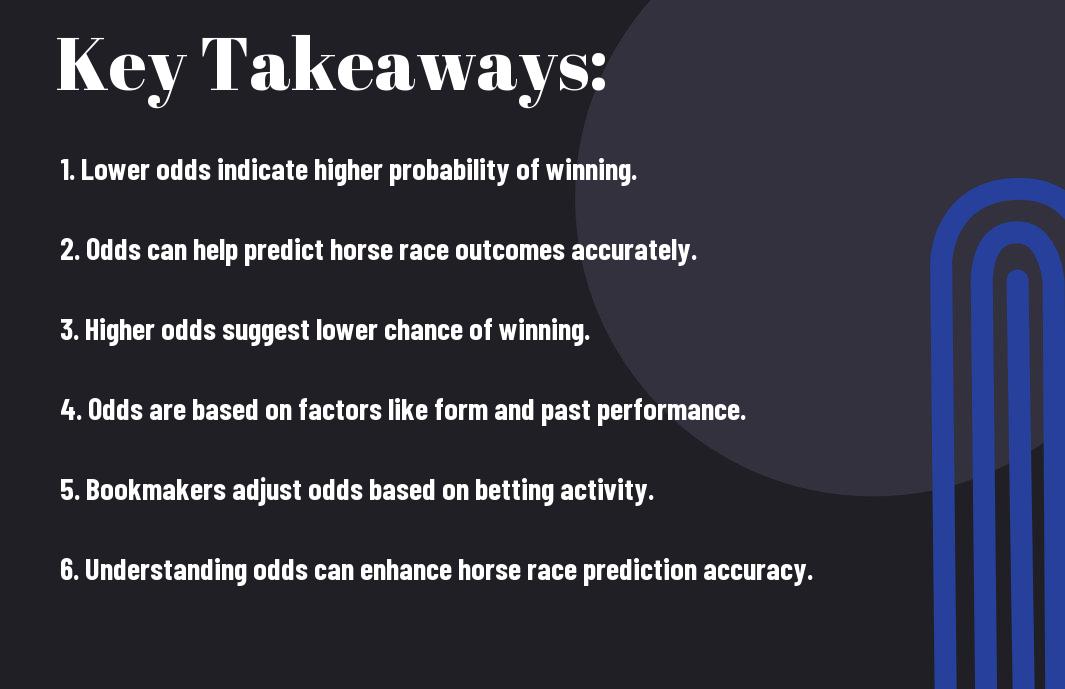
How do betting odds correlate with horse race prediction accuracy

There’s a fascinating relationship between betting odds and horse race prediction accuracy that can impact how you strategize your bets. Understanding how these odds are determined and how they relate to the actual outcome of a race can give you valuable insights into making more informed decisions when it comes to betting on horse races. Let’s examine into the intriguing world of betting odds and prediction accuracy in the context of horse racing.

Key Takeaways:

  • Betting odds reflect the perceived likelihood of a horse winning: Lower odds indicate higher expectations of success, while higher odds indicate lower expectations.
  • Correlation exists between lower odds and higher prediction accuracy: Horses with lower odds are more likely to win, making them more predictable for race prediction accuracy.
  • Using betting odds in combination with other factors can improve prediction accuracy: While odds can be a helpful indicator, combining them with additional information such as past performance and track conditions can lead to more accurate race predictions.

The Basics of Horse Racing and Betting Odds

A brief history of horse racing and betting

Odds are an integral part of horse racing and betting. Horse racing has a rich history that dates back centuries, with roots in ancient civilizations like the Greeks and Romans who held chariot races. Over time, horse racing evolved into the sport we know today, with organized races and betting becoming a significant aspect of the industry.

Today, horse racing is a popular sport globally, with various types of races such as flat racing, steeplechasing, and harness racing. Betting on horse races adds an element of excitement and anticipation for spectators, with odds playing a crucial role in the betting process.

How betting odds are calculated

Any seasoned bettor knows that understanding how betting odds are calculated is crucial for making informed bets. Betting odds are determined based on the probability of a horse winning a race. Factors such as the horse’s past performance, jockey, track conditions, and competition all play a part in calculating odds.

Bookmakers use a complex algorithm to set odds, taking into account various variables to ensure a fair and accurate representation of each horse’s chances of winning. The odds reflect not only the likelihood of a horse winning but also the potential payout for bettors.

Betting on horse races can be both thrilling and rewarding, especially when you grasp the significance of odds in the betting process. Understanding the basics of horse racing and betting odds can give you valuable insights into how to approach betting strategically and increase your chances of making successful bets.

The Role of Probability in Horse Racing

The concept of probability in horse racing

Some of the most critical aspects of horse racing involve understanding the concept of probability. In horse racing, probability refers to the likelihood of a particular event happening, such as a specific horse winning a race. By analyzing past performances, track conditions, jockey statistics, and other relevant factors, you can calculate the probability of each horse winning a race.

How probability affects betting odds

On the other hand, probability also plays a significant role in determining betting odds in horse racing. Bookmakers use the calculated probabilities to set the odds for each horse in a race. The more likely a horse is to win, the lower the odds will be. Conversely, the less likely a horse is to win, the higher the odds will be. Understanding how probability affects betting odds can help you make more informed decisions when placing your bets.

Probability ultimately influences how much you can potentially win when betting on horse races. Bookmakers adjust the odds based on the perceived probability of each horse winning, so the more accurate your own probability calculations are, the better equipped you’ll be to identify value bets with favorable odds.

Analyzing the Correlation between Betting Odds and Prediction Accuracy

Historical data analysis: Do betting odds reflect true probabilities?

All too often, you might wonder whether the odds provided by bookmakers truly reflect the actual probabilities of a horse winning a race. On your quest to understand the correlation between betting odds and prediction accuracy, historical data analysis can be a valuable tool. By examining past races and outcomes, you can start to gauge whether there is a pattern of correlation between the odds offered and the actual results.

Identifying patterns and trends in betting odds and prediction accuracy

Analyzing betting odds and prediction accuracy involves more than just looking at individual races. It requires a keen eye for spotting trends and patterns that can provide valuable insights into the predictive nature of odds. By delving into the data and observing how odds fluctuate leading up to a race, you can start to unravel the intricacies of how bookmakers and punters assess the chances of each horse.

The relationship between betting odds and prediction accuracy is a complex one, influenced by a myriad of factors such as form, track conditions, jockey performance, and even insider information. By analyzing these patterns, you can enhance your understanding of how betting odds are derived and how they impact the accuracy of race predictions.

Factors Influencing Betting Odds and Prediction Accuracy

The impact of horse and jockey performance on betting odds

Accuracy in predicting horse race outcomes is influenced by various factors, with the performance of the horse and jockey playing a significant role. Bookmakers analyze past performances, track records, and the reputation of both the horse and jockey when setting betting odds. A winning streak or a renowned jockey can sway the odds in favor of a particular horse, reflecting the perceived likelihood of success.

After considering the performance of the horse and jockey, bookmakers adjust the odds to align with their predictions based on these factors. A strong track record of victories might result in shorter odds, while inconsistent performances could lead to longer odds being offered.

The role of track conditions and weather on prediction accuracy

Accuracy in predicting horse race outcomes is also affected by track conditions and weather. Different horses perform better under specific conditions, such as firm or soft ground, and bookmakers take these factors into account when setting odds. Weather conditions, such as rain or strong winds, can also impact a horse’s performance on the track.

Another aspect to consider is that certain horses may have a preference for particular track conditions, giving them an advantage over competitors. Bookmakers incorporate this information into their odds to reflect the potential impact of track conditions and weather on race outcomes.

How public opinion and sentiment affect betting odds

An understanding of public opinion and sentiment is crucial in analyzing how they influence betting odds and prediction accuracy. Your perception of a horse’s chances of winning can be swayed by media coverage, rumors, or the popularity of a particular horse or jockey. Bookmakers consider this factor when adjusting odds to balance their risk exposure.

Performance in previous races also influences public opinion and sentiment, affecting the betting odds offered. If a horse has consistently performed well, public confidence and betting activity may increase, leading to shorter odds. Conversely, a string of losses or underwhelming performances can result in longer odds as public sentiment shifts.

The Psychology of Betting and Prediction

Cognitive biases in betting and prediction

On the journey of making betting decisions, your mind can play tricks on you. Cognitive biases, or the systematic patterns of deviation from norm or rationality in judgment, can heavily influence how you perceive information and make predictions. Some common biases include confirmation bias, where you seek out information that confirms your preconceptions, and availability bias, where recent or vivid information holds more weight in your decision-making process. Being aware of these biases and actively trying to counteract them can help you make more accurate assessments in betting and prediction.

The influence of emotions on betting decisions

To research into the world of betting is to confront a rollercoaster of emotions that can sway your decisions. Emotions like excitement, fear, and overconfidence can cloud your judgment and lead you astray when placing bets. Recognizing the role that emotions play in your decision-making process is crucial for maintaining a rational approach to betting. By learning to regulate your emotions and make decisions based on logic rather than impulse, you can improve your chances of making informed and strategic bets.

Prediction: Emotions are an inevitable part of the human experience and can greatly impact your betting decisions. When you feel overwhelmed by emotions, take a step back, assess the situation objectively, and consider the facts before making a bet. By acknowledging and managing your emotions, you can enhance your ability to make insightful predictions and increase your overall success in betting.

Advanced Analytics and Machine Learning in Horse Racing

Not all horse racing predictions are based solely on intuition or historical data anymore. Advanced analytics and machine learning have revolutionized the way analysts approach predicting the outcomes of horse races. In a study titled Horse Racing Prediction using Deep Probabilistic Programming, researchers probed into deep probabilistic programming to enhance prediction accuracy.

Using machine learning algorithms to predict horse racing outcomes

Advanced analytics

Machine learning algorithms have shown great promise in predicting horse racing outcomes. By analyzing vast amounts of data including past performance, track conditions, jockey and trainer statistics, and even weather forecasts, these algorithms can uncover patterns and insights that humans might overlook. These algorithms continuously learn and adapt, improving their accuracy over time.

The potential of advanced analytics in improving prediction accuracy

Learning

This approach opens up a world of possibilities in horse racing prediction. By leveraging advanced analytics, you can refine your predictions and make more informed betting decisions. These tools can help you uncover hidden trends, identify key factors influencing race outcomes, and ultimately increase your chances of success in the world of horse racing betting.

To wrap up

Conclusively, understanding the correlation between betting odds and horse race prediction accuracy can greatly enhance your ability to make informed decisions when placing bets. By recognizing that odds are not merely random numbers but rather reflections of the perceived likelihood of a horse winning a race, you can use this information to your advantage. By analyzing trends in odds and researching factors influencing them, you can increase your chances of making successful predictions and ultimately improve your chances of winning.

Q: How do betting odds correlate with horse race prediction accuracy?

A: Betting odds in horse racing are determined by the probability of a horse winning a race as perceived by the betting public. Generally, lower odds indicate a higher probability of winning according to the public consensus. However, it is important to note that betting odds do not always directly correlate with prediction accuracy. While they can provide some insight into the perceived chances of a horse winning, they are not a guarantee of accuracy.

Q: Can betting odds be used as a reliable indicator of a horse’s chances of winning a race?

A: While betting odds can provide valuable information about the perceived chances of a horse winning a race, they should not be the sole factor used in predicting the outcome. Factors such as past performance, track conditions, jockey and trainer statistics, and other relevant data should also be taken into consideration when making predictions. Betting odds should be used in conjunction with other information to make informed decisions.

Q: How should bettors incorporate betting odds into their horse race predictions?

A: Bettors can use betting odds as one of many tools in their prediction process. By comparing the betting odds with other factors such as form, class, track conditions, and jockey/trainer performance, bettors can get a more comprehensive view of a horse’s chances in a race. It is important to weigh all relevant factors and not rely solely on betting odds when making race predictions.

Bonza training Skip to content