
Revolution

Navigating the AI Revolution – Key Lessons for Modern Entrepreneurs

As you commence on your entrepreneurial journey, you’re likely to encounter the impact of artificial intelligence on your business. You will need to understand how AI is transforming industries and changing the way companies operate. Your ability to adapt to these changes will be vital to your success. You will learn how to harness the power of AI to drive innovation, improve efficiency, and stay ahead of the competition in this rapidly evolving landscape.

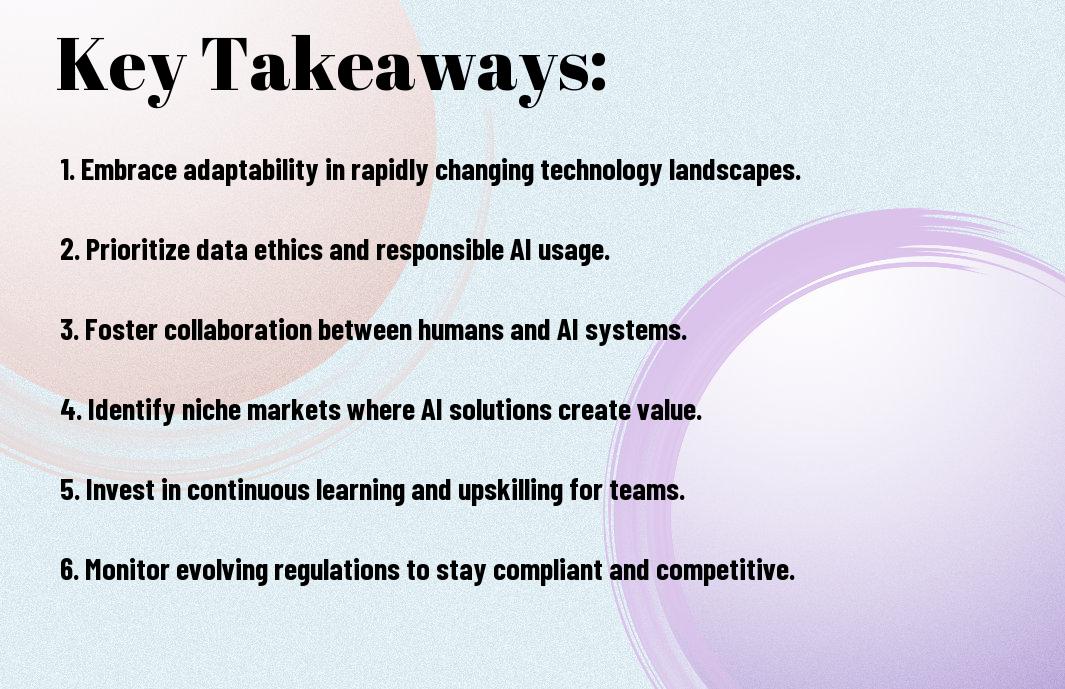
Key Takeaways:

  • Embracing AI can significantly enhance business operations, from automating routine tasks to providing insights that inform strategic decisions, allowing entrepreneurs to focus on innovation and growth.
  • Understanding the ethical implications of AI integration is vital, as it involves considerations around data privacy, job displacement, and bias in algorithmic decision-making, which can impact a company’s reputation and social responsibility.
  • Investing in AI literacy across the organization is important for modern entrepreneurs, enabling them to make informed decisions about AI adoption, manage AI-driven projects effectively, and foster a culture that leverages AI for competitive advantage.
  • Collaboration between humans and AI systems can lead to breakthroughs in problem-solving and innovation, suggesting that entrepreneurs should focus on designing work processes that complement AI capabilities with human skills like creativity, empathy, and critical thinking.
  • Staying adaptable and agile in the face of rapid AI advancements is key for entrepreneurs, requiring continuous learning, experimentation, and a willingness to pivot business models or strategies as new AI technologies emerge and mature.
The Current State of AI in Business

The integration of artificial intelligence (AI) in business is becoming increasingly prevalent, and you will notice its impact across various industries. As you explore the current state of AI, you will find that it is being used to automate tasks, analyze data, and make informed decisions. Your understanding of AI’s capabilities will help you navigate its applications in your own business.

Transformative Technologies

Revolutionary technologies like machine learning and natural language processing are changing the way you approach business operations. You can leverage these technologies to streamline processes, enhance customer experience, and gain a competitive edge. Your ability to adapt to these technologies will determine your success in the AI-driven market.

Industry Adoption Rates

Towards the end of adopting AI, you will notice varying rates of implementation across different industries. You can observe that some sectors are more receptive to AI solutions, while others are still in the early stages of adoption. Your awareness of these trends will help you make informed decisions about AI integration in your business.

State of the art technologies are being adopted at different rates, and you will see that some industries are more open to innovation. You can analyze the adoption rates to identify opportunities for growth and stay ahead of the competition. Your business can benefit from AI adoption, and understanding the current state of industry adoption will help you create a successful implementation strategy.

Strategic Integration of AI

Some of the most successful entrepreneurs have already begun leveraging AI to streamline their operations and gain a competitive edge. You can do the same by understanding how to integrate AI into your business strategy, which will enable you to make more informed decisions and drive growth.

Assessment of Business Needs

Beneath the surface of your business operations, there are areas where AI can bring significant improvements. You will need to assess your business needs to identify these areas and determine how AI can be used to address them, ensuring that your investments in AI technology are targeted and effective.

Implementation Frameworks

On the path to integrating AI into your business, you will need to establish a clear framework for implementation. You should consider factors such as data quality, algorithmic transparency, and employee training to ensure a smooth transition and maximize the benefits of AI adoption.

In addition to establishing a framework, you will also need to consider the ongoing maintenance and evaluation of your AI systems. You should regularly assess the performance of your AI tools, update them as necessary, and make adjustments to your strategy to ensure that you are achieving your desired outcomes and staying ahead of the competition.

Data as the New Currency

After understanding the significance of data in the AI revolution, you’ll realize its potential to transform your business. You’ll learn how to harness its power to drive innovation and growth.

Collection and Management

Among the various aspects of data, collecting and managing it effectively is key to unlocking its value. You’ll need to develop strategies to gather, store, and analyze data to inform your business decisions.

Privacy and Ethical Considerations

Driven by data, your business must prioritize privacy and ethical considerations. You’ll need to ensure that your data collection and usage practices are transparent and respectful of your customers’ rights.

And as you research deeper into the world of data, you’ll encounter complex issues surrounding privacy and ethics. You’ll need to consider how to balance your business needs with the need to protect your customers’ personal information, and develop policies that address these concerns in a way that maintains trust and credibility in your brand.

Workforce Evolution

Many entrepreneurs are aware that the AI revolution will significantly impact their workforce. You will need to adapt to these changes to stay competitive, and this involves understanding the shifting landscape of skills and job roles.

New Skill Requirements

Following the introduction of AI, you will need to acquire new skills to work effectively with these technologies, and you should focus on developing skills that complement AI, such as creativity, empathy, and problem-solving.

Human-AI Collaboration Models

For your business to thrive, you should explore different human-AI collaboration models, and you will need to design workflows that leverage the strengths of both humans and AI systems, enabling you to make the most of their combined capabilities.

But as you investigate deeper into human-AI collaboration, you will find that the key to success lies in striking the right balance between automation and human judgment, and you should be prepared to invest time and effort into training your teams to work effectively with AI, ensuring that they understand its limitations and potential biases, and can intervene when necessary to correct errors or make strategic decisions.

Competitive Advantage Through AI

Unlike traditional business strategies, leveraging AI can give you a significant edge in the market, enabling you to make data-driven decisions and automate tasks with precision and speed.

Market Differentiation Strategies

Beneath the surface of AI adoption lies a wealth of opportunities for market differentiation, allowing you to tailor your services and products to meet the unique needs of your customers, setting you apart from competitors.

Scalability Opportunities

Alongside the benefits of AI, you’ll find numerous scalability opportunities, enabling you to expand your business rapidly and efficiently, without compromising on quality or performance, and allowing you to reach a wider audience.

In addition, as you explore scalability opportunities, you’ll discover that AI can help you optimize your operations, streamline processes, and make predictions about future market trends, giving you the agility to adapt and evolve your business strategy in response to changing circumstances, and ultimately driving your growth and success.

Risk Management

All entrepreneurs must consider the potential risks associated with adopting AI technologies in their businesses, as this can impact your operations and bottom line.

Technical Limitations

With the current state of AI, you need to be aware of its technical limitations and how they may affect your business, including data quality issues and algorithmic biases that can impact your decision-making.

Regulatory Landscape

On the regulatory front, you must stay informed about the evolving laws and guidelines that govern AI development and deployment, as non-compliance can lead to significant fines and reputational damage.

To navigate the regulatory landscape effectively, you should regularly review and update your policies to ensure they align with the latest regulations, and consider consulting with experts to mitigate potential risks and ensure your business remains compliant, protecting your investments and reputation in the process, as you integrate AI into your operations.

To wrap up

With these considerations, you now have a solid foundation to navigate the AI revolution. You will be able to harness its power to drive your business forward, leveraging AI to enhance your operations and decision-making. As you move forward, your ability to adapt and innovate will be key to staying ahead of the curve, ensuring your business remains competitive in an increasingly AI-driven landscape, and ultimately, achieving your goals.

FAQ

Q: What are the most significant challenges that entrepreneurs face when navigating the AI revolution, and how can they overcome them?

A: Entrepreneurs face numerous challenges when navigating the AI revolution, including the need to develop new skills, adapt to changing market conditions, and manage the ethical implications of AI adoption. To overcome these challenges, entrepreneurs can invest in ongoing education and training, foster a culture of innovation and experimentation, and prioritize transparency and accountability in their AI development and deployment practices. By taking a proactive and strategic approach to AI adoption, entrepreneurs can position their businesses for success in a rapidly changing technological landscape.

Q: How can entrepreneurs effectively integrate AI into their business operations, and what are the key considerations for ensuring a successful implementation?

A: To effectively integrate AI into their business operations, entrepreneurs should start by identifying areas where AI can add the most value, such as automating routine tasks, enhancing customer service, or improving decision-making. They should also develop a clear understanding of their data assets and how they can be leveraged to support AI-powered insights and innovation. Additionally, entrepreneurs should prioritize collaboration between technical and non-technical teams, ensure that AI systems are aligned with business objectives, and establish robust testing and evaluation protocols to measure the impact and effectiveness of AI initiatives.

Q: What role will human skills and judgment play in an AI-driven business environment, and how can entrepreneurs balance the benefits of automation with the need for human intuition and creativity?

A: While AI will undoubtedly automate many routine and repetitive tasks, human skills and judgment will continue to play a vital role in an AI-driven business environment. Entrepreneurs should focus on developing and leveraging human capabilities that are complementary to AI, such as creativity, empathy, and complex problem-solving. By balancing the benefits of automation with the need for human intuition and creativity, entrepreneurs can create a hybrid approach that combines the efficiency and scalability of AI with the unique strengths and perspectives of human beings. This will enable businesses to drive innovation, build strong relationships with customers and stakeholders, and make more informed and nuanced decisions.

The AI-Driven Revolution – New Business Models for the Digital Age

As you navigate the ever-changing landscape of the digital age, you’re likely aware that artificial intelligence (AI) is transforming the way businesses operate. You may be wondering how to leverage AI to drive innovation and stay ahead of the competition. Your organization’s ability to adapt to this shift will be key to its success, and understanding the new business models enabled by AI is vital to making informed decisions about your company’s future. You will learn how to harness AI’s power.

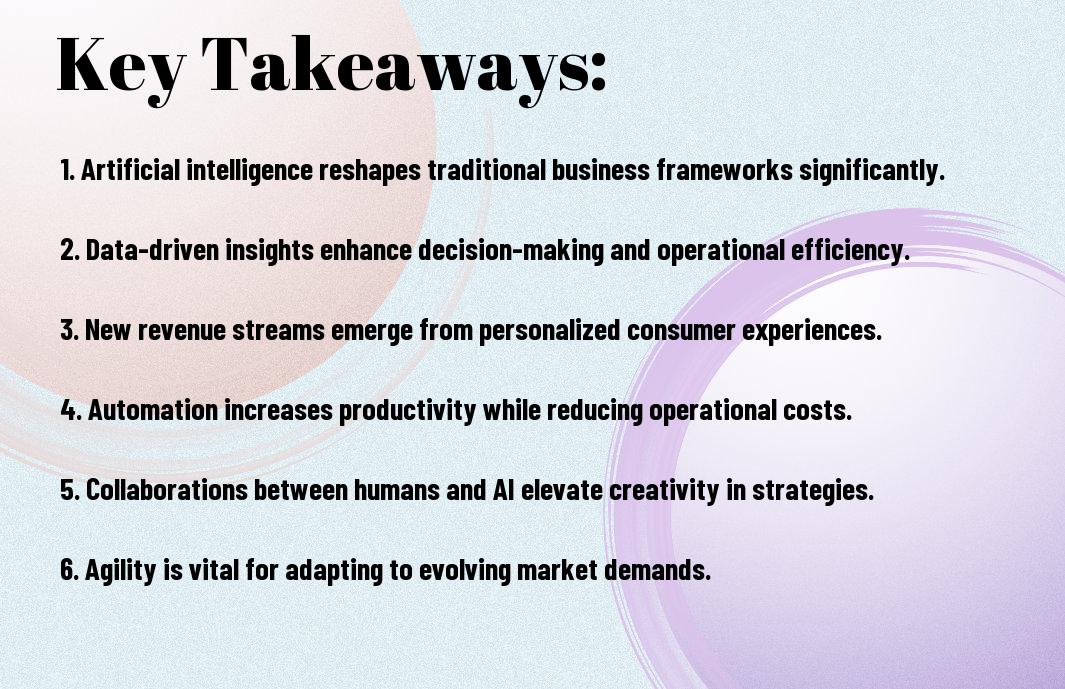
Key Takeaways:

  • The AI-driven revolution is transforming the business landscape by enabling companies to create new business models that are more efficient, agile, and customer-centric, leveraging technologies such as machine learning and natural language processing to drive innovation.
  • Successful companies in the digital age will be those that can harness the power of AI to develop new revenue streams, improve operational efficiency, and enhance customer experiences, thereby gaining a competitive edge in the market.
  • The integration of AI into business operations requires a fundamental shift in organizational culture, with a focus on data-driven decision-making, continuous learning, and collaboration between humans and machines to drive business outcomes.
  • AI-driven business models can take many forms, including subscription-based services, freemium models, and data-as-a-service, allowing companies to monetize their data and intellectual property in new and innovative ways.
  • As AI continues to evolve and improve, companies must prioritize ongoing investment in AI research and development, talent acquisition, and employee upskilling to stay ahead of the curve and capitalize on emerging opportunities in the digital age.

The Strategic Imperative of AI

The advent of AI is transforming the business landscape, and you must adapt to stay competitive. You will need to reassess your business models and strategies to leverage AI’s potential. Your ability to integrate AI into your operations will determine your success in the digital age.

Competitive Advantage Through Algorithmic Decision-Making

Above all, you should focus on developing algorithmic decision-making capabilities to drive your business forward. You can gain a competitive edge by using AI to analyze data, identify patterns, and make informed decisions. Your organization will become more agile and responsive to changing market conditions.

Value Chain Transformation

To fully harness the power of AI, you need to transform your value chain. You should identify areas where AI can streamline processes, improve efficiency, and reduce costs. Your value chain will become more resilient and better equipped to handle the challenges of the digital age.

Another key aspect of value chain transformation is the ability to create new revenue streams and business models. You can use AI to develop innovative products and services that meet the evolving needs of your customers. Your business will become more customer-centric, and you will be able to differentiate yourself from competitors. As you launch on this journey, you will discover new opportunities for growth and expansion.

Five Fundamental Business Models

Now that you’re exploring the AI-driven revolution, you’ll discover new opportunities for growth. You’ll find that these models are designed to help your business thrive in the digital age, leveraging AI to drive innovation and revenue.

AI-as-a-Service Providers

For instance, as you consider AI-as-a-Service providers, you’ll see how they offer scalable solutions, enabling your business to access AI capabilities without significant upfront investments, allowing you to focus on core operations.

Data Monetization Ecosystems

Business leaders like you are turning to data monetization ecosystems, which enable you to unlock the value of your data, creating new revenue streams and driving business growth through strategic partnerships and data-driven insights.

Ecosystems like these allow you to leverage your data assets, creating a competitive advantage in the market. You can develop targeted marketing campaigns, improve customer experiences, and drive innovation, all while maintaining control over your data and ensuring its security and integrity, which is vital for building trust with your customers and partners.

Cost Structure Realignment

Once again, you will need to reassess your business model as AI-driven technologies continue to advance, and this includes reevaluating your cost structure to remain competitive in the digital age.

Fixed to Variable Cost Shifting

Fixing your costs to variable expenses allows you to adapt to changing market conditions, and you can achieve this by adopting AI-driven solutions that reduce your fixed costs and increase your variable costs, enabling your business to scale more efficiently.

Scalability Economics

At the heart of AI-driven business models is the ability to scale quickly and efficiently, and you can achieve this by leveraging AI technologies that enable your business to grow without a corresponding increase in costs, allowing you to reap the benefits of scalability economics.

Realignment of your cost structure to take advantage of scalability economics will enable you to reduce your costs per unit as your business grows, and you can achieve this by investing in AI-driven technologies that automate processes, improve efficiency, and enable your business to scale quickly and efficiently, allowing you to stay competitive in the digital age and increase your profitability.

Market Entry Strategies

To succeed in the AI-driven revolution, you need to develop effective market entry strategies that set your business up for success. Your approach will depend on your goals, resources, and target market.

First-Mover Positioning

Entering a new market first can give you a competitive edge, allowing you to establish your brand and capture market share before others follow. Your early mover advantage can help you shape the market and influence consumer behavior.

Strategic Partnerships and Acquisitions

On the other hand, forming strategic partnerships or acquiring existing businesses can provide a faster and more cost-effective way to enter a new market. Your partnerships can bring new technologies, expertise, and customer bases to your business.

But as you explore strategic partnerships and acquisitions, you should carefully evaluate the potential benefits and risks, considering factors such as cultural fit, financial performance, and regulatory compliance. You will need to assess how these partnerships and acquisitions align with your overall business strategy and goals, and ensure that you have the necessary resources and expertise to integrate them successfully into your operations.

Organizational Architecture

After establishing your AI-driven business model, you need to design an organizational architecture that supports its implementation, enabling you to leverage technology and data to drive growth and innovation, and you must consider how your organization’s structure and processes will be impacted.

Talent Requirements and Knowledge Management

To effectively manage your AI-driven business, you will need to assess your talent requirements and develop a knowledge management strategy that ensures your team has the necessary skills and expertise to succeed in the digital age, and you should prioritize ongoing learning and development.

Governance Frameworks

Above all, you must establish governance frameworks that ensure accountability, transparency, and ethics in your AI-driven decision-making processes, and you should define clear roles and responsibilities for your team members, and you will need to establish a framework that ensures compliance with regulatory requirements.

Knowledge of governance frameworks is necessary for you to develop a comprehensive approach to managing your AI-driven business, and you should consider factors such as data privacy, security, and intellectual property protection when designing your governance framework, and you must ensure that your framework is flexible and adaptable to evolving regulatory requirements and technological advancements.

Measuring AI-Driven Performance

Unlike traditional business models, AI-driven performance requires a new set of metrics. You can learn more about How the Rise of AI Drives New Business Models and discover the latest trends in AI adoption.

Key Performance Indicators

Monitoring your AI-driven performance involves tracking key metrics that matter to your business. You will need to identify the most relevant indicators to measure the success of your AI initiatives.

Return on AI Investment Metrics

For your AI investments to pay off, you need to measure their impact on your bottom line. You should focus on metrics that show the direct financial benefits of your AI initiatives.

In addition, to get the most out of your AI investments, you will need to consider metrics such as customer acquisition costs, customer lifetime value, and revenue growth, which can help you evaluate the effectiveness of your AI-driven business models and make data-driven decisions to optimize your strategies.

Conclusion

So, as you commence on this journey of the AI-driven revolution, you will discover new business models that transform your operations and unlock unprecedented opportunities. You will leverage AI to create innovative products, services, and experiences that meet evolving customer needs. By embracing this digital age, you will stay ahead of the curve and drive your business forward, leveraging the power of AI to achieve your goals and succeed in a rapidly changing landscape. Your ability to adapt will be key to your success.

FAQ

Q: What is the main driving force behind the AI-driven revolution in the digital age?

A: The main driving force behind the AI-driven revolution is the rapid advancement and accessibility of artificial intelligence technologies. This has enabled businesses to leverage AI to automate processes, enhance customer experiences, and develop new business models that were previously unimaginable. As AI continues to evolve, it is transforming industries and creating new opportunities for innovation and growth.

Q: How are new business models emerging in the digital age as a result of AI-driven revolution?

A: New business models are emerging in various forms, including subscription-based services, data-as-a-service, and platform-based economies. For instance, companies are using AI to offer personalized products and services, creating new revenue streams and disrupting traditional industries. Additionally, AI-driven automation is enabling businesses to reduce costs and improve efficiency, allowing them to focus on high-value tasks and create new business opportunities. The AI-driven revolution is also giving rise to new forms of entrepreneurship and innovation, as startups and established companies alike are using AI to develop novel solutions and business models.

Q: What skills and strategies do businesses need to adopt to thrive in the AI-driven digital age?

A: To thrive in the AI-driven digital age, businesses need to adopt a range of skills and strategies. These include developing a deep understanding of AI technologies and their applications, investing in data analytics and digital infrastructure, and fostering a culture of innovation and experimentation. Businesses also need to develop strategies for managing and mitigating the risks associated with AI, such as job displacement and bias in decision-making. Furthermore, they need to prioritize continuous learning and upskilling, as the AI-driven revolution is creating new job categories and requiring workers to develop new skills to remain relevant in the digital economy.

Bonza training Skip to content