
As you navigate the ever-changing landscape of business, you’re likely aware that staying ahead of the curve is key to success. Your ability to analyze market trends and make informed decisions will be revolutionized by the integration of Artificial Intelligence (AI) in business intelligence. You will soon be able to uncover hidden patterns, predict future trends, and optimize your strategies with unprecedented accuracy, giving you a competitive edge in the market.
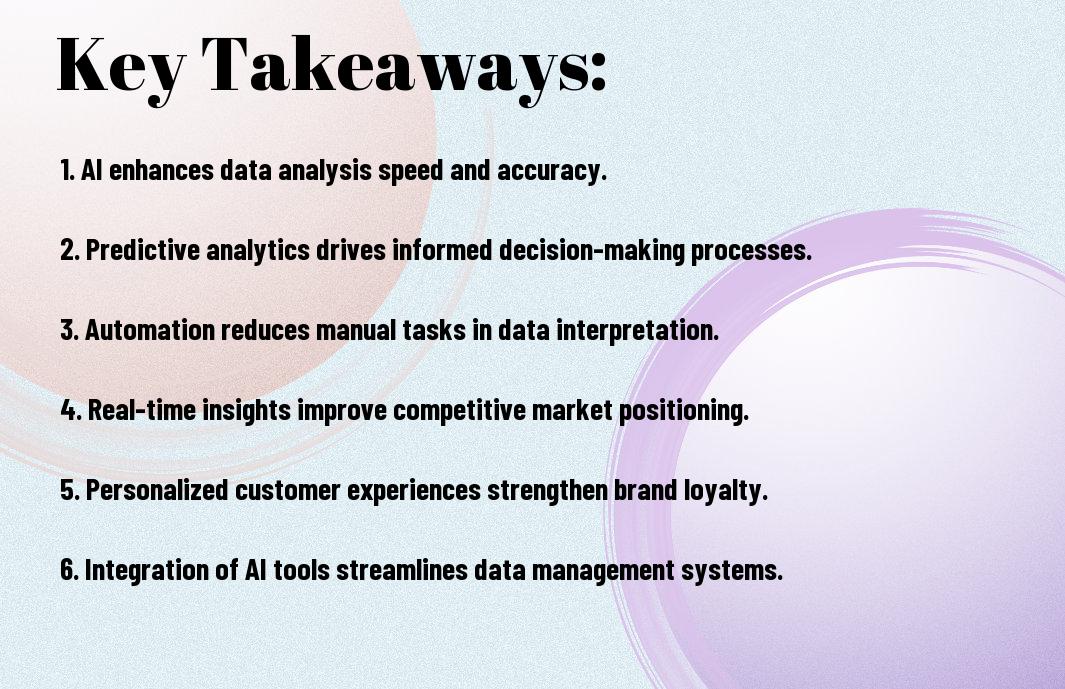
Key Takeaways:
- The integration of Artificial Intelligence (AI) in business intelligence is revolutionizing market analysis by providing faster and more accurate insights, enabling businesses to make informed decisions and stay ahead of the competition.
- AI-powered tools can analyze vast amounts of data, identify patterns, and predict trends, allowing businesses to optimize their operations, improve customer experience, and increase revenue.
- The use of machine learning algorithms in business intelligence enables the automation of routine tasks, freeing up human analysts to focus on higher-level tasks such as strategy development and decision-making.
- AI-driven business intelligence also enhances data visualization, making it easier for stakeholders to understand complex data and trends, and facilitating more effective communication and collaboration across organizations.
- The future of business intelligence will be shaped by the continued advancement of AI technologies, such as natural language processing and deep learning, which will further enhance the accuracy and speed of market analysis and decision-making.
The Tipping Point for AI in Business Intelligence
For businesses, the integration of AI in market analysis is becoming increasingly prevalent, and you are likely to see significant advancements in the near future, transforming your approach to business intelligence.
From Data Collection to Intelligent Insights
Once you start leveraging AI, you will notice a shift from mere data collection to deriving intelligent insights that inform your business decisions, enabling you to make more accurate predictions and drive growth.
The Small Changes Creating Big Impacts
The subtle incorporation of AI in your business operations will start yielding noticeable results, and you will begin to see improvements in your market analysis, allowing you to respond more effectively to changing market conditions.
Point to consider is that these small changes will compound over time, and as you continue to integrate AI into your business intelligence, you will unlock new opportunities for innovation and expansion, ultimately giving you a competitive edge in the market, and enabling you to make more informed decisions about your business strategy.
Cognitive Revolution in Market Analysis
Assuming you are familiar with the concept of business intelligence, you will understand that the integration of AI is transforming market analysis, enabling you to make more informed decisions.
Pattern Recognition Beyond Human Capability
Cognitively, you will be able to analyze vast amounts of data, identifying patterns that may have gone unnoticed, and gaining valuable insights that inform your business strategy.
The Outliers That Machines Can Spot
Revolutionizing the way you approach market analysis, machines can identify anomalies in data that you may have missed, providing you with a more comprehensive understanding of your market.
Spot the differences in your data that machines can identify, and you will be able to refine your strategy, targeting specific areas of your business that require attention, and driving growth as a result of your newfound understanding of the market and its trends.
Predictive Analytics Reimagined
Not only is AI transforming market analysis, but it’s also revolutionizing predictive analytics, enabling you to make more informed decisions about your business’s future.
From Reactive to Proactive Business Decisions
One of the key benefits of AI-powered predictive analytics is that it allows you to shift from reactive to proactive business decisions, enabling you to anticipate and prepare for changes in your market, giving you a competitive edge.
The Blink Moment: Intuitive AI Systems
Moment by moment, AI systems are becoming more intuitive, allowing you to make swift and informed decisions, and as you probe deeper into your data, you’ll uncover new insights that will transform your business.
In fact, as you explore the capabilities of intuitive AI systems, you’ll find that they can analyze vast amounts of data in real-time, providing you with instant insights that will enable you to make swift and informed decisions, and drive your business forward with confidence, allowing you to stay ahead of the curve and capitalize on new opportunities as they arise.
Democratization of Complex Analysis
Many businesses are now able to perform complex analysis, thanks to AI-powered tools. You can now access advanced analytics, enabling your organization to make data-driven decisions.
When Specialized Knowledge Becomes Accessible
Diffusion of specialized knowledge enables you to tap into the power of data analysis, regardless of your technical expertise. You can now interpret complex data, making informed decisions for your business.
The Power Shift in Data Interpretation
The ability to analyze data is no longer limited to experts, as you can now use AI-driven tools to uncover insights. You can interpret complex data, identifying trends and patterns that inform your business strategy.
Complex data analysis is now at your fingertips, as AI-powered tools provide you with the ability to uncover hidden insights. You can explore into your data, identifying areas of opportunity and optimizing your business performance. As you explore your data, you’ll discover new ways to drive growth and stay ahead of the competition, making your business more agile and responsive to changing market conditions.

Ethical Dimensions and Blind Spots
Despite the benefits of AI in business intelligence, you must consider the ethical implications of relying on automated systems for market analysis, as your decisions will have a significant impact on your organization and stakeholders.
The Hidden Biases in Algorithmic Decision-Making
Blindly trusting AI-driven insights can lead to unintended consequences, as you may unknowingly perpetuate biases present in the data, affecting your ability to make informed decisions and potentially harming your business.
Navigating the Moral Landscape of Automated Analysis
Algorithmically driven analysis can raise complex moral questions, and as you probe deeper into the world of AI-powered business intelligence, you will need to carefully consider the potential consequences of your actions and ensure that your use of automation aligns with your values and principles.
For instance, you will need to think about how to address issues like data privacy, transparency, and accountability in your AI-driven market analysis, and develop strategies to mitigate potential risks and ensure that your use of automation is fair, unbiased, and respectful of all stakeholders involved, ultimately protecting your business’s reputation and maintaining trust with your customers.
Human-Machine Collaboration Models
Unlike traditional approaches, human-machine collaboration models enable you to leverage the strengths of both humans and machines, leading to more accurate and efficient market analysis.
Redefining Analytical Roles and Expertise
Roles are evolving as you work alongside AI systems, requiring you to develop new skills and expertise to effectively interpret and apply insights generated by machines.
The Connectors: Interfaces Between Insight and Action
An integral part of human-machine collaboration, you will use interfaces that facilitate seamless interaction between insights and actions, enabling you to make data-driven decisions.
At the heart of these interfaces, you will find advanced visualization tools and natural language processing, allowing you to communicate complex ideas and insights to stakeholders, and to translate data into actionable strategies that drive your business forward, helping you to stay ahead in the market.
Conclusion
From above, you can see how AI is revolutionizing market analysis. As you move forward, your business will rely on AI-driven insights to make informed decisions. You will witness enhanced predictive capabilities, automating your analysis and uncovering new opportunities. Your ability to adapt to this shift will determine your success in the market, enabling you to stay ahead of the competition and drive your business forward with data-driven confidence.
FAQ
Q: What role will Artificial Intelligence (AI) play in the future of business intelligence, particularly in market analysis?
A: AI is poised to revolutionize the field of business intelligence by enhancing market analysis through advanced data analytics, predictive modeling, and machine learning algorithms. This technology will enable businesses to make more informed decisions by providing real-time insights into market trends, customer behavior, and competitor activity. AI-driven tools will automate data processing, identify patterns, and predict future market shifts, allowing companies to stay ahead of the competition and capitalize on emerging opportunities.
Q: How will AI transform the process of market analysis, and what benefits can businesses expect from this transformation?
A: AI will transform market analysis by introducing speed, accuracy, and depth to the process. AI algorithms can analyze vast amounts of data from various sources, including social media, customer feedback, and market research reports, to provide a comprehensive view of the market. This transformation will benefit businesses by enhancing their ability to identify new market opportunities, optimize product development, and improve customer satisfaction. Additionally, AI-driven market analysis will enable businesses to respond quickly to changes in the market, reducing the risk of missing out on trends and opportunities.
Q: What skills and investments will businesses need to make to leverage AI in market analysis and stay competitive in the future of business intelligence?
A: To leverage AI in market analysis, businesses will need to invest in data infrastructure, AI technologies, and talent acquisition. They will need to develop a data-driven culture, ensuring that high-quality data is available and accessible across the organization. Investing in AI tools and platforms that can handle complex data analytics and machine learning will be imperative. Moreover, businesses will need to attract and retain professionals with expertise in data science, AI, and business analysis to interpret AI-generated insights and make strategic decisions. Continuous training and development of existing staff will also be necessary to ensure that they can work effectively with AI systems and understand their capabilities and limitations.