As you navigate the ever-evolving business landscape, you’re likely aware of the significant impact artificial intelligence (AI) is having on industries worldwide. You may be wondering how AI can transform your business into a next-generation empire. With its ability to analyze vast amounts of data and automate complex processes, AI is revolutionizing the way companies operate, making them more efficient and innovative. You will discover how AI can help you stay ahead of the competition and drive growth in your organization.
Key Takeaways:
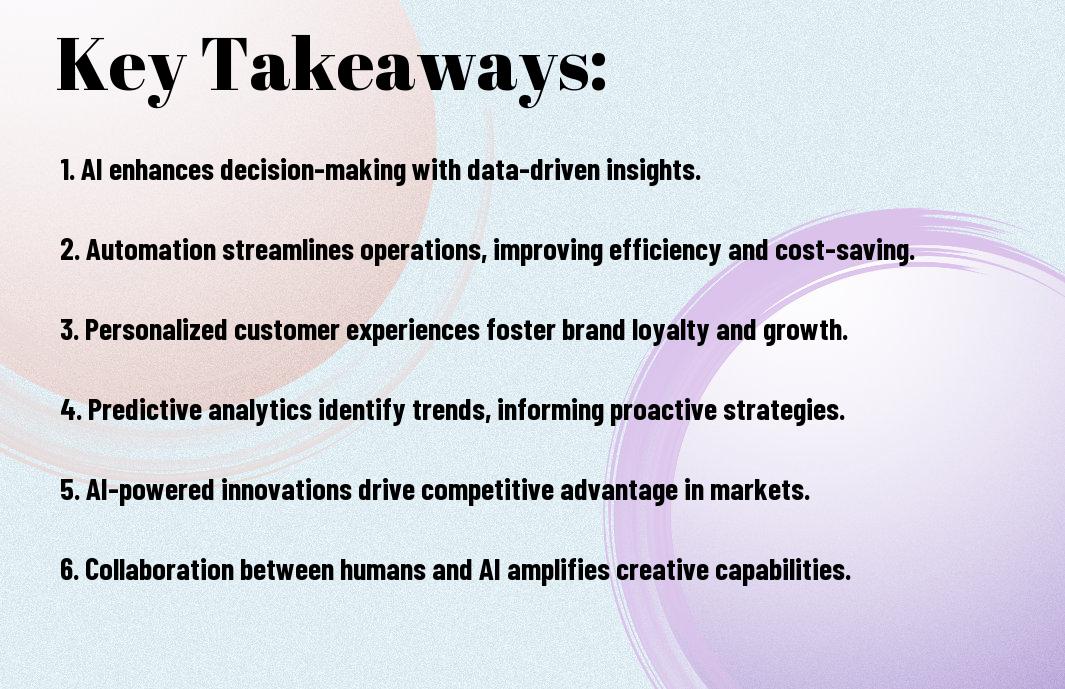
- Artificial intelligence (AI) is transforming the business landscape by enabling companies to make data-driven decisions, automate processes, and enhance customer experiences, ultimately leading to increased efficiency and competitiveness.
- The integration of AI in business operations allows for the analysis of vast amounts of data, providing valuable insights that can inform strategic decisions and drive innovation, thereby creating new opportunities for growth and expansion.
- Next-generation business empires will likely be built on AI-powered platforms that leverage machine learning, natural language processing, and computer vision to create immersive and personalized experiences for customers, setting them apart from traditional businesses.
- The adoption of AI also raises important questions about job displacement, ethics, and accountability, highlighting the need for businesses to develop responsible AI strategies that prioritize transparency, fairness, and human well-being.
- As AI continues to evolve, it is likely to play an increasingly significant role in shaping the future of business, with successful companies being those that can harness its potential to drive innovation, improve operations, and create sustainable value for stakeholders.
The Tipping Point for AI in Business
A significant shift is occurring as you explore the potential of artificial intelligence in your business, with Artificial Intelligence in Business Gets Real becoming a guiding principle for your strategy.
From Experimental to Essential
Against the backdrop of rapid technological advancements, you’re likely to find that AI is transforming from a novelty to a necessity in your business operations.
The Small Changes That Spark Revolutions
At the forefront of this transformation, you’ll notice that small, incremental changes are paving the way for significant revolutions in how you approach business challenges.
Further, as you investigate deeper into the applications of AI, you’ll discover that these small changes can have a profound impact on your business, enabling you to streamline processes, enhance decision-making, and drive innovation, ultimately positioning your company for long-term success in an increasingly competitive landscape.
AI as the New Corporate Outlier
Any business leader looking to stay ahead of the curve should consider the impact of AI on their operations. As you explore the potential of AI, you’ll find that it’s Paving the way for new business achievements in the AI era.
Companies That Leapt Ahead
At the forefront of this revolution, you’ll find companies that have successfully integrated AI into their business models, allowing you to learn from their experiences and apply them to your own operations.
The Patterns of AI-Driven Success
Before exploring into the world of AI, you should understand the common patterns that successful companies have followed to achieve success with AI, and how you can apply these patterns to your own business.
Even as you begin to explore the possibilities of AI, you’ll notice that successful companies have one thing in common: a deep understanding of how AI can be used to drive innovation and improve efficiency, allowing you to make informed decisions about how to integrate AI into your own business and stay ahead of the competition.
The Cognitive Revolution in Corporate Decision-Making
Unlike traditional methods, AI-driven decision-making enables you to analyze vast amounts of data, identify patterns, and make informed choices, thereby transforming your business strategy.
Intuition Meets Algorithm
Akin to a symbiotic relationship, your intuition and AI algorithms come together to enhance your decision-making capabilities, allowing you to make more accurate predictions and drive your business forward.
The New Business Instinct
Opposed to relying solely on gut feelings, you can now develop a data-driven instinct that guides your business decisions, enabling you to navigate complex markets and stay ahead of the competition.
In addition, as you embrace this new business instinct, you’ll find that your ability to adapt to changing market conditions improves, allowing you to pivot your strategy and capitalize on new opportunities, ultimately leading to increased growth and success for your business empire.

Reimagining Organizational Structure
Many businesses are leveraging artificial intelligence to transform their operations, and you can do the same by adopting AI-powered tools to streamline your processes and enhance decision-making.
Flattening Hierarchies Through Intelligence
Structurally, AI is changing the way your organization functions, enabling you to break down traditional barriers and create a more agile, responsive system that allows you to adapt quickly to changing market conditions.
The Human-AI Collaborative Framework
Only by combining human intuition with AI-driven insights can you unlock the full potential of your business, and as you explore this collaborative approach, you’ll discover new ways to drive innovation and growth.
With the Human-AI Collaborative Framework, you can create a symbiotic relationship between your team members and AI systems, allowing you to augment your capabilities, automate routine tasks, and focus on high-value activities that drive your business forward, enabling you to make more informed decisions and stay ahead of the competition.
The Economics of Artificial Intelligence
After understanding the potential of AI, you can explore its economic implications, including how it can benefit your business, as outlined in the 7 Benefits of Artificial Intelligence (AI) for Business, to make informed decisions.
Investment Patterns and ROI Considerations
Economically, you need to consider the investment patterns and ROI considerations when implementing AI in your business, as this will help you allocate your resources effectively and maximize your returns.
The New Metrics of Business Value
Along with the integration of AI, you will need to adopt new metrics to measure your business’s value, focusing on data-driven insights and performance indicators that reflect the impact of AI on your operations.
Hence, as you probe into the new metrics of business value, you will discover that AI-driven data analysis enables you to track key performance indicators, such as customer engagement, process efficiency, and innovation, allowing you to make strategic decisions that drive your business forward and stay competitive in the market.
Ethical Dimensions and Societal Impact
Keep in mind that as you develop and implement AI solutions, you must consider the ethical implications and potential societal impact. Your actions will shape the future of business and society, and it’s vital to prioritize responsibility and transparency.
Responsible AI Deployment
Besides the technical aspects, you should focus on deploying AI in a way that aligns with your values and promotes fairness, accountability, and safety. Your approach to AI deployment will reflect on your brand and reputation, so it’s vital to get it right.
Creating Sustainable AI Advantage
Towards creating a sustainable AI advantage, you need to prioritize long-term benefits over short-term gains. Your goal should be to develop AI solutions that drive continuous innovation and improvement, while also ensuring that they are environmentally and socially sustainable.
Also, as you strive to create a sustainable AI advantage, you will need to invest in ongoing research and development, staying up-to-date with the latest advancements and breakthroughs in AI technology. Your ability to adapt and evolve will be key to maintaining a competitive edge and ensuring that your AI solutions remain relevant and effective in the years to come.
To wrap up
Taking this into account, you now understand the significance of artificial intelligence in shaping your business’s future. As you begin on building your next-generation business empire, you will leverage AI to drive innovation, enhance efficiency, and make informed decisions. Your ability to harness AI’s potential will ultimately determine your success in the competitive market, allowing you to stay ahead of the curve and achieve your goals.
FAQ
Q: What is the primary role of Artificial Intelligence in creating next-generation business empires?
A: The primary role of Artificial Intelligence (AI) in creating next-generation business empires is to drive innovation, enhance operational efficiency, and unlock new revenue streams. AI technologies such as machine learning, natural language processing, and predictive analytics enable businesses to analyze vast amounts of data, identify patterns, and make informed decisions. By leveraging AI, companies can automate routine tasks, improve customer experiences, and develop new products and services that meet evolving market demands.
Q: How can Artificial Intelligence help businesses gain a competitive edge in the market?
A: Artificial Intelligence can help businesses gain a competitive edge in the market by providing them with real-time insights, enabling them to respond quickly to changing market conditions, and improving their decision-making capabilities. AI-powered tools can analyze large datasets, identify trends, and predict future market shifts, allowing businesses to stay ahead of the competition. Additionally, AI-driven automation can help companies reduce costs, enhance productivity, and improve product quality, ultimately leading to increased customer satisfaction and loyalty.
Q: What are the potential risks and challenges associated with implementing Artificial Intelligence in business, and how can they be mitigated?
A: The potential risks and challenges associated with implementing Artificial Intelligence in business include data privacy and security concerns, job displacement, and the need for significant investments in AI infrastructure and talent. To mitigate these risks, businesses can implement robust data governance policies, invest in employee retraining and upskilling programs, and develop strategic partnerships with AI technology providers. Furthermore, companies can adopt a phased approach to AI adoption, starting with small-scale pilots and gradually scaling up to larger implementations, to minimize disruption and ensure a smooth transition to an AI-driven business model.