As you navigate the ever-changing landscape of entrepreneurship, you’re likely aware that innovation is key to staying ahead of the curve. Your ability to leverage cutting-edge technology, such as Artificial Intelligence (AI), can significantly impact your success. You’re probably wondering how AI can drive your business forward, and what benefits it can bring to your entrepreneurial endeavors. This post will explore the role of AI in driving innovation and wealth, and how you can harness its power to achieve your goals.

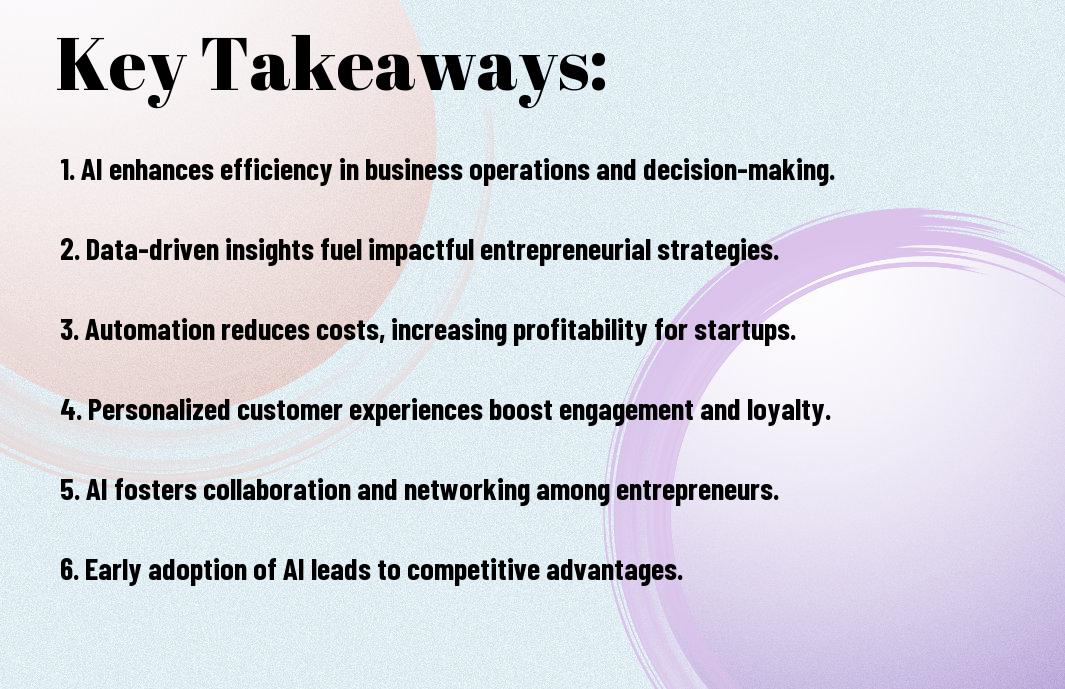
Key Takeaways:
- Artificial Intelligence (AI) plays a significant role in driving entrepreneurial success by automating processes, enhancing decision-making, and improving productivity, ultimately leading to increased wealth creation.
- AI-powered tools and technologies can help entrepreneurs identify new business opportunities, develop innovative products and services, and gain a competitive edge in the market.
- The integration of AI in business operations can lead to improved efficiency, reduced costs, and enhanced customer experience, resulting in increased revenue and profitability.
- Entrepreneurs who leverage AI effectively can gain valuable insights from data analysis, enabling them to make informed decisions and drive business growth through strategic innovation.
- As AI continues to evolve, it is likely to have a profound impact on the entrepreneurial landscape, creating new opportunities for innovation and wealth creation, and transforming the way businesses operate and succeed.
The Tipping Point of AI in Business
Before you can harness the power of AI, it’s crucial to understand its role in driving entrepreneurial success, as it has become a key factor in business innovation, enabling you to make data-driven decisions and stay ahead of the competition.
When Algorithms Become Competitive Advantages
On the path to success, you’ll find that algorithms can become a significant competitive advantage, allowing you to automate tasks, optimize processes, and gain valuable insights that inform your business strategy, giving you an edge over your competitors.
The Stickiness Factor of AI Solutions
Factoring in the long-term benefits, you’ll discover that AI solutions can have a significant impact on your business, as they can lead to increased efficiency, improved customer satisfaction, and ultimately, increased revenue, making them a valuable investment for your company.
And as you research deeper into the world of AI, you’ll find that the stickiness factor of AI solutions lies in their ability to learn and adapt to your business needs, allowing you to refine your strategy and make adjustments as needed, ensuring that you stay on track to achieve your goals, and enabling you to measure the effectiveness of your AI investments, making adjustments to optimize your returns.
Outliers in AI Entrepreneurship
Any entrepreneur looking to leverage AI for success must understand the unique challenges and opportunities that come with it. You will need to navigate complex technologies and adapt to rapid changes in the market to stay ahead of the competition.
The 10,000-Hour Rule Reimagined
Above all, you should focus on developing a deep understanding of AI and its applications, as this will be key to driving your entrepreneurial success. You can achieve this by dedicating time to learning and experimenting with different AI technologies.
Opportunity and Timing in AI Ventures
Hour after hour, you will be faced with decisions that can make or break your AI venture, and it is your ability to seize opportunities and time your moves correctly that will set you apart from others. You must be able to identify emerging trends and capitalize on them quickly.
Outliers in AI entrepreneurship are those who can balance their technical expertise with business acumen, allowing them to identify opportunities and time their ventures perfectly. You can join their ranks by staying informed about the latest developments in AI and being prepared to adapt your strategy as the landscape evolves, ensuring your venture stays ahead of the curve and achieves long-term success.
Blink Decisions in AI-Driven Markets
Your ability to make swift decisions is vital in today’s fast-paced entrepreneurial landscape, where AI-driven markets demand agility and adaptability to stay ahead of the competition.
Intuition versus Data-Driven Decision Making
Prior to relying solely on intuition, you should consider the benefits of data-driven decision making, which enables you to make informed choices backed by concrete evidence and insights.
The Power of Thin-Slicing Customer Needs
Driven by the need for precision, you can leverage AI to thin-slice customer needs, uncovering patterns and preferences that inform your business strategy and drive innovation.
It is through this process that you can develop a deeper understanding of your target audience, allowing you to create tailored solutions that meet their evolving needs and preferences, ultimately driving your entrepreneurial success in AI-driven markets.
The AI Entrepreneurial Mindset
Unlike traditional entrepreneurs, you will need to develop a unique mindset that combines creativity with technical expertise to succeed in an AI-driven environment. You must be open to new ideas and willing to invest time in understanding the capabilities and limitations of AI technologies. This mindset will enable you to harness the power of AI and drive your entrepreneurial ventures forward.
Adaptability and Continuous Learning
The ability to adapt quickly to changing market conditions and technological advancements is vital for your success as an AI entrepreneur. You will need to stay up-to-date with the latest developments in AI and be willing to pivot your business strategy as needed. This will enable you to stay ahead of the competition and capitalize on new opportunities.
Risk Assessment in Automated Environments
For you to effectively navigate the risks associated with AI, you must develop a deep understanding of the potential pitfalls and challenges. You will need to carefully evaluate the potential risks and benefits of implementing AI solutions in your business and take steps to mitigate any potential downsides. This will enable you to minimize losses and maximize gains.
Due to the complexity of AI systems, you will need to carefully consider the potential risks and consequences of automating certain business processes. You should assess the potential impact on your business, including the potential for job displacement, data breaches, and other unintended consequences. By taking a thoughtful and informed approach to risk assessment, you can ensure that your use of AI drives business success while minimizing potential downsides.
Wealth Creation Through AI Implementation
Despite the initial investment required, AI can significantly enhance your business operations, leading to increased efficiency and revenue. By automating tasks and providing valuable insights, AI helps you make informed decisions, driving your entrepreneurial success.
Scaling Without Proportional Cost Increases
Prior to expanding your business, you can leverage AI to streamline processes, allowing you to scale without incurring proportional cost increases, thus maximizing your returns on investment.
Value Extraction from Data Assets
Cost effectively, you can utilize AI to analyze your data assets, uncovering hidden patterns and trends that inform your business strategies, enabling you to make data-driven decisions.
Wealth generated from AI-driven insights can be substantial, as you can identify new opportunities, optimize operations, and create innovative products or services, ultimately leading to increased revenue and competitiveness in the market, allowing you to achieve your business goals and expand your entrepreneurial pursuits.
Ethical Considerations and Social Impact
To ensure that AI-driven innovation benefits society as a whole, you must consider the ethical implications of your entrepreneurial endeavors. As you harness the power of AI to drive your business forward, you need to be aware of the potential social impact of your actions.
Responsible Innovation Frameworks
For instance, you can establish guidelines that prioritize transparency, accountability, and fairness in your AI development and deployment. By doing so, you can mitigate potential risks and ensure that your innovative solutions align with your values and principles.
Distributional Effects of AI-Generated Wealth
Responsibly, you should consider how AI-generated wealth will be distributed among stakeholders, including employees, customers, and the broader community. As you navigate the complex landscape of AI-driven entrepreneurship, you need to think critically about the potential consequences of your actions on different groups.
And as you research deeper into the distributional effects of AI-generated wealth, you will realize that the benefits of innovation are not always evenly distributed. You may notice that certain groups, such as those with limited access to education or technological resources, may be left behind, exacerbating existing social and economic inequalities. You must consider these dynamics and develop strategies to address them, ensuring that your AI-driven entrepreneurial success contributes to a more equitable and just society.
Conclusion
Conclusively, as you commence on your entrepreneurial journey, you will find that innovation and wealth are closely tied to the effective utilization of AI. You can leverage AI to drive your success by automating tasks, analyzing data, and making informed decisions. By embracing AI, you can stay ahead of the competition and achieve your business goals, ultimately leading to increased wealth and prosperity for your venture.
FAQ
Q: What is the impact of Artificial Intelligence on entrepreneurship and wealth creation?
A: Artificial Intelligence (AI) has a significant impact on entrepreneurship and wealth creation. AI-driven technologies can help entrepreneurs automate tasks, gain insights from data, and make informed decisions, leading to increased efficiency and productivity. Additionally, AI can facilitate the development of new products and services, enabling entrepreneurs to tap into new markets and create new revenue streams. By leveraging AI, entrepreneurs can drive innovation, improve customer experiences, and ultimately, create wealth.
Q: How can AI be used to drive entrepreneurial success, particularly in terms of innovation and wealth generation?
A: AI can be used to drive entrepreneurial success in several ways. For instance, AI-powered tools can help entrepreneurs identify market trends, analyze customer behavior, and develop personalized marketing strategies. AI can also be used to optimize business operations, such as supply chain management and logistics, leading to cost savings and increased profitability. Furthermore, AI can facilitate the development of new business models, such as subscription-based services and freemium models, which can help entrepreneurs generate new revenue streams and create wealth. By embracing AI, entrepreneurs can stay ahead of the competition, drive innovation, and achieve long-term success.
Q: What are the key challenges and opportunities that entrepreneurs face when leveraging AI to drive innovation and wealth creation, and how can they overcome these challenges?
A: Entrepreneurs face several challenges when leveraging AI to drive innovation and wealth creation, including the need for significant investments in AI infrastructure, talent acquisition, and data management. Additionally, entrepreneurs must navigate complex regulatory environments and address concerns around data privacy and ethics. However, these challenges also present opportunities for entrepreneurs to develop new AI-powered solutions, create new markets, and establish themselves as leaders in their industries. To overcome these challenges, entrepreneurs can focus on building strategic partnerships, investing in AI education and training, and prioritizing data-driven decision making. By doing so, entrepreneurs can harness the power of AI to drive innovation, create wealth, and achieve long-term success.