
As you navigate the evolving landscape of investment opportunities, you’re likely considering the role of artificial intelligence in shaping the future of venture capital. Your investments have the potential to revolutionize industries and transform the way businesses operate. With AI-driven innovations on the rise, you’re poised to capitalize on the tremendous growth potential that this intersection of technologies presents, and this blog post will guide you through the key aspects to consider when investing in this exciting space.
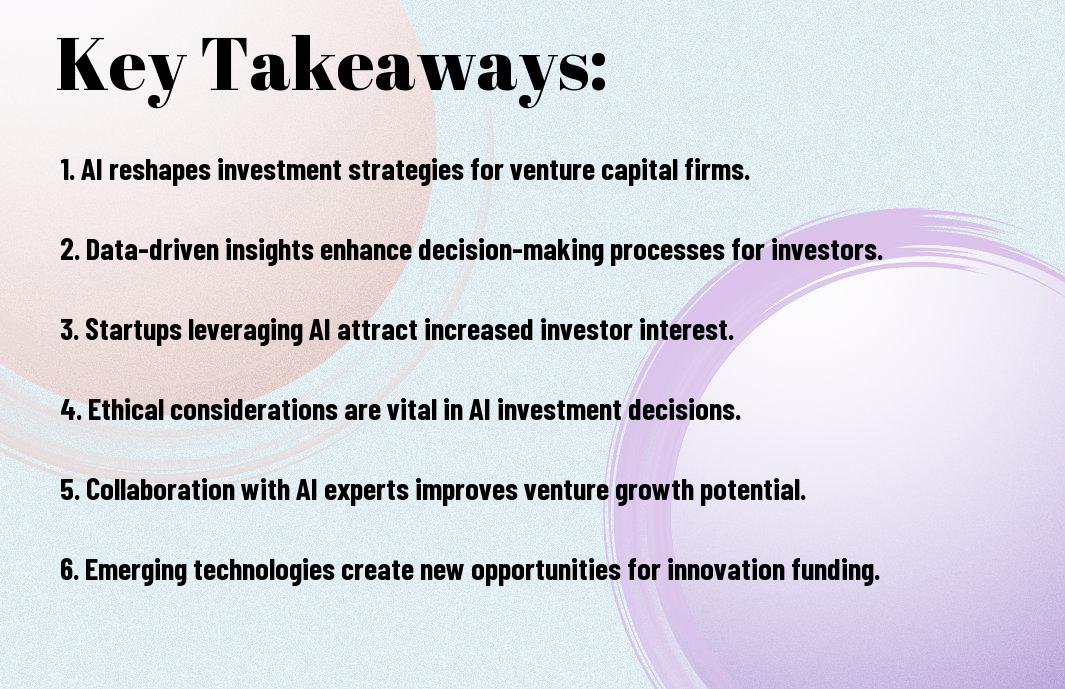
Key Takeaways:
- The integration of Artificial Intelligence (AI) in venture capital is transforming the investment landscape by enhancing deal sourcing, due diligence, and portfolio management, leading to more informed investment decisions.
- AI-driven tools are being utilized to analyze vast amounts of data, identify patterns, and predict market trends, allowing venture capital firms to uncover promising startups and investment opportunities more efficiently.
- The use of machine learning algorithms in venture capital enables the assessment of startup potential based on quantitative metrics, reducing the reliance on traditional methods that often involve personal biases and intuition.
- As AI continues to evolve, venture capital firms are adapting by developing specialized AI-focused investment strategies, such as investing in AI startups and companies that leverage AI to drive innovation and growth.
- The intersection of AI and venture capital also raises important considerations around ethics, transparency, and accountability, highlighting the need for investors to prioritize responsible AI development and deployment in their investment portfolios.

The AI Revolution in Investment Landscapes
While the integration of AI in venture capital is still in its early stages, you are likely to see significant changes in the way investments are made. AI-driven tools are being used to analyze vast amounts of data, identify patterns, and make predictions about investment outcomes.
Algorithmic Decision-Making
Landscaping the future of investments, you will find that algorithmic decision-making is becoming increasingly prevalent. You can expect to see more AI-powered systems being used to inform investment decisions, allowing for faster and more accurate analysis of potential investments.
Risk Assessment Paradigms
With the advent of AI, you are witnessing a shift in risk assessment paradigms. You can use AI-driven tools to analyze complex data sets and identify potential risks, allowing you to make more informed investment decisions.
This ability to assess risk more accurately is particularly valuable in the venture capital space, where you are often dealing with high-risk, high-reward investments. You can use AI to analyze market trends, financial data, and other factors to determine the potential risks and returns on an investment, helping you to make more informed decisions and maximize your returns.
Venture Capital’s Evolution in the Digital Age
It is evident that the venture capital landscape has undergone significant changes with the advent of digital technologies, and you are now witnessing a new era of investment opportunities. You can see how AI is transforming the way you invest in startups, and your approach to venture capital is evolving rapidly.
Traditional Models Disrupted
Before the digital age, you relied on traditional models of venture capital, but now you are experiencing a shift towards more innovative and tech-driven approaches. Your investment strategies are being redefined, and you are adapting to the new landscape.
New Metrics of Value
Evolving alongside the digital age, you are seeing new metrics of value emerge, and your assessment of startup potential is becoming more sophisticated. You are considering factors such as user engagement, data-driven insights, and AI-powered growth projections to inform your investment decisions.
Indeed, as you investigate deeper into the new metrics of value, you will discover that they offer a more nuanced understanding of a startup’s potential for success. You will be able to evaluate factors such as the quality of a startup’s data, the effectiveness of its AI algorithms, and the potential for scalability, allowing you to make more informed investment decisions and maximize your returns in the rapidly evolving venture capital landscape.
The Technical Underpinnings of AI in VC
Now, as you explore into the world of AI in venture capital, it’s crucial to understand the technical aspects that drive this intersection. You’ll encounter various technologies that enable AI-driven decision-making, and it’s vital to grasp these concepts to navigate this space effectively.
Machine Learning Applications
Beneath the surface of AI lies machine learning, which enables systems to learn from data and make predictions. You’ll find that machine learning applications are being used to analyze large datasets, identify patterns, and make informed investment decisions, allowing you to make more accurate predictions about your investments.
Predictive Analytics Frameworks
Among the key technologies used in AI-driven venture capital are predictive analytics frameworks, which provide a structured approach to analyzing data and making predictions. You’ll use these frameworks to identify trends, forecast outcomes, and optimize your investment strategies, giving you a competitive edge in the market.
And as you explore predictive analytics frameworks in more depth, you’ll discover that they rely on complex algorithms and statistical models to analyze large datasets, identify patterns, and make predictions about future outcomes. You can use these frameworks to analyze market trends, assess the potential of startups, and make informed investment decisions, ultimately helping you to maximize your returns and achieve your investment goals.
Capital Allocation Strategies
After determining your investment goals, you’ll need to develop a capital allocation strategy that balances risk and potential returns. You’ll want to consider how to distribute your investments across various AI-focused sectors, from healthcare to finance, to maximize your portfolio’s growth potential.
Sector-Specific Approaches
Across different industries, you’ll find unique opportunities for AI-driven growth, and you should tailor your investment approach to each sector’s specific needs and trends. You’ll need to assess the competitive landscape, market demand, and potential for disruption in each sector to make informed investment decisions.
Growth Stage Considerations
Against the backdrop of a rapidly evolving AI landscape, you’ll need to consider the growth stage of each investment opportunity, from seed funding to late-stage investments. You’ll want to evaluate the potential for scalability, the competitive advantage, and the management team’s ability to execute on their vision.
Considerations such as cash flow management, talent acquisition, and regulatory compliance become more significant as your investments grow. You’ll need to assess whether your portfolio companies have the necessary resources and expertise to navigate these challenges and achieve long-term success, and adjust your investment strategy accordingly to support their growth.
Ethical Dimensions
Unlike other investment areas, AI raises unique ethical concerns. As you explore the intersection of AI and venture capital, consider the implications of The AI Investment Boom: Impact on Venture Capital. You must navigate these complexities to make informed decisions.
Bias in Algorithmic Investing
Any investment strategy that relies on AI must account for potential biases in algorithmic decision-making. You should be aware of how biases can impact your investment choices and take steps to mitigate them.
Transparency Imperatives
Bias in AI systems can have significant consequences, which is why transparency is important. You need to understand how AI-driven investment decisions are made and be able to track the underlying factors that influence them.
In addition, as you probe into the world of AI-powered venture capital, you will need to prioritize transparency in your investment approach, ensuring that you can explain and justify the decisions made by your AI systems, and make adjustments as needed to maintain accountability and trust in your investment strategy.
Future Trajectories
Your investment decisions in the intersection of AI and venture capital will shape the future of various industries, and it’s important to consider the potential outcomes of your choices.
Emerging Technologies
Against the backdrop of rapid advancements, you’ll encounter new opportunities in areas like machine learning and natural language processing, which will continue to transform the way you approach investment strategies.
Regulatory Horizons
Emerging from the complexities of AI development, you’ll need to navigate the evolving regulatory landscape, which will impact your investment decisions and the overall growth of the industry.
With the regulatory environment constantly changing, you should stay informed about the latest developments and their potential effects on your investments, ensuring you’re well-positioned to capitalize on new opportunities and mitigate potential risks in the AI and venture capital space.
Conclusion
With this in mind, you now have a deeper understanding of the intersection of AI and venture capital, and how it can impact your investment decisions. As you consider investing in the future, you will be better equipped to navigate the opportunities and challenges presented by AI-driven technologies, ultimately informing your strategy and guiding your investments in this exciting and rapidly evolving space, shaping your approach to investing in the future.
FAQ
Q: What is the current state of AI adoption in the venture capital industry, and how is it impacting investment decisions?
A: The venture capital industry is witnessing a significant surge in AI adoption, with many firms leveraging AI-powered tools to analyze investment opportunities, predict market trends, and optimize portfolio management. AI is being used to process vast amounts of data, identify patterns, and provide insights that can inform investment decisions. As a result, venture capital firms are able to make more informed decisions, reduce risk, and increase potential returns. The intersection of AI and venture capital is creating new opportunities for investment in AI-powered startups, and we can expect to see more innovative applications of AI in the industry in the future.
Q: How do venture capital firms evaluate the potential of AI startups, and what are the key factors that influence their investment decisions?
A: Venture capital firms evaluate the potential of AI startups by assessing several key factors, including the strength of the founding team, the uniqueness and scalability of the technology, the size and growth potential of the market, and the competitive landscape. They also consider the startup’s ability to collect and leverage high-quality data, as well as its potential to drive meaningful social and economic impact. Additionally, venture capital firms look for startups that have a clear understanding of the regulatory environment and potential risks associated with AI development and deployment. By carefully evaluating these factors, venture capital firms can make informed investment decisions and identify AI startups with high growth potential.
Q: What are the potential risks and challenges associated with investing in AI startups, and how can venture capital firms mitigate these risks to ensure successful investments?
A: Investing in AI startups carries several potential risks and challenges, including regulatory uncertainty, data privacy concerns, and the potential for AI systems to be biased or flawed. Venture capital firms can mitigate these risks by conducting thorough due diligence on AI startups, evaluating their data management practices, and assessing their approach to AI development and deployment. They should also consider the potential for AI systems to be used in ways that are detrimental to society, and invest in startups that prioritize transparency, accountability, and social responsibility. By taking a thoughtful and informed approach to investing in AI startups, venture capital firms can minimize risks and maximize returns, while also contributing to the development of AI technologies that benefit society as a whole.


