
As you launch on your entrepreneurial journey, you face numerous risks that can impact your business. You need to make informed decisions to mitigate these risks and ensure your venture’s success. With the advent of Artificial Intelligence (AI), you now have access to powerful tools that can help you navigate risk more effectively. You can leverage AI-driven solutions to analyze data, identify potential threats, and make smarter decisions that drive your business forward.
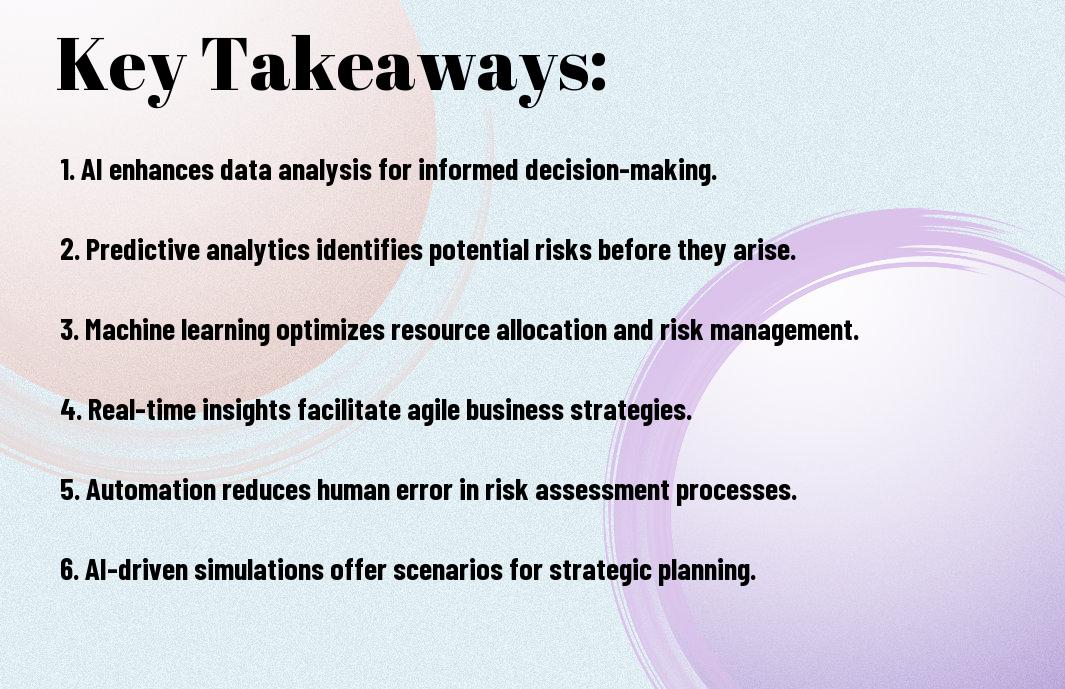
Key Takeaways:
- Entrepreneurs can leverage AI to analyze market trends, identify potential risks, and make informed decisions to mitigate them, ultimately leading to smarter business choices.
- AI-powered tools can help assess the likelihood of various outcomes, allowing entrepreneurs to develop strategies that balance risk and opportunity.
- By integrating AI into their decision-making processes, entrepreneurs can enhance their ability to adapt to changing market conditions and stay ahead of the competition.
- AI-driven risk assessment can also facilitate more effective resource allocation, enabling entrepreneurs to focus on high-priority areas and minimize potential losses.
- Embracing AI as a decision-support tool can lead to more confident and proactive entrepreneurial decision-making, driving business growth and innovation in an increasingly complex and uncertain environment.
Risk Assessment in Modern Business
To effectively navigate the complexities of modern business, you need to understand the role of risk assessment in informing your decisions. As you evaluate opportunities and challenges, you must consider the potential risks and rewards, using data and analytics to guide your choices.
Traditional Risk Models
By leveraging established frameworks and methodologies, you can identify and mitigate potential risks, protecting your business from unforeseen threats. You will use these models to analyze historical data and industry trends, providing a foundation for your decision-making process.
AI-Enhanced Risk Detection
The integration of artificial intelligence (AI) into your risk assessment toolkit enables you to analyze vast amounts of data, identifying patterns and anomalies that may indicate potential risks. You can use AI-powered tools to monitor your business in real-time, responding quickly to emerging threats.
Risk management is an ongoing process, and AI-enhanced risk detection allows you to refine your approach over time, incorporating new data and insights into your decision-making. As you continue to leverage AI in your risk assessment, you will be able to identify potential risks more effectively, taking proactive steps to mitigate them and protect your business from potential threats, ultimately informing your entrepreneurial decisions with data-driven confidence.
Machine Learning for Market Analysis
While leveraging machine learning for market analysis, you can make more informed decisions by utilizing data-driven insights. This approach enables you to analyze large datasets, identify trends, and predict market fluctuations, ultimately giving your business a competitive edge.
Pattern Recognition Systems
Among the various machine learning techniques, pattern recognition systems are particularly useful for identifying trends and anomalies in market data, allowing you to adjust your strategies accordingly and stay ahead of the competition.
Predictive Analytics Tools
Behind the success of many businesses lies the effective use of predictive analytics tools, which enable you to forecast market trends and make data-driven decisions, thereby minimizing risks and maximizing opportunities for your entrepreneurial ventures.
The predictive analytics tools at your disposal can be used to analyze customer behavior, market trends, and other factors that impact your business, providing you with actionable insights to drive growth and profitability. By harnessing the power of predictive analytics, you can optimize your business strategies, mitigate potential risks, and achieve your goals more efficiently.
Decision Support Systems
Now, as an entrepreneur, you can leverage decision support systems to make informed decisions with the help of AI. These systems analyze data and provide recommendations, enabling you to navigate risk and uncertainty in your business.
Real-Time Data Processing
Decisively, you can process data in real-time, allowing you to respond quickly to changes in the market and make timely decisions that drive your business forward.
Scenario Modeling Frameworks
With the ability to model different scenarios, you can anticipate potential outcomes and develop strategies to mitigate risk, giving you a competitive edge in the market.
Support for scenario modeling frameworks is important for your business, as it enables you to test hypotheses and predict the impact of different decisions on your operations, allowing you to refine your strategy and make more informed choices that drive growth and success.
AI-Powered Financial Forecasting
Unlike traditional methods, AI-powered financial forecasting provides you with accurate and data-driven insights to inform your business decisions. You can leverage AI tools to analyze market trends, predict revenue, and identify potential risks, enabling you to make smarter entrepreneurial decisions.
Cash Flow Prediction
Following a steady stream of financial data, you can use AI to predict your cash flow and make informed decisions about investments and resource allocation. You will be able to anticipate and prepare for fluctuations in your cash flow, ensuring your business remains stable and profitable.
Investment Return Analysis
Fluent in analyzing large datasets, AI can help you evaluate investment opportunities and predict potential returns. You can use AI tools to assess the viability of different investments and make data-driven decisions that align with your business goals.
With investment return analysis, you can optimize your investment portfolio and maximize your returns. You will be able to identify the most profitable investments and allocate your resources accordingly, ensuring your business achieves its financial objectives. By leveraging AI-powered investment return analysis, you can minimize risks and make informed decisions that drive your business forward.
Customer Behavior Analytics
Despite the complexity of understanding your customers, you can leverage AI tools to make informed decisions, as discussed in Navigating the Risks of Artificial Intelligence: A Strategic Approach. This helps you navigate risks and opportunities in your business.
Demand Forecasting
For your business to thrive, you need to accurately predict customer demand, and AI-powered analytics can help you achieve this by analyzing historical data and market trends.
Loyalty Pattern Recognition
Around the clock, your customers are interacting with your brand, and AI can help you identify loyalty patterns, allowing you to tailor your marketing strategies to retain loyal customers.
And as you probe deeper into loyalty pattern recognition, you’ll discover that AI can help you identify the most effective channels to reach your loyal customers, enabling you to personalize your marketing efforts and strengthen your relationship with them, ultimately driving business growth and increasing customer retention rates, which is important for your business success.

Operational Risk Management
All businesses face operational risks that can impact their bottom line. You can mitigate these risks by leveraging AI tools to identify and manage potential threats, ensuring your business runs smoothly and efficiently.
Supply Chain Optimization
Any disruption to your supply chain can have significant consequences. You can use AI to analyze your supply chain, predict potential disruptions, and optimize your logistics to minimize risks and ensure timely delivery of products.
Resource Allocation Systems
Among the most significant operational risks is the inefficient allocation of resources. You can use AI-powered resource allocation systems to optimize your resource utilization, reducing waste and improving productivity.
At the heart of effective resource allocation is data-driven decision making. You can use AI to analyze your resource utilization patterns, identify areas of inefficiency, and make informed decisions about resource allocation, ensuring that your business is running at optimal levels. This enables you to maximize your returns on investment and stay ahead of the competition.
To wrap up
Following this exploration of navigating risk with AI, you now have the knowledge to make smarter entrepreneurial decisions. You can leverage AI tools to analyze your business and identify potential risks, allowing you to take proactive measures to mitigate them. With your newfound understanding, you can harness the power of AI to drive your business forward, making informed decisions that minimize risk and maximize returns on your investments, ultimately leading to greater success for your venture.
FAQ
Q: What are the key benefits of using AI tools for navigating risk in entrepreneurial decision-making?
A: The key benefits of using AI tools for navigating risk in entrepreneurial decision-making include enhanced predictive analytics, improved data-driven insights, and the ability to simulate various scenarios to forecast potential outcomes. By leveraging AI, entrepreneurs can make more informed decisions, minimize potential risks, and maximize opportunities for growth and success. Additionally, AI tools can help entrepreneurs identify patterns and trends that may not be immediately apparent, allowing them to adjust their strategies and stay ahead of the competition.
Q: How can AI tools help entrepreneurs assess and mitigate potential risks in their business ventures?
A: AI tools can help entrepreneurs assess and mitigate potential risks by providing advanced risk assessment models, real-time monitoring, and predictive analytics. These tools can analyze large datasets, including market trends, customer behavior, and financial performance, to identify potential risks and provide recommendations for mitigation. Furthermore, AI-powered tools can help entrepreneurs develop contingency plans, identify potential blind spots, and optimize their risk management strategies to ensure business continuity and resilience. By leveraging AI, entrepreneurs can proactively manage risk and make more informed decisions to drive business success.
Q: What are some best practices for entrepreneurs to effectively integrate AI tools into their decision-making processes and navigate risk?
A: To effectively integrate AI tools into their decision-making processes and navigate risk, entrepreneurs should start by identifying areas where AI can add the most value, such as predictive analytics or risk assessment. They should also ensure that their AI tools are aligned with their business goals and objectives, and that they have a clear understanding of the data and insights being generated. Additionally, entrepreneurs should establish a culture of continuous learning and experimentation, staying up-to-date with the latest AI trends and technologies, and being willing to adapt and adjust their strategies as needed. By taking a strategic and informed approach to AI adoption, entrepreneurs can harness the power of AI to drive smarter decision-making and navigate risk with confidence.