As you navigate the landscape of startup innovation, you’re likely exploring ways to leverage machine learning to drive growth. Your ability to harness the power of machine learning can be a game-changer, enabling you to unlock new revenue streams and stay ahead of the competition. By understanding how to effectively monetize machine learning, you can transform your business and create new opportunities for success, which is exactly what this post will guide you through.
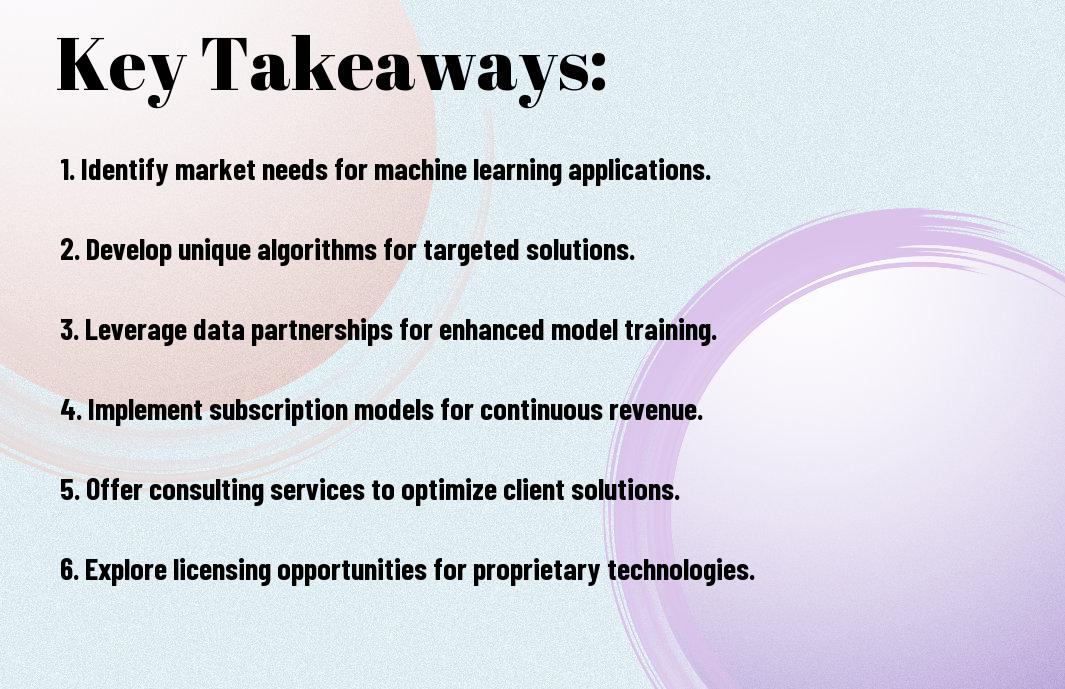
Key Takeaways:
- Startups can leverage machine learning to create new revenue streams by developing and licensing proprietary algorithms, models, and data sets to other companies, generating significant income through royalties and licensing fees.
- Machine learning can be used to improve existing products and services, making them more attractive to customers and increasing their value proposition, which can lead to higher sales and revenue growth for startups.
- Startups can utilize machine learning to offer data-driven services, such as predictive analytics and insights, to customers, providing them with valuable information to inform their business decisions and creating a new source of revenue.
- Monetizing machine learning models through subscription-based services, where customers pay for access to the models and their outputs, can provide a steady stream of revenue for startups and help them scale their businesses.
- Startups can also generate revenue by using machine learning to reduce costs and improve operational efficiency, and then passing these savings on to customers in the form of lower prices, making their offerings more competitive and attractive in the market.
The Value Proposition of Machine Learning
To unlock new revenue streams, you need to understand the value proposition of machine learning. You can leverage machine learning to drive business growth, improve customer experiences, and gain a competitive edge. By integrating machine learning into your startup, you can create new opportunities and increase your bottom line.
Identifying Profitable ML Applications
About the most effective way to monetize machine learning, you should focus on identifying profitable applications that align with your business goals. You can explore various use cases, such as predictive maintenance, customer segmentation, or personalized recommendations, to find the most promising opportunities for your startup.
Assessing Market Readiness
Profitably deploying machine learning models requires assessing market readiness. You need to evaluate whether your target market is prepared to adopt your machine learning-based solutions and whether there is a demand for them. You should conduct market research to determine the potential revenue streams and growth opportunities.
But as you assess market readiness, you will need to consider factors such as regulatory compliance, data privacy, and security. You should also evaluate the competitive landscape and assess the potential barriers to entry. By carefully evaluating these factors, you can determine whether your machine learning-based solutions are ready for market launch and whether they will generate significant revenue for your startup. You can then develop a go-to-market strategy that effectively addresses the needs of your target market and drives business growth.
Revenue Models for ML-Driven Startups
Clearly, developing a robust revenue model is necessary for your startup’s success. You need to consider various strategies to monetize your machine learning capabilities and unlock new revenue streams.
Subscription-Based Services
Around this concept, you can offer your customers access to exclusive machine learning-driven features and tools for a recurring fee, providing a steady stream of revenue for your startup.
Usage-Based Pricing Strategies
On the other hand, you can adopt usage-based pricing, where your customers pay based on their actual usage of your machine learning services, allowing you to generate revenue based on the value delivered.
Services like predictive analytics, natural language processing, and computer vision can be offered under usage-based pricing, enabling you to charge your customers based on the number of predictions, text processed, or images analyzed, giving you a flexible and scalable revenue stream.
Data Monetization Frameworks
After establishing a solid foundation in machine learning, you can leverage data monetization frameworks to unlock new revenue streams for your startup, enabling you to turn your data into a valuable asset that drives business growth.
Ethical Considerations
Along with the potential benefits of data monetization, you must consider the ethical implications of collecting, processing, and selling data, ensuring that your practices align with regulatory requirements and respect your customers’ privacy.
Privacy-Preserving Techniques
Beside the ethical considerations, you should also explore privacy-preserving techniques that allow you to protect sensitive information while still extracting value from your data, providing a secure and trustworthy environment for your customers.
PrivacyPreserving techniques are necessary for your startup, as they enable you to balance the need to monetize your data with the need to protect your customers’ sensitive information, you can use methods such as data anonymization, encryption, and secure multi-party computation to ensure that your data is handled responsibly and in compliance with regulations, allowing you to build trust with your customers and establish a strong reputation in the market.
Building ML Products That Sell
Once again, you’ll need to focus on creating machine learning products that meet the needs of your target market. Your goal is to develop solutions that solve real problems and provide tangible value to your customers.
User Experience Design
After considering your product’s functionality, you’ll want to prioritize user experience design. You should create an intuitive and seamless interface that makes it easy for your customers to interact with your machine learning product.
Technical Scalability
Products like yours require robust technical infrastructure to handle large volumes of data and user traffic. You must ensure that your machine learning product is scalable and can handle growth without compromising performance.
Understanding the technical requirements of your machine learning product is imperative to its success. You need to consider factors such as data storage, processing power, and network bandwidth to ensure that your product can handle increasing demand and provide reliable service to your customers.
Go-to-Market Strategies
For startups looking to monetize machine learning, developing effective go-to-market strategies is crucial. You need to consider your target audience, unique value proposition, and competitive landscape to successfully launch your product or service.
Positioning Against Competitors
Around the time you’re preparing to launch, you should assess your competitors’ strengths and weaknesses to position your product or service uniquely in the market, allowing you to differentiate your offerings and attract your target audience, helping you stand out from the competition.
Customer Acquisition Channels
Channels such as social media, content marketing, and paid advertising can be effective for acquiring customers, and you should consider which channels align best with your target audience and marketing goals, enabling you to reach and engage with potential customers.
Due to the complexity of machine learning solutions, you may need to invest in educational content and thought leadership initiatives to establish your authority in the market and build trust with potential customers, which can help drive conversions and ultimately, revenue growth for your startup.

Measuring ML Business Success
Unlike traditional business metrics, measuring the success of machine learning (ML) initiatives requires a unique set of benchmarks. You need to track key metrics that reflect the impact of ML on your business, such as revenue growth, customer engagement, and model accuracy.
Key Performance Indicators
One of the first steps in measuring ML success is identifying the right key performance indicators (KPIs) for your business. You will need to select metrics that align with your business goals, such as model precision, recall, or F1 score, to evaluate the effectiveness of your ML models.
Iterative Improvement Cycles
Performance metrics will help you refine your ML models over time. You can use these metrics to identify areas for improvement, retrain your models, and deploy updated versions, creating a cycle of continuous improvement that drives business value.
Further, as you iterate on your ML models, you will be able to refine your understanding of what drives business success, allowing you to make data-driven decisions and unlock new revenue streams for your startup, and you will be able to measure the impact of these improvements on your bottom line.
To wrap up
On the whole, you now have a comprehensive understanding of monetizing machine learning, enabling you to unlock new revenue streams for your startup. You can leverage your data to create innovative products and services, driving business growth and increasing your competitive edge. By applying these strategies, you will be able to capitalize on the vast potential of machine learning, transforming your business and securing your position in the market, with your unique offerings and solutions.
FAQ
Q: What are the primary ways startups can monetize machine learning models to unlock new revenue streams?
A: Startups can monetize machine learning models through various strategies, including offering predictive analytics as a service, creating and selling machine learning-powered products, licensing their models to other companies, and providing consulting services to help other businesses implement machine learning solutions. Additionally, startups can also generate revenue by offering subscription-based access to their machine learning-powered platforms, providing data labeling and enrichment services, and creating machine learning-based marketplaces. By exploring these avenues, startups can effectively unlock new revenue streams and maximize the potential of their machine learning investments.
Q: How can startups measure the effectiveness of their machine learning monetization strategies and identify areas for improvement?
A: To measure the effectiveness of their machine learning monetization strategies, startups should track key performance indicators (KPIs) such as revenue growth, customer acquisition costs, customer lifetime value, and model performance metrics like accuracy and precision. They should also conduct regular market research and gather feedback from customers to identify areas for improvement and optimize their strategies accordingly. Moreover, startups can leverage data analytics and visualization tools to gain insights into their machine learning models’ performance and make data-driven decisions to refine their monetization approaches. By continuously monitoring and evaluating their strategies, startups can refine their approaches and ensure they are maximizing their revenue potential.
Q: What are the common challenges startups face when trying to monetize their machine learning models, and how can they overcome them?
A: Startups often face challenges such as data quality issues, lack of skilled talent, regulatory compliance, and intense competition when trying to monetize their machine learning models. To overcome these challenges, startups should prioritize data quality and invest in data preprocessing and validation, attract and retain top talent by offering competitive compensation and benefits, and stay up-to-date with changing regulatory requirements. Additionally, startups can collaborate with other companies, research institutions, or industry experts to access new data sources, technologies, and expertise, and differentiate their offerings through innovative applications of machine learning. By being aware of these potential challenges and taking proactive steps to address them, startups can successfully navigate the process of monetizing their machine learning models and achieve their revenue goals.