Building a Resilient Business with AI – Strategies for Long-Term Wealth

You are likely aware that artificial intelligence (AI) is transforming the business landscape, and your company’s ability to adapt will determine its success. As you navigate this new era, you need to develop strategies that harness AI’s power to drive growth and sustainability. Your business can thrive with the right approach, and this post will guide you in building a resilient enterprise that leverages AI for long-term wealth and prosperity. You will discover key tactics to future-proof your organization.

Key Takeaways:

  • Implementing AI solutions can help businesses build resilience by automating processes, enhancing decision-making, and improving operational efficiency, ultimately leading to long-term wealth and sustainability.
  • Developing a strategic AI roadmap is important to ensure alignment with business goals and objectives, and to maximize the benefits of AI adoption, such as increased productivity and competitiveness.
  • Investing in AI-powered data analytics can provide businesses with valuable insights and predictive capabilities, enabling them to anticipate and respond to market changes, mitigate risks, and capitalize on new opportunities.
  • Building a resilient business with AI requires a culture of innovation and continuous learning, where employees are empowered to develop new skills and adapt to emerging technologies, ensuring the organization stays ahead of the curve.
  • Effective integration of AI into business operations demands a balanced approach, considering both the benefits and potential risks, such as job displacement and bias, to ensure that AI adoption supports the well-being of both the business and its stakeholders.
Identifying AI Opportunities for Business Resilience

For businesses seeking to build resilience, AI offers a wealth of opportunities. You can leverage AI to enhance operational efficiency, improve decision-making, and drive innovation, ultimately leading to long-term wealth and sustainability.

Assessing Your Current Business Vulnerabilities

With a thorough understanding of your business, you can identify areas where AI can mitigate risks and improve resilience. You will need to evaluate your current systems, processes, and infrastructure to determine where AI solutions can be effectively integrated.

Matching AI Solutions to Core Business Needs

Beside your business goals, AI solutions can be tailored to address specific challenges and opportunities. You should consider how AI can be applied to your core business functions, such as customer service, supply chain management, or financial planning, to drive growth and resilience.

It is necessary to align AI solutions with your business objectives, ensuring that they support your overall strategy and drive meaningful outcomes. You should consider factors such as data quality, scalability, and integration with existing systems when selecting AI solutions, and prioritize those that offer the greatest potential for impact and return on investment.

Financial Frameworks for AI Investment

Any business looking to invest in AI needs a solid financial framework to ensure long-term wealth. You must consider the costs and benefits of AI implementation, as well as the potential return on investment.

Capital Allocation Principles for AI Projects

Behind every successful AI project is a well-planned capital allocation strategy. You should prioritize your AI investments based on your business goals and allocate your resources accordingly, ensuring that your investments align with your overall business strategy.

Measuring Return on AI Investments

Investing in AI requires a clear understanding of how to measure the return on your investments. You need to establish key performance indicators (KPIs) to evaluate the success of your AI projects and make data-driven decisions to optimize your investments.

Projects that incorporate AI can be complex and challenging to evaluate, but you can start by tracking metrics such as revenue growth, cost savings, and customer engagement. You should also consider using advanced analytics tools to help you measure the impact of your AI investments and make adjustments to your strategy as needed, allowing you to maximize your returns and achieve your business goals.

Risk Management Through Predictive Analytics

To effectively manage risk in your business, you can leverage predictive analytics to forecast potential threats and opportunities. This enables you to make informed decisions and mitigate risks, ensuring your business remains resilient in the face of uncertainty.

Market Volatility Forecasting Systems

Alongside other tools, advanced market volatility forecasting systems can help you anticipate and prepare for market fluctuations, allowing you to adjust your strategy accordingly and protect your investments.

Supply Chain Resilience Modeling

Meanwhile, management of your supply chain is vital to your business’s overall resilience, and predictive analytics can help you identify potential vulnerabilities and develop strategies to address them, ensuring that your supply chain remains robust and adaptable.

Considering the complexities of modern supply chains, you will need to develop a comprehensive understanding of the various factors that can impact your operations, from logistics and transportation to supplier relationships and inventory management. By using predictive analytics to model different scenarios and identify potential risks, you can develop proactive strategies to mitigate these risks and ensure that your supply chain remains resilient in the face of disruption, ultimately protecting your business’s long-term wealth and stability.

Customer Relationship Enhancement via AI

After implementing AI in your business, you can significantly enhance customer relationships, leading to increased loyalty and retention. You can leverage AI to analyze customer data, preferences, and behavior, allowing you to tailor your services to meet their needs.

Personalization at Scale

By utilizing AI-powered tools, you can personalize your customer interactions at scale, enabling you to provide a unique experience for each customer, thereby strengthening your bond with them.

Retention Strategy Automation

Above all, automating your retention strategy with AI helps you identify and address potential issues before they lead to customer churn, allowing you to proactively retain your customers.

Retention is a key aspect of your business, and with AI, you can develop targeted strategies to retain your customers, such as offering personalized loyalty programs, sending timely notifications, and providing exceptional customer support, ultimately leading to long-term wealth and growth for your business as you continue to meet the evolving needs of your customers.

Operational Efficiency Transformation

Your business can benefit from AI-driven operational efficiency transformation, learn more about How to Build a Resilient Business in an Ever-Changing Economy to stay ahead.

Process Automation Selection Criteria

Among the key factors to consider when selecting process automation, you should evaluate the potential return on investment and the impact on your workforce.

Workforce Augmentation Strategies

To effectively implement AI, you need to develop strategies that augment your workforce, enhancing their capabilities and productivity.

Even as you adopt AI, your focus should be on upskilling your employees, enabling them to work alongside AI systems and maximize the benefits of automation, leading to increased efficiency and long-term wealth for your business.

Competitive Advantage Through Data Assets

Keep in mind that your business’s ability to collect, analyze, and act on data is key to gaining a competitive edge in the market, and leveraging AI can help you make the most of your data assets.

Building Proprietary Data Moats

Alongside your existing data collection efforts, acquiring and utilizing unique data sources can help you build a proprietary data moat that sets your business apart from competitors and provides a foundation for long-term success.

Turning Data into Strategic Decisions

Among the most effective ways to drive business growth, using data to inform your strategic decisions enables you to make informed choices that drive your business forward, and AI can help you uncover hidden insights in your data.

Data drives your ability to make strategic decisions, and by leveraging AI-powered analytics, you can uncover patterns and trends in your data that might otherwise go unnoticed, allowing you to adjust your business strategy and stay ahead of the competition, ultimately leading to increased efficiency and profitability for your business.

Summing up

Now that you have explored the strategies for building a resilient business with AI, you can apply these insights to secure your company’s long-term wealth. You will be able to leverage AI to drive growth, mitigate risks, and stay competitive. By implementing these approaches, you will strengthen your business and ensure its prosperity, ultimately achieving your goals and protecting your investments. Your ability to adapt and innovate with AI will be key to your success.

FAQ

Q: What are the key benefits of incorporating AI into my business strategy for long-term wealth creation?

A: Incorporating AI into your business strategy can bring numerous benefits, including enhanced operational efficiency, improved decision-making, and increased competitiveness. AI can help automate routine tasks, analyze large datasets, and provide valuable insights, enabling you to make informed decisions and stay ahead of the competition. Additionally, AI can help you identify new business opportunities, optimize resource allocation, and mitigate potential risks, ultimately contributing to long-term wealth creation and business resilience.

Q: How can I ensure that my business is prepared to adapt to the changing landscape of AI technology and its applications?

A: To ensure your business is prepared to adapt to the changing landscape of AI technology, it’s vital to stay informed about the latest developments and advancements in the field. This can be achieved by attending industry conferences, participating in online forums, and engaging with AI experts and thought leaders. Furthermore, you should prioritize investing in employee training and development, focusing on building a workforce with the necessary skills to effectively leverage AI technologies. By fostering a culture of innovation and experimentation, you can encourage your team to explore new AI-powered solutions and identify opportunities for growth and improvement.

Q: What role does data quality play in building a resilient business with AI, and how can I ensure that my business has access to high-quality data?

A: Data quality plays a vital role in building a resilient business with AI, as high-quality data is vital for training accurate AI models and generating reliable insights. To ensure access to high-quality data, it’s vital to establish robust data management practices, including data collection, storage, and processing protocols. This can involve implementing data validation and verification processes, as well as investing in data cleansing and normalization tools. Additionally, you should prioritize data security and compliance, ensuring that your business adheres to relevant data protection regulations and standards. By prioritizing data quality, you can trust the insights generated by your AI systems and make informed decisions to drive long-term business success.

The Intersection of AI and Venture Capital – Investing in the Future

As you navigate the evolving landscape of investment opportunities, you’re likely considering the role of artificial intelligence in shaping the future of venture capital. Your investments have the potential to revolutionize industries and transform the way businesses operate. With AI-driven innovations on the rise, you’re poised to capitalize on the tremendous growth potential that this intersection of technologies presents, and this blog post will guide you through the key aspects to consider when investing in this exciting space.

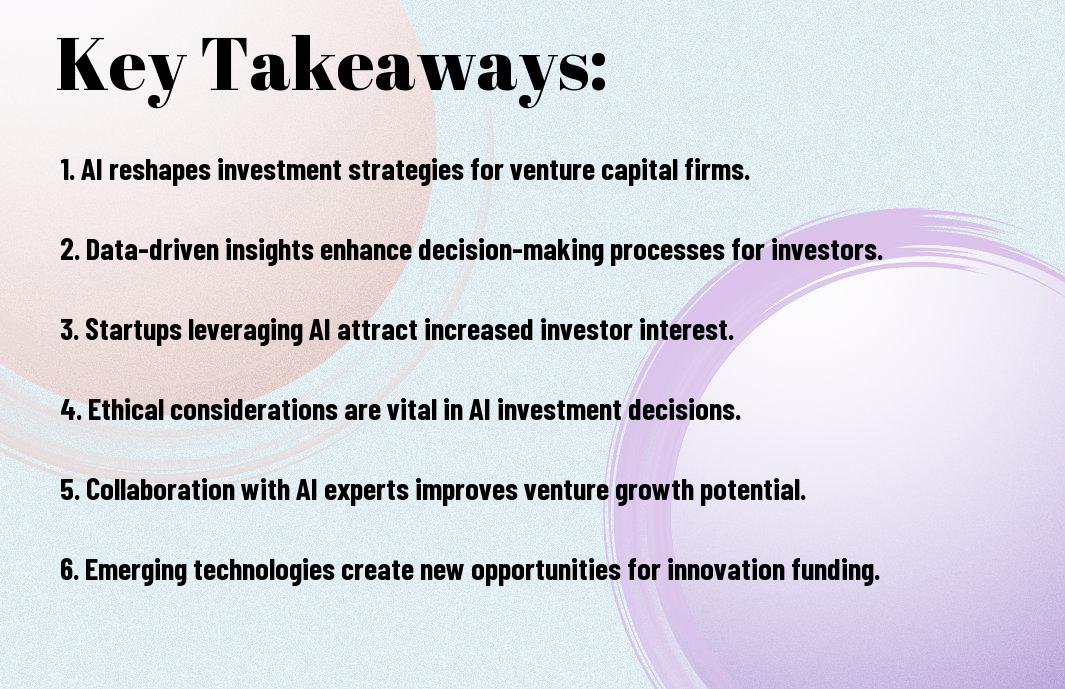
Key Takeaways:

  • The integration of Artificial Intelligence (AI) in venture capital is transforming the investment landscape by enhancing deal sourcing, due diligence, and portfolio management, leading to more informed investment decisions.
  • AI-driven tools are being utilized to analyze vast amounts of data, identify patterns, and predict market trends, allowing venture capital firms to uncover promising startups and investment opportunities more efficiently.
  • The use of machine learning algorithms in venture capital enables the assessment of startup potential based on quantitative metrics, reducing the reliance on traditional methods that often involve personal biases and intuition.
  • As AI continues to evolve, venture capital firms are adapting by developing specialized AI-focused investment strategies, such as investing in AI startups and companies that leverage AI to drive innovation and growth.
  • The intersection of AI and venture capital also raises important considerations around ethics, transparency, and accountability, highlighting the need for investors to prioritize responsible AI development and deployment in their investment portfolios.

The AI Revolution in Investment Landscapes

While the integration of AI in venture capital is still in its early stages, you are likely to see significant changes in the way investments are made. AI-driven tools are being used to analyze vast amounts of data, identify patterns, and make predictions about investment outcomes.

Algorithmic Decision-Making

Landscaping the future of investments, you will find that algorithmic decision-making is becoming increasingly prevalent. You can expect to see more AI-powered systems being used to inform investment decisions, allowing for faster and more accurate analysis of potential investments.

Risk Assessment Paradigms

With the advent of AI, you are witnessing a shift in risk assessment paradigms. You can use AI-driven tools to analyze complex data sets and identify potential risks, allowing you to make more informed investment decisions.

This ability to assess risk more accurately is particularly valuable in the venture capital space, where you are often dealing with high-risk, high-reward investments. You can use AI to analyze market trends, financial data, and other factors to determine the potential risks and returns on an investment, helping you to make more informed decisions and maximize your returns.

Venture Capital’s Evolution in the Digital Age

It is evident that the venture capital landscape has undergone significant changes with the advent of digital technologies, and you are now witnessing a new era of investment opportunities. You can see how AI is transforming the way you invest in startups, and your approach to venture capital is evolving rapidly.

Traditional Models Disrupted

Before the digital age, you relied on traditional models of venture capital, but now you are experiencing a shift towards more innovative and tech-driven approaches. Your investment strategies are being redefined, and you are adapting to the new landscape.

New Metrics of Value

Evolving alongside the digital age, you are seeing new metrics of value emerge, and your assessment of startup potential is becoming more sophisticated. You are considering factors such as user engagement, data-driven insights, and AI-powered growth projections to inform your investment decisions.

Indeed, as you investigate deeper into the new metrics of value, you will discover that they offer a more nuanced understanding of a startup’s potential for success. You will be able to evaluate factors such as the quality of a startup’s data, the effectiveness of its AI algorithms, and the potential for scalability, allowing you to make more informed investment decisions and maximize your returns in the rapidly evolving venture capital landscape.

The Technical Underpinnings of AI in VC

Now, as you explore into the world of AI in venture capital, it’s crucial to understand the technical aspects that drive this intersection. You’ll encounter various technologies that enable AI-driven decision-making, and it’s vital to grasp these concepts to navigate this space effectively.

Machine Learning Applications

Beneath the surface of AI lies machine learning, which enables systems to learn from data and make predictions. You’ll find that machine learning applications are being used to analyze large datasets, identify patterns, and make informed investment decisions, allowing you to make more accurate predictions about your investments.

Predictive Analytics Frameworks

Among the key technologies used in AI-driven venture capital are predictive analytics frameworks, which provide a structured approach to analyzing data and making predictions. You’ll use these frameworks to identify trends, forecast outcomes, and optimize your investment strategies, giving you a competitive edge in the market.

And as you explore predictive analytics frameworks in more depth, you’ll discover that they rely on complex algorithms and statistical models to analyze large datasets, identify patterns, and make predictions about future outcomes. You can use these frameworks to analyze market trends, assess the potential of startups, and make informed investment decisions, ultimately helping you to maximize your returns and achieve your investment goals.

Capital Allocation Strategies

After determining your investment goals, you’ll need to develop a capital allocation strategy that balances risk and potential returns. You’ll want to consider how to distribute your investments across various AI-focused sectors, from healthcare to finance, to maximize your portfolio’s growth potential.

Sector-Specific Approaches

Across different industries, you’ll find unique opportunities for AI-driven growth, and you should tailor your investment approach to each sector’s specific needs and trends. You’ll need to assess the competitive landscape, market demand, and potential for disruption in each sector to make informed investment decisions.

Growth Stage Considerations

Against the backdrop of a rapidly evolving AI landscape, you’ll need to consider the growth stage of each investment opportunity, from seed funding to late-stage investments. You’ll want to evaluate the potential for scalability, the competitive advantage, and the management team’s ability to execute on their vision.

Considerations such as cash flow management, talent acquisition, and regulatory compliance become more significant as your investments grow. You’ll need to assess whether your portfolio companies have the necessary resources and expertise to navigate these challenges and achieve long-term success, and adjust your investment strategy accordingly to support their growth.

Ethical Dimensions

Unlike other investment areas, AI raises unique ethical concerns. As you explore the intersection of AI and venture capital, consider the implications of The AI Investment Boom: Impact on Venture Capital. You must navigate these complexities to make informed decisions.

Bias in Algorithmic Investing

Any investment strategy that relies on AI must account for potential biases in algorithmic decision-making. You should be aware of how biases can impact your investment choices and take steps to mitigate them.

Transparency Imperatives

Bias in AI systems can have significant consequences, which is why transparency is important. You need to understand how AI-driven investment decisions are made and be able to track the underlying factors that influence them.

In addition, as you probe into the world of AI-powered venture capital, you will need to prioritize transparency in your investment approach, ensuring that you can explain and justify the decisions made by your AI systems, and make adjustments as needed to maintain accountability and trust in your investment strategy.

Future Trajectories

Your investment decisions in the intersection of AI and venture capital will shape the future of various industries, and it’s important to consider the potential outcomes of your choices.

Emerging Technologies

Against the backdrop of rapid advancements, you’ll encounter new opportunities in areas like machine learning and natural language processing, which will continue to transform the way you approach investment strategies.

Regulatory Horizons

Emerging from the complexities of AI development, you’ll need to navigate the evolving regulatory landscape, which will impact your investment decisions and the overall growth of the industry.

With the regulatory environment constantly changing, you should stay informed about the latest developments and their potential effects on your investments, ensuring you’re well-positioned to capitalize on new opportunities and mitigate potential risks in the AI and venture capital space.

Conclusion

With this in mind, you now have a deeper understanding of the intersection of AI and venture capital, and how it can impact your investment decisions. As you consider investing in the future, you will be better equipped to navigate the opportunities and challenges presented by AI-driven technologies, ultimately informing your strategy and guiding your investments in this exciting and rapidly evolving space, shaping your approach to investing in the future.

FAQ

Q: What is the current state of AI adoption in the venture capital industry, and how is it impacting investment decisions?

A: The venture capital industry is witnessing a significant surge in AI adoption, with many firms leveraging AI-powered tools to analyze investment opportunities, predict market trends, and optimize portfolio management. AI is being used to process vast amounts of data, identify patterns, and provide insights that can inform investment decisions. As a result, venture capital firms are able to make more informed decisions, reduce risk, and increase potential returns. The intersection of AI and venture capital is creating new opportunities for investment in AI-powered startups, and we can expect to see more innovative applications of AI in the industry in the future.

Q: How do venture capital firms evaluate the potential of AI startups, and what are the key factors that influence their investment decisions?

A: Venture capital firms evaluate the potential of AI startups by assessing several key factors, including the strength of the founding team, the uniqueness and scalability of the technology, the size and growth potential of the market, and the competitive landscape. They also consider the startup’s ability to collect and leverage high-quality data, as well as its potential to drive meaningful social and economic impact. Additionally, venture capital firms look for startups that have a clear understanding of the regulatory environment and potential risks associated with AI development and deployment. By carefully evaluating these factors, venture capital firms can make informed investment decisions and identify AI startups with high growth potential.

Q: What are the potential risks and challenges associated with investing in AI startups, and how can venture capital firms mitigate these risks to ensure successful investments?

A: Investing in AI startups carries several potential risks and challenges, including regulatory uncertainty, data privacy concerns, and the potential for AI systems to be biased or flawed. Venture capital firms can mitigate these risks by conducting thorough due diligence on AI startups, evaluating their data management practices, and assessing their approach to AI development and deployment. They should also consider the potential for AI systems to be used in ways that are detrimental to society, and invest in startups that prioritize transparency, accountability, and social responsibility. By taking a thoughtful and informed approach to investing in AI startups, venture capital firms can minimize risks and maximize returns, while also contributing to the development of AI technologies that benefit society as a whole.

The AI Blueprint – Crafting a Profitable Business Model from Scratch

You’re about to begin on a journey to create a successful business from the ground up, leveraging the power of AI. Your goal is to develop a profitable business model that drives growth and revenue. With the right guidance, you can navigate the process of designing and implementing an effective AI-driven business strategy, tailored to your unique needs and goals, and set your business up for long-term success.

Key Takeaways:

  • Developing a successful AI business model requires a deep understanding of the market, including identifying potential customers, understanding their needs, and recognizing the competitive landscape to create a unique value proposition.
  • A well-defined business strategy is vital for the effective integration of AI into a company, ensuring alignment with overall business goals and maximizing the potential of AI technologies.
  • Building a profitable AI business model from scratch involves designing and implementing a robust revenue stream, managing costs, and continuously monitoring and adapting the model to changing market conditions and technological advancements.
  • Effective data management is a key component of a successful AI business, as high-quality data is necessary for training and improving AI algorithms, and for making informed business decisions.
  • Staying up-to-date with the latest advancements in AI and being open to innovation and experimentation are vital for maintaining a competitive edge and driving long-term growth in an AI-driven business.

The AI Landscape

The AI landscape is constantly evolving, and you need to stay up-to-date with the latest trends and technologies to craft a profitable business model. You will encounter various AI applications and innovations that can transform your business. Your understanding of the AI landscape will help you make informed decisions and create a successful business strategy.

Current Market Realities

Beneath the surface of the AI landscape, you’ll find a complex web of market realities that affect your business. You must consider these factors to develop a viable business model, and your ability to navigate them will determine your success.

Identifying Profitable Niches

With the vast array of AI applications available, you can identify profitable niches that align with your business goals. You should focus on areas where AI can add significant value, and your expertise can help you stand out from the competition.

In addition to identifying profitable niches, you need to analyze your target market and understand the specific needs of your customers. You can then develop AI-powered solutions that cater to these needs, setting your business up for success and helping you establish a strong presence in the market, which will ultimately drive your revenue and growth.

Core Business Models

Any successful AI-powered business starts with a solid foundation, and that begins with your core business model. You’ll need to consider how you’ll generate revenue, deliver value to your customers, and differentiate yourself from competitors. Your business model will serve as the backbone of your organization, guiding your decisions and shaping your strategy.

SaaS and Subscription Approaches

Above all, SaaS and subscription models offer a predictable revenue stream, allowing you to forecast and plan for the future. You can leverage these approaches to provide ongoing value to your customers, while also generating recurring revenue for your business. This can be an attractive option for AI-powered businesses, as it enables you to deliver continuous updates and improvements to your customers.

Custom Solutions and Consulting

By offering custom solutions and consulting services, you can tailor your AI offerings to meet the unique needs of your clients. You’ll work closely with them to understand their challenges and develop tailored solutions that address their specific pain points. This approach allows you to deliver high-value services and build strong relationships with your clients.

In fact, custom solutions and consulting can be a highly lucrative approach for AI-powered businesses, as you can command premium prices for your expertise and tailored services. You’ll have the opportunity to work with a range of clients, from small startups to large enterprises, and help them leverage AI to drive innovation and growth. As you deliver successful projects and build your reputation, you can attract new clients and expand your business, creating a strong foundation for long-term success.

Revenue Streams

To establish a profitable business model, you need to identify and develop multiple revenue streams. This involves creating a diverse range of income sources that can help your business grow and thrive.

Primary Income Sources

Sources of revenue are the foundation of your business, and you should focus on developing a strong primary income stream. You can achieve this by identifying your target market and creating products or services that meet their needs, allowing you to generate consistent revenue.

Diversification Strategies

With a solid primary income stream in place, you can explore diversification strategies to expand your revenue streams. You can consider offering complementary products or services, or targeting new markets to increase your revenue potential.

Streams of revenue can be developed through various channels, such as subscription-based models, advertising, or affiliate marketing. As you diversify your revenue streams, you can reduce your dependence on a single source of income, making your business more resilient and better equipped to handle market fluctuations, allowing you to achieve long-term success and increase your overall revenue.

Cost Structure Analysis

Unlike traditional businesses, your AI-powered venture requires a unique cost structure analysis. You need to consider the expenses associated with developing and maintaining your AI systems, as well as the operational costs of running your business.

Development Investments

About the initial investments, you should consider the costs of developing your AI technology, including talent acquisition, research, and development expenses. You will need to allocate funds for these investments to ensure your AI system is robust and efficient.

Operational Expenses

Around the operational aspects, you will incur expenses such as infrastructure, maintenance, and update costs. You should factor these expenses into your cost structure analysis to ensure your business remains profitable.

In addition to these expenses, you should also consider the costs of data storage, security, and compliance. You will need to ensure that your AI system is secure and compliant with relevant regulations, which may require additional investments in infrastructure and talent. As you develop your cost structure analysis, you should carefully consider these operational expenses to ensure your business remains competitive and profitable.

Customer Acquisition

Despite the complexity of AI technology, your customer acquisition strategy should be straightforward and focused on delivering value to your target audience. You need to understand your ideal customer’s needs and pain points to create an effective acquisition plan.

Marketing in the AI Space

Any successful marketing strategy in the AI space begins with a deep understanding of your target audience and the problems they are trying to solve. You will need to tailor your marketing efforts to speak directly to these needs, highlighting the benefits and value that your AI solution provides.

Sales Funnels That Convert

By designing a sales funnel that addresses the specific needs and concerns of your target audience, you can increase conversions and drive revenue growth. You should focus on creating a seamless and intuitive experience that guides potential customers through the sales process.

With a well-designed sales funnel in place, you can optimize your conversion rates and maximize the return on investment for your marketing efforts. You will be able to track the performance of your sales funnel, identify areas for improvement, and make data-driven decisions to refine your approach and achieve even better results.

Scaling Strategies

Your business model is now ready to be taken to the next level, and scaling is the key to unlocking its full potential, enabling you to reach new heights and expand your customer base.

From Prototype to Product

Against all odds, you have successfully developed a prototype, and now it’s time to refine it into a fully-fledged product that meets the needs of your target market, setting you up for success.

Growth Metrics That Matter

Strategically, you need to focus on the right growth metrics to measure your progress, including revenue, customer acquisition, and retention rates, which will help you make informed decisions about your business.

At this stage, you are likely to be closely monitoring your growth metrics, and you should be using this data to identify areas for improvement, optimize your operations, and make strategic decisions about investments and resource allocation, allowing you to drive your business forward and achieve your goals.

Conclusion

Summing up, you now have a comprehensive understanding of the AI blueprint, enabling you to craft a profitable business model from scratch. You can leverage this knowledge to create a tailored strategy, driving your business forward. By applying the principles outlined, you will be well-equipped to navigate the AI landscape, making informed decisions to propel your venture towards success, and ultimately, maximizing your returns on investment in the AI-powered market, shaping your business into a thriving entity.

FAQ

Q: What is The AI Blueprint and how can it help me in creating a profitable business model from scratch?

A: The AI Blueprint is a comprehensive guide that provides a step-by-step approach to crafting a profitable business model from scratch, leveraging the power of Artificial Intelligence (AI). It helps entrepreneurs and business owners to identify opportunities, develop a unique value proposition, and create a scalable business model that drives revenue and growth. By following The AI Blueprint, you can validate your business idea, develop a go-to-market strategy, and build a sustainable competitive advantage in your industry.

Q: What are the key components of The AI Blueprint and how do they contribute to the development of a profitable business model?

A: The AI Blueprint consists of several key components, including market analysis, customer segmentation, product development, marketing and sales strategy, and financial planning. These components work together to help you develop a deep understanding of your target market, create a unique and compelling product or service, and design a business model that is tailored to your specific needs and goals. By following The AI Blueprint, you can create a comprehensive business plan that takes into account the latest trends and technologies in AI, and sets you up for success in today’s fast-paced and competitive business landscape.

Q: How can The AI Blueprint help me to stay ahead of the competition and adapt to changing market conditions in my industry?

A: The AI Blueprint provides a flexible and adaptable framework for building a profitable business model, allowing you to stay ahead of the competition and respond to changing market conditions. By leveraging the power of AI and machine learning, you can analyze market trends, identify new opportunities, and make data-driven decisions that drive business growth. The AI Blueprint also provides guidance on how to continuously monitor and evaluate your business model, making adjustments as needed to stay competitive and achieve long-term success. With The AI Blueprint, you can build a business that is resilient, agile, and poised for success in an ever-changing business environment.

Accelerating Startup Growth with AI-Enhanced Market Insights

As you navigate the competitive startup landscape, you need to make informed decisions to drive your business forward. Your ability to analyze market trends and identify opportunities is key to success. With the advent of AI-enhanced market insights, you can now gain a deeper understanding of your target audience and stay ahead of the competition. By leveraging these insights, you can optimize your strategy and accelerate your startup’s growth, ultimately achieving your business goals more efficiently.

Key Takeaways:

  • Utilizing AI-enhanced market insights can significantly accelerate startup growth by providing data-driven decision-making capabilities, enabling businesses to respond quickly to market trends and stay ahead of the competition.
  • AI-powered market analysis can help startups identify new business opportunities, predict customer behavior, and optimize their marketing strategies to maximize ROI and improve customer engagement.
  • AI-driven market research can provide startups with real-time insights into their target audience, allowing them to develop more effective product development and marketing strategies that meet the evolving needs of their customers.
  • By leveraging AI-enhanced market insights, startups can reduce the risk of launching new products or services, as they can test and validate their ideas with data-driven confidence, minimizing potential losses and maximizing potential gains.
  • Integrating AI into market research and analysis can also help startups streamline their operations, automate routine tasks, and free up resources for more strategic and creative endeavors, ultimately driving innovation and growth.

    The Current Landscape of Market Intelligence

    A midst the rapid evolution of technology, you are likely aware that market intelligence plays a vital role in driving business growth, and you need to stay informed to make data-driven decisions.

    Traditional Methods and Their Limitations

    Beneath the surface of traditional market research methods, you will find limitations in terms of data analysis and insight generation, which can hinder your ability to respond quickly to changing market conditions.

    The Emergence of AI-Driven Analytics

    Across the market intelligence landscape, you are seeing a shift towards AI-driven analytics, which enables you to process vast amounts of data and uncover hidden patterns, giving you a competitive edge.

    This emergence of AI-driven analytics is transforming the way you approach market intelligence, as you can now leverage machine learning algorithms to analyze large datasets, identify trends, and predict future market developments, allowing you to make more informed decisions and drive your business forward with confidence.

    Core AI Technologies Transforming Market Research

    The integration of AI in market research has revolutionized the way you gather and analyze data, enabling your business to make informed decisions. You can now leverage AI-enhanced market insights to accelerate your startup’s growth.

    Machine Learning Algorithms for Pattern Recognition

    Beneath the surface of traditional market research lies a wealth of untapped data, and you can uncover it using machine learning algorithms that identify patterns and trends, helping your business stay ahead of the competition.

    Natural Language Processing for Sentiment Analysis

    Alongside machine learning, you have natural language processing, which enables your business to analyze customer sentiments and opinions, allowing you to tailor your products and services to meet their needs.

    Research indicates that natural language processing for sentiment analysis is a powerful tool, as you can use it to monitor social media, customer reviews, and feedback, providing valuable insights into your target audience’s preferences and pain points, helping you refine your marketing strategy and improve customer satisfaction, ultimately driving your startup’s growth and success.

    Implementation Strategies for Startups

    Now that you have decided to leverage AI-enhanced market insights, it’s time to develop a strategy for implementation, considering your startup’s unique needs and goals, to drive growth and stay competitive.

    Cost-Effective AI Solutions for Early-Stage Companies

    Alongside other considerations, an affordable and scalable AI solution is crucial for your early-stage company, allowing you to access valuable market insights without breaking the bank, and enabling you to make data-driven decisions that drive your business forward.

    Integration with Existing Business Processes

    Above all, seamless integration with your existing business processes is vital, ensuring that your AI-enhanced market insights are actionable and aligned with your overall business strategy, allowing you to maximize the benefits of AI and drive meaningful growth.

    Companies like yours can integrate AI-enhanced market insights into their existing business processes by identifying areas where data-driven decision making can have the greatest impact, and then implementing AI solutions that provide actionable insights, enabling you to refine your strategy and drive growth, as you continue to scale and evolve your business.

    Competitive Advantages Through Predictive Insights

    After gaining access to predictive insights, you can make informed decisions to drive your startup’s growth, staying ahead of the competition with data-driven strategies.

    Anticipating Market Shifts Before Competitors

    About the time your competitors are reacting to market changes, you can be proactively adjusting your approach, leveraging AI-enhanced market insights to anticipate shifts and capitalize on emerging trends.

    Dynamic Pricing and Product Positioning

    On the path to optimizing your startup’s market performance, you will find that AI-driven insights enable you to adjust pricing and positioning in real-time, ensuring your products or services meet the evolving needs of your target audience.

    Pricing strategies can be tailored to specific customer segments, maximizing your revenue potential, and with AI-enhanced insights, you can continuously monitor and refine your approach, ensuring your startup remains competitive and agile in a rapidly changing market landscape, allowing you to make the most of your resources and drive growth.

    Data Collection and Management

    Many startups struggle with collecting and managing large amounts of data, but you can overcome this challenge by implementing effective data collection and management strategies, allowing you to make informed decisions and drive growth.

    Ethical Considerations and Privacy Compliance

    Around the issue of data collection, you must consider ethical implications and ensure your practices comply with regulations, protecting your customers’ privacy and maintaining their trust in your brand.

    Building Robust Data Infrastructure

    Around the clock, your data infrastructure should be working seamlessly to support your business operations, and you can achieve this by designing a scalable and secure system that meets your specific needs.

    Data infrastructure is the backbone of your startup’s data-driven decision-making process, and as you build yours, you should focus on creating a system that can handle large volumes of data, provide real-time insights, and support advanced analytics, enabling you to gain a deeper understanding of your market and make informed decisions to drive your growth and success.

    Measuring ROI on AI Market Intelligence

    All businesses strive to maximize their return on investment, and AI-enhanced market intelligence is no exception. You need to assess the effectiveness of your AI-powered market insights to ensure they drive your startup’s growth. By doing so, you can refine your strategy and allocate resources more efficiently.

    Key Performance Indicators for Success

    Besides tracking revenue growth, you should also monitor metrics such as customer acquisition costs, retention rates, and market share. These key performance indicators will help you evaluate the impact of AI-enhanced market intelligence on your business and make data-driven decisions to optimize your strategy.

    Iterative Improvement Methodology

    Between each iteration of your AI-enhanced market intelligence strategy, you should assess what works and what doesn’t. You can then adjust your approach to better meet your business objectives, ensuring continuous improvement and maximizing your ROI.

    Understanding the iterative improvement methodology is key to getting the most out of your AI-enhanced market intelligence. You will be able to identify areas for improvement, refine your strategy, and ultimately drive your startup’s growth by continuously evaluating and adjusting your approach, allowing you to stay ahead of the competition and achieve your business goals.

    To wrap up

    On the whole, you now have the tools to accelerate your startup’s growth with AI-enhanced market insights. You can leverage these insights to inform your business decisions, drive innovation, and stay ahead of the competition. By harnessing the power of AI, you can unlock new opportunities and take your startup to the next level, achieving your goals and realizing your vision for your business, and ultimately driving your success.

    FAQ

    Q: What role does AI play in accelerating startup growth through market insights?

    A: AI-enhanced market insights play a significant role in accelerating startup growth by providing actionable data-driven recommendations. AI algorithms analyze vast amounts of market data, identifying trends, patterns, and consumer behaviors that inform strategic business decisions. This enables startups to refine their products, target the right audience, and optimize their marketing efforts, ultimately driving growth and competitiveness in the market.

    Q: How can startups leverage AI-enhanced market insights to inform their product development strategies?

    A: Startups can leverage AI-enhanced market insights to inform their product development strategies by utilizing machine learning models that analyze customer feedback, preferences, and pain points. This analysis helps identify areas of improvement and opportunities for innovation, allowing startups to develop products that meet the evolving needs of their target market. Additionally, AI-driven insights can facilitate the prioritization of product features, ensuring that development resources are allocated efficiently and effectively.

    Q: What are the key benefits of using AI-enhanced market insights for startup growth, and how can they be measured?

    A: The key benefits of using AI-enhanced market insights for startup growth include enhanced decision-making, improved product-market fit, and increased efficiency in marketing efforts. These benefits can be measured through key performance indicators (KPIs) such as customer acquisition costs, customer retention rates, revenue growth, and return on investment (ROI) from marketing campaigns. By tracking these metrics, startups can assess the effectiveness of their AI-driven market insights and make data-driven adjustments to their growth strategies, ensuring continuous improvement and accelerated growth.

Turning Data into Riches – The Entrepreneur's Guide to AI Analytics

As you navigate the complex world of entrepreneurship, you’re constantly looking for ways to gain a competitive edge. Your business generates vast amounts of data, and harnessing its power can be a game-changer. You can unlock new insights, optimize operations, and drive growth by leveraging AI analytics. This guide will show you how to turn your data into riches, helping you make informed decisions and stay ahead of the curve in today’s fast-paced business landscape.

Key Takeaways:

  • Businesses can leverage AI analytics to turn data into actionable insights, driving informed decision-making and ultimately, revenue growth.
  • Implementing AI-powered analytics tools enables entrepreneurs to automate data processing, identify patterns, and uncover hidden trends that may not be apparent through traditional analysis methods.
  • AI-driven analytics can help entrepreneurs optimize their operations, improve customer experiences, and develop targeted marketing strategies, leading to increased competitiveness in the market.
  • Effective use of AI analytics requires a combination of technical expertise, business acumen, and strategic thinking, making it vital for entrepreneurs to invest in talent and resources that can support their analytics initiatives.
  • By embracing AI analytics, entrepreneurs can gain a significant edge over their competitors, drive innovation, and create new business opportunities, ultimately turning data into a valuable asset that drives long-term success.

The Hidden Patterns in Your Business Data

To unlock the full potential of your business, you need to understand the hidden patterns in your data, and How AI is Transforming Data Analytics: A Guide for Tech Professionals can provide valuable insights. This will help you make informed decisions and drive growth.

The Tipping Point of Data Collection

Toward the point where your data collection reaches its peak, you will start to notice patterns emerging, giving you a competitive edge in the market. Your ability to analyze and interpret this data will be key to your success.

Separating Signals from Noise

Between the vast amounts of data you collect, you need to identify what is relevant and what is not, to make accurate predictions and informed decisions about your business. This is where AI analytics comes in, helping you to separate the signals from the noise.

Business owners like you face the challenge of extracting meaningful insights from their data, and this is where the process of separating signals from noise becomes vital. By using AI-powered analytics tools, you can filter out irrelevant data and focus on the patterns and trends that will drive your business forward, giving you a deeper understanding of your customers, market, and operations, and enabling you to make data-driven decisions that will propel your business towards success.

AI Tools That Transform Raw Numbers into Strategy

Some of the most powerful AI tools available to you as an entrepreneur are those that can take raw data and turn it into actionable strategy. You can use these tools to gain insights into your business and make informed decisions to drive growth and increase revenue.

Predictive Analytics for the Non-Technical Founder

About leveraging predictive analytics, you don’t need to be a technical expert to benefit from its power. You can use user-friendly platforms to forecast sales, predict customer behavior, and identify trends in your industry.

Automation Systems That Pay for Themselves

To maximize your ROI, you should consider implementing automation systems that can streamline your operations and reduce costs. You can use automation to optimize your marketing campaigns, manage your supply chain, and improve customer service.

Numbers don’t lie, and when you invest in automation systems, you can expect to see a significant return on your investment. You will be able to reduce manual errors, increase efficiency, and free up resources to focus on high-level strategy and growth. By automating routine tasks, you can also improve your customer experience and build a competitive advantage in your market, allowing you to make data-driven decisions and drive your business forward.

The Psychology of Data-Driven Decisions

Many entrepreneurs struggle to make data-driven decisions, often relying on instinct instead of insights. You need to understand the psychology behind your decision-making process to effectively leverage AI analytics.

Overcoming Intuition Bias

Instinctively, you may trust your gut feelings over data, but this can lead to poor decisions. You must be aware of your biases and take steps to overcome them, ensuring your decisions are based on facts, not feelings.

When to Trust the Algorithm (And When Not To)

Any algorithm is only as good as the data it’s trained on, so you need to carefully evaluate its limitations. You should consider the quality of the data, the complexity of the problem, and the potential risks involved before trusting the algorithm’s output.

Consequently, as you become more comfortable with AI analytics, you will develop a sense of when to trust the algorithm and when to exercise caution. You will learn to identify situations where the algorithm is likely to provide accurate insights and situations where human judgment is necessary, allowing you to make more informed decisions and drive your business forward.

Small Data Moves with Outsized Returns

All entrepreneurs know that making data-driven decisions is key to success. You can leverage small data to drive significant returns by focusing on high-impact areas of your business.

Customer Journey Insights Worth Their Weight in Gold

Valuable as gold, your customer data holds the key to unlocking new revenue streams. You can use it to identify pain points and optimize your customer journey for maximum conversion.

Pricing Optimization Through Machine Learning

Besides driving revenue, machine learning can help you optimize your pricing strategy. You can use algorithms to analyze market trends and adjust your prices for maximum profit.

This pricing optimization technique allows you to stay competitive in the market while maximizing your revenue. You can use machine learning models to analyze historical data, seasonality, and customer behavior to determine the optimal price for your products or services. By doing so, you can increase your profit margins and stay ahead of the competition.

Building Your Data Analytics Team

Not every entrepreneur has the luxury of hiring a full-fledged data analytics team, but you can start by identifying the key roles you need to fill to get started with AI analytics.

In-House vs. Outsourced Expertise

Between the options of hiring in-house experts or outsourcing to a third-party vendor, you need to weigh the pros and cons of each approach to determine what works best for your business and budget.

The Surprising Skills That Matter Most

For your data analytics team to be effective, you will need individuals with a combination of technical, business, and soft skills, including communication, collaboration, and problem-solving abilities.

Another key aspect to consider when building your data analytics team is the ability of your team members to tell stories with data, as this will enable you to make informed decisions and drive business growth, you will need to look for individuals who can extract insights from data and present them in a clear and actionable way, allowing you to turn data into riches.

Privacy Concerns in the Age of Data Capitalism

For entrepreneurs, navigating the complex landscape of data analytics and privacy is a significant challenge. You must balance the need for data-driven insights with the need to protect your customers’ sensitive information. As you collect and analyze data, you must consider the potential risks and consequences of data breaches and misuse.

Navigating Regulations Without Paralyzing Progress

Proceeding with caution, you can ensure compliance with regulations while still driving innovation. You will need to stay up-to-date on the latest laws and guidelines, such as GDPR and CCPA, to avoid costly fines and reputational damage.

Building Customer Trust Through Transparency

Concerned about the potential backlash from customers, you should prioritize transparency in your data collection and usage practices. You can achieve this by clearly communicating what data you collect, how you use it, and with whom you share it.

Navigating the complexities of customer trust, you will find that transparency is key to building and maintaining strong relationships with your customers. You can establish trust by being open and honest about your data practices, providing customers with control over their data, and ensuring that their information is protected and secure. By doing so, you can create a loyal customer base and drive long-term growth for your business.

Conclusion

Conclusively, you now have the tools to turn data into riches using AI analytics. You can leverage your newfound knowledge to make informed decisions, driving your business forward. Your ability to analyze and interpret data will give you a competitive edge, allowing you to maximize your returns and achieve your goals. You are equipped to unlock the full potential of your data, transforming it into a valuable asset that fuels your success.

FAQ

Q: What is the main focus of the book “Turning Data into Riches – The Entrepreneur’s Guide to AI Analytics”?

A: The book “Turning Data into Riches – The Entrepreneur’s Guide to AI Analytics” primarily focuses on empowering entrepreneurs with the knowledge and skills to leverage Artificial Intelligence (AI) and analytics to turn their data into actionable insights and wealth. It provides a comprehensive guide on how to harness the power of AI-driven analytics to make informed business decisions, drive innovation, and stay ahead in the competitive market.

Q: How can entrepreneurs benefit from using AI analytics in their businesses as outlined in the book?

A: Entrepreneurs can benefit from using AI analytics in several ways. Firstly, AI analytics enables them to process and analyze large volumes of data quickly and efficiently, uncovering patterns and trends that might be missed by human analysis. This leads to better decision-making and strategic planning. Secondly, AI analytics can automate many routine tasks, freeing up resources for more strategic and creative endeavors. Lastly, by leveraging AI analytics, entrepreneurs can gain a deeper understanding of their customers’ needs and preferences, allowing for personalized marketing and improved customer satisfaction.

Q: Does the book “Turning Data into Riches – The Entrepreneur’s Guide to AI Analytics” provide practical advice and examples for implementing AI analytics in real-world business scenarios?

A: Yes, the book “Turning Data into Riches – The Entrepreneur’s Guide to AI Analytics” is designed to be a practical guide for entrepreneurs. It includes numerous case studies, real-world examples, and step-by-step instructions on how to implement AI analytics in various business contexts. From setting up an AI analytics system to interpreting results and making data-driven decisions, the book covers the entire spectrum of AI analytics implementation. It also discusses common challenges and pitfalls, offering advice on how to overcome them, making it a valuable resource for entrepreneurs looking to integrate AI analytics into their business operations.

Skip to content