As you navigate the complex landscape of entrepreneurship, you’re likely seeking innovative strategies to drive your business forward. You understand that staying ahead of the curve is crucial to achieving success. Your journey to riches begins with embracing the power of artificial intelligence (AI). By leveraging AI-driven tactics, you can optimize your operations, enhance decision-making, and unlock new opportunities for growth. You will discover how to harness the potential of AI to propel your entrepreneurial endeavors and achieve unparalleled success.
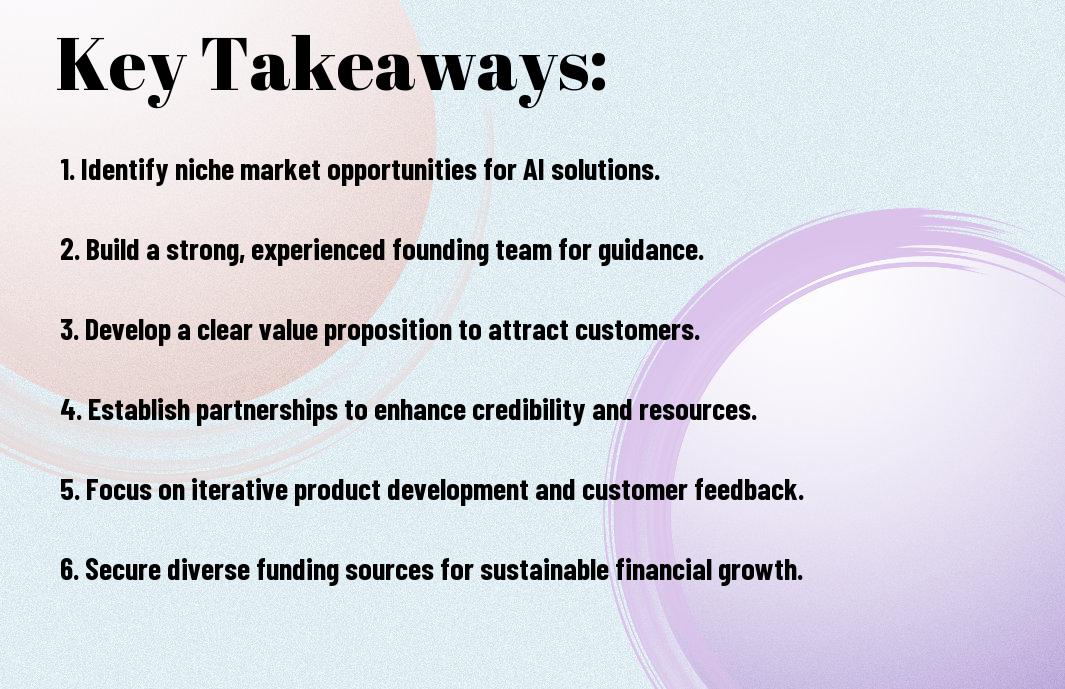
Key Takeaways:
- The book “The Roadmap to Riches” provides a comprehensive guide to achieving entrepreneurial success through the strategic use of Artificial Intelligence (AI), highlighting the potential for AI-driven tactics to revolutionize business operations and decision-making processes.
- By leveraging AI, entrepreneurs can gain valuable insights into market trends, customer behavior, and competitor activity, enabling them to make informed decisions and stay ahead of the competition in an increasingly complex and dynamic business landscape.
- Effective implementation of AI-driven tactics requires a deep understanding of the technology and its applications, as well as the ability to adapt and innovate in response to emerging opportunities and challenges, making it crucial for entrepreneurs to stay up-to-date with the latest developments in AI and its potential to drive business growth.
The AI Revolution in Business
For entrepreneurs, understanding the AI revolution is key to unlocking new opportunities. You will learn how to leverage AI to drive growth, improve efficiency, and gain a competitive edge. Your business will thrive in a rapidly changing landscape with the right AI-driven strategies.
Core AI Technologies for Entrepreneurs
Upon exploring the world of AI, you’ll discover key technologies that can transform your business. You will learn about machine learning, natural language processing, and computer vision, and how to apply them to your entrepreneurial ventures.
Market Disruption Opportunities
Businesses like yours can capitalize on AI-driven market disruptions. You can identify areas where AI can solve real-world problems, creating new products, services, and revenue streams.
Consequently, as you explore deeper into market disruption opportunities, you’ll find that AI can help you anticipate and respond to changing market conditions, allowing you to stay ahead of the competition and achieve your business goals. You will be able to identify gaps in the market and create innovative solutions that meet the evolving needs of your customers.
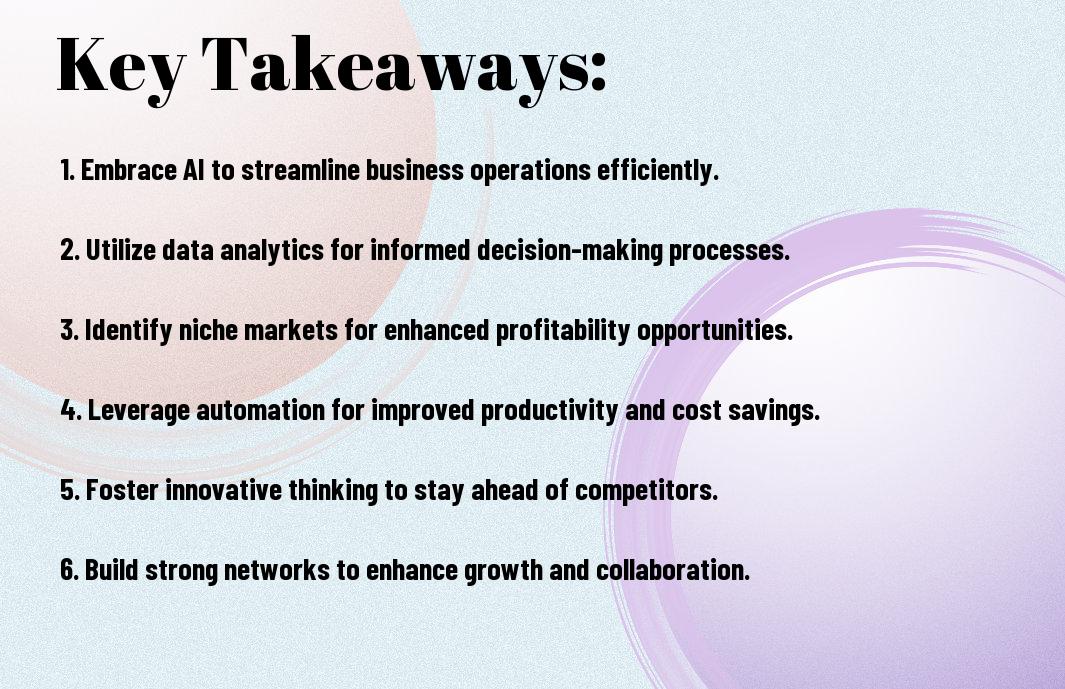
Data-Driven Decision Making
Now that you’re on the path to entrepreneurial success, leveraging data is key. You’ll make informed decisions, driving your business forward with precision and accuracy, using AI-driven tactics to analyze and interpret complex data sets.
Customer Analytics That Matter
Alike other successful entrepreneurs, you will focus on customer analytics that provide actionable insights, helping you understand your target audience and tailor your strategies to meet their needs, ultimately boosting your business’s growth and profitability.
Predictive Business Modeling
Most notably, you will utilize predictive business modeling to forecast market trends and identify potential opportunities, enabling you to stay ahead of the competition and make data-driven decisions that drive your business forward.
Making the most of predictive business modeling, you will be able to analyze historical data, identify patterns, and predict future outcomes, allowing you to optimize your business strategies, mitigate risks, and capitalize on new opportunities, giving you a competitive edge in the market and driving your business towards long-term success.

Automation Strategies
After implementing AI-driven tactics, you’ll notice a significant boost in your business’s efficiency. Automation strategies enable you to streamline tasks, freeing up time for more strategic decision-making, allowing you to focus on growing your entrepreneurial venture.
Workflow Optimization
Besides enhancing productivity, workflow optimization helps you identify areas where AI can be leveraged to improve your business processes, enabling you to make data-driven decisions and drive your company forward.
Cost Reduction Tactics
Beneath the surface of automation strategies lies the potential for significant cost savings. By adopting cost reduction tactics, you can minimize waste, reduce labor costs, and allocate resources more effectively, ultimately increasing your bottom line.
Indeed, cost reduction tactics are a key component of automation strategies, allowing you to reap the benefits of AI-driven efficiencies while minimizing expenses. As you explore cost reduction tactics, you’ll discover opportunities to renegotiate contracts, optimize supply chains, and eliminate unnecessary expenditures, all of which will contribute to the long-term financial health and success of your business.
AI-Enhanced Marketing
Keep your marketing strategy ahead of the curve with AI-driven tactics that amplify your reach and engagement. You can leverage AI to analyze customer data, identify trends, and create personalized experiences that drive conversions and boost your bottom line.
Personalization at Scale
Behind every successful marketing campaign is a deep understanding of your target audience. You can use AI to segment your audience, tailor your messaging, and deliver content that resonates with your customers, fostering a loyal community around your brand.
Conversion Optimization
Any marketer knows that conversion rates are the ultimate measure of success. You can use AI-powered tools to optimize your website, streamline your sales funnel, and maximize your return on investment, ensuring that your marketing efforts yield tangible results.
Marketing teams can further utilize AI-driven conversion optimization to refine their strategies, identifying the most effective channels, messaging, and creative assets that drive conversions. You can apply AI algorithms to analyze customer behavior, predict purchase intent, and automate decision-making, allowing you to focus on high-level strategy and creative vision, while AI handles the heavy lifting of data analysis and optimization, ultimately driving your business forward.
Digital Product Development
Many entrepreneurs struggle to bring their digital product ideas to life, but with AI-driven tactics, you can streamline your development process and create innovative solutions that meet your customers’ needs. You can leverage AI-powered tools to analyze market trends, identify gaps, and develop tailored products that drive business growth.
Rapid Prototyping with AI
Around the clock, AI algorithms can process vast amounts of data, enabling you to quickly develop and refine your digital product prototypes, saving you time and resources. You can utilize AI-driven design tools to create interactive prototypes, test assumptions, and gather feedback from your target audience.
Testing and Iteration
Any successful digital product development process involves rigorous testing and iteration, and AI can help you optimize this phase. You can use AI-powered testing tools to identify bugs, detect patterns, and predict user behavior, allowing you to refine your product and improve its overall quality.
Another key aspect of testing and iteration is analyzing user feedback and incorporating it into your product development cycle. You can use AI-driven analytics tools to process user feedback, identify areas for improvement, and make data-driven decisions to enhance your digital product, ensuring it meets your customers’ evolving needs and exceeds their expectations, ultimately driving your business forward and contributing to your entrepreneurial success.
Scaling with Limited Resources
Your ability to scale your business with limited resources is a key factor in achieving success, and you can learn more about this in The AI-Driven Entrepreneur: Unleashing The Power Of AI For Business, which provides valuable insights on leveraging AI for growth.
Lean Team Management
Adeptly managing a small team is vital for maximizing productivity, and you’ll need to prioritize tasks, set clear goals, and empower your team members to take ownership of their work.
Strategic Outsourcing to AI
Outsourcing tasks to AI can help you free up resources and focus on high-priority tasks, allowing you to scale your business more efficiently, and you can use AI-powered tools to automate routine tasks and make data-driven decisions.
With strategic outsourcing to AI, you can access advanced technologies and expertise without having to invest in expensive infrastructure or hire specialized staff, enabling you to compete with larger businesses and achieve your goals more quickly, and you’ll be able to monitor and adjust your outsourcing strategy as your business evolves, ensuring that you’re always getting the most out of your resources.
Summing up
With these considerations, you now have a solid foundation to integrate AI-driven tactics into your entrepreneurial pursuits. As you initiate on your journey to riches, you can further explore the potential of AI by learning about Leveraging Artificial Intelligence in Business Strategy to optimize your approach and maximize your chances of success, ultimately transforming your business and securing your financial future, with your newfound understanding of AI-driven tactics.
FAQ
Q: What is “The Roadmap to Riches – AI-Driven Tactics for Entrepreneurial Success” and how can it help me achieve my business goals?
A: “The Roadmap to Riches – AI-Driven Tactics for Entrepreneurial Success” is a comprehensive guide designed to equip entrepreneurs with the latest AI-driven strategies and tactics to navigate the complex business landscape. By leveraging the power of artificial intelligence, this roadmap provides actionable insights and expert advice to help entrepreneurs make informed decisions, drive innovation, and achieve sustainable success in their respective industries.
Q: How does “The Roadmap to Riches” utilize AI-driven tactics to support entrepreneurial success?
A: “The Roadmap to Riches” harnesses the potential of AI to analyze market trends, identify opportunities, and predict potential challenges. By integrating AI-driven tools and techniques, entrepreneurs can optimize their business operations, enhance customer engagement, and develop data-driven marketing strategies that yield tangible results. This roadmap offers a unique blend of human expertise and AI-powered insights to help entrepreneurs stay ahead of the competition.
Q: What kind of support and resources can I expect from “The Roadmap to Riches” to help me implement AI-driven tactics in my business?
A: “The Roadmap to Riches” provides a wide range of support and resources, including step-by-step guides, video tutorials, and access to a community of like-minded entrepreneurs. Additionally, the roadmap offers customizable templates, worksheets, and checklists to help entrepreneurs apply AI-driven tactics to their specific business needs. With ongoing updates and new content added regularly, entrepreneurs can stay up-to-date with the latest AI trends and best practices.
Q: Is “The Roadmap to Riches” suitable for entrepreneurs at any stage of their business journey, or is it geared towards a specific level of experience?
A: “The Roadmap to Riches” is designed to be accessible and beneficial for entrepreneurs at any stage of their business journey, from startup founders to established business owners. The roadmap’s flexible and modular approach allows entrepreneurs to tailor the content to their specific needs and goals, whether they’re looking to launch a new venture, scale an existing business, or explore new markets and opportunities.
Q: How will “The Roadmap to Riches” help me measure the effectiveness of AI-driven tactics in my business and make data-driven decisions to drive growth?
A: “The Roadmap to Riches” provides entrepreneurs with a robust framework for tracking key performance indicators (KPIs) and measuring the impact of AI-driven tactics on their business. By leveraging AI-powered analytics and visualization tools, entrepreneurs can gain valuable insights into their business operations, identify areas for improvement, and make informed decisions to drive growth, optimize resources, and maximize returns on investment.