
As you navigate the ever-changing landscape of entrepreneurship, you’re likely wondering how artificial intelligence (AI) will impact your business. You’ll need to adapt to new technologies and strategies to stay ahead. Your role as an entrepreneur is evolving, and understanding how AI transforms your responsibilities is imperative to success. You must consider how AI will change your daily operations, decision-making processes, and overall business model to thrive in this new era.
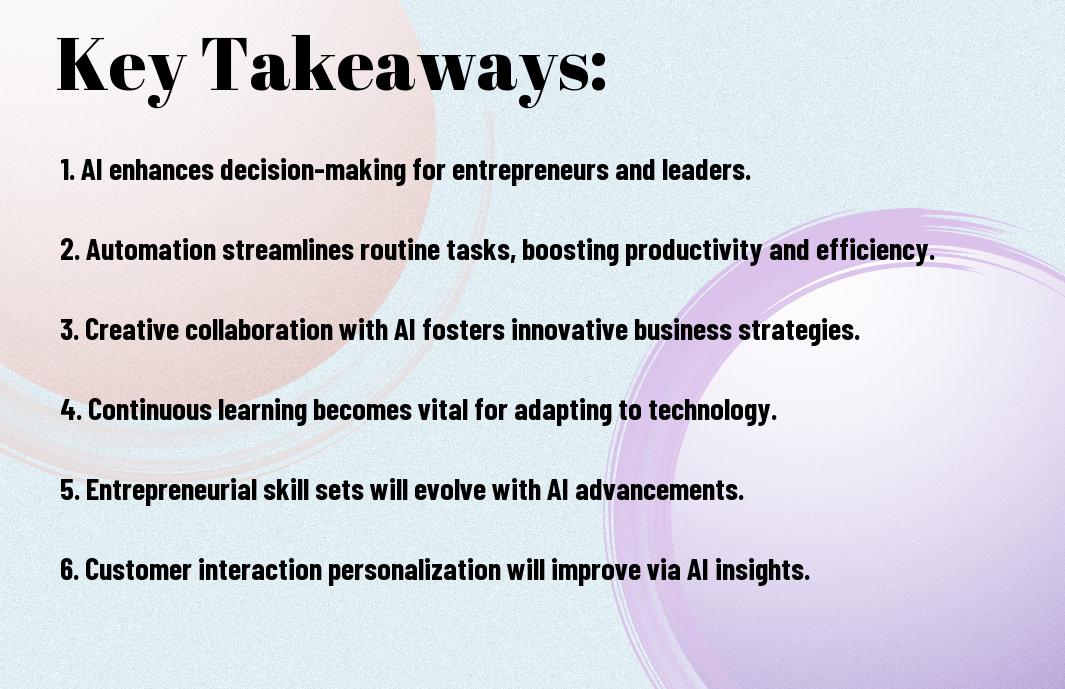
Key Takeaways:
- The integration of AI in the workforce is revolutionizing entrepreneurial roles, enabling business owners to automate routine tasks and focus on strategic decision-making, innovation, and customer relationships.
- AI-driven tools are transforming the way entrepreneurs approach marketing, sales, and customer service, allowing for more personalized and efficient interactions with clients and stakeholders.
- The rise of AI is creating new opportunities for entrepreneurs to develop and offer innovative products and services, such as AI-powered solutions, data analytics, and digital consulting services.
- As AI takes over routine and administrative tasks, entrepreneurs will need to develop new skills, such as data interpretation, critical thinking, and creativity, to remain competitive in the market.
- The future of work will require entrepreneurs to be adaptable, resilient, and open to continuous learning, as AI continues to evolve and shape the business landscape, presenting both opportunities and challenges for entrepreneurial success.
The Evolution of Entrepreneurship
Your role as an entrepreneur is undergoing a significant transformation, driven by technological advancements and shifting market demands, leading to new opportunities and challenges in the business landscape.
Traditional Entrepreneurial Models
Previously, entrepreneurial success relied on traditional models, where you would invest time and resources into building a business from the ground up, managing every aspect, from production to marketing, and navigating the risks associated with each step.
Digital Transformation of Business Ownership
Unlike the past, today’s digital landscape presents you with unprecedented opportunities for growth, as you can now leverage technology to streamline operations, reach a broader audience, and innovate your products and services, thereby redefining the way you approach business ownership.
Models of business ownership are evolving, and you are now able to adopt more flexible and adaptable approaches, such as remote work, outsourcing, and partnerships, allowing you to focus on high-level strategy and decision-making, while automation and AI handle more mundane tasks, freeing up your time to drive innovation and growth.
AI as the New Business Partner
Some entrepreneurs are leveraging AI to transform their businesses, as seen in The Future of Work: How AI is Transforming Job Roles and Required Skills, to streamline operations and improve decision-making, allowing you to focus on high-level strategy and growth.
Algorithmic Decision-Making
Across various industries, you’re witnessing the rise of algorithmic decision-making, where AI analyzes data to inform business choices, enabling you to make more informed decisions and drive your business forward.
Automated Strategic Planning
Above all, automated strategic planning is becoming increasingly prevalent, allowing you to automate routine tasks and focus on high-level strategy, as AI takes care of analyzing market trends and predicting future outcomes.
The automated strategic planning process involves AI analyzing your business data, identifying areas of improvement, and providing recommendations for growth, enabling you to make data-driven decisions and drive your business forward, as you navigate the ever-changing landscape of your industry, you can rely on AI to provide valuable insights and support your strategic planning efforts.
The Shifting Skills Landscape
Now, as AI transforms the entrepreneurial landscape, you will need to adapt to new roles and responsibilities, and develop skills that complement automation, enabling you to stay ahead in the changing job market.
Technical Competencies for Tomorrow
To thrive in an AI-driven economy, you must acquire technical skills such as data analysis, programming, and digital literacy, which will enable you to effectively collaborate with AI systems and leverage their capabilities to drive your business forward.
Human Skills in an Automated Economy
Capabilities such as creativity, empathy, and problem-solving will become increasingly valuable in an automated economy, as you will need to focus on high-touch, high-value tasks that require a human touch, and that AI systems are not yet able to replicate.
Even as AI assumes more routine and repetitive tasks, you will need to develop your human skills to work effectively with machines, focusing on tasks that require imagination, innovation, and emotional intelligence, allowing you to create value and drive growth in your business, and stay competitive in a rapidly changing market.
Redefining Risk and Opportunity
Despite the uncertainty surrounding AI’s impact on entrepreneurial roles, you will need to adapt to the changing landscape. As AI transforms the way you work, your responsibilities will shift, and you must be prepared to redefine risk and opportunity in this new context.
AI-Driven Market Analysis
AIDriven technologies will enable you to analyze market trends and make data-driven decisions, allowing you to stay ahead of the competition and capitalize on new opportunities. You will be able to leverage AI-driven insights to inform your business strategy and drive growth.
Predictive Business Modeling
After implementing AI-powered predictive models, you will be able to forecast market fluctuations and make informed decisions about your business. You will have the ability to simulate different scenarios and predict outcomes, giving you a competitive edge in the market.
In fact, predictive business modeling will become an necessary tool for you as an entrepreneur, enabling you to anticipate and respond to changes in the market, and make strategic decisions that drive your business forward. You will be able to identify potential risks and opportunities, and develop strategies to mitigate or capitalize on them, ultimately leading to increased success and growth.

The Augmented Entrepreneur
To become a successful entrepreneur in the future, you will need to adapt to the changing landscape of work, where AI transforms your roles and responsibilities, enabling you to focus on high-level creative problem-solving and strategic decision-making.
Cognitive Enhancement Through AI
Bridging the gap between human and artificial intelligence, AI enhances your cognitive abilities, allowing you to process vast amounts of data, identify patterns, and make informed decisions, ultimately augmenting your entrepreneurial capabilities.
The New Division of Labor
For you, the new division of labor means redefining your role and responsibilities, as AI takes over routine and repetitive tasks, freeing you to focus on innovative and creative work that drives your business forward.
The new division of labor brings significant changes to your workflow, as you learn to collaborate with AI systems, delegate tasks, and prioritize high-value activities that leverage your unique skills and expertise, enabling you to achieve greater productivity and efficiency in your entrepreneurial endeavors.
Ethical Dimensions of AI Entrepreneurship
Unlike traditional entrepreneurship, AI-driven ventures raise unique ethical concerns that you must consider when building your business, as you navigate the complexities of automated decision-making and potential biases in AI systems.
Responsibility in Automated Systems
Toward the goal of creating trustworthy AI, you should prioritize transparency and accountability in your automated systems, ensuring that you can identify and address potential errors or biases that may impact your customers or stakeholders.
Building Values-Based AI Businesses
Building on the foundation of ethical principles, you can create AI-powered businesses that align with your values and promote a positive social impact, considering the potential consequences of your innovations on your customers and the broader community.
And as you develop your values-based AI business, you will need to consider the long-term implications of your technologies, ensuring that they contribute to the well-being of society and the environment, while also driving growth and innovation in your industry, and you will have to make informed decisions about the data you collect, how you use it, and the potential risks associated with your AI systems.
Summing up
Hence, as you navigate the future of work, you will witness AI transforming your entrepreneurial roles and responsibilities. You will need to adapt to new technologies and leverage AI to enhance your business operations. Your ability to innovate and lead will be key to success in this new landscape, and you must be prepared to evolve your skills to remain competitive. You will shape the future of work, and AI will be your catalyst.
FAQ
Q: How will AI impact the role of entrepreneurs in the future?
A: The integration of AI in the workplace will significantly transform the role of entrepreneurs, enabling them to focus on high-level strategic decision-making, innovation, and creative problem-solving. AI will automate routine and repetitive tasks, freeing up entrepreneurs to concentrate on developing new business models, building relationships, and driving growth. As AI takes over administrative and operational tasks, entrepreneurs will need to develop skills such as data analysis, digital literacy, and emotional intelligence to effectively collaborate with AI systems and lead their organizations.
Q: What new responsibilities will entrepreneurs have to take on as AI becomes more prevalent in the workplace?
A: As AI becomes more integrated into business operations, entrepreneurs will need to take on new responsibilities such as AI strategy development, AI ethics management, and workforce retraining. They will need to develop a deep understanding of AI technologies, including machine learning, natural language processing, and computer vision, to make informed decisions about AI adoption and implementation. Additionally, entrepreneurs will need to ensure that AI systems are transparent, accountable, and fair, and that they do not perpetuate biases or discriminate against certain groups. They will also need to invest in retraining and upskilling their workforce to work effectively with AI systems.
Q: How can entrepreneurs prepare themselves for the changes brought about by AI in the workplace?
A: To prepare themselves for the changes brought about by AI, entrepreneurs should focus on developing a range of skills, including data analysis, digital literacy, and emotional intelligence. They should also stay up-to-date with the latest developments in AI research and technology, and explore ways to apply AI to their business operations. Additionally, entrepreneurs should prioritize lifelong learning, seeking out training and education opportunities to enhance their skills and knowledge in areas such as AI, data science, and digital transformation. By being proactive and adaptable, entrepreneurs can position themselves for success in an AI-driven future and leverage the benefits of AI to drive innovation, growth, and competitiveness.