simon weiner

AI-Powered Startups – How Intelligent Automation is Changing the Business Landscape

As you navigate the ever-evolving business world, you’re likely noticing the significant impact of artificial intelligence on startups. Your business operations are being transformed by intelligent automation, enabling you to streamline processes, enhance efficiency, and drive innovation. You’re witnessing how AI-powered startups are revolutionizing industries, and you may be wondering how to leverage this technology to stay ahead of the curve. This post will explore the ways in which AI is changing the business landscape and what it means for your company’s future.

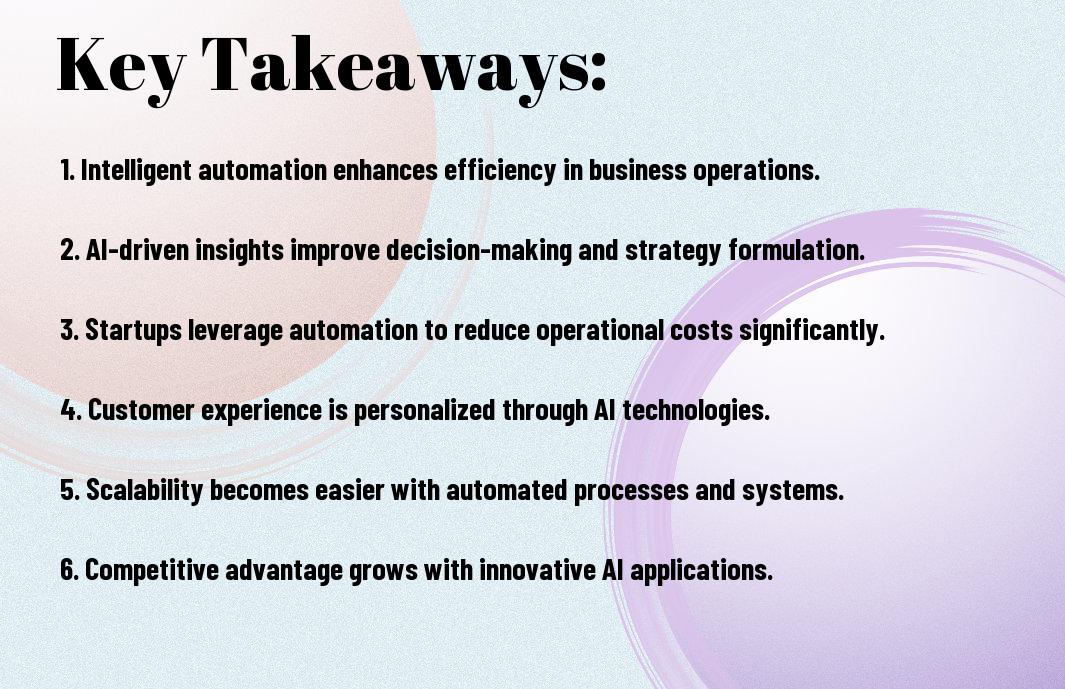
Key Takeaways:

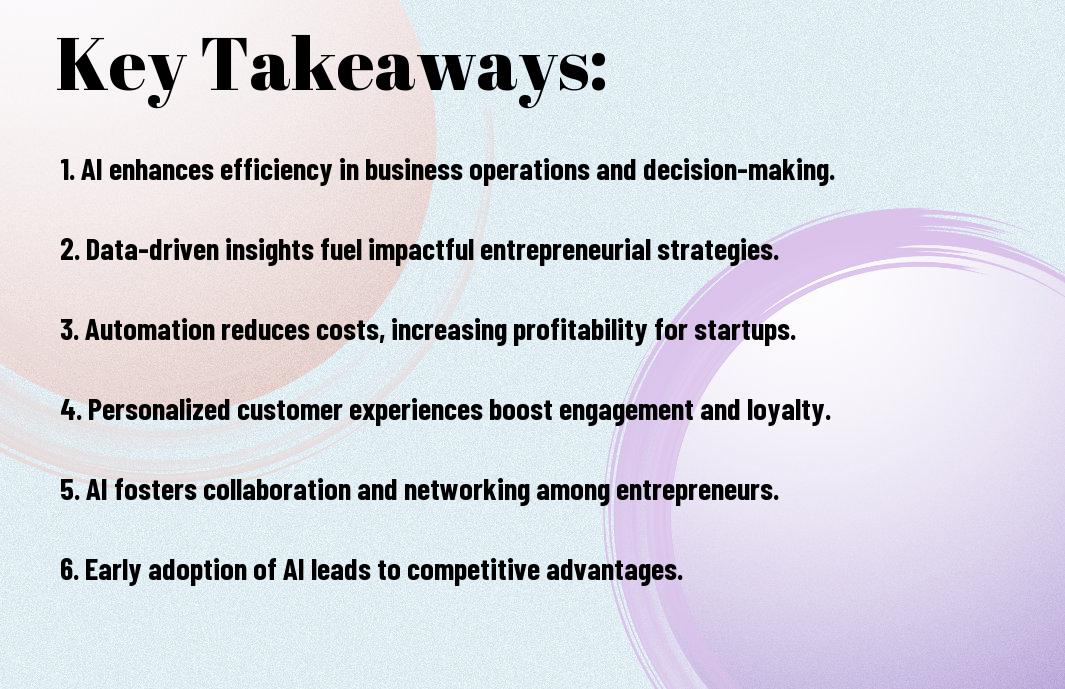
  • AI-powered startups are revolutionizing industries by leveraging intelligent automation to streamline processes, enhance efficiency, and drive innovation, leading to significant improvements in productivity and competitiveness.
  • The integration of AI and machine learning is enabling startups to analyze vast amounts of data, gain valuable insights, and make informed decisions, thereby reducing the risk of human error and improving overall performance.
  • Intelligent automation is also facilitating the development of new business models, such as subscription-based services and pay-per-use models, which are transforming the way companies interact with customers and generate revenue.
  • AI-powered startups are creating new job opportunities in areas like AI development, deployment, and maintenance, while also augmenting existing roles by automating routine tasks and freeing up human resources for more strategic and creative work.
  • The increasing adoption of AI-powered automation is driving a shift towards a more agile and adaptable business landscape, where companies must be able to quickly respond to changing market conditions and customer needs in order to remain competitive.
    The Foundation of AI in Modern Startups

    For your startup to thrive in today’s competitive landscape, understanding the role of AI is imperative. You need to recognize how AI-powered technologies are transforming industries and creating new opportunities for growth and innovation.

    Evolution of Machine Learning Applications

    Almost any industry you can think of is being impacted by machine learning, and you are likely to see its applications in your own business. You will notice how machine learning algorithms can analyze data, identify patterns, and make predictions, helping you make informed decisions.

    Core Technologies Driving the Revolution

    Applications of AI in your business can be vast, and you will find that core technologies such as natural language processing and computer vision are driving this revolution. You can leverage these technologies to automate tasks, enhance customer experience, and gain a competitive edge.

    Modern technologies like deep learning and neural networks are enabling your startup to tackle complex problems and create innovative solutions. You can use these technologies to analyze large datasets, identify trends, and make predictions, helping you stay ahead of the curve and drive business success. As you explore the potential of AI, you will discover new ways to streamline operations, improve efficiency, and create new products and services that meet the evolving needs of your customers.

    Market Disruption Through Automation

    Any business leader knows that automation is revolutionizing the way you operate, making it important to adapt to stay competitive. As you navigate this shift, you’ll notice significant changes in various sectors, leading to new opportunities and challenges.

    Traditional Industries Transformed

    Around the globe, you see traditional industries transforming due to automation, with you being at the forefront of this change, leveraging technology to improve efficiency and reduce costs, and as you do, you’re redefining the way business is done.

    New Business Models Emerging

    Along with the rise of automation, you’re witnessing the emergence of innovative business models that you can capitalize on, enabling you to create new revenue streams and stay ahead of the curve, and as you explore these models, you’ll find opportunities to disrupt markets and create new value.

    Due to the proliferation of automation, you’re seeing the creation of new business models that are more agile, flexible, and responsive to changing market conditions, allowing you to pivot quickly and capitalize on emerging trends, and as you embrace these models, you’ll be able to drive growth, improve customer satisfaction, and establish a strong competitive edge in the market.

    Capital Investment Patterns

    After analyzing the current market trends, you can see that AI-powered startups are attracting significant investments from venture capitalists and angel investors. Your investment decisions can greatly impact the growth and success of these startups.

    Venture Funding Trends

    Funding for AI-powered startups has increased exponentially, with you having access to various funding options, including seed funding, series funding, and crowdfunding, to support your business ideas.

    Return on Investment Metrics

    For your investment to yield significant returns, you need to track key performance indicators such as revenue growth, customer acquisition, and retention rates to measure the success of your AI-powered startup.

    Also, as you examine deeper into the world of AI-powered startups, you will discover that return on investment metrics play a significant role in determining the viability of your business. You can use data analytics tools to monitor your startup’s performance and make informed decisions to optimize your investment returns, ultimately leading to the growth and success of your business.

    Workforce Transformation

    Many organizations are leveraging AI-powered automation to streamline processes, enhancing your productivity and efficiency. This transformation is redefining the way you work, making your business more agile and competitive.

    Human-AI Collaboration

    By embracing AI, you can augment your capabilities, freeing up time for strategic decision-making and innovation, allowing you to focus on high-value tasks that drive growth.

    New Skill Requirements

    After implementing AI solutions, you’ll need to develop skills that complement AI, such as data analysis, problem-solving, and creativity, to maximize the benefits of automation and stay ahead in the market.

    And as you adapt to this new landscape, you’ll find that your role is evolving to work in tandem with AI systems, requiring you to develop a deeper understanding of AI-driven technologies and their applications, enabling you to make informed decisions and drive business success.

    Competitive Advantage Factors

    Despite the challenges, you can gain a competitive edge with AI-powered startups. Key factors include:

    • Efficient operations
    • Innovative products
    • The ability to leverage these factors will set your business apart.

      Data as the New Currency

      For instance, you can utilize data to drive decision-making and improve your startup’s performance, enabling you to make informed choices.

      Scalability and Adaptability

      The ability to scale and adapt quickly is vital for your AI-powered startup’s success, allowing you to respond to changing market conditions.

      Currency in the form of data and expertise will be vital as you navigate the landscape of scalability and adaptability, and you will need to prioritize investments in these areas to ensure your startup remains competitive and agile in a rapidly evolving business environment, enabling you to make the most of your AI-powered startup’s potential.

      Regulatory Landscape

      Keep in mind that the regulatory landscape for AI-powered startups is evolving rapidly. As you navigate this landscape, you’ll need to stay informed about the latest developments and updates.

      Current Governance Frameworks

      Frameworks such as data protection laws and industry standards are being developed to regulate AI-powered startups. You should familiarize yourself with these frameworks to ensure your business is compliant.

      Ethical Considerations

      With the increasing use of AI, ethical considerations are becoming more prominent. You need to consider the potential impact of your AI-powered startup on society and ensure that your business practices are transparent and fair.

      To address ethical considerations, you should establish clear guidelines and principles for the development and deployment of AI in your startup. This includes ensuring that your AI systems are transparent, accountable, and unbiased, and that they prioritize human well-being and safety. As you develop your AI-powered startup, you should also consider the potential risks and consequences of your actions, and take steps to mitigate them.

      Final Words

      Considering all points, you now understand how AI-powered startups are transforming the business landscape. As you look to the future, you can explore more about Artificial Intelligence in the Business Landscape: 2025 and Beyond to stay ahead. Your business can leverage intelligent automation to drive growth and innovation, and by embracing this technology, you can position your company for success in an increasingly competitive market.

      FAQ

      Q: What is the role of AI-powered startups in the current business landscape?

      A: AI-powered startups are revolutionizing the business landscape by leveraging intelligent automation to streamline processes, enhance customer experiences, and drive innovation. These startups utilize machine learning algorithms, natural language processing, and computer vision to develop cutting-edge solutions that improve operational efficiency, reduce costs, and unlock new revenue streams. By harnessing the power of AI, these startups are able to disrupt traditional industries and create new markets, ultimately changing the way businesses operate and compete.

      Q: How is intelligent automation impacting the workforce in AI-powered startups?

      A: Intelligent automation is transforming the workforce in AI-powered startups by augmenting human capabilities, freeing up resources, and enabling employees to focus on high-value tasks. While automation may replace some routine and repetitive jobs, it also creates new opportunities for workers to develop skills in areas like AI development, deployment, and maintenance. Moreover, AI-powered startups are creating new job categories, such as AI ethicists, data scientists, and machine learning engineers, which are in high demand. As a result, the workforce in AI-powered startups is becoming more agile, adaptable, and skilled, with a focus on human-AI collaboration.

      Q: What are the key benefits of investing in AI-powered startups, and how can investors identify promising opportunities?

      A: The key benefits of investing in AI-powered startups include potential for high returns, access to innovative technologies, and the opportunity to shape the future of various industries. To identify promising opportunities, investors should look for startups with strong AI talent, a clear value proposition, and a scalable business model. They should also evaluate the startup’s ability to address real-world problems, its competitive landscape, and its potential for growth and expansion. Additionally, investors should consider the startup’s commitment to ethical AI development, data privacy, and social responsibility, as these factors will become increasingly important in the AI-powered economy.

Innovation and Wealth – The Role of AI in Driving Entrepreneurial Success

As you navigate the ever-changing landscape of entrepreneurship, you’re likely aware that innovation is key to staying ahead of the curve. Your ability to leverage cutting-edge technology, such as Artificial Intelligence (AI), can significantly impact your success. You’re probably wondering how AI can drive your business forward, and what benefits it can bring to your entrepreneurial endeavors. This post will explore the role of AI in driving innovation and wealth, and how you can harness its power to achieve your goals.

Key Takeaways:

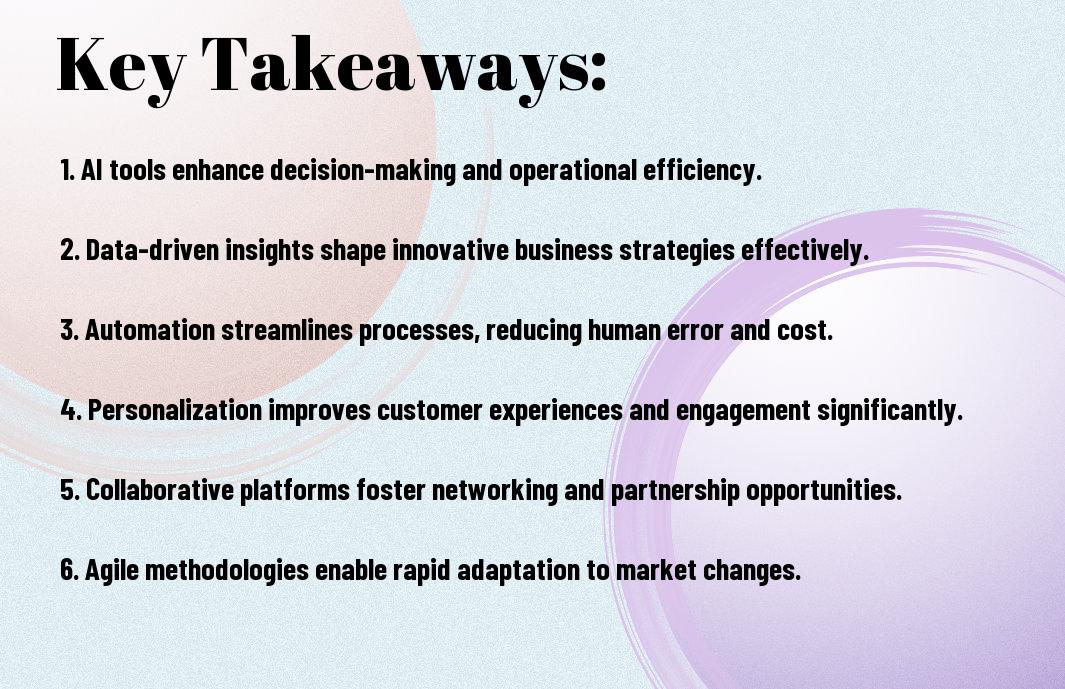
  • Artificial Intelligence (AI) plays a significant role in driving entrepreneurial success by automating processes, enhancing decision-making, and improving productivity, ultimately leading to increased wealth creation.
  • AI-powered tools and technologies can help entrepreneurs identify new business opportunities, develop innovative products and services, and gain a competitive edge in the market.
  • The integration of AI in business operations can lead to improved efficiency, reduced costs, and enhanced customer experience, resulting in increased revenue and profitability.
  • Entrepreneurs who leverage AI effectively can gain valuable insights from data analysis, enabling them to make informed decisions and drive business growth through strategic innovation.
  • As AI continues to evolve, it is likely to have a profound impact on the entrepreneurial landscape, creating new opportunities for innovation and wealth creation, and transforming the way businesses operate and succeed.

The Tipping Point of AI in Business

Before you can harness the power of AI, it’s crucial to understand its role in driving entrepreneurial success, as it has become a key factor in business innovation, enabling you to make data-driven decisions and stay ahead of the competition.

When Algorithms Become Competitive Advantages

On the path to success, you’ll find that algorithms can become a significant competitive advantage, allowing you to automate tasks, optimize processes, and gain valuable insights that inform your business strategy, giving you an edge over your competitors.

The Stickiness Factor of AI Solutions

Factoring in the long-term benefits, you’ll discover that AI solutions can have a significant impact on your business, as they can lead to increased efficiency, improved customer satisfaction, and ultimately, increased revenue, making them a valuable investment for your company.

And as you research deeper into the world of AI, you’ll find that the stickiness factor of AI solutions lies in their ability to learn and adapt to your business needs, allowing you to refine your strategy and make adjustments as needed, ensuring that you stay on track to achieve your goals, and enabling you to measure the effectiveness of your AI investments, making adjustments to optimize your returns.

Outliers in AI Entrepreneurship

Any entrepreneur looking to leverage AI for success must understand the unique challenges and opportunities that come with it. You will need to navigate complex technologies and adapt to rapid changes in the market to stay ahead of the competition.

The 10,000-Hour Rule Reimagined

Above all, you should focus on developing a deep understanding of AI and its applications, as this will be key to driving your entrepreneurial success. You can achieve this by dedicating time to learning and experimenting with different AI technologies.

Opportunity and Timing in AI Ventures

Hour after hour, you will be faced with decisions that can make or break your AI venture, and it is your ability to seize opportunities and time your moves correctly that will set you apart from others. You must be able to identify emerging trends and capitalize on them quickly.

Outliers in AI entrepreneurship are those who can balance their technical expertise with business acumen, allowing them to identify opportunities and time their ventures perfectly. You can join their ranks by staying informed about the latest developments in AI and being prepared to adapt your strategy as the landscape evolves, ensuring your venture stays ahead of the curve and achieves long-term success.

Blink Decisions in AI-Driven Markets

Your ability to make swift decisions is vital in today’s fast-paced entrepreneurial landscape, where AI-driven markets demand agility and adaptability to stay ahead of the competition.

Intuition versus Data-Driven Decision Making

Prior to relying solely on intuition, you should consider the benefits of data-driven decision making, which enables you to make informed choices backed by concrete evidence and insights.

The Power of Thin-Slicing Customer Needs

Driven by the need for precision, you can leverage AI to thin-slice customer needs, uncovering patterns and preferences that inform your business strategy and drive innovation.

It is through this process that you can develop a deeper understanding of your target audience, allowing you to create tailored solutions that meet their evolving needs and preferences, ultimately driving your entrepreneurial success in AI-driven markets.

The AI Entrepreneurial Mindset

Unlike traditional entrepreneurs, you will need to develop a unique mindset that combines creativity with technical expertise to succeed in an AI-driven environment. You must be open to new ideas and willing to invest time in understanding the capabilities and limitations of AI technologies. This mindset will enable you to harness the power of AI and drive your entrepreneurial ventures forward.

Adaptability and Continuous Learning

The ability to adapt quickly to changing market conditions and technological advancements is vital for your success as an AI entrepreneur. You will need to stay up-to-date with the latest developments in AI and be willing to pivot your business strategy as needed. This will enable you to stay ahead of the competition and capitalize on new opportunities.

Risk Assessment in Automated Environments

For you to effectively navigate the risks associated with AI, you must develop a deep understanding of the potential pitfalls and challenges. You will need to carefully evaluate the potential risks and benefits of implementing AI solutions in your business and take steps to mitigate any potential downsides. This will enable you to minimize losses and maximize gains.

Due to the complexity of AI systems, you will need to carefully consider the potential risks and consequences of automating certain business processes. You should assess the potential impact on your business, including the potential for job displacement, data breaches, and other unintended consequences. By taking a thoughtful and informed approach to risk assessment, you can ensure that your use of AI drives business success while minimizing potential downsides.

Wealth Creation Through AI Implementation

Despite the initial investment required, AI can significantly enhance your business operations, leading to increased efficiency and revenue. By automating tasks and providing valuable insights, AI helps you make informed decisions, driving your entrepreneurial success.

Scaling Without Proportional Cost Increases

Prior to expanding your business, you can leverage AI to streamline processes, allowing you to scale without incurring proportional cost increases, thus maximizing your returns on investment.

Value Extraction from Data Assets

Cost effectively, you can utilize AI to analyze your data assets, uncovering hidden patterns and trends that inform your business strategies, enabling you to make data-driven decisions.

Wealth generated from AI-driven insights can be substantial, as you can identify new opportunities, optimize operations, and create innovative products or services, ultimately leading to increased revenue and competitiveness in the market, allowing you to achieve your business goals and expand your entrepreneurial pursuits.

Ethical Considerations and Social Impact

To ensure that AI-driven innovation benefits society as a whole, you must consider the ethical implications of your entrepreneurial endeavors. As you harness the power of AI to drive your business forward, you need to be aware of the potential social impact of your actions.

Responsible Innovation Frameworks

For instance, you can establish guidelines that prioritize transparency, accountability, and fairness in your AI development and deployment. By doing so, you can mitigate potential risks and ensure that your innovative solutions align with your values and principles.

Distributional Effects of AI-Generated Wealth

Responsibly, you should consider how AI-generated wealth will be distributed among stakeholders, including employees, customers, and the broader community. As you navigate the complex landscape of AI-driven entrepreneurship, you need to think critically about the potential consequences of your actions on different groups.

And as you research deeper into the distributional effects of AI-generated wealth, you will realize that the benefits of innovation are not always evenly distributed. You may notice that certain groups, such as those with limited access to education or technological resources, may be left behind, exacerbating existing social and economic inequalities. You must consider these dynamics and develop strategies to address them, ensuring that your AI-driven entrepreneurial success contributes to a more equitable and just society.

Conclusion

Conclusively, as you commence on your entrepreneurial journey, you will find that innovation and wealth are closely tied to the effective utilization of AI. You can leverage AI to drive your success by automating tasks, analyzing data, and making informed decisions. By embracing AI, you can stay ahead of the competition and achieve your business goals, ultimately leading to increased wealth and prosperity for your venture.

FAQ

Q: What is the impact of Artificial Intelligence on entrepreneurship and wealth creation?

A: Artificial Intelligence (AI) has a significant impact on entrepreneurship and wealth creation. AI-driven technologies can help entrepreneurs automate tasks, gain insights from data, and make informed decisions, leading to increased efficiency and productivity. Additionally, AI can facilitate the development of new products and services, enabling entrepreneurs to tap into new markets and create new revenue streams. By leveraging AI, entrepreneurs can drive innovation, improve customer experiences, and ultimately, create wealth.

Q: How can AI be used to drive entrepreneurial success, particularly in terms of innovation and wealth generation?

A: AI can be used to drive entrepreneurial success in several ways. For instance, AI-powered tools can help entrepreneurs identify market trends, analyze customer behavior, and develop personalized marketing strategies. AI can also be used to optimize business operations, such as supply chain management and logistics, leading to cost savings and increased profitability. Furthermore, AI can facilitate the development of new business models, such as subscription-based services and freemium models, which can help entrepreneurs generate new revenue streams and create wealth. By embracing AI, entrepreneurs can stay ahead of the competition, drive innovation, and achieve long-term success.

Q: What are the key challenges and opportunities that entrepreneurs face when leveraging AI to drive innovation and wealth creation, and how can they overcome these challenges?

A: Entrepreneurs face several challenges when leveraging AI to drive innovation and wealth creation, including the need for significant investments in AI infrastructure, talent acquisition, and data management. Additionally, entrepreneurs must navigate complex regulatory environments and address concerns around data privacy and ethics. However, these challenges also present opportunities for entrepreneurs to develop new AI-powered solutions, create new markets, and establish themselves as leaders in their industries. To overcome these challenges, entrepreneurs can focus on building strategic partnerships, investing in AI education and training, and prioritizing data-driven decision making. By doing so, entrepreneurs can harness the power of AI to drive innovation, create wealth, and achieve long-term success.

Building a Robust Business Strategy with AI – Insights for Wealth Generation

You are on the cusp of revolutionizing your business with the power of artificial intelligence. As you consider integrating AI into your operations, you will unlock new avenues for wealth generation. Your ability to leverage AI will depend on developing a robust business strategy that harnesses its potential. By understanding how to effectively utilize AI, you can drive growth, enhance decision-making, and stay ahead of the competition, ultimately leading to increased profitability and success for your business.

Key Takeaways:

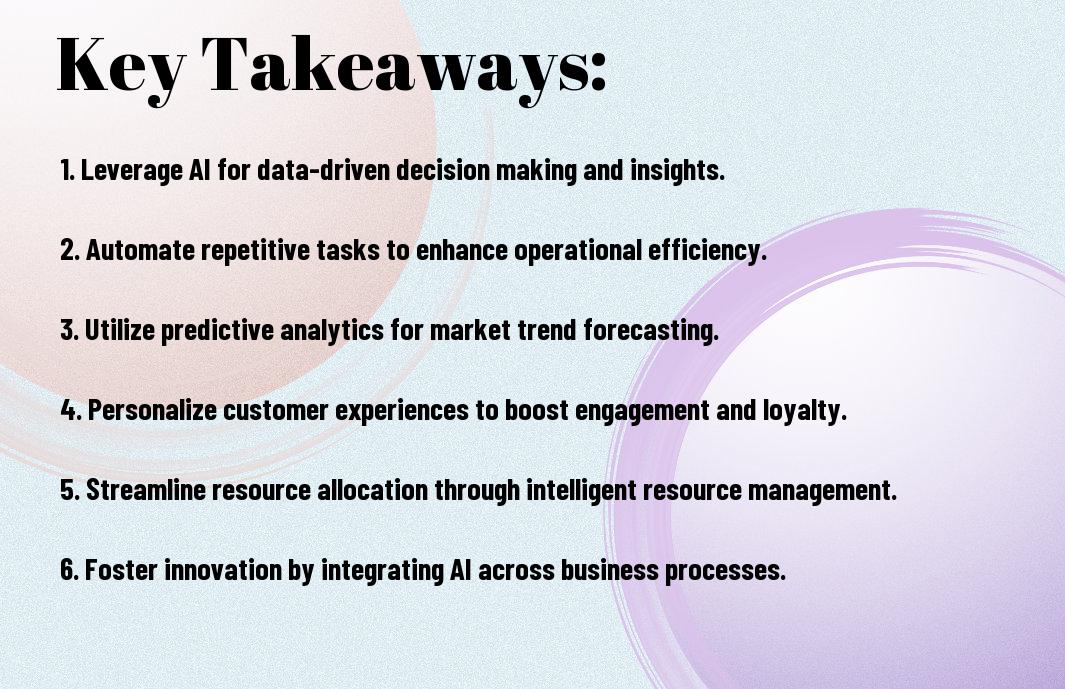
  • Implementing AI in business operations can significantly enhance decision-making processes by providing data-driven insights, leading to more informed strategic choices for wealth generation.
  • A robust AI strategy involves integrating machine learning algorithms to analyze market trends, predict consumer behavior, and optimize business models for maximum profitability.
  • AI-driven automation can streamline business processes, reduce operational costs, and improve efficiency, allowing companies to allocate resources more effectively towards growth initiatives.
  • Developing an AI-centric business strategy requires a deep understanding of the technology’s capabilities and limitations, as well as the ability to adapt to its evolving nature and applications.
  • By leveraging AI, businesses can uncover new opportunities for innovation and revenue growth, ultimately driving long-term wealth generation and sustainability in an increasingly competitive market landscape.

The AI Revolution in Business Strategy

To stay ahead in today’s fast-paced business landscape, you need to understand the impact of AI on your business strategy. You will learn how AI is transforming the way you approach wealth generation and how to leverage it for success.

How AI is Redefining Traditional Business Models

Along with the rise of AI, you are seeing a shift in traditional business models, and you need to adapt to stay competitive. You will discover how AI is changing the way you operate and make decisions, and how to harness its power to drive growth.

The Tipping Point: When AI Becomes Essential

Any business that wants to thrive in the future will need to embrace AI, and you are no exception. You will learn when AI becomes crucial for your business and how to prepare for this shift.

Becomes clear that AI is no longer a luxury, but a necessity for businesses looking to generate wealth and stay ahead of the curve. You will need to assess your current strategy and identify areas where AI can be integrated to drive innovation and growth, and you will learn how to do this effectively, ensuring your business remains competitive in a rapidly changing landscape, and you achieve your goals.

Data as the New Currency

One of the most significant advantages of AI in business is its ability to turn data into a valuable asset, allowing you to make informed decisions and drive your strategy forward, ultimately leading to wealth generation.

Transforming Raw Data into Strategic Insights

Translating raw data into actionable insights enables you to optimize your operations, identify new opportunities, and refine your business strategy to achieve your goals, giving you a competitive edge in the market.

Predictive Analytics and Competitive Advantage

Above all, predictive analytics allows you to forecast trends and make data-driven decisions, giving you a significant competitive advantage in the market and enabling you to stay ahead of the curve.

And as you explore deeper into predictive analytics, you will discover that it enables you to identify patterns, anticipate customer behavior, and make informed decisions about your business strategy, ultimately driving your wealth generation and long-term success, allowing you to adjust your approach as needed to stay competitive and achieve your objectives.

AI Implementation Framework

Not every business needs to overhaul its operations to implement AI. You can start by identifying areas where AI can bring the most value to your organization.

Starting Small: Pilot Projects and Quick Wins

Stepping into AI implementation, you begin with small pilot projects that can demonstrate quick wins and build momentum for further investment in AI technologies.

Scaling Across Business Functions

After you have tested the waters with pilot projects, you can start scaling AI across various business functions to maximize its impact on your operations and decision-making processes.

Pilot projects often serve as a precursor to larger AI initiatives, allowing you to refine your approach and build a robust business case for scaling AI across your organization, which you can then use to guide your strategy and ensure that your AI investments are closely aligned with your overall business objectives, helping you to generate wealth and drive long-term growth.

Risk Management in the AI Era

Many businesses are leveraging AI to enhance their operations, but you must also consider the potential risks involved. As you integrate AI into your strategy, it’s vital to assess and mitigate potential downsides, ensuring your business remains resilient and adaptable in the face of uncertainty.

Ethical Considerations and Guardrails

Across various industries, you’ll encounter ethical dilemmas when implementing AI solutions. As you navigate these challenges, you must establish clear guidelines and protocols to ensure your AI systems operate within acceptable boundaries, aligning with your values and principles.

Navigating Regulatory Landscapes

Managing the complexities of AI regulation is vital for your business. As you develop your AI strategy, you need to stay informed about evolving laws and standards, ensuring your operations comply with relevant requirements and avoid potential penalties.

Considering the nuances of regulatory environments, you should prioritize ongoing monitoring and adaptation, enabling your business to respond effectively to changes in the AI landscape. This involves staying up-to-date with the latest developments and engaging with regulatory bodies to ensure your voice is heard, ultimately shaping the future of AI governance and its impact on your business.

Human-AI Collaboration

All successful businesses understand the importance of collaboration between humans and AI systems to drive growth and innovation. You can leverage AI to enhance your decision-making, automate tasks, and gain valuable insights, ultimately leading to increased efficiency and productivity in your organization.

Augmentation vs. Replacement

On the path to integrating AI into your business, you’ll need to consider how AI will augment or replace existing roles, and how this will impact your operations and workforce. You should focus on using AI to enhance the capabilities of your employees, rather than replacing them.

Building Teams for the AI-Enhanced Workplace

Building on the concept of human-AI collaboration, you’ll need to assemble teams that can effectively work alongside AI systems, ensuring that your organization can maximize the benefits of this partnership. You should prioritize developing the skills and expertise necessary for your employees to work seamlessly with AI.

AI-Enhanced workplaces require you to rethink your approach to team building, focusing on creating a harmonious blend of human and artificial intelligence. You’ll need to identify the skills and strengths that your employees bring to the table and determine how AI can complement these, allowing you to build a more efficient and effective workforce that drives your business forward.

Wealth Generation Strategies

Unlike traditional methods, AI-driven wealth generation strategies offer unprecedented opportunities for growth and expansion, allowing you to make informed decisions and stay ahead of the competition.

New Revenue Streams Through AI Innovation

For instance, you can leverage AI to identify new markets, develop innovative products, and create alternative revenue streams, thereby diversifying your income sources and increasing your wealth.

Cost Optimization and Efficiency Gains

After implementing AI-powered solutions, you can expect significant reductions in operational costs and improvements in efficiency, enabling you to allocate resources more effectively and maximize your returns.

Revenue growth is often accompanied by increased expenses, but with AI-driven cost optimization, you can minimize waste, streamline processes, and make the most of your investments, ultimately leading to enhanced profitability and wealth creation, as you continue to refine your strategy and make data-driven decisions to drive your business forward.

Final Words

Summing up, you now have the tools to build a robust business strategy with AI, driving your wealth generation forward. You can leverage AI insights to make informed decisions, optimizing your operations and maximizing returns. By integrating AI into your business, you will stay ahead of the competition, achieving your financial goals and securing your future success. Your ability to adapt and innovate with AI will be the key to unlocking your full potential.

FAQ

Q: What role does Artificial Intelligence (AI) play in building a robust business strategy for wealth generation?

A: Artificial Intelligence (AI) plays a significant role in building a robust business strategy for wealth generation by providing insights that can help in making informed decisions. AI can analyze large amounts of data, identify patterns, and predict trends, which can be used to develop a competitive business strategy. Additionally, AI can automate various business processes, improve operational efficiency, and enhance customer experience, ultimately leading to increased revenue and wealth generation.

Q: How can businesses leverage AI to gain a competitive edge in the market and drive wealth generation?

A: Businesses can leverage AI to gain a competitive edge in the market and drive wealth generation by implementing AI-powered solutions that drive innovation, improve operational efficiency, and enhance customer experience. For instance, AI can be used to develop personalized marketing campaigns, optimize supply chain operations, and predict market trends. Furthermore, AI can help businesses to identify new opportunities, mitigate risks, and make data-driven decisions, which can lead to increased revenue and wealth generation. By adopting AI, businesses can stay ahead of the competition and achieve sustainable growth.

Q: What are the key considerations that businesses should keep in mind when integrating AI into their strategy for wealth generation?

A: When integrating AI into their strategy for wealth generation, businesses should consider several key factors, including data quality, algorithmic transparency, and regulatory compliance. It is important to ensure that the data used to train AI models is accurate, reliable, and unbiased. Additionally, businesses should be transparent about their use of AI and ensure that their AI systems are explainable and accountable. Moreover, businesses should comply with relevant regulations and laws related to AI, such as data protection and privacy laws. By considering these factors, businesses can ensure that their AI-powered strategy is effective, efficient, and sustainable, and drives long-term wealth generation.

Reinventing Entrepreneurship – AI Technologies Redefining Success

As you navigate the ever-changing landscape of entrepreneurship, you’re likely aware that artificial intelligence (AI) is transforming the way you do business. Your ability to adapt to these advancements will be key to your success. With AI technologies on the rise, you have the opportunity to revolutionize your approach to entrepreneurship, streamlining processes and unlocking new possibilities. You will discover how AI is redefining the path to success and what this means for your entrepreneurial journey.

Key Takeaways:

  • AI technologies are transforming the entrepreneurial landscape by automating tasks, enhancing decision-making, and providing data-driven insights to drive business growth and innovation.
  • The integration of AI in entrepreneurship enables founders to focus on high-level strategic thinking, creativity, and human-centric aspects of business, leading to increased productivity and competitiveness.
  • AI-powered tools and platforms are democratizing access to entrepreneurship, allowing more people to start and scale businesses, and bridging the gap between traditional industries and emerging technologies.
  • The rise of AI-driven entrepreneurship requires a new set of skills, including data literacy, technical expertise, and adaptability, to effectively leverage AI technologies and stay ahead in the market.
  • As AI continues to redefine the entrepreneurial landscape, it is vital for entrepreneurs to prioritize ethical considerations, transparency, and accountability in the development and deployment of AI-powered solutions to ensure long-term success and positive impact.

    The Tipping Point of AI in Business

    While you navigate the ever-changing landscape of entrepreneurship, you’ll notice that AI technologies are revolutionizing the way you do business, making it crucial to adapt and evolve your strategies to stay ahead of the curve.

    From Automation to Augmentation

    Beneath the surface of AI implementation, you’ll find that it’s not just about automating tasks, but also about augmenting your capabilities, enabling you to make more informed decisions and drive innovation in your business.

    Breaking Traditional Entrepreneurial Barriers

    Bursting through the constraints of traditional entrepreneurship, you’ll discover that AI technologies are democratizing access to resources, expertise, and markets, allowing you to compete on a level playing field and achieve your goals more efficiently.

    In addition, as you break traditional entrepreneurial barriers, you’ll have the opportunity to tap into new revenue streams, explore uncharted markets, and create innovative products and services that cater to the evolving needs of your customers, ultimately redefining the trajectory of your business and setting you up for long-term success.

    The AI Entrepreneur’s Toolkit

    Even as you launch on your entrepreneurial journey, you’ll need to leverage AI technologies to stay ahead of the curve. Your toolkit should include a range of innovative solutions that streamline operations, enhance decision-making, and drive growth.

    Decision Intelligence Systems

    Prior to making any key decisions, you’ll want to utilize decision intelligence systems that provide data-driven insights, enabling you to make informed choices that propel your business forward. Your ability to analyze complex data sets will be significantly enhanced, allowing you to optimize your strategy.

    Predictive Market Analysis

    Alongside other tools, you’ll find that predictive market analysis is necessary for anticipating trends and staying competitive. Your business will benefit from forecasts that help you navigate uncertain markets and make strategic decisions.

    Systems like predictive market analysis enable you to analyze large datasets, identify patterns, and forecast future market trends, allowing you to adjust your business strategy accordingly. You can use this information to optimize your product offerings, pricing, and marketing efforts, ultimately driving revenue growth and increasing your market share.

    Outliers: AI-Native Business Models

    Many entrepreneurs are leveraging AI to create innovative business models that disrupt traditional industries, and you can do the same by exploring new opportunities and technologies.

    Platform Ecosystems

    Outstanding examples of AI-native business models can be seen in platform ecosystems, where you can create value by connecting buyers and sellers, and generating revenue through transaction fees or advertising.

    Data-as-Currency Ventures

    Around the globe, data-as-currency ventures are emerging, and you can participate by collecting, analyzing, and monetizing data to create new revenue streams and gain a competitive edge.

    Considering the potential of data-as-currency ventures, you can develop a business model that focuses on collecting and analyzing data to provide valuable insights to customers, and as you investigate deeper into this space, you will discover new opportunities to create innovative products and services that meet the evolving needs of your target market, ultimately driving your business forward and achieving success in the AI-driven economy.

    The 10,000 Hours Myth Revisited

    Keep in mind that the traditional notion of dedicating 10,000 hours to master a skill is being challenged by AI technologies. You can now accelerate your learning and achieve expertise in a fraction of the time, thanks to AI-powered tools and platforms that provide personalized feedback and guidance.

    Accelerated Learning Through AI

    Above all, AI-driven learning systems enable you to learn at an unprecedented pace, allowing you to acquire new skills and knowledge in a highly efficient manner. You can leverage AI-powered adaptive learning platforms to tailor your learning experience to your needs and abilities.

    New Metrics of Mastery

    Between the lines of traditional metrics, you’ll find that AI is redefining what it means to be an expert. You’ll need to reassess your understanding of mastery, as AI technologies enable you to achieve high levels of proficiency in a shorter amount of time.

    Indeed, as you explore the new metrics of mastery, you’ll discover that AI provides you with a more nuanced understanding of your strengths and weaknesses. You’ll be able to track your progress, identify areas for improvement, and adjust your learning strategy accordingly, ultimately achieving a higher level of expertise and success in your entrepreneurial endeavors.

    Blink: Intuition Versus Algorithm

    Not surprisingly, the debate between intuition and algorithm has sparked intense discussion among entrepreneurs. You are faced with the challenge of balancing your instincts with the precision of AI technologies, and this dilemma is redefining the way you approach decision-making.

    Merging Human Instinct with Machine Precision

    Mechanically, you will need to integrate your human intuition with the accuracy of machine learning models to make informed decisions. You can leverage AI to analyze vast amounts of data, providing you with valuable insights to support your business strategies.

    The New Decision-Making Framework

    Behind the scenes, a new paradigm is emerging, one that combines the best of human judgment with the power of AI-driven analytics. You are now able to make more accurate predictions and optimize your business operations like never before.

    Algorithmic thinking is becoming an important skill for you as an entrepreneur, enabling you to navigate the complex landscape of data-driven decision-making. You will need to understand how to harness the potential of AI to augment your decision-making processes, and in doing so, you will unlock new opportunities for growth and innovation in your business.

    Social Contagion of AI Success

    Your business can thrive in a world where AI technologies are redefining success, and understanding the social aspects of this phenomenon is key to your growth.

    Network Effects in AI-Powered Businesses

    Above all, you’ll notice that AI-powered businesses often exhibit network effects, where your value increases as more users join, creating a self-reinforcing cycle that drives your success.

    Viral Scaling Mechanisms

    Contagious by nature, viral scaling mechanisms in AI-powered businesses allow you to reach a wider audience, with your message spreading quickly and your user base growing exponentially, fueling your business’s rapid expansion.

    Further, as you explore deeper into viral scaling mechanisms, you’ll discover that they rely on your ability to create engaging experiences that encourage users to share your content, invite others to join, and participate in your ecosystem, ultimately driving your business’s growth and reinforcing your position in the market, allowing you to stay ahead of the competition and achieve unparalleled success.

    Conclusion

    With this in mind, you can see how AI technologies are transforming your approach to entrepreneurship. As you initiate on your journey, you’ll find that your understanding of success is redefined by the integration of AI. To learn more about the future of entrepreneurship, visit AI and Entrepreneurship: Redefining Success for Startups in 2025 to discover how you can leverage AI to drive your business forward.

    FAQ

    Q: What role does Artificial Intelligence (AI) play in reinventing entrepreneurship, and how is it redefining success in the business world?

    A: AI technologies are revolutionizing the entrepreneurial landscape by automating processes, enhancing decision-making, and providing innovative solutions to complex problems. Through AI, entrepreneurs can gain valuable insights into market trends, customer behavior, and operational efficiency, allowing them to make data-driven decisions and stay ahead of the competition. This shift towards AI-driven entrepreneurship is redefining success by prioritizing adaptability, innovation, and technological integration as key performance indicators.

    Q: How can entrepreneurs leverage AI technologies to drive innovation and growth in their businesses, and what are the potential benefits of adopting AI solutions?

    A: Entrepreneurs can leverage AI technologies by integrating machine learning algorithms, natural language processing, and predictive analytics into their business operations. This can help streamline processes, improve customer engagement, and identify new market opportunities. The potential benefits of adopting AI solutions include increased efficiency, enhanced customer experience, and improved competitiveness. Additionally, AI can help entrepreneurs identify and mitigate risks, optimize resource allocation, and make informed strategic decisions, ultimately driving growth and innovation in their businesses.

    Q: What skills and knowledge do entrepreneurs need to acquire to effectively harness the power of AI technologies and navigate the changing landscape of entrepreneurship?

    A: To effectively harness the power of AI technologies, entrepreneurs need to acquire a combination of technical, business, and soft skills. This includes understanding the fundamentals of AI and machine learning, as well as developing skills in data analysis, programming, and digital literacy. Additionally, entrepreneurs need to stay up-to-date with the latest trends and advancements in AI, and be able to apply this knowledge to drive business innovation and growth. They also need to develop strong critical thinking, problem-solving, and collaboration skills to effectively work with AI systems and lead their organizations through the digital transformation.

Future-Proof Your Business – Adopting AI for Long-Term Wealth and Growth

As you navigate the ever-changing business landscape, you’re likely considering ways to stay ahead of the curve. You understand that embracing innovation is key to driving long-term wealth and growth. Your business can benefit greatly from adopting Artificial Intelligence (AI), which enables you to streamline operations, enhance decision-making, and foster a competitive edge. By leveraging AI, you can position your business for sustained success and unlock new opportunities for expansion and development.

Key Takeaways:

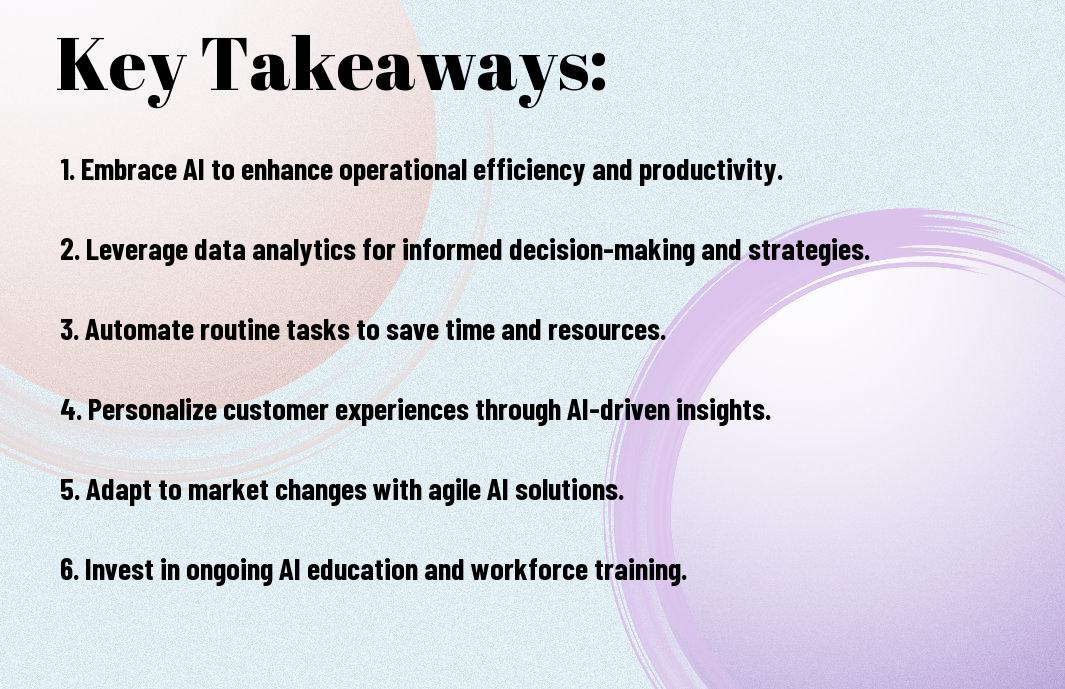
  • Embracing AI technology can significantly enhance business efficiency and productivity, leading to increased competitiveness and profitability in the long run.
  • AI adoption enables companies to make data-driven decisions, driving innovation and growth through predictive analytics and insights that inform strategic business moves.
  • Investing in AI can help businesses automate repetitive tasks, freeing up resources for more complex and creative work, and leading to improved employee satisfaction and retention.
  • By leveraging AI, companies can better understand their customers’ needs and preferences, allowing for personalized marketing and customer service that fosters loyalty and drives revenue growth.
  • Staying ahead of the curve with AI adoption can provide a significant competitive advantage, allowing businesses to adapt quickly to changing market conditions and capitalize on new opportunities for expansion and growth.

The AI Revolution in Business

A new era of technological advancement is transforming the way you operate your business, and artificial intelligence (AI) is at the forefront of this change, enabling you to streamline processes, enhance customer experiences, and drive growth.

Current State of AI Technologies

By leveraging AI, you can automate tasks, gain valuable insights, and make data-driven decisions to stay ahead of the competition, and as you explore the current state of AI technologies, you will discover the vast potential they hold for your business.

Market Trends and Predictions

Revolutionizing the business landscape, AI is poised to disrupt industries and create new opportunities for growth, and as you consider adopting AI, you should be aware of the market trends and predictions that will shape the future of your business.

This understanding of market trends and predictions will allow you to position your business for long-term success, as you will be able to identify areas where AI can have the greatest impact, and make informed decisions about investments and resource allocation, ultimately driving your business forward and achieving your goals.

Strategic Implementation of AI

One of the key factors in successfully adopting AI is developing a strategic plan for implementation. You need to consider your business goals and objectives, and determine how AI can help you achieve them. This involves assessing your current systems and processes, and identifying areas where AI can add value.

Identifying Opportunities for AI Integration

Besides understanding your business needs, you must also identify areas where AI can be integrated to improve efficiency and productivity. You should look for processes that are repetitive, time-consuming, or prone to errors, as these are often ideal candidates for AI automation.

Building an AI-Ready Infrastructure

Integrating AI into your business requires a solid infrastructure to support it. You need to ensure that your systems and data are compatible with AI technologies, and that you have the necessary resources and expertise to implement and maintain them.

Further, building an AI-ready infrastructure involves investing in data management and analytics, as well as developing a skilled workforce that can work effectively with AI systems. You should also consider issues such as data security and ethics, to ensure that your AI systems are transparent and trustworthy.

Financial Implications of AI Adoption

Despite the potential benefits of AI, adopting this technology can have significant financial implications for your business. You need to consider the costs of implementation, maintenance, and training, as well as the potential return on investment.

Investment Considerations

Across various industries, you will need to assess your budget and resources to determine the feasibility of AI adoption, considering the costs of hardware, software, and personnel.

Return on AI Investment Metrics

Considerations about measuring the success of AI adoption are vital, and you should establish clear metrics to evaluate the return on investment, such as increased efficiency, cost savings, and revenue growth.

For instance, you can track key performance indicators like productivity gains, customer satisfaction, and revenue increases to determine the effectiveness of your AI investment, allowing you to make informed decisions about future investments and optimizations, and ultimately, driving your business towards long-term wealth and growth.

Competitive Advantage Through AI

Keep in mind that AI can be a game-changer for your business, enabling you to stay ahead of the competition and achieve long-term success. By leveraging AI, you can automate tasks, enhance decision-making, and drive innovation, ultimately leading to increased efficiency and profitability.

Market Differentiation Strategies

Alongside other benefits, AI helps you develop unique market differentiation strategies, allowing you to stand out from competitors and attract a loyal customer base. As you explore AI adoption, you’ll discover new ways to tailor your products and services to meet evolving customer needs.

Innovation Acceleration

Across various industries, AI is accelerating innovation, enabling businesses like yours to develop new products, services, and business models. You can leverage AI to identify emerging trends, anticipate customer needs, and create innovative solutions that drive growth and revenue.

Considering the potential of innovation acceleration, you can use AI to streamline your product development process, reduce time-to-market, and improve overall quality. By embracing AI-driven innovation, you’ll be able to respond quickly to changing market conditions, stay ahead of the competition, and achieve sustainable growth, ultimately future-proofing your business for long-term success.

Human-AI Collaboration

Now that you’re considering adopting AI, it’s necessary to focus on human-AI collaboration to maximize benefits and drive long-term growth. You’ll need to strike a balance between leveraging AI’s capabilities and utilizing your workforce’s unique skills.

Workforce Transformation

Beneath the surface of AI adoption lies a significant shift in your workforce’s roles and responsibilities. You’ll need to assess your organization’s structure and identify areas where AI can augment your employees’ work, leading to increased efficiency and productivity.

Skills Development for the AI Era

Above all, your employees will need to acquire new skills to effectively work alongside AI systems. You should prioritize training programs that focus on developing skills like data analysis, problem-solving, and decision-making, enabling your workforce to thrive in an AI-driven environment.

Understanding the skills required for the AI era is vital to your organization’s success. You’ll need to identify the gaps in your workforce’s skills and develop strategies to address them, whether through training, hiring, or upskilling. By doing so, you’ll empower your employees to work effectively with AI, driving innovation and growth in your business.

Ethical Considerations and Governance

Unlike other technologies, AI requires careful consideration of ethical implications to ensure its benefits are realized while minimizing risks. You must prioritize transparency, accountability, and fairness in your AI systems to maintain trust with your customers and stakeholders.

Responsible AI Implementation

Around the globe, organizations are recognizing the need for responsible AI implementation, and you should too, by developing and deploying AI in ways that align with your values and principles, ensuring that your AI systems are fair, transparent, and secure.

Regulatory Compliance

Any organization adopting AI must consider regulatory compliance, and you are no exception, as you will need to navigate a complex landscape of laws and regulations governing AI development and deployment, which can vary significantly depending on your location and industry.

This regulatory compliance is an ongoing process, and you will need to stay up-to-date with the latest developments and changes in AI regulations, ensuring that your AI systems meet the required standards, and you are prepared to adapt to new regulations as they emerge, to avoid potential risks and reputational damage, and to maintain the trust of your customers and stakeholders.

Summing up

On the whole, you have learned how to future-proof your business by adopting AI for long-term wealth and growth. You now understand the benefits of leveraging AI to drive innovation, efficiency, and competitiveness. By embracing AI, you can stay ahead of the curve and achieve sustained success, ensuring your business remains relevant and prosperous in an ever-evolving landscape, ultimately securing your company’s future and driving your long-term goals.

FAQ

Q: What are the benefits of adopting AI in my business for long-term wealth and growth?

A: Adopting AI in your business can bring numerous benefits, including increased efficiency, enhanced decision-making, and improved customer experiences. AI can automate repetitive tasks, analyze large datasets, and provide valuable insights, allowing you to make data-driven decisions and stay ahead of the competition. Additionally, AI can help you identify new business opportunities, optimize operations, and develop innovative products and services, ultimately driving long-term wealth and growth.

Q: How can I ensure a successful AI adoption in my business, and what are the key factors to consider?

A: To ensure a successful AI adoption, it’s necessary to have a clear understanding of your business goals and objectives, as well as a well-defined AI strategy. You should identify areas where AI can add the most value, assess your current infrastructure and technology, and develop a roadmap for implementation. It’s also important to consider factors such as data quality, talent acquisition, and change management, as well as to establish metrics for measuring the success of your AI initiatives. Furthermore, you should stay up-to-date with the latest AI trends and advancements, and be prepared to continuously evaluate and adjust your AI strategy as your business evolves.

Q: What are the potential risks and challenges associated with adopting AI, and how can I mitigate them?

A: While AI offers many benefits, there are also potential risks and challenges associated with its adoption, such as job displacement, bias in AI decision-making, and cybersecurity threats. To mitigate these risks, it’s necessary to develop a comprehensive AI risk management strategy, which includes ensuring transparency and explainability in AI decision-making, implementing robust security measures, and providing training and upskilling programs for employees. You should also establish clear guidelines and regulations for AI development and deployment, and continuously monitor and evaluate the performance of your AI systems. By being aware of these potential risks and taking proactive steps to address them, you can minimize their impact and ensure a successful AI adoption that drives long-term wealth and growth for your business.

Skip to content