Uncategorized

Entrepreneurial Agility – Using AI to Adapt and Thrive in Competitive Markets

As you navigate the ever-changing landscape of competitive markets, your ability to adapt and innovate is key to success. You face numerous challenges, from evolving consumer behaviors to emerging technologies, and leveraging artificial intelligence (AI) can be a game-changer. By harnessing the power of AI, you can enhance your decision-making, streamline operations, and drive growth, ultimately staying ahead of the curve in today’s fast-paced business environment.

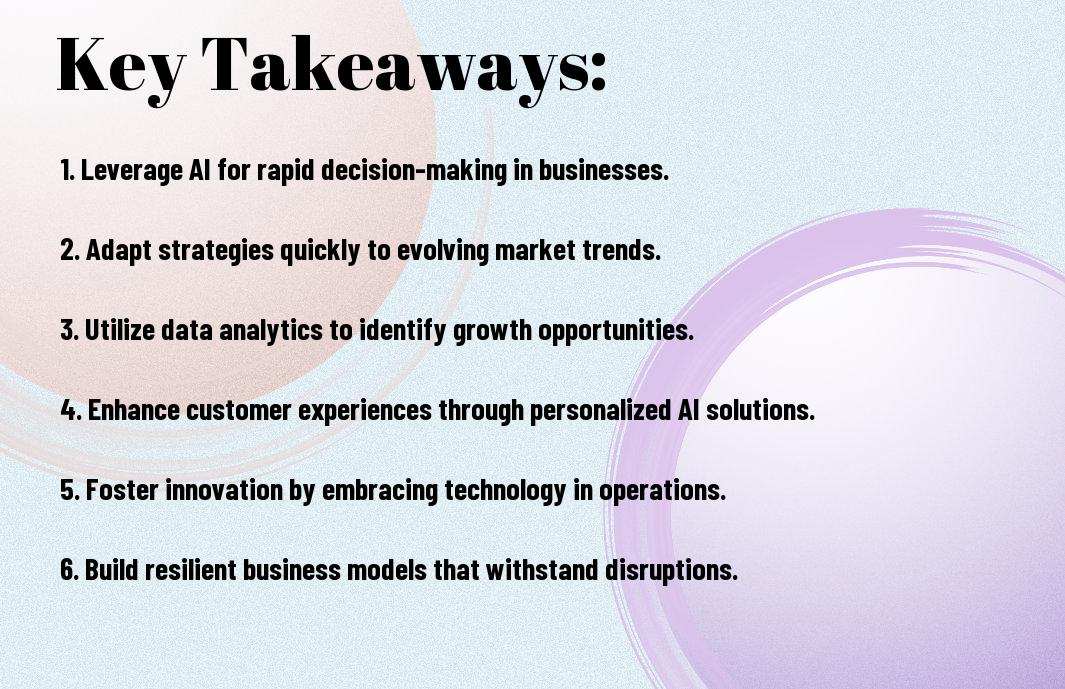
Key Takeaways:

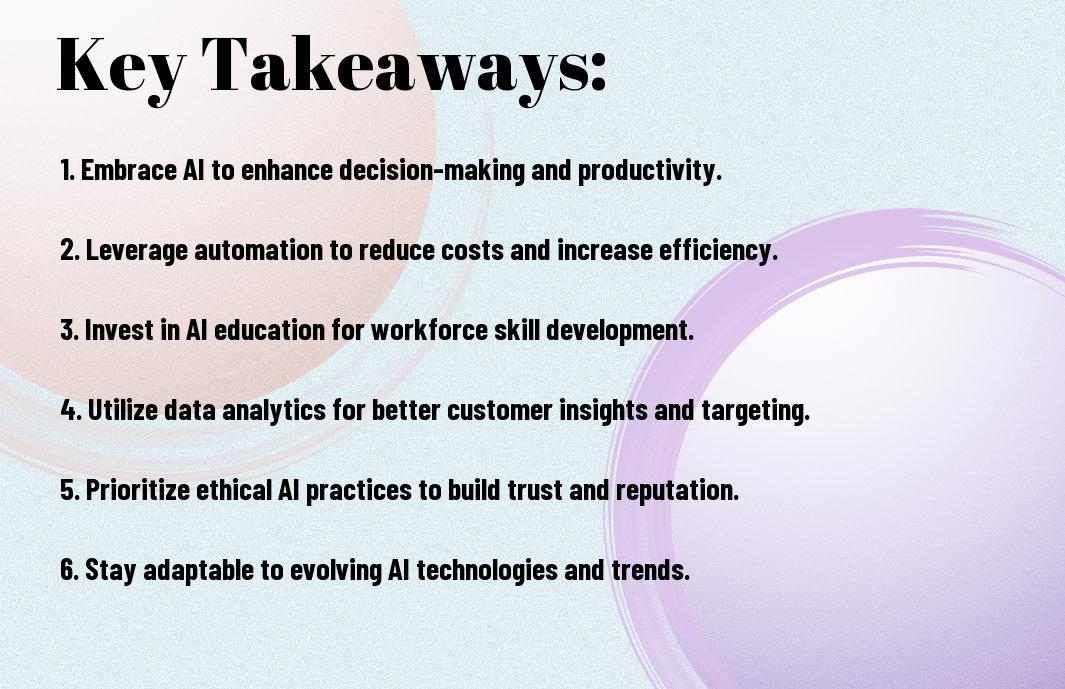
  • Embracing AI technology can significantly enhance entrepreneurial agility, allowing businesses to respond swiftly to market changes and stay competitive in a rapidly evolving landscape.
  • By leveraging AI-driven insights, entrepreneurs can make informed decisions, identify new opportunities, and develop innovative strategies to outmaneuver their competitors and drive growth.
  • Effective integration of AI into business operations enables entrepreneurs to streamline processes, improve efficiency, and foster a culture of adaptability, ultimately leading to increased resilience and long-term success in dynamic markets.

The Tipping Point of AI in Business

To stay ahead in competitive markets, you need to understand the role of AI in driving business success. As AI technology advances, you’ll see significant changes in how companies operate and adapt to new challenges.

When Technology Becomes Indispensable

Along with the increasing use of AI, you’ll find that technology becomes an integral part of your business strategy, enabling you to make data-driven decisions and improve efficiency. You’ll start to rely on AI to streamline processes and drive innovation.

The Few That Create Massive Change

When a small number of innovative companies leverage AI effectively, you’ll see a significant impact on the market, disrupting traditional business models and creating new opportunities. You’ll need to be prepared to adapt and evolve to stay competitive.

Considering the potential of AI to drive massive change, you should focus on developing a strategic approach to implementing AI in your business. You’ll need to identify areas where AI can have the greatest impact, invest in the right technologies, and develop the skills and expertise needed to harness its power. By doing so, you’ll be well-positioned to thrive in a rapidly changing market and stay ahead of the competition.
Competitive Intelligence Through AI

The ability to gather and analyze vast amounts of data is a key aspect of competitive intelligence, and AI can help you make sense of it all, providing valuable insights to inform your business decisions.

Reading Market Signals

Through the use of AI-powered tools, you can monitor market trends and identify patterns that may indicate changes in your industry, allowing you to stay ahead of the competition and make informed decisions about your business strategy.

Predictive Analytics for Decision Making

Reading the data and analytics provided by AI can help you anticipate future market fluctuations and make data-driven decisions to drive your business forward, giving you a competitive edge in the market.

Considering the predictive analytics for decision making, you can use AI to analyze historical data, identify trends, and forecast future outcomes, enabling you to make strategic decisions that drive growth and profitability for your business, and stay ahead of the competition in an ever-changing market landscape.

Agile Business Models

Keep your business ahead of the competition by adopting agile models that leverage AI to drive innovation and growth. You can achieve this by streamlining your operations, improving efficiency, and making data-driven decisions to stay competitive.

Flexibility in Product Development

To stay adaptable, you need to be able to pivot your product development strategy quickly in response to changing market conditions. You can achieve this by using AI to analyze customer feedback, identify trends, and make informed decisions about your product roadmap.

Responsive Customer Engagement

Along with agile product development, you also need to focus on responsive customer engagement to build strong relationships with your customers. You can use AI-powered chatbots and virtual assistants to provide 24/7 support, helping you to improve customer satisfaction and loyalty.

Hence, as you focus on responsive customer engagement, you will be able to gather valuable feedback and insights that can inform your product development strategy, allowing you to create products that meet the evolving needs of your customers, and ultimately driving business growth and success. You will be able to make data-driven decisions, anticipate customer needs, and stay ahead of the competition in a rapidly changing market.

AI Implementation Strategies

Unlike traditional approaches, AI implementation requires a flexible and iterative mindset, allowing you to adapt and refine your strategy as you navigate the complexities of AI adoption, and you will need to be prepared to pivot when necessary to ensure the successful integration of AI into your business.

Starting Small but Thinking Big

Thinking strategically about your AI implementation, you should begin with small, targeted projects that can deliver tangible results, enabling you to build momentum and confidence in your AI capabilities, and you will be able to scale up your efforts as you gain more experience and insight into the potential of AI to drive your business forward.

Building an AI-Ready Culture

Any successful AI implementation depends on a culture that is open to innovation and experimentation, and you will need to foster an environment that encourages collaboration, creativity, and continuous learning, allowing you to unlock the full potential of AI and drive meaningful business outcomes.

Considering the importance of building an AI-ready culture, you should focus on developing a workforce with the necessary skills and expertise to work effectively with AI systems, and you will need to establish clear governance and decision-making processes to ensure that AI is aligned with your business goals and values, ultimately enabling you to harness the power of AI to drive growth, innovation, and competitiveness in your organization.

Risk Management and Adaptation

Once again, you can leverage AI to enhance your risk management and adaptation strategies, allowing you to navigate competitive markets with confidence. By exploring the intersection of agile, AI, and strategic thinking, as discussed in When Agile, AI, and Strategic Thinking Converge, you can develop a robust framework for identifying and mitigating risks.

Identifying Blind Spots

Beneath the surface of your operations, potential risks may be lurking, waiting to disrupt your business. You can use AI-powered tools to analyze your market, competitors, and internal processes, helping you identify blind spots and areas for improvement.

Pivoting with Precision

Below the threshold of traditional risk management lies the ability to pivot with precision, using AI-driven insights to inform your strategic decisions and drive innovation. You can leverage AI to analyze market trends, customer behavior, and competitor activity, enabling you to make data-driven decisions and stay ahead of the curve.

Further, by combining AI with agile methodologies, you can create a flexible and responsive framework for pivoting with precision, allowing you to quickly adjust your strategy in response to changing market conditions, and stay focused on your core objectives, ensuring your business remains competitive and adaptable in an ever-changing landscape, and you can achieve your goals with confidence and precision.

Ethical Considerations

For entrepreneurs, incorporating AI into your business strategy raises important ethical questions, and you must consider the potential consequences of your actions on your customers, employees, and the environment.

Responsible AI Deployment

Along with the benefits of AI, you must also acknowledge the potential risks and take steps to mitigate them, ensuring that your AI systems are transparent, accountable, and fair, and that you are using them in a way that aligns with your values and principles.

Balancing Efficiency and Humanity

The key to successful AI adoption is finding a balance between efficiency and humanity, and you will need to consider how to use AI in a way that enhances the human experience, rather than replacing it, and that supports your business goals while also respecting the needs and rights of your stakeholders.

Balancing the benefits of AI with the need to protect human values and interests is a complex challenge, and you will need to carefully consider the potential impact of your AI systems on your customers, employees, and the wider community, and take steps to ensure that your use of AI is responsible, sustainable, and ethical, and that it supports your long-term success and your reputation as a responsible business leader.

Summing up

To wrap up, you now have the tools to leverage entrepreneurial agility and AI to adapt and thrive in competitive markets. You can harness AI to analyze your business, make informed decisions, and stay ahead of the curve. By embracing this approach, you will enhance your ability to navigate complex market landscapes and drive your business forward, ultimately achieving your goals and maintaining a competitive edge in today’s fast-paced environment, with your business thriving as a result of your informed decisions.

FAQ

Q: What is Entrepreneurial Agility and how does it relate to using AI in business?

A: Entrepreneurial Agility refers to the ability of a company to quickly adapt and respond to changes in the market, leveraging technologies like Artificial Intelligence (AI) to stay competitive. By integrating AI into their operations, businesses can analyze market trends, make data-driven decisions, and innovate rapidly, allowing them to thrive in fast-paced and competitive environments.

Q: How can AI be used to enhance business agility and what are the benefits of its implementation?

A: AI can be used in various ways to enhance business agility, such as automating routine tasks, providing predictive analytics, and personalizing customer experiences. The benefits of implementing AI include increased efficiency, improved decision-making, enhanced customer satisfaction, and the ability to innovate and stay ahead of competitors. By leveraging AI, businesses can respond more quickly to market changes and capitalize on new opportunities.

Q: What role does data play in enabling Entrepreneurial Agility through AI, and how can businesses ensure they are collecting and utilizing data effectively?

A: Data plays a central role in enabling Entrepreneurial Agility through AI, as it provides the insights necessary for informed decision-making and innovation. Businesses can ensure they are collecting and utilizing data effectively by implementing robust data collection systems, investing in data analytics tools, and fostering a culture that values data-driven decision-making. Additionally, ensuring data quality, security, and compliance with regulatory standards is important for trustworthy AI outputs.

Q: How can small and medium-sized enterprises (SMEs) adopt AI technologies to improve their Entrepreneurial Agility without significant upfront investments?

A: SMEs can adopt AI technologies through cloud-based services, which offer scalable and affordable solutions. They can also start by automating specific business processes or leveraging pre-built AI models that can be easily integrated into their existing systems. Collaborating with AI startups or consulting with AI experts can provide SMEs with the guidance they need to implement AI solutions effectively without requiring large initial investments.

Q: What skills and mindset are required for entrepreneurs and their teams to successfully leverage AI for Entrepreneurial Agility, and how can these be developed?

A: To successfully leverage AI for Entrepreneurial Agility, entrepreneurs and their teams need to develop a mindset that is open to innovation and change. They should possess skills in data analysis, understanding of AI technologies, and the ability to integrate AI solutions into business strategies. These skills can be developed through training programs, workshops, and continuous learning initiatives focused on AI, data science, and digital transformation. Encouraging experimentation, learning from failures, and fostering a culture of innovation are also key to successfully adopting AI and achieving Entrepreneurial Agility.


The Power of Disruption – How AI is Reshaping Wealth in Business

Key Takeaways:
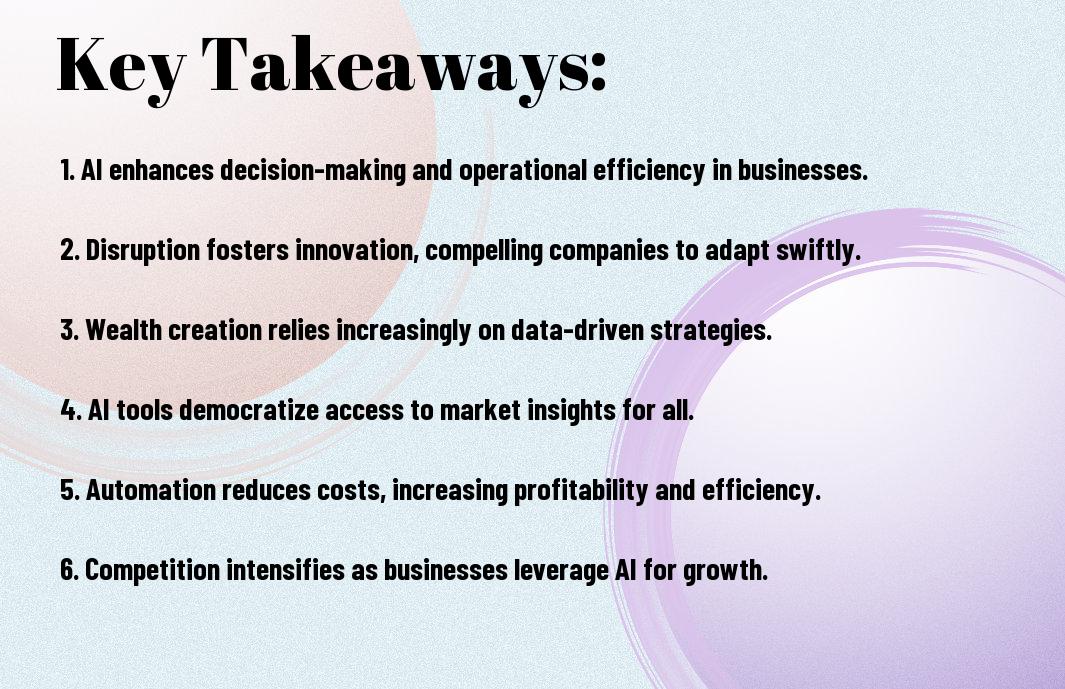
  • AI is transforming the wealth management industry by providing personalized investment advice and automating routine tasks, allowing businesses to focus on high-value services and improve client relationships.
  • The integration of AI in business operations enables companies to analyze large datasets, identify patterns, and make data-driven decisions, leading to increased efficiency and competitiveness in the market.
  • As AI continues to reshape the business landscape, companies must adapt and innovate to stay ahead, leveraging AI-powered tools to enhance their services, reduce costs, and drive growth in a rapidly changing environment.

The Tipping Point of AI in Modern Business

A significant shift is occurring in the business world, driven by the rapid advancement of Artificial Intelligence (AI). As you navigate this new landscape, you’ll notice that AI is transforming the way companies operate, creating new opportunities for growth and innovation.

From Incremental to Exponential Change

Once you start to implement AI solutions, you’ll find that the impact is not just incremental, but exponential, leading to unprecedented levels of efficiency and productivity in your organization.

The Wealth Redistribution Effect

About to experience a significant impact on your business, you should consider how AI is redistributing wealth, creating new winners and losers in the market, and affecting your position within it.

Understanding the wealth redistribution effect of AI is important for your business strategy, as it can help you identify potential risks and opportunities, and make informed decisions about investments and resource allocation, ultimately determining your success in this new era of business.

Small Changes, Big Consequences

Any business can benefit from AI, and you may be surprised at the impact it can have on your wealth. By incorporating AI into your operations, you can streamline processes, reduce costs, and increase efficiency, leading to significant profits.

How Minor AI Implementations Create Major Profits

Moderate adjustments to your business strategy, such as implementing AI-powered tools, can have a substantial effect on your bottom line, allowing you to stay ahead of the competition and increase your wealth.

The Outliers Who Saw It Coming

After analyzing the market, you may have noticed that some businesses have successfully harnessed the power of AI to revolutionize their operations, and you can learn from their experiences to inform your own strategy.

With the benefit of hindsight, you can see that these outliers were able to anticipate the potential of AI and adapt their business models accordingly, resulting in significant financial gains and increased wealth, and you can apply these lessons to your own business to achieve similar success.

Historical Patterns of Technological Disruption

Unlike previous technological advancements, AI is transforming industries at an unprecedented pace, and you are witnessing its impact on your business and wealth. You see how AI is changing the way you operate, making some jobs obsolete while creating new ones, and you must adapt to stay ahead.

Lessons from the Industrial Revolution

Around the time of the Industrial Revolution, you began to notice significant changes in the way goods were produced and distributed, and you realized that similar patterns of disruption are emerging with AI, affecting your wealth and business in profound ways.

The Digital Parallel

One of the most significant aspects of AI disruption is its ability to parallel human thought processes, and you are seeing this play out in your own business as AI takes over routine tasks, freeing you to focus on higher-level decision-making.

Disruption in the digital age is happening at a much faster pace than you might have anticipated, and you need to be prepared to pivot your business strategy to take advantage of emerging trends and technologies, such as AI-powered analytics and automation, which can help you make more informed decisions and stay ahead of the competition, ultimately reshaping your wealth and business for the better.

The Counterintuitive Economics of AI Integration

Your business can benefit from AI integration, as seen in How artificial intelligence is reshaping the financial services industry, where innovative approaches lead to increased efficiency.

When Less Investment Yields Greater Returns

At the outset, you may find that minimal investment in AI can yield significant returns, allowing you to allocate resources more effectively and streamline operations.

The Sticky Factor in AI Adoption

On the surface, AI adoption appears straightforward, but you will soon discover that successful integration relies on various factors, including data quality and employee buy-in.

Another aspect to consider is the long-term commitment required for AI adoption, as you will need to continuously update and refine your systems to ensure they remain effective and aligned with your business goals, allowing you to maximize the potential of AI and drive sustainable growth.

Cognitive Biases in AI Investment Decisions

Not surprisingly, your investment decisions are influenced by cognitive biases when it comes to AI. You may overlook potential pitfalls or overestimate the benefits, leading to poor investment choices.

Why Traditional Business Leaders Miss the Signs

With the rise of AI, you will notice that traditional business leaders often fail to adapt, missing signs of disruption in their industry, and you must be aware of this to avoid similar mistakes.

The Psychology of Technological Resistance

For instance, you may experience resistance to new technologies, including AI, due to fear of change or lack of understanding, which can hinder your ability to make informed investment decisions.

At the heart of this resistance lies a complex mix of emotional and psychological factors, including your comfort with uncertainty and willingness to learn, which you must acknowledge and address in order to make the most of AI’s potential in your business and investment strategies.

The New Rules of Wealth Creation

Once again, you’re witnessing a significant shift in the way wealth is created and distributed, as AI continues to disrupt traditional business models, enabling you to rethink your approach to wealth creation and stay ahead of the curve.

Shifting from Ownership to Access Models

Above all, you need to understand that the rise of AI is driving a shift from ownership to access models, allowing you to access goods and services without the need for direct ownership, and you can leverage this trend to create new wealth opportunities.

The Democratization of Enterprise Tools

For instance, you can now access advanced enterprise tools and technologies that were previously only available to large corporations, enabling you to level the playing field and compete with bigger players in your industry.

Wealth creation is no longer the exclusive domain of large corporations, as you can now access a wide range of tools and technologies that enable you to build and grow your own business, and you can use these tools to create new products, services, and business models that generate wealth and drive growth.

Conclusion

Conclusively, as you navigate the evolving landscape of business, you will find that AI is revolutionizing your approach to wealth creation. You are witnessing a seismic shift in how businesses operate, and your ability to adapt will be key to unlocking new opportunities. By harnessing the power of disruption, you can stay ahead of the curve and reshape your wealth in the process, ultimately transforming your business and securing your place in the future.

FAQ

Q: What is the concept of “The Power of Disruption” in the context of AI and wealth in business?

A: The concept of “The Power of Disruption” refers to the significant impact that Artificial Intelligence (AI) is having on traditional business models and wealth creation. AI is disrupting industries and creating new opportunities for growth, innovation, and profit. This disruption is driven by the ability of AI to automate processes, analyze vast amounts of data, and make predictions, leading to increased efficiency, productivity, and competitiveness.

Q: How is AI reshaping wealth in business, and what are the key drivers of this change?

A: AI is reshaping wealth in business by creating new revenue streams, improving operational efficiency, and enabling businesses to make data-driven decisions. The key drivers of this change include the increasing availability of data, advances in machine learning algorithms, and the growing adoption of cloud computing. Additionally, AI is enabling businesses to personalize customer experiences, optimize supply chains, and develop new products and services, leading to increased revenue and profitability.

Q: What are the potential benefits of AI adoption for businesses, and how can they be realized?

A: The potential benefits of AI adoption for businesses include increased efficiency, improved decision-making, enhanced customer experiences, and new revenue opportunities. These benefits can be realized by investing in AI technologies such as machine learning, natural language processing, and computer vision. Businesses can also benefit from AI by automating routine tasks, analyzing large datasets, and identifying new business opportunities. Furthermore, AI can help businesses to improve their risk management, reduce costs, and increase their competitiveness in the market.

Q: What are the potential risks and challenges associated with AI adoption in business, and how can they be mitigated?

A: The potential risks and challenges associated with AI adoption in business include job displacement, data privacy concerns, and the potential for AI systems to perpetuate biases and errors. These risks can be mitigated by implementing robust governance and regulatory frameworks, investing in employee retraining and upskilling, and ensuring that AI systems are designed and deployed in a transparent and accountable manner. Additionally, businesses can mitigate these risks by conducting thorough risk assessments, implementing robust testing and validation protocols, and ensuring that AI systems are aligned with their overall business strategy and values.

Q: What is the future outlook for AI in business, and how will it continue to shape wealth creation and industry disruption?

A: The future outlook for AI in business is highly promising, with AI expected to continue to drive innovation, growth, and disruption across industries. As AI technologies continue to evolve and improve, we can expect to see increased adoption and deployment of AI in areas such as healthcare, finance, and education. AI will also continue to shape wealth creation by enabling businesses to develop new products and services, improve operational efficiency, and make data-driven decisions. Furthermore, AI will drive industry disruption by creating new business models, enabling new forms of entrepreneurship, and changing the way businesses interact with customers and stakeholders.

Charting a Course to Prosperity – AI Strategies Every Entrepreneur Should Know

As you navigate the complex landscape of modern entrepreneurship, you’ll find that leveraging artificial intelligence (AI) is key to driving your business forward. You’re likely aware that AI is transforming industries, but do you know how to harness its power to boost your own success? Your ability to adapt and innovate with AI will be the deciding factor in staying ahead of the competition, and this post will guide you through the vital strategies you need to know to thrive in this new era of business.

Key Takeaways:

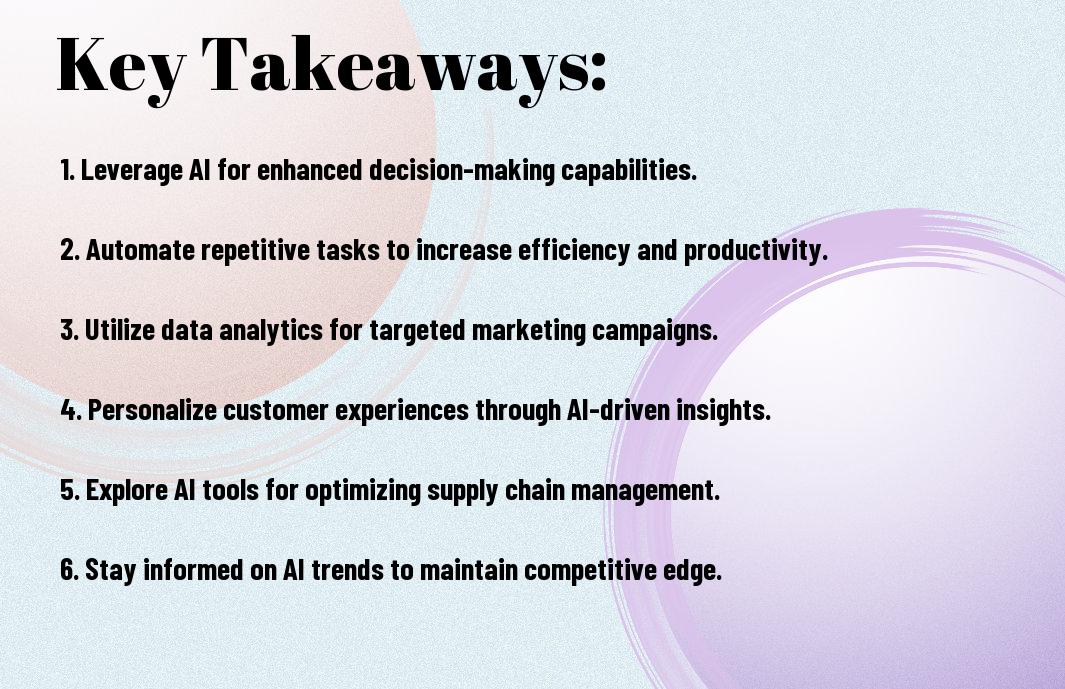
  • Embracing AI technology can significantly enhance business operations, leading to increased efficiency and productivity, which is imperative for entrepreneurs aiming to stay competitive in their respective markets.
  • Understanding the different types of AI, such as machine learning and natural language processing, can help entrepreneurs identify areas where AI can be effectively integrated into their business strategies.
  • AI-driven data analysis can provide valuable insights, enabling entrepreneurs to make informed decisions and develop targeted marketing campaigns that resonate with their audience.
  • Implementing AI solutions can automate routine tasks, freeing up resources for more strategic and creative endeavors, and allowing entrepreneurs to focus on high-value activities that drive growth and innovation.
  • Staying up-to-date with the latest AI trends and advancements is vital for entrepreneurs, as it enables them to leverage new opportunities, mitigate potential risks, and navigate the evolving business landscape with confidence.

The AI Revolution in Business

Your business is on the cusp of a revolution, driven by artificial intelligence (AI). AI is transforming the way you operate, make decisions, and interact with customers. As you navigate this shift, you’ll need to stay ahead of the curve to remain competitive.

The Tipping Point of AI Adoption

Above all, the rapid advancement of AI technologies has brought about a significant shift in the business landscape. You are now faced with the opportunity to leverage AI to streamline processes, enhance customer experiences, and drive growth.

Small Changes, Big Results

Against the backdrop of AI’s growing influence, you can start making small changes to your business strategy. You can begin by automating routine tasks, analyzing customer data, and personalizing your marketing efforts.

This approach will allow you to test the waters, assess the impact of AI on your operations, and make informed decisions about future investments. As you start to see the benefits of AI, you can scale up your efforts, exploring more advanced applications such as predictive analytics, chatbots, and machine learning algorithms to drive even greater results.

Essential AI Tools for Modern Entrepreneurs

Clearly, as an entrepreneur, you need to stay ahead of the curve when it comes to AI tools, and there are several vital ones that can help you achieve your goals, including customer insight platforms and operational efficiency systems that can streamline your business and improve decision-making.

Customer Insight Platforms

Besides having a solid business plan, you need to understand your customers, and customer insight platforms can help you do just that, providing you with valuable data and analytics to inform your marketing and sales strategies, and help you better serve your target audience.

Operational Efficiency Systems

Around the clock, your business is generating data, and operational efficiency systems can help you make sense of it all, automating tasks and providing insights that can help you optimize your operations and improve your bottom line, making you a more competitive and successful entrepreneur.

With operational efficiency systems, you can streamline your workflow, reduce waste, and improve productivity, allowing you to focus on high-level strategy and growth, and make data-driven decisions that drive your business forward, giving you a significant edge in the market and helping you achieve your goals, as you continue to grow and expand your business.

Data-Driven Decision Making

Not having a data-driven approach can hinder your business growth, but by leveraging AI, you can make informed decisions that drive prosperity. You’ll be able to analyze your business performance, identify areas of improvement, and optimize your strategies for success.

Finding Patterns in Business Chaos

Toward achieving business success, you need to uncover hidden patterns and trends in your data. You can use AI-powered tools to sift through vast amounts of data, identifying correlations and insights that inform your decision-making and help you stay ahead of the competition.

The Power of Predictive Analytics

With predictive analytics, you can forecast future outcomes and make proactive decisions that drive your business forward. You’ll be able to anticipate customer needs, prevent potential problems, and capitalize on emerging opportunities, giving you a competitive edge in the market.

Another key benefit of predictive analytics is that it enables you to refine your business strategies over time, as you gather more data and insights. You can continuously monitor your performance, adjust your approaches, and optimize your operations to achieve your goals, ensuring that your business remains on a trajectory of growth and prosperity.

AI Implementation Without Breaking the Bank

Despite the perceived high costs, you can implement AI strategies without overspending. You can start by identifying areas where AI can bring the most value to your business and allocate your budget accordingly.

Scalable Solutions for Growing Businesses

Above all, you should consider solutions that can scale with your business, providing flexibility and cost-effectiveness. You can explore cloud-based AI services that offer pay-as-you-go pricing models, allowing you to adjust your spending as your business grows.

Free and Low-Cost Entry Points

Against the common misconception that AI is expensive, you can find free and low-cost entry points to get started. You can leverage open-source AI tools and libraries, such as TensorFlow or PyTorch, to build and deploy AI models without breaking the bank.

Further, you can take advantage of free trials and limited-time offers from AI service providers to test and evaluate their solutions before committing to a paid plan. This allows you to experiment with different AI technologies and find the best fit for your business needs and budget.

Navigating AI Ethics as an Entrepreneur

For entrepreneurs, understanding AI ethics is vital to building a successful and responsible business. You can learn more about entrepreneurial courses, such as ENTR Courses, to develop your skills. As you navigate AI ethics, you’ll need to consider the impact of your decisions on your business and customers.

Building Trust Through Transparency

Transparently communicating your AI practices helps you build trust with your customers and stakeholders. You can achieve this by being open about your data collection and usage, as well as the decision-making processes behind your AI systems. This will help you establish a strong reputation and maintain customer loyalty.

Avoiding Algorithmic Pitfalls

On the path to AI adoption, you’ll encounter various challenges, including biases in your algorithms. You must be aware of these potential pitfalls and take steps to mitigate them, ensuring your AI systems are fair and unbiased.

Understanding the potential pitfalls of algorithmic decision-making is key to avoiding them. You can do this by regularly auditing your AI systems, testing for biases, and implementing measures to prevent discrimination. By taking these steps, you can ensure your AI systems are fair, transparent, and aligned with your business values.

The Human-AI Partnership

All entrepreneurs should focus on building a strong human-AI partnership to drive business success. You can learn more about this by checking out 10 AI Strategies Every Entrepreneur Should Know for 2024! to stay ahead of the curve.

Augmenting Your Team’s Capabilities

Around the globe, you’ll find that AI is being used to enhance your team’s productivity and efficiency, allowing you to focus on high-value tasks that drive growth and innovation.

Jobs That Evolve Rather Than Disappear

Your business will likely see significant changes as AI becomes more prevalent, but this doesn’t mean job loss – instead, you’ll see roles evolve to work alongside AI systems.

A key aspect of this evolution is the development of new skills that complement AI capabilities, allowing you to work effectively with these systems and drive business success. As you navigate this changing landscape, you’ll need to focus on upskilling and reskilling to stay ahead, ensuring that your business remains competitive in an AI-driven world.

To wrap up

Presently, you have gained valuable insights into charting a course to prosperity with AI strategies. You can now leverage these innovative approaches to drive your business forward. By integrating AI into your operations, you will enhance your decision-making and stay ahead of the competition. Your ability to adapt and capitalize on AI-driven solutions will ultimately determine your success in today’s fast-paced entrepreneurial landscape.

FAQ

Q: What are the key AI strategies that entrepreneurs should adopt to chart a course to prosperity?

A: To chart a course to prosperity, entrepreneurs should adopt AI strategies such as automating repetitive tasks, leveraging machine learning for data analysis, and utilizing natural language processing for customer service. These strategies can help entrepreneurs streamline their operations, gain valuable insights, and improve customer engagement. By implementing these AI strategies, entrepreneurs can stay ahead of the competition and achieve long-term success.

Q: How can entrepreneurs effectively integrate AI into their business operations to drive growth and innovation?

A: Entrepreneurs can effectively integrate AI into their business operations by identifying areas where AI can add value, investing in AI-powered tools and technologies, and developing a skilled team to manage and implement AI solutions. Additionally, entrepreneurs should focus on building a data-driven culture, encouraging experimentation and innovation, and continuously monitoring and evaluating the impact of AI on their business. By taking a strategic and holistic approach to AI integration, entrepreneurs can unlock new opportunities for growth and innovation.

Q: What are the potential risks and challenges that entrepreneurs should be aware of when implementing AI strategies, and how can they mitigate them?

A: When implementing AI strategies, entrepreneurs should be aware of potential risks and challenges such as data privacy and security concerns, job displacement, and bias in AI decision-making. To mitigate these risks, entrepreneurs should prioritize transparency and accountability in their AI systems, invest in robust data protection measures, and develop strategies to upskill and reskill their workforce. Additionally, entrepreneurs should regularly audit and test their AI systems to ensure they are fair, reliable, and aligned with their business values and goals. By being aware of these potential risks and challenges, entrepreneurs can take proactive steps to minimize their impact and ensure the successful implementation of AI strategies.

The Wealth-Building Entrepreneur – How AI is Paving the Way to Financial Freedom

As you navigate the ever-changing landscape of entrepreneurship, you’re likely exploring innovative ways to build wealth and secure your financial future. Your journey to financial freedom is about to get a significant boost, thanks to the rapid advancement of Artificial Intelligence (AI). You can leverage AI to streamline your business operations, make data-driven decisions, and unlock new revenue streams, ultimately paving the way to achieving your financial goals and living the life you desire.

Key Takeaways:

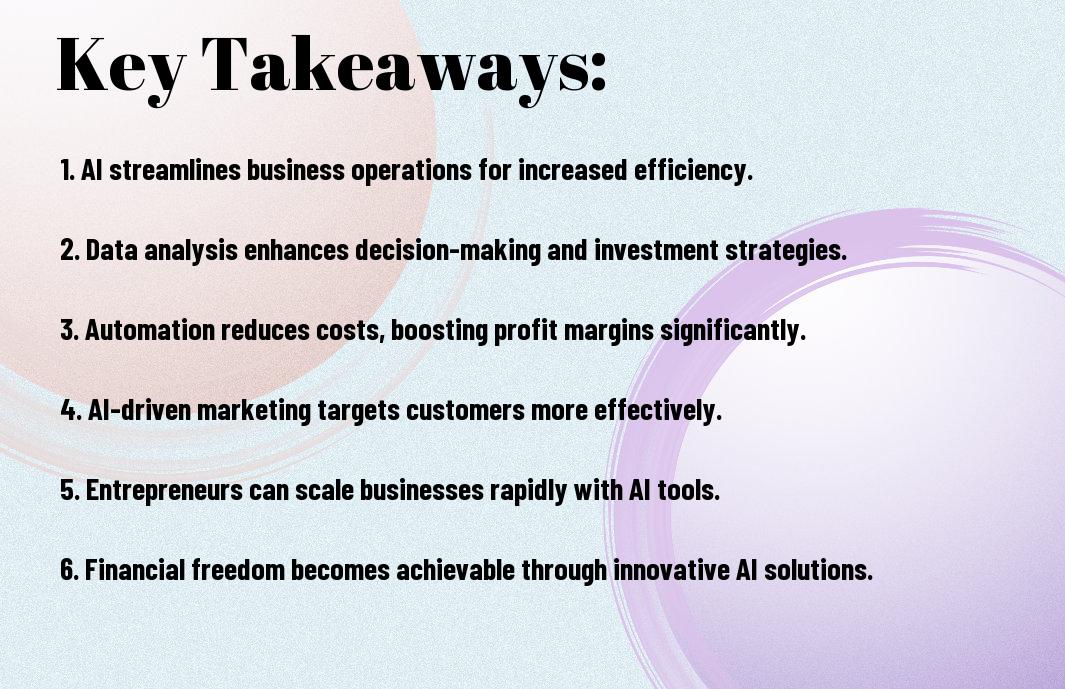
  • The integration of AI in business operations is revolutionizing the way entrepreneurs approach wealth-building, offering unprecedented opportunities for financial growth and freedom.
  • AI-driven technologies, such as machine learning and data analytics, enable entrepreneurs to make informed decisions, optimize resources, and streamline processes, leading to increased efficiency and profitability.
  • By leveraging AI, entrepreneurs can automate repetitive tasks, focus on high-value activities, and develop innovative products and services that meet the evolving needs of their customers, ultimately driving business success.
  • The strategic use of AI can also help entrepreneurs mitigate risks, identify new market trends, and stay ahead of the competition, paving the way for long-term financial stability and security.
  • As AI continues to advance, entrepreneurs who embrace this technology will be well-positioned to achieve financial freedom, create lasting wealth, and build a sustainable legacy for themselves and their businesses.

The AI Revolution in Business

While the concept of artificial intelligence (AI) has been around for decades, its application in business is relatively new. You are now witnessing a significant shift in the way companies operate, with AI-powered tools streamlining processes and improving efficiency.

Automating Mundane Tasks

Around the clock, you can rely on AI to handle repetitive tasks, freeing up your time to focus on high-value activities. Your business can benefit from automation, which enables you to allocate resources more effectively.

Data-Driven Decision Making

Deciding on the best course of action is now easier with AI-driven insights. You can make informed decisions based on data analysis, which helps you navigate your business landscape with confidence. Your ability to interpret data will be enhanced, leading to better outcomes.

For instance, with AI-powered analytics, you can gain a deeper understanding of your customers’ behavior, preferences, and needs. You can then use this information to develop targeted marketing campaigns, optimize your product offerings, and improve your overall customer experience, ultimately driving your business growth and increasing your revenue.

Building Wealth Through AI Integration

Any entrepreneur looking to build wealth through AI integration must understand the potential for increased efficiency and productivity. You can leverage AI to automate tasks, analyze data, and make informed decisions, ultimately driving your business forward.

Scalability Without Proportional Costs

Across various industries, you can scale your business without incurring proportional costs, thanks to AI. You can handle increased demand and grow your customer base without a significant increase in expenses, allowing you to maximize your profits.

The 24/7 Business Model

After implementing AI-powered systems, you can operate your business around the clock. You can automate tasks, respond to customer inquiries, and process transactions 24/7, allowing you to reach a global audience and increase your revenue streams.

Proportional to the growth of your business, your wealth will also increase as you capitalize on the opportunities presented by AI. You can use AI to optimize your operations, identify new markets, and develop innovative products, ultimately leading to financial freedom and a successful entrepreneurial journey.

Financial Freedom Strategies

Once again, you can leverage AI to achieve your financial goals by exploring innovative approaches, such as learning How Digital Technology and AI Will Change Wealth Management, to make informed decisions.

Passive Income Streams

With the power of AI, you can create passive income streams that generate wealth without requiring direct involvement, allowing you to focus on other aspects of your life and business.

Portfolio Diversification

Before investing, you should consider diversifying your portfolio to minimize risk and maximize returns, using AI-driven tools to analyze and optimize your investments.

In addition, you can use AI to identify new investment opportunities, such as emerging markets or industries, and make data-driven decisions to allocate your resources effectively, ultimately helping you achieve your goal of financial freedom.

Overcoming Implementation Barriers

Despite the potential of AI to transform your business, you may face challenges in implementing this technology. You need to address these barriers to unlock the full potential of AI and achieve financial freedom.

Technical Knowledge Gaps

Against the backdrop of rapid technological advancements, you may struggle to keep up with the latest AI developments. You must acquire the necessary skills to harness the power of AI and drive your business forward.

Investment Considerations

After weighing the benefits and risks, you will need to consider the investment required to implement AI solutions. You should assess your budget and prioritize your spending to maximize your returns.

A key aspect of investment considerations is evaluating the potential return on investment (ROI) of AI solutions. You should analyze your business needs and identify areas where AI can have the greatest impact, then invest accordingly to achieve your financial goals and build wealth.

The Competitive Edge

Many entrepreneurs are leveraging AI to gain a competitive advantage in the market, and you can do the same by implementing AI-powered tools and strategies to streamline your business operations and improve your decision-making process.

Market Positioning

Edging out the competition, you can use AI to analyze market trends and identify opportunities to position your business for success, allowing you to make informed decisions about your products and services.

Customer Experience Enhancement

Behind every successful business is a strong focus on customer experience, and you can use AI to enhance yours by personalizing interactions and improving response times, leading to increased customer satisfaction and loyalty.

A key aspect of customer experience enhancement is the ability to analyze customer data and use it to tailor your offerings to meet their specific needs, and with AI, you can do this quickly and efficiently, allowing you to stay ahead of the competition and build a loyal customer base.

Future-Proofing Your Business

Not only is AI transforming the way you do business, but it’s also creating new opportunities for wealth-building entrepreneurs like yourself to thrive in a rapidly changing market.

Emerging AI Technologies

Prior to the current AI landscape, you may have been unaware of the vast potential that emerging technologies like machine learning and natural language processing hold for your business, and now you can leverage them to stay ahead.

Adaptation Strategies

With the rise of AI, you need to develop strategies to adapt your business model, and this involves identifying areas where AI can augment your operations and improve efficiency, allowing you to focus on high-value tasks.

And as you research deeper into adaptation strategies, you’ll find that it’s necessary to assess your current infrastructure and determine how AI can be integrated to enhance your decision-making processes, streamline your workflow, and ultimately drive growth, enabling you to achieve financial freedom and secure your position as a wealth-building entrepreneur.

Summing up

From above, you can see how AI is revolutionizing the path to financial freedom. As you begin on your wealth-building journey, you’ll find that AI-driven tools and strategies can significantly enhance your chances of success. By leveraging these technologies, you can make informed decisions, optimize your investments, and ultimately achieve your financial goals, securing your financial future and unlocking your full potential, allowing you to reap the benefits of your hard work and strategic planning.

FAQ

Q: What is the role of AI in wealth-building for entrepreneurs, and how is it changing the landscape of financial freedom?

A: The Wealth-Building Entrepreneur highlights the significant impact of Artificial Intelligence (AI) on the journey to financial freedom. AI is revolutionizing the way entrepreneurs approach wealth creation by providing innovative tools and strategies that enhance productivity, efficiency, and decision-making. With AI, entrepreneurs can automate routine tasks, gain valuable insights from data analysis, and develop personalized investment plans. This technology is paving the way for entrepreneurs to make informed decisions, minimize risks, and maximize returns, ultimately leading to financial independence.

Q: How can entrepreneurs leverage AI to make smart investment decisions and grow their wealth?

A: The Wealth-Building Entrepreneur emphasizes the importance of leveraging AI in making informed investment decisions. AI-powered tools can analyze vast amounts of market data, identify trends, and predict future market fluctuations. By utilizing these tools, entrepreneurs can make data-driven decisions, diversify their portfolios, and optimize their investment strategies. Additionally, AI can help entrepreneurs identify new business opportunities, assess risks, and develop effective risk management plans. By harnessing the power of AI, entrepreneurs can stay ahead of the curve and make smart investment decisions that drive wealth growth.

Q: What skills and knowledge do entrepreneurs need to acquire to effectively utilize AI in their wealth-building journey, and how can they stay up-to-date with the latest AI trends and technologies?

A: To effectively utilize AI in their wealth-building journey, entrepreneurs need to acquire a combination of technical, business, and financial skills. They should have a basic understanding of AI concepts, such as machine learning and natural language processing, as well as knowledge of financial markets, investment strategies, and risk management. The Wealth-Building Entrepreneur provides guidance on how to develop these skills and stay up-to-date with the latest AI trends and technologies. Entrepreneurs can attend workshops, webinars, and conferences, participate in online forums, and follow industry leaders to stay informed about the latest AI developments and applications in the financial sector. By acquiring these skills and knowledge, entrepreneurs can harness the full potential of AI and achieve financial freedom.

Future Trends in AI – What Every Entrepreneur Needs to Build Wealth

As you navigate the ever-evolving landscape of entrepreneurship, you’re likely aware that artificial intelligence (AI) is transforming industries at an unprecedented pace. Your ability to adapt and leverage AI will be key to driving growth and staying competitive. You need to stay informed about the latest developments and trends in AI to make strategic decisions that will propel your business forward and maximize your wealth-building potential. You will learn how to harness the power of AI to drive your success.

Key Takeaways:

  • Artificial intelligence (AI) is expected to play a significant role in shaping the future of various industries, and entrepreneurs who adapt to these changes will be better positioned to build wealth and stay competitive in the market.
  • Investing in AI-powered technologies such as machine learning, natural language processing, and computer vision can help entrepreneurs automate tasks, improve efficiency, and make data-driven decisions to drive business growth.
  • As AI continues to evolve, entrepreneurs will need to develop strategies to address potential job displacement and focus on upskilling and reskilling their workforce to work effectively with AI systems.
  • AI-driven innovation will create new opportunities for entrepreneurs to develop novel products and services, such as AI-powered chatbots, virtual assistants, and predictive analytics tools, which can help them tap into new markets and revenue streams.
  • Staying informed about the latest AI trends and advancements will be vital for entrepreneurs to identify potential areas of investment and stay ahead of the curve in terms of innovation and competitiveness, ultimately building wealth and achieving long-term success.

The AI Revolution in Business

Your business is on the cusp of an AI revolution, and it’s vital to stay ahead of the curve. As you explore the potential of AI, consider reading How AI Is Changing The Game For Entrepreneurs In 2025 And Beyond to gain valuable insights.

Current State of AI Technologies

Any entrepreneur looking to leverage AI must understand its current state. You’ll find that AI technologies are rapidly advancing, with applications in various industries, from healthcare to finance, and transforming the way you do business.

Why Entrepreneurs Can’t Afford to Ignore AI

Against the backdrop of rapid technological change, you must consider the implications of AI on your business. As AI adoption increases, you’ll need to adapt to stay competitive, and ignoring AI could mean falling behind.

Hence, as you navigate the AI landscape, you’ll discover that its potential to drive growth, improve efficiency, and enhance customer experiences is vast. You’ll need to invest in AI technologies and develop strategies to harness its power, ensuring your business remains relevant and prosperous in the years to come.

Key AI Trends Reshaping Industries

If you’re looking to stay ahead of the curve, you need to understand the latest AI trends. Check out the Top 9 AI Trends 2025: What Every Entrepreneur Must Know to learn more about the future of AI.

Machine Learning as a Service

Besides the obvious benefits, machine learning as a service is becoming increasingly popular, allowing you to integrate AI into your business without extensive expertise.

Natural Language Processing Advancements

Naturally, advancements in natural language processing are enabling you to interact with your customers in a more human-like way, improving your overall customer experience.

Another significant development in natural language processing is the ability to analyze and understand vast amounts of data, allowing you to make more informed decisions about your business and stay ahead of the competition, which is imperative for your growth and success.

AI-Driven Business Models

After witnessing the rise of AI, you can expect significant changes in business models, enabling you to build wealth through innovative approaches, such as AI-driven services and products that cater to evolving customer needs.

Subscription-Based AI Solutions

About to revolutionize the way you do business, subscription-based AI solutions offer you a competitive edge, providing access to cutting-edge technology and expertise, while ensuring a steady revenue stream.

Data as the New Currency

Behind every successful AI-driven business model lies a treasure trove of data, which you can leverage to make informed decisions, drive growth, and stay ahead of the competition, as you navigate the complex landscape of AI-driven entrepreneurship.

Understanding the value of data as the new currency, you will be able to unlock new opportunities, create new revenue streams, and build a robust foundation for your business, allowing you to harness the full potential of AI and drive your wealth-building journey forward.

Building AI-Ready Infrastructure

Keep in mind that creating a solid foundation is vital for successful AI integration. You’ll need to assess your current infrastructure and make necessary adjustments to support AI technologies.

Technical Requirements

About the technical aspects, you should consider factors like data storage, processing power, and security to ensure seamless AI implementation.

Team Composition for AI Integration

Building a skilled team is vital for AI integration, and you should focus on hiring professionals with expertise in AI development, data science, and machine learning to drive your projects forward.

Composition of your team will play a significant role in determining the success of your AI initiatives, and you should strive to create a diverse team with a mix of technical and business skills to ensure that your AI solutions meet your business needs and goals, and that you can effectively leverage AI to drive your business growth and increase your wealth.

Ethical Considerations and Regulatory Landscape

Unlike other technologies, AI raises unique ethical concerns that you must address to build wealth. You need to consider the impact of AI on your business and society.

Privacy Concerns and Solutions

On the issue of privacy, you should prioritize transparency and security to protect your customers’ data. You can implement solutions like encryption and access controls to safeguard sensitive information.

Navigating the Evolving Legal Framework

Navigating the regulatory landscape is necessary for your business to comply with AI-related laws. You should stay updated on the latest developments and adjust your strategies accordingly.

Concerns about liability and accountability are growing as AI becomes more prevalent. You will need to understand your responsibilities and potential risks when developing and deploying AI systems, and take steps to mitigate them to ensure your business’s long-term success.

Investment Strategies for AI Ventures

Many entrepreneurs are turning to AI ventures as a means to build wealth, and with the right investment strategies, you can capitalize on this trend. You’ll need to stay informed about the latest developments and advancements in AI to make informed investment decisions.

Identifying Promising AI Startups

With the AI landscape evolving rapidly, you’ll want to identify startups that have potential for growth and scalability. You should look for companies with innovative solutions, strong leadership, and a clear vision for the future.

Building Your Own AI Portfolio

Along with investing in existing startups, you may also consider building your own AI portfolio by developing your own AI-powered products or services. You can leverage your existing expertise and resources to create innovative solutions that meet the needs of your target market.

Further, as you build your own AI portfolio, you’ll need to consider factors such as data privacy, security, and ethics. You’ll want to ensure that your AI-powered solutions are transparent, accountable, and aligned with your values and goals, allowing you to establish trust with your customers and stakeholders, and ultimately driving your success in the AI market.

Summing up

Following this, you now have a solid understanding of future trends in AI and how to leverage them to build your wealth. You can harness AI’s power to drive your business forward, making informed decisions and staying ahead of the competition. As you move forward, you will be able to capitalize on emerging opportunities, maximizing your returns and securing your position in the market, ultimately achieving your goals and growing your wealth.

FAQ

Q: What are the most significant future trends in AI that entrepreneurs should focus on to build wealth?

A: The most significant future trends in AI that entrepreneurs should focus on to build wealth include the development of more sophisticated chatbots and virtual assistants, the integration of AI with the Internet of Things (IoT), and the use of machine learning algorithms to analyze and make decisions based on large datasets. Additionally, entrepreneurs should also explore the potential of AI in areas such as natural language processing, computer vision, and predictive analytics. By staying ahead of the curve and investing in these emerging trends, entrepreneurs can unlock new revenue streams, improve operational efficiency, and gain a competitive edge in the market.

Q: How can entrepreneurs leverage AI to drive business growth and increase profitability?

A: Entrepreneurs can leverage AI to drive business growth and increase profitability by automating routine tasks, enhancing customer experience, and gaining valuable insights from data analysis. AI-powered tools can help entrepreneurs streamline their operations, reduce costs, and improve productivity, allowing them to focus on high-value tasks such as strategy and innovation. Furthermore, AI-driven analytics can provide entrepreneurs with a deeper understanding of their customers’ needs and preferences, enabling them to develop targeted marketing campaigns and create personalized products and services that meet the evolving demands of the market.

Q: What skills and knowledge do entrepreneurs need to acquire to successfully build and implement AI-powered solutions?

A: To successfully build and implement AI-powered solutions, entrepreneurs need to acquire a range of skills and knowledge, including programming languages such as Python and R, data science and machine learning frameworks, and cloud computing platforms such as AWS and Azure. They should also have a solid understanding of data structures, algorithms, and software engineering principles, as well as the ability to work with large datasets and develop predictive models. Moreover, entrepreneurs should stay up-to-date with the latest AI trends and breakthroughs, and be able to communicate effectively with data scientists, engineers, and other stakeholders to ensure successful collaboration and integration of AI solutions into their business operations.

Skip to content