Business

How to Build an AI-Enhanced Business That Stands the Test of Time

As you launch on building a successful business, you’re likely considering how to leverage artificial intelligence to drive growth and stay competitive. Your goal is to create a company that not only thrives today, but also endures for years to come. You understand that incorporating AI into your business strategy can be a game-changer, and you’re eager to learn how to harness its power to drive innovation, efficiency, and profitability, setting your business up for long-term success.

Key Takeaways:

  • Develop a clear understanding of your business goals and identify areas where AI can be leveraged to drive growth, improve efficiency, and enhance customer experience, ultimately building a strong foundation for long-term success.
  • Invest in data quality and management, as high-quality data is imperative for training and deploying effective AI models that can provide actionable insights and inform business decisions.
  • Foster a culture of innovation and experimentation, encouraging collaboration between human and machine to unlock new opportunities and stay ahead of the competition in an ever-evolving business landscape.
  • Implement AI solutions that are transparent, explainable, and accountable, ensuring that your business can maintain trust with customers, stakeholders, and regulatory bodies, and adapt to changing market conditions.
  • Continuously monitor and evaluate the impact of AI on your business, making adjustments as needed to ensure that AI-enhanced systems remain aligned with your overall business strategy and continue to drive value over time.

    Foundations of AI-Enhanced Business Models

    To build a successful AI-enhanced business, you need to understand the fundamentals of AI-driven models. You will learn how to leverage AI to drive growth, improve efficiency, and enhance customer experiences, setting your business up for long-term success.

    Identifying Core Business Processes for AI Integration

    By analyzing your operations, you can identify areas where AI can have the most impact, streamlining processes and improving productivity, allowing you to make informed decisions about where to apply AI solutions.

    Balancing Innovation with Proven Business Principles

    Any successful AI-enhanced business must strike a balance between innovation and established practices, ensuring that new technologies serve your overall strategy, and you can achieve this by prioritizing your goals and evaluating AI solutions based on their potential impact.

    Principles such as customer-centricity, financial discipline, and operational efficiency are vital to your business’s longevity, and when you integrate AI, you should consider how these principles can be augmented and supported by new technologies, rather than replaced, allowing you to innovate while maintaining a solid foundation for your business.
    Strategic Implementation of AI Technologies

    While implementing AI technologies, you need to consider your business goals and objectives. You should assess your current infrastructure and identify areas where AI can bring the most value. This will help you make informed decisions about which AI solutions to adopt and how to integrate them into your business.

    Selecting the Right AI Solutions for Your Industry

    By evaluating your industry’s specific needs, you can choose AI solutions that address your unique challenges. You should consider factors such as data availability, scalability, and compatibility with your existing systems. This will enable you to select the most effective AI solutions for your business.

    Creating a Scalable AI Infrastructure

    Solutions such as cloud-based services and flexible architectures can help you build a scalable AI infrastructure. You should design your infrastructure to accommodate growing amounts of data and increasing computational demands. This will allow you to expand your AI capabilities as your business grows.

    Strategic planning is important when creating a scalable AI infrastructure. You should consider your long-term goals and develop a roadmap for AI adoption. This will help you prioritize investments, allocate resources effectively, and ensure that your AI infrastructure supports your business objectives. As you build your AI infrastructure, you should also consider factors such as data management, security, and maintenance to ensure that your systems remain efficient and effective over time.

    Human-AI Collaboration Framework

    Despite the potential of AI, you need a framework to collaborate effectively with your human workforce. This framework will help you leverage AI’s capabilities while ensuring your business remains agile and adaptable in a rapidly changing environment.

    Developing AI-Ready Workforce Capabilities

    Among the key factors in building a successful human-AI collaboration is developing your workforce’s capabilities to work with AI. You will need to invest in training and upskilling your employees to ensure they can effectively utilize AI tools and technologies.

    Establishing Ethical Guidelines for AI Use

    Against the backdrop of increasing AI adoption, you must establish ethical guidelines for its use in your business. You will need to consider issues like data privacy, bias, and transparency to ensure your AI systems are fair and trustworthy.

    Indeed, establishing ethical guidelines for AI use is necessary to maintaining your business’s reputation and building trust with your customers. You should consider developing a comprehensive ethics framework that outlines the principles and values that will guide your AI development and deployment, and ensure that your AI systems are aligned with your business’s overall mission and values. This will help you navigate the complex ethical landscape of AI and ensure that your business remains responsible and accountable.

    Data Architecture for Longevity

    Many businesses struggle to create a data architecture that supports long-term growth. You need to design a system that can adapt to changing needs and technologies, ensuring your business remains competitive.

    Building Robust Data Collection Systems

    Around the clock, your systems should be collecting and processing data to inform your business decisions. You should focus on building robust data collection systems that can handle large volumes of data and provide accurate insights.

    Implementing Adaptive Analytics Frameworks

    Any successful business needs to be able to analyze and act on data quickly. You should implement adaptive analytics frameworks that can help you respond to changing market conditions and customer needs.

    Hence, when implementing adaptive analytics frameworks, you will be able to identify trends and patterns in your data, and make informed decisions to drive your business forward. You will be able to create a data-driven culture that enables your business to innovate and stay ahead of the competition, and your adaptive analytics frameworks will be a key component of your overall data architecture, supporting your business’s long-term success.

    Navigating Regulatory Landscapes

    Unlike other business ventures, building an AI-enhanced business requires careful consideration of regulatory landscapes. As you explore AI opportunities, you can find inspiration in 25+ Profitable AI Business Ideas to ensure your venture stays ahead of the curve.

    Compliance Strategies for Evolving AI Regulations

    Alike other regulatory environments, compliance strategies for AI regulations involve understanding the evolving landscape and adapting your business accordingly, which enables you to make informed decisions about your AI-enhanced business.

    Privacy-Centric Approaches to AI Development

    For instance, prioritizing privacy in your AI development process helps you build trust with your customers and maintain a competitive edge in the market, allowing you to create AI solutions that respect user data and privacy.

    Development of privacy-centric AI approaches requires you to consider the ethical implications of your AI systems and implement measures to protect user data, which in turn enables you to create AI solutions that not only drive business growth but also respect user privacy, ultimately helping you build a sustainable and trustworthy AI-enhanced business that stands the test of time.

    Measuring AI-Driven Business Impact

    After implementing AI initiatives, you need to assess their impact on your business. To achieve this, you can visit Creating a content supply chain that will stand the test of time for guidance on building a sustainable business model.

    Key Performance Indicators for AI Initiatives

    Against the backdrop of your AI strategy, you will need to establish key performance indicators to measure the success of your initiatives, allowing you to adjust your approach as needed to maximize your returns.

    Long-term Value Assessment Methodologies

    By adopting a long-term perspective, you can better evaluate the effectiveness of your AI investments, considering factors such as customer satisfaction and revenue growth to determine the overall value of your initiatives.

    At this stage, you should consider methodologies such as cost-benefit analysis, return on investment (ROI) calculations, and total cost of ownership (TCO) assessments to evaluate the long-term value of your AI investments, enabling you to make informed decisions about your business strategy and ensure the sustainability of your AI-enhanced business model.

    Final Words

    Conclusively, you now have the foundation to build an AI-enhanced business that stands the test of time. You have learned how to leverage AI to drive innovation and growth in your organization. By integrating AI into your business strategy, you will be able to stay ahead of the competition and achieve long-term success. Your ability to adapt and evolve with AI will be key to your business’s enduring prosperity.

    FAQ

    Q: What are the key components of building an AI-enhanced business that stands the test of time?

    A: To build an AI-enhanced business that stands the test of time, several key components must be in place. First, a clear understanding of the company’s goals and objectives is necessary to determine how AI can be leveraged to drive business success. This involves identifying areas where AI can automate processes, enhance decision-making, and improve customer experiences. Additionally, a strong data foundation is crucial, as AI algorithms rely on high-quality data to learn and make accurate predictions. A talented team with expertise in AI, data science, and business operations is also vital to develop and implement effective AI strategies. Finally, a culture of continuous learning and innovation must be fostered to ensure the company stays ahead of the curve and adapts to changing market conditions.

    Q: How can businesses ensure that their AI systems are transparent, explainable, and fair?

    A: Ensuring that AI systems are transparent, explainable, and fair is crucial for building trust with customers, employees, and stakeholders. To achieve this, businesses can implement several strategies. First, they can use techniques such as model interpretability and feature attribution to provide insights into how AI-driven decisions are made. Second, they can establish clear guidelines and regulations for AI development and deployment, ensuring that AI systems are designed and tested to avoid bias and discrimination. Third, they can invest in AI auditing and testing tools to detect and mitigate potential issues. Finally, they can foster a culture of accountability and transparency, encouraging open communication and collaboration between AI developers, business leaders, and stakeholders to ensure that AI systems are aligned with human values and ethical principles.

    Q: What role does continuous learning and adaptation play in building an AI-enhanced business that stands the test of time?

    A: Continuous learning and adaptation are crucial for building an AI-enhanced business that stands the test of time. As AI technologies and market conditions evolve, businesses must be able to adapt quickly to stay competitive. This involves investing in ongoing education and training for employees, as well as encouraging a culture of experimentation and innovation. Businesses can also leverage AI itself to drive continuous learning, using techniques such as reinforcement learning and transfer learning to improve AI models and adapt to new situations. Additionally, businesses can establish partnerships with academia, research institutions, and other industry leaders to stay at the forefront of AI research and development. By embracing a mindset of continuous learning and adaptation, businesses can ensure that their AI-enhanced strategies remain effective and relevant in the face of changing market conditions and technological advancements.

Breaking New Ground – AI Strategies for Building a Multi-Million Dollar Business

As you begin on building a multi-million dollar business, you’ll need to leverage the latest advancements in artificial intelligence to stay ahead of the curve. Your ability to harness AI strategies will be the key to unlocking unprecedented growth and profitability. You’ll discover how to harness the power of AI to drive innovation, optimize operations, and make data-driven decisions that propel your business forward, setting you up for unparalleled success in today’s competitive landscape.

Key Takeaways:

  • Developing a robust AI strategy is necessary for building a multi-million dollar business, as it enables companies to leverage cutting-edge technology and drive innovation.
  • Identifying the right AI applications and use cases is vital to maximizing returns on investment and achieving business objectives, such as improving operational efficiency or enhancing customer experiences.
  • Building a strong team with the necessary AI skills and expertise is necessary to successfully implement and maintain AI systems, and to drive business growth through data-driven decision making.
  • Continuous monitoring and evaluation of AI performance is necessary to ensure that AI systems are meeting business objectives and to identify areas for improvement, allowing for data-driven decision making and optimization.
  • Embracing a culture of innovation and experimentation is key to unlocking the full potential of AI and driving long-term business success, by encouraging the development of new AI-powered products and services.

    The AI Revolution in Business

    Before you commence on building a multi-million dollar business, consider the impact of AI on your strategy, as seen in Harnessing AI for Strategic Business Insights, to drive growth and innovation.

    Transformative Technologies

    Across various industries, you’ll find AI-powered tools revolutionizing the way you operate, making it imperative to understand how to leverage these technologies for your business.

    Market Disruption Potential

    Transformative technologies like AI can disrupt traditional markets, creating new opportunities for you to innovate and stay ahead of the competition.

    Plus, as you explore the market disruption potential of AI, you’ll discover how it can help you identify gaps in the market, creating new revenue streams and giving you a competitive edge, allowing you to make informed decisions about your business strategy and stay ahead in a rapidly changing landscape.

    Strategic AI Implementation

    You will need to develop a comprehensive strategy for AI implementation, considering your business goals and objectives. Check out this article Half way building a new company with AI in 30 days! My key lessons so far to learn from someone who has done it.

    Identifying High-Value Opportunities

    Any business looking to leverage AI must identify areas where it can add significant value. You should assess your operations, customer interactions, and market trends to pinpoint opportunities for AI-driven growth.

    Technology Selection Framework

    Opportunities for AI adoption are vast, but selecting the right technology is key. You should evaluate factors like scalability, integration, and cost when choosing an AI solution that aligns with your business needs.

    Further, when developing your technology selection framework, you will need to consider your current infrastructure, data management capabilities, and the level of expertise within your organization. This will enable you to make informed decisions about the AI technologies that will drive the greatest impact for your business, and help you build a multi-million dollar company.

    Data as the New Currency

    Despite the rapidly changing business landscape, one thing is clear: data is now the lifeblood of any successful organization. You need to harness its power to drive your growth and stay ahead of the competition. Your ability to collect, analyze, and act on data will determine your success in building a multi-million dollar business.

    Building Valuable Data Assets

    On the path to building a data-driven business, you will need to focus on collecting and integrating data from various sources. You should prioritize building a robust data infrastructure that can handle large volumes of data and provide actionable insights that inform your business decisions.

    Analytics for Decision Superiority

    After establishing a solid data foundation, you can leverage analytics to gain a competitive edge. You will be able to make data-driven decisions that drive business growth and optimize your operations, giving you a significant advantage over your competitors.

    Another key aspect of analytics for decision superiority is the ability to identify patterns and trends in your data. You can use machine learning algorithms and statistical models to uncover hidden insights that inform your business strategy, allowing you to stay ahead of the curve and drive innovation in your industry. By leveraging these capabilities, you can unlock new opportunities for growth and expansion, and solidify your position as a market leader.

    AI-Driven Customer Experiences

    Once again, you’ll find that AI is revolutionizing the way you interact with your customers, enabling you to deliver tailored experiences that drive loyalty and revenue. By leveraging AI, you can analyze customer data, preferences, and behaviors to create personalized interactions that meet their unique needs.

    Personalization at Scale

    Before you can deliver personalized experiences, you need to understand your customers’ individual preferences and behaviors, and AI helps you do just that, allowing you to tailor your marketing efforts and improve customer satisfaction.

    Predictive Engagement Models

    With the power of AI, you can build predictive models that forecast customer behavior, enabling you to proactively engage with them and build stronger relationships, ultimately driving business growth.

    A key aspect of predictive engagement models is their ability to analyze vast amounts of customer data, identifying patterns and trends that inform your marketing strategies, allowing you to make data-driven decisions that optimize your customer interactions and maximize your ROI, helping you to build a multi-million dollar business.

    Operational Excellence Through Automation

    Many businesses have achieved significant success by leveraging automation to streamline their operations. You can do the same by identifying areas where automation can improve efficiency and reduce costs, allowing you to focus on high-value tasks that drive growth and innovation in your business.

    Process Reinvention

    Above all, you need to rethink your business processes to maximize the benefits of automation. You will be able to eliminate manual errors, increase productivity, and enhance customer experience by automating repetitive and time-consuming tasks.

    Efficiency Metrics and Optimization

    After implementing automation, you need to track key performance indicators to measure the effectiveness of your automated processes. You can identify areas for improvement and make data-driven decisions to optimize your operations and achieve your business goals by monitoring metrics such as processing time, error rates, and cost savings.

    Efficiency is the key to unlocking the full potential of automation in your business. You can achieve operational excellence by continuously monitoring and optimizing your automated processes, allowing you to stay ahead of the competition and drive long-term success. As you analyze your efficiency metrics, you will be able to refine your automation strategies and make adjustments to maximize your return on investment.

    Scaling Your AI Business

    To scale your AI business, you need to develop a strategic plan that outlines your goals, target market, and revenue projections. You must also establish a strong team and invest in the right technology to support your growth.

    Investment Strategies

    Across various industries, you’ll find that investing in AI technology can be a significant factor in driving business growth. You should consider allocating a substantial budget to AI research and development to stay ahead of the competition.

    Talent Acquisition and Development

    About the people who will drive your AI business forward, you should focus on attracting and retaining top talent in the field. You need experts who can develop and implement AI solutions that meet your business needs.

    This talent acquisition and development process involves providing your team with ongoing training and resources to help them stay up-to-date with the latest AI trends and technologies. You should also foster a culture of innovation, encouraging your team to experiment and explore new AI applications that can benefit your business. By doing so, you’ll be able to leverage AI to drive growth, improve efficiency, and increase profitability in your organization.

    Conclusion

    So, as you launch on building a multi-million dollar business, you will leverage AI strategies to drive growth and innovation. You will utilize AI to optimize operations, enhance customer experiences, and inform data-driven decisions. By embracing AI, you will position your business for long-term success and stay ahead of the competition, ultimately achieving your entrepreneurial goals and realizing your vision for a thriving and sustainable business.

    FAQ

    Q: What is the main focus of the book “Breaking New Ground – AI Strategies for Building a Multi-Million Dollar Business”?

    A: The book “Breaking New Ground – AI Strategies for Building a Multi-Million Dollar Business” focuses on providing entrepreneurs and business leaders with practical strategies and insights on how to leverage Artificial Intelligence (AI) to build and grow a successful, multi-million dollar business. It explores the latest AI trends, technologies, and applications, and offers guidance on how to integrate AI into various aspects of business operations, from marketing and sales to product development and customer service.

    Q: How can AI strategies help businesses achieve rapid growth and scalability?

    A: AI strategies can help businesses achieve rapid growth and scalability by automating routine tasks, enhancing decision-making, and improving operational efficiency. With AI, businesses can analyze large amounts of data, identify patterns, and make data-driven decisions, leading to increased productivity and competitiveness. Additionally, AI-powered tools can help businesses personalize customer experiences, optimize supply chains, and predict market trends, ultimately driving revenue growth and expansion.

    Q: What kind of businesses can benefit from the AI strategies outlined in the book “Breaking New Ground – AI Strategies for Building a Multi-Million Dollar Business”?

    A: The AI strategies outlined in the book “Breaking New Ground – AI Strategies for Building a Multi-Million Dollar Business” can benefit a wide range of businesses, from startups and small to medium-sized enterprises (SMEs) to large corporations. Whether you’re in e-commerce, healthcare, finance, or any other industry, the book’s insights and strategies can help you harness the power of AI to drive innovation, improve customer engagement, and stay ahead of the competition. The book’s principles and techniques are applicable to businesses of all sizes and stages, making it a valuable resource for anyone looking to leverage AI for business success.

The Future of Business Intelligence – AI Transforming Market Analysis

As you navigate the ever-changing landscape of business, you’re likely aware that staying ahead of the curve is key to success. Your ability to analyze market trends and make informed decisions will be revolutionized by the integration of Artificial Intelligence (AI) in business intelligence. You will soon be able to uncover hidden patterns, predict future trends, and optimize your strategies with unprecedented accuracy, giving you a competitive edge in the market.

Key Takeaways:

  • The integration of Artificial Intelligence (AI) in business intelligence is revolutionizing market analysis by providing faster and more accurate insights, enabling businesses to make informed decisions and stay ahead of the competition.
  • AI-powered tools can analyze vast amounts of data, identify patterns, and predict trends, allowing businesses to optimize their operations, improve customer experience, and increase revenue.
  • The use of machine learning algorithms in business intelligence enables the automation of routine tasks, freeing up human analysts to focus on higher-level tasks such as strategy development and decision-making.
  • AI-driven business intelligence also enhances data visualization, making it easier for stakeholders to understand complex data and trends, and facilitating more effective communication and collaboration across organizations.
  • The future of business intelligence will be shaped by the continued advancement of AI technologies, such as natural language processing and deep learning, which will further enhance the accuracy and speed of market analysis and decision-making.

The Tipping Point for AI in Business Intelligence

For businesses, the integration of AI in market analysis is becoming increasingly prevalent, and you are likely to see significant advancements in the near future, transforming your approach to business intelligence.

From Data Collection to Intelligent Insights

Once you start leveraging AI, you will notice a shift from mere data collection to deriving intelligent insights that inform your business decisions, enabling you to make more accurate predictions and drive growth.

The Small Changes Creating Big Impacts

The subtle incorporation of AI in your business operations will start yielding noticeable results, and you will begin to see improvements in your market analysis, allowing you to respond more effectively to changing market conditions.

Point to consider is that these small changes will compound over time, and as you continue to integrate AI into your business intelligence, you will unlock new opportunities for innovation and expansion, ultimately giving you a competitive edge in the market, and enabling you to make more informed decisions about your business strategy.

Cognitive Revolution in Market Analysis

Assuming you are familiar with the concept of business intelligence, you will understand that the integration of AI is transforming market analysis, enabling you to make more informed decisions.

Pattern Recognition Beyond Human Capability

Cognitively, you will be able to analyze vast amounts of data, identifying patterns that may have gone unnoticed, and gaining valuable insights that inform your business strategy.

The Outliers That Machines Can Spot

Revolutionizing the way you approach market analysis, machines can identify anomalies in data that you may have missed, providing you with a more comprehensive understanding of your market.

Spot the differences in your data that machines can identify, and you will be able to refine your strategy, targeting specific areas of your business that require attention, and driving growth as a result of your newfound understanding of the market and its trends.

Predictive Analytics Reimagined

Not only is AI transforming market analysis, but it’s also revolutionizing predictive analytics, enabling you to make more informed decisions about your business’s future.

From Reactive to Proactive Business Decisions

One of the key benefits of AI-powered predictive analytics is that it allows you to shift from reactive to proactive business decisions, enabling you to anticipate and prepare for changes in your market, giving you a competitive edge.

The Blink Moment: Intuitive AI Systems

Moment by moment, AI systems are becoming more intuitive, allowing you to make swift and informed decisions, and as you probe deeper into your data, you’ll uncover new insights that will transform your business.

In fact, as you explore the capabilities of intuitive AI systems, you’ll find that they can analyze vast amounts of data in real-time, providing you with instant insights that will enable you to make swift and informed decisions, and drive your business forward with confidence, allowing you to stay ahead of the curve and capitalize on new opportunities as they arise.

Democratization of Complex Analysis

Many businesses are now able to perform complex analysis, thanks to AI-powered tools. You can now access advanced analytics, enabling your organization to make data-driven decisions.

When Specialized Knowledge Becomes Accessible

Diffusion of specialized knowledge enables you to tap into the power of data analysis, regardless of your technical expertise. You can now interpret complex data, making informed decisions for your business.

The Power Shift in Data Interpretation

The ability to analyze data is no longer limited to experts, as you can now use AI-driven tools to uncover insights. You can interpret complex data, identifying trends and patterns that inform your business strategy.

Complex data analysis is now at your fingertips, as AI-powered tools provide you with the ability to uncover hidden insights. You can explore into your data, identifying areas of opportunity and optimizing your business performance. As you explore your data, you’ll discover new ways to drive growth and stay ahead of the competition, making your business more agile and responsive to changing market conditions.

Ethical Dimensions and Blind Spots

Despite the benefits of AI in business intelligence, you must consider the ethical implications of relying on automated systems for market analysis, as your decisions will have a significant impact on your organization and stakeholders.

The Hidden Biases in Algorithmic Decision-Making

Blindly trusting AI-driven insights can lead to unintended consequences, as you may unknowingly perpetuate biases present in the data, affecting your ability to make informed decisions and potentially harming your business.

Navigating the Moral Landscape of Automated Analysis

Algorithmically driven analysis can raise complex moral questions, and as you probe deeper into the world of AI-powered business intelligence, you will need to carefully consider the potential consequences of your actions and ensure that your use of automation aligns with your values and principles.

For instance, you will need to think about how to address issues like data privacy, transparency, and accountability in your AI-driven market analysis, and develop strategies to mitigate potential risks and ensure that your use of automation is fair, unbiased, and respectful of all stakeholders involved, ultimately protecting your business’s reputation and maintaining trust with your customers.

Human-Machine Collaboration Models

Unlike traditional approaches, human-machine collaboration models enable you to leverage the strengths of both humans and machines, leading to more accurate and efficient market analysis.

Redefining Analytical Roles and Expertise

Roles are evolving as you work alongside AI systems, requiring you to develop new skills and expertise to effectively interpret and apply insights generated by machines.

The Connectors: Interfaces Between Insight and Action

An integral part of human-machine collaboration, you will use interfaces that facilitate seamless interaction between insights and actions, enabling you to make data-driven decisions.

At the heart of these interfaces, you will find advanced visualization tools and natural language processing, allowing you to communicate complex ideas and insights to stakeholders, and to translate data into actionable strategies that drive your business forward, helping you to stay ahead in the market.

Conclusion

From above, you can see how AI is revolutionizing market analysis. As you move forward, your business will rely on AI-driven insights to make informed decisions. You will witness enhanced predictive capabilities, automating your analysis and uncovering new opportunities. Your ability to adapt to this shift will determine your success in the market, enabling you to stay ahead of the competition and drive your business forward with data-driven confidence.

FAQ

Q: What role will Artificial Intelligence (AI) play in the future of business intelligence, particularly in market analysis?

A: AI is poised to revolutionize the field of business intelligence by enhancing market analysis through advanced data analytics, predictive modeling, and machine learning algorithms. This technology will enable businesses to make more informed decisions by providing real-time insights into market trends, customer behavior, and competitor activity. AI-driven tools will automate data processing, identify patterns, and predict future market shifts, allowing companies to stay ahead of the competition and capitalize on emerging opportunities.

Q: How will AI transform the process of market analysis, and what benefits can businesses expect from this transformation?

A: AI will transform market analysis by introducing speed, accuracy, and depth to the process. AI algorithms can analyze vast amounts of data from various sources, including social media, customer feedback, and market research reports, to provide a comprehensive view of the market. This transformation will benefit businesses by enhancing their ability to identify new market opportunities, optimize product development, and improve customer satisfaction. Additionally, AI-driven market analysis will enable businesses to respond quickly to changes in the market, reducing the risk of missing out on trends and opportunities.

Q: What skills and investments will businesses need to make to leverage AI in market analysis and stay competitive in the future of business intelligence?

A: To leverage AI in market analysis, businesses will need to invest in data infrastructure, AI technologies, and talent acquisition. They will need to develop a data-driven culture, ensuring that high-quality data is available and accessible across the organization. Investing in AI tools and platforms that can handle complex data analytics and machine learning will be imperative. Moreover, businesses will need to attract and retain professionals with expertise in data science, AI, and business analysis to interpret AI-generated insights and make strategic decisions. Continuous training and development of existing staff will also be necessary to ensure that they can work effectively with AI systems and understand their capabilities and limitations.

Harnessing the Power of Big Data – AI for Smarter Business Decisions

As you navigate the complex landscape of modern business, you’re constantly seeking ways to make informed decisions that drive growth and success. Your ability to analyze and interpret vast amounts of data is key to unlocking new opportunities and staying ahead of the competition. With the advent of artificial intelligence (AI), you can now harness the power of big data to gain valuable insights and make smarter business decisions that propel your organization forward.

Key Takeaways:

  • Big Data analytics, combined with Artificial Intelligence (AI), enables businesses to make informed decisions by uncovering hidden patterns and insights from large datasets, leading to improved operational efficiency and strategic planning.
  • AI-powered tools can process vast amounts of data quickly, providing real-time analytics and facilitating swift decision-making, which is vital for staying competitive in today’s fast-paced business environment.
  • By leveraging Big Data and AI, organizations can enhance customer experiences through personalized marketing, improved customer service, and tailored product offerings, ultimately driving business growth and revenue.
  • Integrating AI into Big Data analytics helps mitigate risks by identifying potential threats and vulnerabilities, allowing businesses to take proactive measures to prevent data breaches and maintain data integrity.
  • Effective implementation of Big Data and AI solutions requires a skilled workforce, ongoing training, and a culture that embraces data-driven decision-making, ensuring that businesses can maximize the benefits of these technologies and achieve long-term success.

The Data Revolution

Before the advent of big data, your business decisions were likely based on limited information and intuition. With the exponential growth of data, you now have the opportunity to make informed decisions, driving your business forward.

From Information Overload to Strategic Asset

Overwhelming amounts of data can be transformed into a valuable resource, helping you to identify trends, patterns, and insights that inform your business strategy, enabling you to stay ahead of the competition.

The Tipping Point in Data Utilization

Any organization can leverage big data to gain a competitive edge, and you are no exception, as you can harness the power of data to optimize operations, improve customer experiences, and drive innovation.

Indeed, as you reach the tipping point in data utilization, you will begin to see significant returns on investment, from increased efficiency to enhanced decision-making capabilities, ultimately leading to improved business outcomes and a stronger market position, allowing you to make the most of your data-driven strategy.

AI as the Modern Business Interpreter

While navigating the complexities of big data, you’ll find that AI plays a significant role in interpreting insights that inform your business decisions, enabling you to make smarter choices.

Machine Learning Fundamentals

About the basics of machine learning, you’ll discover that it involves training algorithms on your data to identify trends and patterns, ultimately enhancing your decision-making process.

Pattern Recognition in Business Contexts

After applying machine learning to your business, you’ll begin to see patterns emerge that can be leveraged to optimize operations, predict customer behavior, and drive growth.

Indeed, as you research deeper into pattern recognition, you’ll find that it allows you to uncover hidden relationships between variables, forecast market shifts, and make data-driven decisions that propel your business forward, giving you a competitive edge in the market and enabling you to achieve your goals more effectively.

Decision-Making Reimagined

Not only does big data provide you with vast amounts of information, but it also enables you to make informed decisions. With AI, your business can analyze complex data sets, identify patterns, and predict outcomes, leading to smarter decision-making.

From Intuition to Algorithm-Assisted Choices

Behind the scenes, AI algorithms process vast amounts of data, providing you with actionable insights that inform your choices. You can now make decisions based on data-driven evidence, rather than relying solely on intuition.

The Human-AI Partnership

About to revolutionize your decision-making process, the collaboration between humans and AI enables you to leverage the strengths of both. You bring expertise and context, while AI provides data-driven insights, resulting in more accurate and informed decisions.

Due to the complementary nature of human and AI capabilities, you can focus on high-level strategic thinking, while AI handles complex data analysis, freeing up your time to drive business growth and innovation. As you navigate the complexities of big data, your partnership with AI will become increasingly vital to making smarter, more informed decisions that drive your business forward.

Implementation Challenges

Despite the potential benefits of big data and AI, you will face several challenges when implementing these technologies in your business. You need to consider the technical, organizational, and cultural hurdles that can hinder the successful adoption of big data and AI solutions.

Technical Hurdles and Solutions

Challenging as it may seem, integrating big data and AI into your existing infrastructure can be overcome with the right strategies and tools. You can leverage cloud-based services, data integration platforms, and AI-powered software to streamline your data management and analysis processes.

Organizational Resistance

With the introduction of new technologies, you may encounter resistance from your employees, particularly those who are accustomed to traditional methods. You should address their concerns and provide training to help them adapt to the changes and understand the benefits of big data and AI.

Also, as you implement big data and AI solutions, you will need to establish clear goals, define new roles and responsibilities, and foster a culture of innovation and experimentation within your organization. You should encourage your employees to explore new ideas and approaches, and provide them with the necessary support and resources to succeed.

Ethical Considerations

Once again, you face a dilemma in using big data and AI, as ethical concerns arise, and you must address them to maintain your business’s integrity and trust with your customers.

Privacy Concerns in the Data Age

Prior to implementing any big data or AI solution, you should consider the potential risks to your customers’ privacy, as their personal data is being collected and analyzed, and you must ensure that you handle it securely and transparently.

Responsible AI Deployment

Around the time you decide to deploy AI in your business, you should think about the potential consequences of your actions, and strive to use AI in a way that benefits both your business and society as a whole, by being mindful of the potential biases and ensuring that your AI systems are fair and transparent.

Considering the potential impact of AI on your business and the world, you should take a proactive approach to responsible AI deployment, by establishing clear guidelines and principles that prioritize fairness, accountability, and transparency, and by continuously monitoring and evaluating the performance of your AI systems to ensure that they align with your values and goals, and you can achieve this by investing in AI solutions that are designed with ethics and social responsibility in mind, and by fostering a culture of accountability and transparency within your organization.

Measuring Impact

After implementing AI-driven decision making, you can assess its effectiveness by checking out Harnessing the Power of Big Data Analytics for Smarter Business Decisions to learn more about the benefits of big data analytics.

ROI of AI-Driven Decision Making

Alongside the implementation, you will notice significant improvements in your business, as AI-driven decision making enhances your ability to make informed decisions, leading to increased efficiency and productivity.

Key Performance Indicators

Beneath the surface of your business operations, you will find that key performance indicators (KPIs) play a significant role in measuring the success of AI-driven decision making, allowing you to track progress and make adjustments as needed.

Decision makers like you rely on KPIs to evaluate the effectiveness of their strategies, and with AI-driven decision making, you can set and track KPIs that align with your business goals, enabling you to make data-driven decisions and drive growth.

To wrap up

Conclusively, you now have the tools to harness the power of big data and AI for smarter business decisions. You can leverage this technology to analyze your data, identify patterns, and make informed decisions that drive your business forward. By utilizing big data and AI, you will be able to optimize your operations, enhance customer experiences, and stay ahead of the competition, ultimately leading to increased success and growth for your business.

FAQ

Q: What is Big Data and how can it be leveraged to make smarter business decisions?

A: Big Data refers to the vast amounts of structured and unstructured data that organizations generate and collect on a daily basis. By harnessing the power of Big Data, businesses can gain valuable insights into customer behavior, market trends, and operational efficiency. With the help of Artificial Intelligence (AI), this data can be analyzed and interpreted to inform strategic decision-making, drive innovation, and optimize business processes. By leveraging Big Data and AI, companies can uncover hidden patterns, predict future outcomes, and make data-driven decisions that drive growth and profitability.

Q: How can AI be used to analyze and interpret Big Data for business insights?

A: AI technologies such as machine learning, natural language processing, and deep learning can be applied to Big Data to uncover insights and patterns that would be impossible for humans to detect. These AI algorithms can process vast amounts of data in real-time, identify correlations and anomalies, and provide predictive analytics that enable businesses to anticipate and respond to changing market conditions. Additionally, AI-powered tools can help to automate data processing, reduce manual errors, and provide scalable solutions for handling large volumes of data. By combining Big Data with AI, businesses can unlock new levels of insight and intelligence that drive informed decision-making.

Q: What are the benefits of using Big Data and AI for business decision-making, and how can organizations get started with implementation?

A: The benefits of using Big Data and AI for business decision-making include improved accuracy, increased efficiency, and enhanced competitiveness. By leveraging these technologies, businesses can gain a deeper understanding of their customers, optimize their operations, and drive innovation. To get started with implementation, organizations should first identify their business goals and objectives, and then assess their current data infrastructure and analytics capabilities. They should also consider investing in AI-powered tools and technologies, such as data management platforms, machine learning algorithms, and data visualization software. Additionally, businesses should develop a data-driven culture that encourages collaboration, experimentation, and continuous learning, and provides the necessary training and support for employees to work effectively with Big Data and AI.

Building a Robust Business Strategy with AI – Insights for Wealth Generation

You are on the cusp of revolutionizing your business with the power of artificial intelligence. As you consider integrating AI into your operations, you will unlock new avenues for wealth generation. Your ability to leverage AI will depend on developing a robust business strategy that harnesses its potential. By understanding how to effectively utilize AI, you can drive growth, enhance decision-making, and stay ahead of the competition, ultimately leading to increased profitability and success for your business.

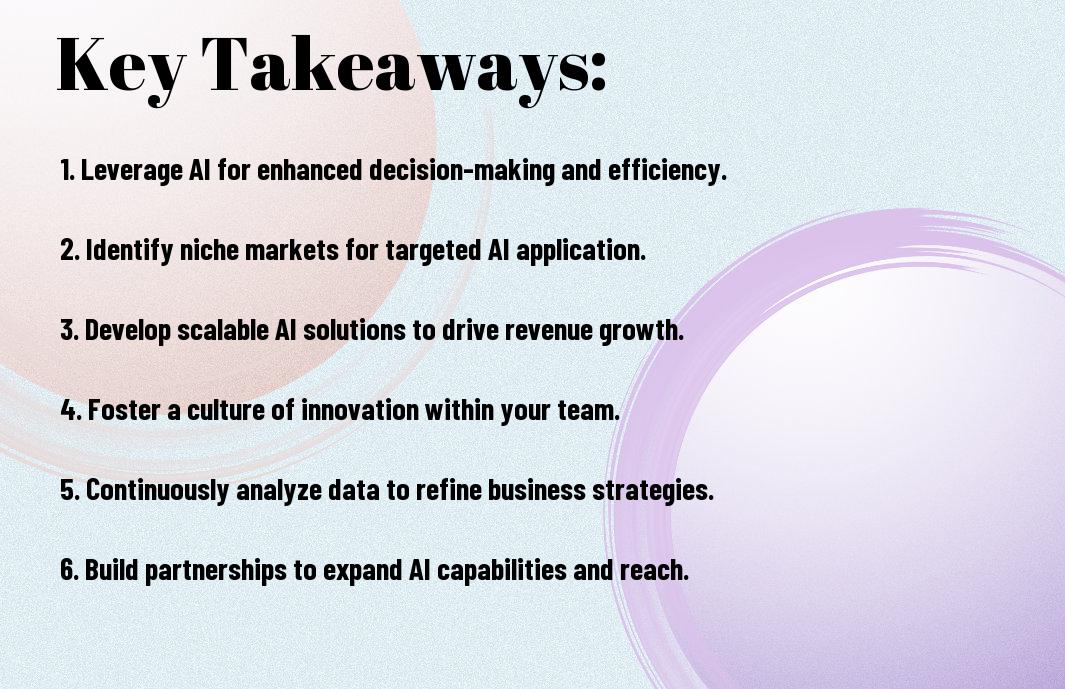
Key Takeaways:

  • Implementing AI in business operations can significantly enhance decision-making processes by providing data-driven insights, leading to more informed strategic choices for wealth generation.
  • A robust AI strategy involves integrating machine learning algorithms to analyze market trends, predict consumer behavior, and optimize business models for maximum profitability.
  • AI-driven automation can streamline business processes, reduce operational costs, and improve efficiency, allowing companies to allocate resources more effectively towards growth initiatives.
  • Developing an AI-centric business strategy requires a deep understanding of the technology’s capabilities and limitations, as well as the ability to adapt to its evolving nature and applications.
  • By leveraging AI, businesses can uncover new opportunities for innovation and revenue growth, ultimately driving long-term wealth generation and sustainability in an increasingly competitive market landscape.

The AI Revolution in Business Strategy

To stay ahead in today’s fast-paced business landscape, you need to understand the impact of AI on your business strategy. You will learn how AI is transforming the way you approach wealth generation and how to leverage it for success.

How AI is Redefining Traditional Business Models

Along with the rise of AI, you are seeing a shift in traditional business models, and you need to adapt to stay competitive. You will discover how AI is changing the way you operate and make decisions, and how to harness its power to drive growth.

The Tipping Point: When AI Becomes Essential

Any business that wants to thrive in the future will need to embrace AI, and you are no exception. You will learn when AI becomes crucial for your business and how to prepare for this shift.

Becomes clear that AI is no longer a luxury, but a necessity for businesses looking to generate wealth and stay ahead of the curve. You will need to assess your current strategy and identify areas where AI can be integrated to drive innovation and growth, and you will learn how to do this effectively, ensuring your business remains competitive in a rapidly changing landscape, and you achieve your goals.

Data as the New Currency

One of the most significant advantages of AI in business is its ability to turn data into a valuable asset, allowing you to make informed decisions and drive your strategy forward, ultimately leading to wealth generation.

Transforming Raw Data into Strategic Insights

Translating raw data into actionable insights enables you to optimize your operations, identify new opportunities, and refine your business strategy to achieve your goals, giving you a competitive edge in the market.

Predictive Analytics and Competitive Advantage

Above all, predictive analytics allows you to forecast trends and make data-driven decisions, giving you a significant competitive advantage in the market and enabling you to stay ahead of the curve.

And as you explore deeper into predictive analytics, you will discover that it enables you to identify patterns, anticipate customer behavior, and make informed decisions about your business strategy, ultimately driving your wealth generation and long-term success, allowing you to adjust your approach as needed to stay competitive and achieve your objectives.

AI Implementation Framework

Not every business needs to overhaul its operations to implement AI. You can start by identifying areas where AI can bring the most value to your organization.

Starting Small: Pilot Projects and Quick Wins

Stepping into AI implementation, you begin with small pilot projects that can demonstrate quick wins and build momentum for further investment in AI technologies.

Scaling Across Business Functions

After you have tested the waters with pilot projects, you can start scaling AI across various business functions to maximize its impact on your operations and decision-making processes.

Pilot projects often serve as a precursor to larger AI initiatives, allowing you to refine your approach and build a robust business case for scaling AI across your organization, which you can then use to guide your strategy and ensure that your AI investments are closely aligned with your overall business objectives, helping you to generate wealth and drive long-term growth.

Risk Management in the AI Era

Many businesses are leveraging AI to enhance their operations, but you must also consider the potential risks involved. As you integrate AI into your strategy, it’s vital to assess and mitigate potential downsides, ensuring your business remains resilient and adaptable in the face of uncertainty.

Ethical Considerations and Guardrails

Across various industries, you’ll encounter ethical dilemmas when implementing AI solutions. As you navigate these challenges, you must establish clear guidelines and protocols to ensure your AI systems operate within acceptable boundaries, aligning with your values and principles.

Navigating Regulatory Landscapes

Managing the complexities of AI regulation is vital for your business. As you develop your AI strategy, you need to stay informed about evolving laws and standards, ensuring your operations comply with relevant requirements and avoid potential penalties.

Considering the nuances of regulatory environments, you should prioritize ongoing monitoring and adaptation, enabling your business to respond effectively to changes in the AI landscape. This involves staying up-to-date with the latest developments and engaging with regulatory bodies to ensure your voice is heard, ultimately shaping the future of AI governance and its impact on your business.

Human-AI Collaboration

All successful businesses understand the importance of collaboration between humans and AI systems to drive growth and innovation. You can leverage AI to enhance your decision-making, automate tasks, and gain valuable insights, ultimately leading to increased efficiency and productivity in your organization.

Augmentation vs. Replacement

On the path to integrating AI into your business, you’ll need to consider how AI will augment or replace existing roles, and how this will impact your operations and workforce. You should focus on using AI to enhance the capabilities of your employees, rather than replacing them.

Building Teams for the AI-Enhanced Workplace

Building on the concept of human-AI collaboration, you’ll need to assemble teams that can effectively work alongside AI systems, ensuring that your organization can maximize the benefits of this partnership. You should prioritize developing the skills and expertise necessary for your employees to work seamlessly with AI.

AI-Enhanced workplaces require you to rethink your approach to team building, focusing on creating a harmonious blend of human and artificial intelligence. You’ll need to identify the skills and strengths that your employees bring to the table and determine how AI can complement these, allowing you to build a more efficient and effective workforce that drives your business forward.

Wealth Generation Strategies

Unlike traditional methods, AI-driven wealth generation strategies offer unprecedented opportunities for growth and expansion, allowing you to make informed decisions and stay ahead of the competition.

New Revenue Streams Through AI Innovation

For instance, you can leverage AI to identify new markets, develop innovative products, and create alternative revenue streams, thereby diversifying your income sources and increasing your wealth.

Cost Optimization and Efficiency Gains

After implementing AI-powered solutions, you can expect significant reductions in operational costs and improvements in efficiency, enabling you to allocate resources more effectively and maximize your returns.

Revenue growth is often accompanied by increased expenses, but with AI-driven cost optimization, you can minimize waste, streamline processes, and make the most of your investments, ultimately leading to enhanced profitability and wealth creation, as you continue to refine your strategy and make data-driven decisions to drive your business forward.

Final Words

Summing up, you now have the tools to build a robust business strategy with AI, driving your wealth generation forward. You can leverage AI insights to make informed decisions, optimizing your operations and maximizing returns. By integrating AI into your business, you will stay ahead of the competition, achieving your financial goals and securing your future success. Your ability to adapt and innovate with AI will be the key to unlocking your full potential.

FAQ

Q: What role does Artificial Intelligence (AI) play in building a robust business strategy for wealth generation?

A: Artificial Intelligence (AI) plays a significant role in building a robust business strategy for wealth generation by providing insights that can help in making informed decisions. AI can analyze large amounts of data, identify patterns, and predict trends, which can be used to develop a competitive business strategy. Additionally, AI can automate various business processes, improve operational efficiency, and enhance customer experience, ultimately leading to increased revenue and wealth generation.

Q: How can businesses leverage AI to gain a competitive edge in the market and drive wealth generation?

A: Businesses can leverage AI to gain a competitive edge in the market and drive wealth generation by implementing AI-powered solutions that drive innovation, improve operational efficiency, and enhance customer experience. For instance, AI can be used to develop personalized marketing campaigns, optimize supply chain operations, and predict market trends. Furthermore, AI can help businesses to identify new opportunities, mitigate risks, and make data-driven decisions, which can lead to increased revenue and wealth generation. By adopting AI, businesses can stay ahead of the competition and achieve sustainable growth.

Q: What are the key considerations that businesses should keep in mind when integrating AI into their strategy for wealth generation?

A: When integrating AI into their strategy for wealth generation, businesses should consider several key factors, including data quality, algorithmic transparency, and regulatory compliance. It is important to ensure that the data used to train AI models is accurate, reliable, and unbiased. Additionally, businesses should be transparent about their use of AI and ensure that their AI systems are explainable and accountable. Moreover, businesses should comply with relevant regulations and laws related to AI, such as data protection and privacy laws. By considering these factors, businesses can ensure that their AI-powered strategy is effective, efficient, and sustainable, and drives long-term wealth generation.

Bonza training Skip to content